A former British Minister from the ruling Conservative Party joins the call on international boycott of Beijing 2022 Winter Olympics.
Tim Loughton, Co-Chair of The All-Party Parliament Group on Tibet (AGGPT), who was recently sanctioned along with other British politicians by the Chinese government for highlighting China’s continued abuse of human rights in Tibet and Xinjiang Uyghur Autonomous Region (aka East Turkistan), has released a statement on the international community should boycott 2022 Beijing Olympics.
Mr Tim Loughton’s Full Statement:
“In response to sanctions against us we pledged to call out China’s human rights abuses even more loudly. Boycotting the 2022 Olympics will show China that democracies cannot be bullied, and human rights matter.
On Christmas Eve in 1979 Russia invaded Afghanistan. As a result of that unprovoked act and the subsequent brutal oppression of any Afghanis who got in the way of the occupying Russian forces, 65 countries carried out a full boycott of the 1980 Olympic Games held in Moscow the following summer. Amongst those nations supporting the boycott were strange bedfellows like the US and Iran, Israel and Saudi Arabia, and China.
Whilst governments of countries like the UK, France and Australia supported the boycott they left the final decision to National Olympic Committees and individual athletes. As a result, some British athletes competed whilst our equestrians and hockey players stayed at home. We competed under the Olympic flag and the Olympic anthem replaced the national anthem at the few Gold Medal ceremonies we participated in (in those days.)
My overriding memory of the 1980 Olympics was a triumphant and emotional Daley Thompson collecting his world record beating Decathlon gold medal and belting out God Save the Queen from the podium to the tune of the choral cantata that is the Olympic Hymn.
So, in February 2022 the Winter Olympics are due to be back in Beijing and China really cannot be surprised if this time a bit of what goes around comes around, aimed at them. That is why I have applied to hold a debate in the Commons, including a vote committing the UK to exercise a diplomatic boycott of the Olympic Games if an alternative venue is not found and if Chinese state terror is still being meted out to the Uighurs, Tibetans and others. Additionally, it would be conditional on the Chinese government not lifting sanctions on we 7 Parliamentarians, a British academic and lawyer and sundry British right of centre human rights’ groups.
In response to those extraordinarily inept and counter-productive sanctions against us, the Speaker granted an urgent question debate in which we pledged to call out China’s human rights abuses even more loudly. Subsequently Nus Ghani guided a vote through Parliament recognising the Uyghur genocide; we have heard shocking testimonies of torture at the Westminster Uyghur Tribunal hearings and virtually every week the issue of China’s totalitarian government is raised in Parliament in some form.
We cannot endorse the appalling abuse by sending ministers, royalty and diplomats to join the applauding crowds
In addition, we have been in regular Zoom calls with parliamentarians from the US to Australia, from the European Parliament to the IPU, whose response to China’s attempts at gagging democratically elected politicians is to turn up the volume and impose consequences.
One of those consequences is an internationally co-ordinated diplomatic boycott of the 2022 Olympics. Throughout this month similar motions and debates will be put to parliaments and ministers in initially 11 countries, with a high chance of success. If we can pass a similar motion in the Commons, we will be at the vanguard of showing China that democracies cannot be bullied, and human rights matter.
To China, hosting the 2008 summer Olympics was a huge propaganda coup. They used it to try to convince the world that China was a modern emerging superpower and had changed. It may have emerged since then, but it has certainly not changed. A million Tibetans dead and imprisoned since the 1959 occupation then, a million Uyghurs incarcerated and tortured now.
China should never have been selected as hosts in the first place and whoever thought them fit to uphold the Olympic values of ‘excellence, friendship and respect’ needs sanctioning too.
We know from the Moscow Olympics that the biggest victims of a full sporting boycott were the athletes themselves and so we are not asking them to make that sacrifice. But we cannot endorse the appalling abuse by sending ministers, royalty and diplomats to join the applauding crowds.
By staying at home, a strong message will be sent and we know from the threats they have already made against an anticipated US boycott that they take seriously the loss of face it would represent. That is the least they should be suffering and I hope enough colleagues agree and step forward with their vote to get this motion through Parliament.”
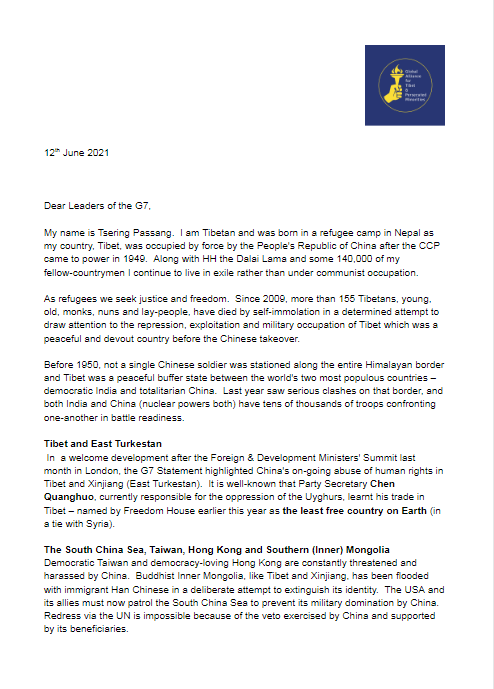
My name is Tsering Passang. I am Tibetan and was born in a refugee camp in Nepal as my country, Tibet, was occupied by force by the People’s Republic of China after the CCP came to power in 1949. Along with HH the Dalai Lama and some 140,000 of my fellow-countrymen I continue to live in exile rather than under communist occupation.
As refugees we seek justice and freedom. Since 2009, more than 155 Tibetans, young, old, monks, nuns and lay-people, have died by self-immolation in a determined attempt to draw attention to the repression, exploitation and military occupation of Tibet which was a peaceful and devout country before the Chinese takeover.
Before 1950, not a single Chinese soldier was stationed along the entire Himalayan border and Tibet was a peaceful buffer state between the world’s two most populous countries – democratic India and totalitarian China. Last year saw serious clashes on that border, and both India and China (nuclear powers both) have tens of thousands of troops confronting one-another in battle readiness.
Tibet and East Turkestan
In a welcome development after the Foreign & Development Ministers’ Summit last month in London, the G7 Statement highlighted China’s on-going abuse of human rights in Tibet and Xinjiang (East Turkestan). It is well-known that Party Secretary Chen Quanghuo, currently responsible for the oppression of the Uyghurs, learnt his trade in Tibet – named by Freedom House earlier this year as the least free country on Earth (in a tie with Syria).
The South China Sea, Taiwan, Hong Kong and Southern (Inner) Mongolia
Democratic Taiwan and democracy-loving Hong Kong are constantly threatened and harassed by China. Buddhist Inner Mongolia, like Tibet and Xinjiang, has been flooded with immigrant Han Chinese in a deliberate attempt to extinguish its identity. The USA and its allies must now patrol the South China Sea to prevent its military domination by China.
Redress via the UN is impossible because of the veto exercised by China and supported by its beneficiaries.
The Central Asian Plateau/Tibet (the ‘Third Pole’) and Climate Change
What happens in Tibet and the Central Asian Plateau affects the whole of Asia and the planet itself. Ten of the world’s major rivers flow from Tibet to India and China – including the Indus, Ganges, Yangtze and Mekong. Half the world’s population depend on these rivers for irrigation and food. Irresponsible policies of the CCP, including the damming of rivers, threaten the melting of glaciers and permafrost and cause irreversible damage to the fragile eco-system. Along with its pollution, China alone can cause environmental catastrophe and can trigger mass migration.
What can be done?
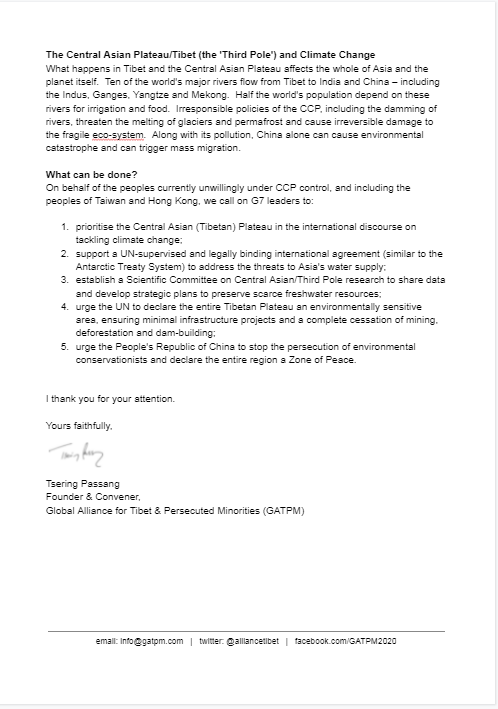
On behalf of the peoples currently unwillingly under CCP control, and including the peoples of Taiwan and Hong Kong, we call on G7 leaders to:
prioritise the Central Asian (Tibetan) Plateau in the international discourse on tackling climate change;
support a UN-supervised and legally binding international agreement (similar to the Antarctic Treaty System) to address the threats to Asia’s water supply;
establish a Scientific Committee on Central Asian/Third Pole research to share data and develop strategic plans to preserve scarce freshwater resources;
urge the UN to declare the entire Tibetan Plateau an environmentally sensitive area, ensuring minimal infrastructure projects and a complete cessation of mining, deforestation and dam-building;
urge the People’s Republic of China to stop the persecution of environmental conservationists and declare the entire region a Zone of Peace.
I thank you for your attention.
Yours faithfully,
Tsering Passang
Founder & Convener,
Global Alliance for Tibet & Persecuted Minorities (GATPM)
By Tsering Passang, Global Alliance for Tibet & Persecuted Minorities (GATPM)
An independent tribunal in Britain aiming to establish whether the Chinese government’s alleged rights abuses against Uyghur Muslims in Xinjiang Uyghur Autonomous Region (aka East Turkistan) constitute genocide saw dozens of witness testimonies during its first public hearing in London.
The first set of hearings was held at Church House Conference Centre in Westminster, near the UK Parliament, from 4 to 7 June 2021. The hearings were streamed live via the World Uyghur Congress’s Youtube and Twitter channels.
According to www.UyghurTribunal.Com, Mr Dolkun Isa, President of the World Uyghur Congress formally requested in June 2020 that Sir Geoffrey Nice QC establish and chair an independent people’s tribunal to investigate ‘ongoing atrocities and possible Genocide’ against the Uyghurs, Kazakhs and other Turkic Muslim Populations. The Uyghur Tribunal was then launched on 3 September 2020 with assistance from a non-governmental organisation, the Coalition for Genocide Response.
Written witness testimonies include submissions from people who have had direct experience or tangential experience, alleging relations or family members are missing in addition to a substantial number of expert witness accounts. some were not published earlier. On each day of the hearings, the Witness Statements were published on the Tribunal’s website.
Researchers for the tribunal sifted through about 1,500 documents and pieces of evidence submitted from different countries. Over 30 witnesses and experts gave evidence at the first public hearing. After the second hearing, which is scheduled for mid-September 2021, the eight-member panel of the Uyghur Tribunal hopes to issue a judgment by the end of the year.
Rights groups and researchers estimate that China has rounded up a million or more Uyghurs and other minorities into prisons and vast indoctrination camps that the state calls training centers since 2016.
An increasing numbers of parliaments and governments around the world have been showing great concerns over the treatment of Uyghurs by China and have declared “genocide” committed by the Chinese state.
After the People’s Republic of China’s (PRC) Press Conference on Xinjiang-related issues held on the 9th June 2021, the Uyghur Tribunal released a press statement on its website. It said, “To date the PRC cannot be dealt with over allegations of genocide because it joined the Convention on terms, as allowed, that allow it to avoid being dealt with at the ICJ [International Court of Justice] for genocide. It can easily and immediately change its position and withdraw those terms. In which event it would be open to another bold country to take it to the ICJ for genocide.”
The press statement further added, “The Uyghur Tribunal’s primary concern is the impact on the wellbeing of the witnesses who gave evidence at the recent Tribunal Hearings in London and to the relatives and a neighbour of those witnesses who appeared at the PRC conference.
“The Tribunal notes the statements made by the relatives and a neighbour and the Tribunal extends an invitation to them to attend the Tribunal’s next Hearings in September of this year. We would invite the PRC to confirm that they are at liberty to travel to the UK if they so wished.”
Inviting China’s cooperation once again, the Uyghur Tribunal said, “The Tribunal will continue with its work in seeking the truth in an impartial manner. To that end, we would, again, request that the PRC provides any evidence that it may possess to the Tribunal.”
Before the first hearing, Nick Vetch, Vice Chair of the Uyghur Tribunal, said that the tribunal had written to the former and current Chinese ambassadors to London to request the Chinese government’s presence and cooperation, but so far received no response.
This is not the first time such a tribunal was held to investigate crimes against humanity by the Chinese government. In 2018, the China Tribunal, an independent people’s tribunal, was established to inquire into forced organ harvesting from, amongst others, prisoners of conscience in China and to investigate what criminal offences, if any, have been committed by state or state-approved bodies, organisations or individuals in China that may have engaged in forced organ harvesting. The hearings were held in December 2018 and April 2019. Led by Sir Geoffrey Nice QC, the Final Judgement was made on 1st March 2020 in a 562-page report.
The Uyghur Tribunal, which doesn’t have government backing, was chaired by prominent barrister Sir Geoffrey Nice QC, who previously led the prosecution of ex-Serbian President Slobodan Milosevic and worked with the International Criminal Court.
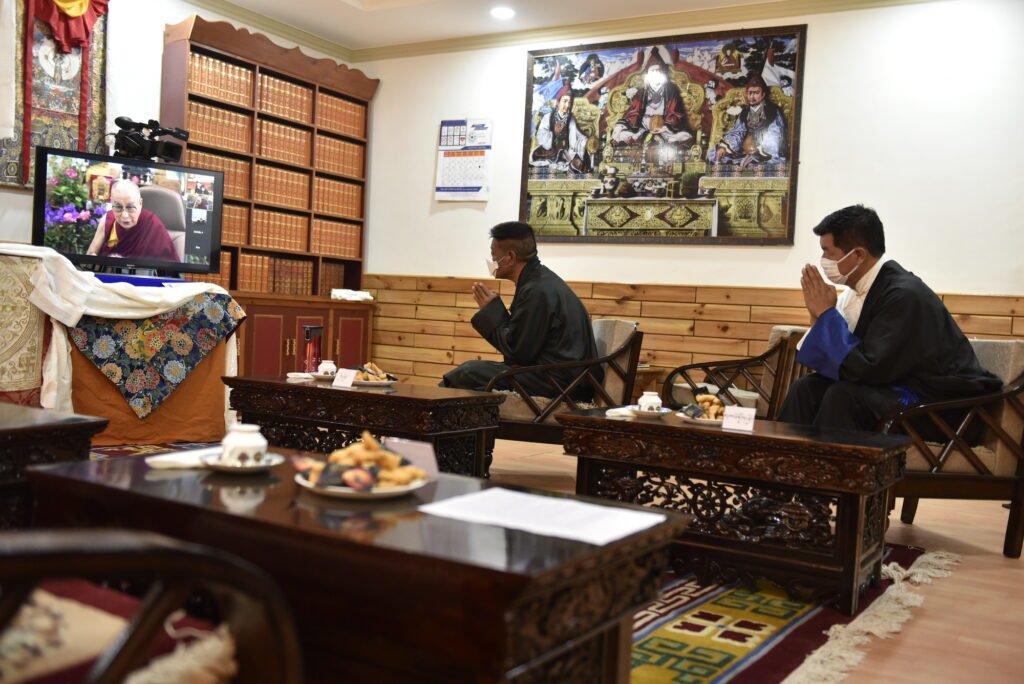
Tibetan spiritual leader, His Holiness the Dalai Lama blessing the Sikyong Swearing-in ceremony. Sikyong Penpa Tsering and outgoing Sikyong Lobsang Sangay on 27th May 2021 (Photo credit: Tibet.net)
By Tsering Passang*
London | 29th May 2021
Dr. Lobsang Sangay, who was first elected in 2011, completed his second-term as President of the Central Tibetan Administration (CTA) on 26th May.
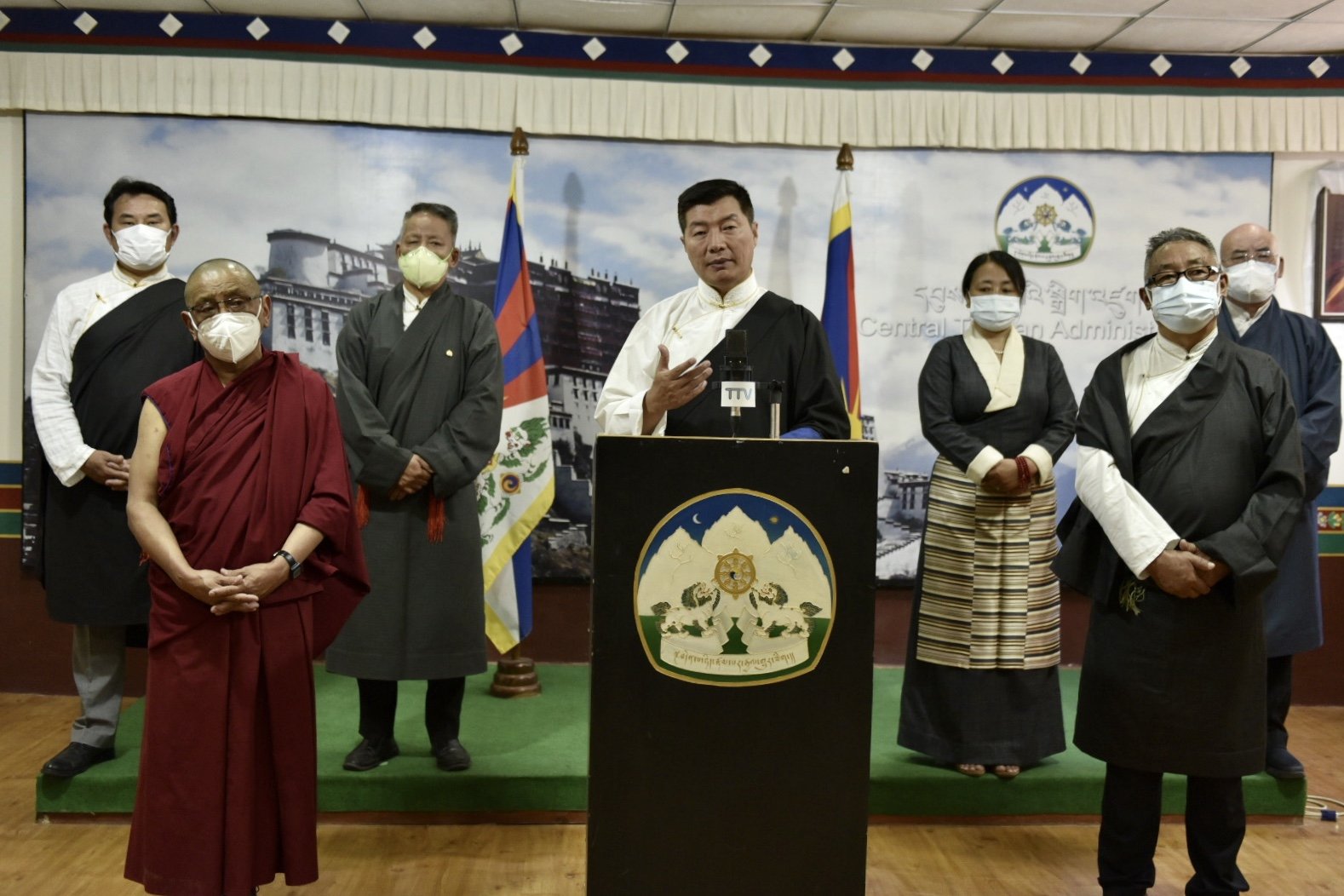
On the final day of his duty, the outgoing Sikyong Lobsang Sangay addressed the official thank you function, and said, “To fulfill my mandate as Sikyong, I formulated new strategies to elevate CTA’s profile and to express our willingness to restore dialogues with China to obtain genuine autonomy for the Tibetan people based on the Middle Way Approach. I met with various foreign government officials in small coffee shops, private offices, and other public locations. I gave priority to substance and relationship-building while making concerted efforts to upgrade protocol and level of meetings whenever I could.”
Sikyong Dr. Lobsang Sangay addressing the official Thank you function on 26th May 2021 with his full cabinet members (Photo credit: Tibet.net)
Prior to joining the CTA in 2011, Sangay, who grew up in a small Tibetan refugee settlement near Darjeeling, West Bengal, was a Senior Fellow at Harvard University. Sangay’s sudden rise and his adoption of western leadership-style came across as a disruptive Tibetan leader to the more conservative Tibetan society to an extent.
His supporters say that Sangay’s direct jump to the highest office with no prior experience in CTA public service had raised eyebrows and drew criticisms from many Tibetan quarters including senior bureaucrats and elite political class from the start. However, Sangay was much admired by the younger generation, drawing big crowds during Tibetan public gatherings in India and overseas. He speaks plain Tibetan with no jargon, and reaches out to the masses at ease. Youth aspires to change and shake-up the CTA and they believe Sangay was their man to do that job.
Of his many achievements during the ten-year period, as President of the CTA, Dr. Lobsang Sangay highlighted the Tibetan Policy and Support Act of 2020. He said, “Finally, during the last months of my term, I was able to visit the US State Department and the White House as the Sikyong of the CTA, and as the legitimate representative of the Tibetan people. These developments, along with the passage of the Tibetan Policy and Support Act of 2020 by the US Congress, mark a new turn in the relationship between the US and the CTA. I hope our relations with other countries take a similar turn.”
Like in any administration, President Lobsang Sangay too faced some challenges including resignation of ministers towards the end of his first term in office. Whilst acknowledging his colleagues, President Sangay stated, “I would like to thank my colleagues in both the 14th and 15th Kashag, senior advisors, and the dedicated and hardworking staff of the CTA. We worked together through the historic devolution of political and administrative power from His Holiness the Dalai Lama to an elected Tibetan leadership. Together, we strengthened support for Tibet from various governments and legislatures across the globe. Together, we invested in education, ensured the financial resiliency of the CTA, and the Tibetan refugee community.”
Sangay, who was once a leader of the largest network of Tibetan youth, the Tibetan Youth Congress, based in Dharamsala, said, “My role as the Sikyong ends today, but my resolve to fight for the Tibetan cause will continue and will remain strong forever. I was born a freedom fighter and I will die a freedom fighter.”
There were no shortages of appreciation and recognition awards from Tibetan communities both in India and overseas to Dr Lobsang Sangay for his outstanding leadership, commitment and hard work during his two terms as the Sikyong. Even Tibetans from inside Tibet as well as those in exile composed songs and paid tributes to what they call the “people’s Sikyong”.
In a good human society, it is reasonable that Sangay’s public service is accorded with respect and that the Tibetans in diasporas extend their warm appreciation to him for his political leadership. Sangay may not have achieved all the things that he said he would do ten years ago, but no Tibetan can deny the fact that Dr. Lobsang Sangay had not worked hard to advance the cause of Tibet on the global stage. Sangay was often praised for his savvy media engagements and outreach via new global platforms. The Cabinet Office has recently released a report detailing ten major achievements under Sikyong Dr. Lobsang Sangay’s ten-year leadership, published on www.tibet.net, the official website of the Central Tibetan Administration.
One major task that Dr. Lobsang Sangay would have liked to achieve during his Sikyong-tenure, is the revival of the Sino-Tibetan Dialogue between His Holiness the Dalai Lama’s representatives and the Chinese government. However, this did not materialise despite efforts put by Sangay and his administration. Sangay often pointed out that the dialogue between Dharamsala and Beijing had stalled in 2010, before he joined the CTA.
Handover of Sikyong Seal to President Penpa Tsering
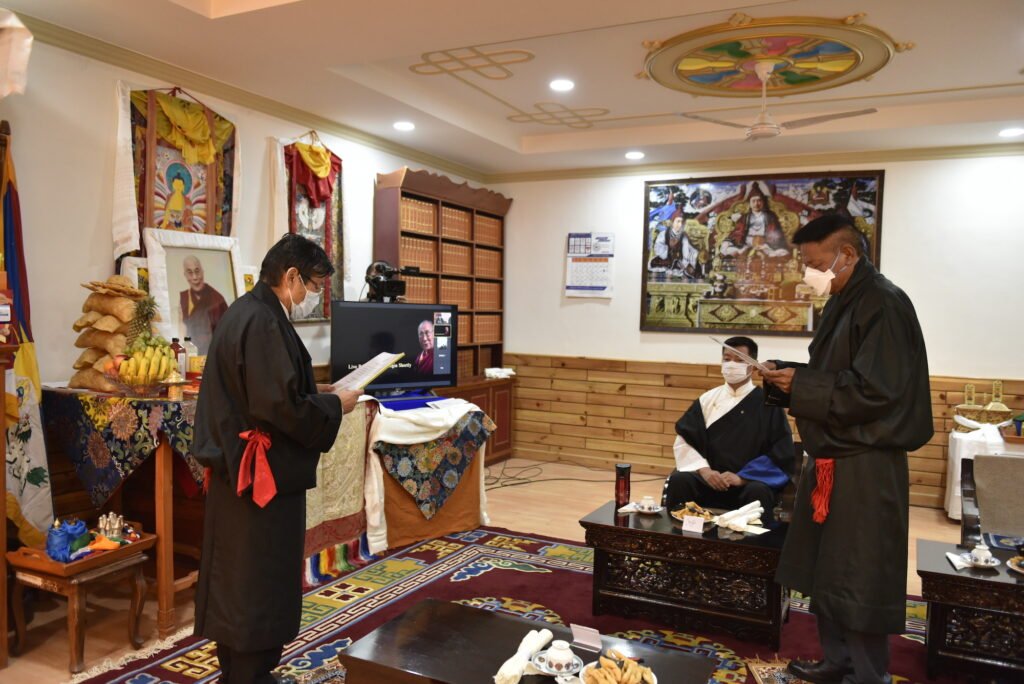
The official swearing-in ceremony of the new Sikyong, Mr. Penpa Tsering, held on 27th May, in the Office of the Tibetan Supreme Justice Commission, was administered by the Chief Justice Commissioner, Mr Sonam Norbu Dagpo.
Sikyong Swearing-in Ceremony, administered by Chief Commissioner Sonam Norbu Dagpo 27th May 2021 (Photos credit: Tibet.net)
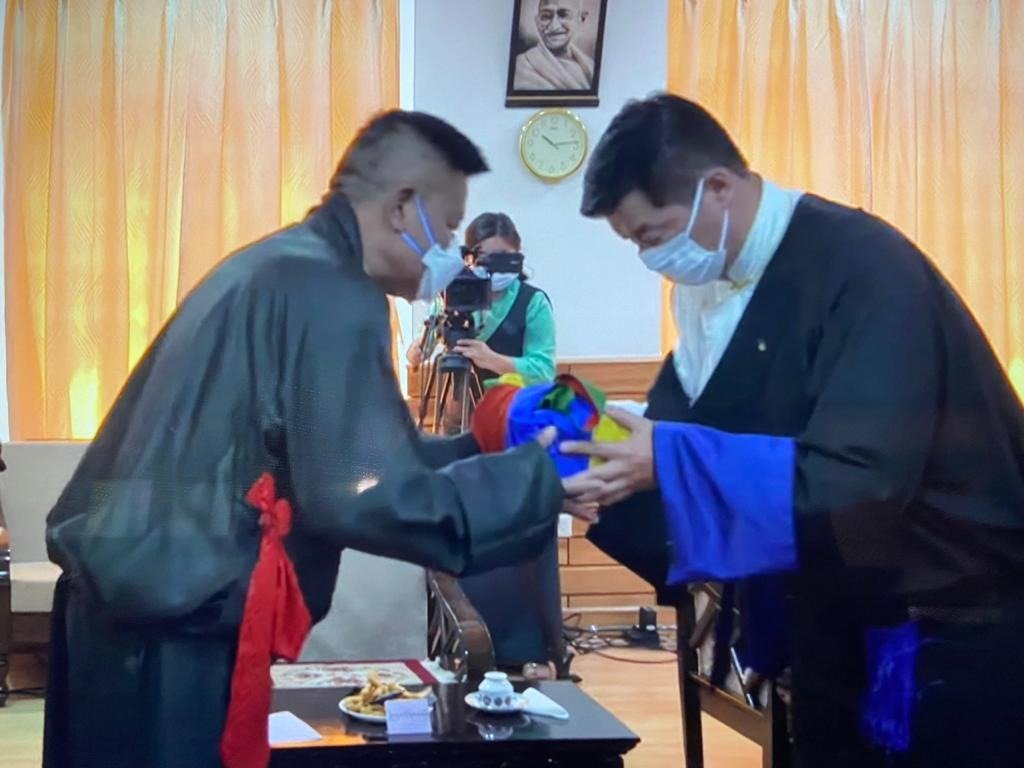
The ceremony was blessed by His Holiness the Dalai Lama via a video-link, which was broadcast live on Tibet TV, the official media channel of the Central Tibetan Administration. The outgoing Sikyong, Dr. Lobsang Sangay was seen handing over the Sikyong Seal to the incoming Sikyong Penpa Tsering at the official ceremony, ensuring a smooth handover of power. Due to COVID restrictions, the swearing-in ceremony’s attendance was limited to the Secretary of Tibetan Supreme Justice Commission and the Cabinet Secretary in addition to the outgoing Sikyong. In 2011, Dr. Sangay received the Sikyong Seal from His Holiness the Dalai Lama, representing the official transfer of inherited political authority of the Tibetan people in Tibet, to the directly elected exiled political leader.
The Tibetan spiritual leader then gave a special address after extending congratulations and commending both political leaders for their service. The Dalai Lama once again reiterated his full faith in the “Middle-Way” approach which he said would bring great benefits to both Chinese and Tibetan peoples when liberal Chinese leaders accept the pragmatic proposal. Under this proposal, Tibet is to remain within the People’s Republic of China (PRC) and the whole Tibetan regions should come under one single entity, which is to be governed by the Tibetans themselves. Beijing is to command foreign relations and defence whilst the Tibetans themselves should enjoy genuine self-rule internally. But, so far, the Chinese leadership in Beijing has not accepted the Dalai Lama’s proposal.
Outgoing Sikyong Lobsang Sangay handing over Sikyong Seal to Sikyong Penpa Tsering; Group photo with Tibetan Supreme Justice Commissioners | 27th May 2021 (Photos credit: Tibet.net)
Inaugural address by Sikyong Penpa Tsering
In his first official address after taking the oath of office, Sikyong Penpa Tsering said, “In response to the trust and expectations of the majority of the general public in this election, I reiterate my commitment to direct all my energies in carrying out the responsibility of finding a lasting solution for the Sino-Tibet conflict and looking after the welfare of the Tibetan people.
“We shall not dither from pointing out the gross mistakes of the Chinese government’s policies and programs and seek to redress, withdraw or amend the wrong policies.”
Responding to the latest Chinese government’s white paper ‘Tibet Since 1951, Liberation, Development and Prosperity’ published on 21st May, Sikyong Penpa Tsering added, “All I can say today is that we are open to sending people to verify all the claims made in the white paper.”
He appealed to the Tibetan people and said, “We lost our country and are political refugees. We all share the common goal of resolving the Sino-Tibet conflict. To resolve issues and disputes within the community, all of us have the right and the means to resolve such issues as per norms, rules and regulations. The executive shall not only respect the right to freedom of expression and listen to reasonable opinions but also respond appropriately. I earnestly request the general public for better cooperation and responsibility.”
Tibetan General Elections 2021
The Tibetan people went to the polls in January (preliminary round) and April (final round) 2021 to elect their Sikyong (President) and 45 Chithue (MPs). Penpa Tsering, a former Speaker of the Tibetan Parliament, secured the highest votes in both rounds.
On 14th May, the Central Tibetan Election Commission declared Mr. Penpa Tsering as the new Sikyong, who narrowly beat Mr Kelsang Dorjee Aukatsang. Aukatsang, friend of Dr Lobsang Sangay, served as a close aide in his administration in various roles during the past ten years. He secured strong personal backing from Sangay but narrowly lost in the Sikyong elections by just over 5000 votes. Some 77% of the 83,000 registered Tibetan voters across 26 countries took part in the recent elections to elect their President and MPs.
The Central Tibetan Administration (aka Tibetan Government-in-exile) serves as the headquarters for the Tibetans in diasporas. Dharamsala-based CTA was established soon after His Holiness the Dalai Lama reached India in March 1959, following China’s occupation of Tibet.
*Tsering Passang is the Founder & Convener at the Global Alliance for Tibet & Persecuted Minorities (GATPM). With 20 years experience in development and advocacy work on Tibet and human rights, Tsering most recently served as Tibet Foundation’s Director. He was elected Chairman and led the Tibetan Community UK from 2014 to 2016. Between 2014 and 2018, Tsering served on the Council of Tibet Society and later as its Special Adviser. Tsering’s blog: www.tsamtruk.com Twitter: @tsamtruk
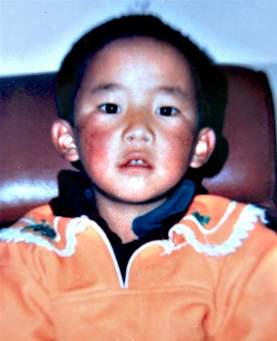
Gedhun Choekyi Nyima, 11th Panchen Lama recognised by The Dalai Lama
For the past 26 years, followers of Tibetan Buddhism have been waiting patiently for a glimpse of their spiritual leader, Gedhun Choekyi Nyima, The 11th Panchen Lama of Tibet. This is still yet to materialise.
Born 25th April 1989, Gedhun Choekyi Nyima was recognised as the reincarnation of the 10th Panchen Lama by His Holiness the Dalai Lama as per the Tibetan Buddhist tradition, on 14th May 1995. Within days of his public recognition, on 17th May, the six-year old Gedhun Choekyi Nyima disappeared with his parents and Jadrel Rinpoche, Head of Tashi Lhunpo Monastery in Shigatse, who was in secretly in touch with the Dalai Lama in India regarding the 11th Panchen Lama’s search. Jadrel Rinpoche was appointed as the Head of the Panchen Lama Search Committee, entrusted by the Chinese Government.
Six months later, China announced its own 11th Panchen Lama, Gyaincain Norbu as the reincarnation of the previous 10th Panchen Lama.
For Tibetan Buddhists, the Dalai Lama’s recognised 11th Panchen Lama, Gedhun Choekyi Nyima is the true reincarnation of Tibet’s second highest spiritual leader. Despite repeated requests for access, the whereabouts of the Dalai Lama’s recognised Panchen Lama is not still known to anyone to this day, except to the Chinese authorities. At the time of his disappearance in 1995, Gedhun Choekyi Nyima became the world’s youngest political prisoner.
The mysterious death of the 10th Panchen Lama in 1989 is still a fresh memory to many of his followers. Tibetans suspect foul play by the Chinese authorities over their spiritual leader’s untimely death 32 years ago.
Significance of The Panchen Lama
The successive throne holders of the Panchen Lama lineage have contributed immensely to the temporal and spiritual traditions of Tibet. Tashi Lhunpo Monastery, founded in 1447 by the 1st Dalai Lama, is the traditional monastic seat of the Panchen Lama. It is a historically and culturally important Buddhist monastery based in Shigatse, Tibet’s second-largest city.
The 10th Panchen Lama’s significant contribution to the cause of the Tibetan people both in temporal and spiritual traditions, especially at a time of critical danger of being wiped out by the Chinese Communist regime cannot be discounted easily.
Lobsang Trinley Lhündrub Chökyi Gyaltsen, The 10th Panchen Lama
Following the illegal invasion of Tibet by the People’s Republic of China, and with the subsequent escape of the Dalai Lama into exile in India, in March 1959, the Chinese government courted the 10th Panchen Lama and appointed him as Chairman of the Preparatory Committee for the establishments of the Tibet Autonomous Region (TAR). In 1960, Beijing named him Vice-Chairman of the National People’s Congress (NPC) of the People’s Republic of China (PRC) in order that he acts as the spokesperson for Chinese policy in Tibet.
Formally established in 1965, the Tibet Autonomous Region (TAR) became Beijing’s newly-designed political entity aimed at splitting the whole Tibetan Nation into several regions. Other traditional Tibetan regions including Amdo (north-east) and Kham (east) were incorporated into neighbouring Chinese provinces such as Qinghai, Gansu, Yunnan and Sichuan. For Tibetans, Tibet comprises Dotoe (Kham), Domed (Amdo) and Utsang (central) – the three Cholkhas.
The Panchen Lama’s 70,000-character petition
After official tours across various places in Tibet, the 10th Panchen Lama started documenting his findings, started in Shigatse and completed in Beijing. Along with his recommendations, the Panchen Lama submitted the findings to Chinese Premier Zhou Enlai in 1962 – widely known as the 70,000-character petition.
In his official report, the Panchen Lama denounced the draconian policies and actions of the Chinese Communist Party (CCP) in Tibet. He also criticised the Great Leap Forward and a multitude of “inept orders” on the part of the CCP which had caused chronic food shortages.
In Beijing, the Panchen Lama also urged Mao Tsetung to “put an end to the abuses committed against the Tibetan people, to increase their food rations, to provide adequate care for the elderly and the poor, and to respect religious liberty.” Mao listened to him but did nothing to address the matters raised.
According to British journalist Isabel Hilton, the 70,000-character petition remains the “most detailed and informed attack on China’s policies in Tibet that would ever be written.”
For several decades, the Panchen Lama’s petition remained hidden from all but the very highest levels of the Chinese leadership, until one copy surfaced in 1996. In January 1998, to coincide with the 60th anniversary of the birth of the late 10th Panchen Lama, an English translation by Tibet expert Prof. Robert Barnett entitled A Poisoned Arrow: The Secret Report of the 10th Panchen Lama, was published by the London-based Tibet Information Network (TIN), now a defunct news research agency on Tibet.
In 1964, the 10th Panchen Lama was publicly humiliated at Politburo meetings, dismissed from all posts of authority, declared ‘an enemy of the Tibetan people’, and later imprisoned. At the time he was 26 years old. The Tibetan spiritual leader’s situation worsened when the Cultural Revolution started. The Chinese dissident Wei Jingsheng, who was a former Red Guard, published in March 1979 a letter under his name but written by another anonymous author denouncing the conditions at Qincheng Prison, where the 10th Panchen Lama was in captivity. In October 1977 the Panchen Lama was released, but held under house arrest in Beijing until 1982. After his release, the Panchen Lama served as Vice Chairman of the National People’s Congress.
Tseten Wangchuk, a senior Tibetan journalist working for the Voice of America’s (VOA) Tibetan section in the United States, reported that during a 1980 meeting between the Secretary of the Communist Party Hu Yaobang and the Panchen Lama, the latter told Hu “how much he was moved by his reforms, and remarked that had the suggestions of the 70,000-character petition been put in place when they were proposed, the problems in Tibet would not have endured.
The 70,000-character petition was founded on the principle that the specific characteristics of Tibet should be taken into account. This premise was central to the policies of Deng Xiaoping in China during the 1980s and allowed the Panchen Lama to introduce numerous liberalisations into Tibet. However, in early 1992, the CCP removed the concession concerning the “specific characteristics” of Tibet, and current policy monitors religious practices and the monasteries, limits the instruction of Tibetan language, and has since suppressed some of the religious and cultural liberalisations implemented by Hu Yaobang and requested by the Panchen Lama.
In March 1999, during the annual commemoration of Tibetan National Uprising of Lhasa in 1959, the Dalai Lama declared that “the 70,000-character petition published in 1962 by the former Panchen Lama constitutes an eloquent historical document on the policies carried out by the Chinese in Tibet and on the draconian measures put in place there.”
In brief, pushing aside his own personal safety issues, and for the sake of the Tibetan people’s identity, spiritual practice and survival of the unique way of life, the 10th Panchen Lama struggled fearlessly and unrelentingly for their preservation and promotion. He rebuilt Tibet’s religious and cultural heritages and worked hard in the interests of Tibetans, for which he gained high prestige among the Tibetans. His efforts have spread far and wide from Tibet into the Himalayan regions, and through these into the wider world. The previous 10th Panchen Lama has dedicated his whole life to Tibet and Tibetan people.
So, why is China interfering in the religious affairs of Tibetan people?
The 10th Panchen Lama and the 14th Dalai Lama in 1954. The two Tibetan spiritual leaders were 16 and 19 years old respectively.
The “Article 36” of the Constitution of the People’s Republic of China guarantees “Citizens of the People’s Republic of China enjoy freedom of religious belief. No state organ, public organization or individual may compel citizens to believe in, or not to believe in, any religion; nor may they discriminate against citizens who believe in, or do not believe in, any religion.”
In the “Note on the Memorandum of Genuine Autonomy for the Tibetan People”, a follow-up clarification note submitted by the Envoys of His Holiness the Dalai Lama to the Chinese Government after the eighth round of talks in 2008, it states, “The spiritual relationship between master and student and the giving of religious teachings, etc. are essential components of the Dharma practice. Restricting these is a violation of religious freedom. Similarly, the interference and direct involvement by the state and its institutions in matters of recognition of reincarnated lamas, as provided in the regulation on management of reincarnated lamas adopted by the State on July 18, 2007 is a grave violation of the freedom of religious belief enshrined in the Chinese Constitution.”
The Dalai Lama and Panchen Lama share a warm and friendly relationship and have previously served as mentors and apprentices. They hold the highest decision-making power on the issue of reincarnation, and each had participated in the process of recognising each other’s reincarnation. If one of them passes away, the other has undertaken the responsibility of searching for the reincarnated soul boy of the other and vice-versa.
In his memoir, “Surviving The Dragon: A Tibetan Lama’s Account of 40 Years Under Chinese Rule”, Arjia Rinpoche, former member of the 11th Panchen Lama Search Committee, wrote, “As for the people of Tibet, no matter how politics changed, for them the Dalai Lama and the Panchen Lama remained the sun and the moon. To this day they believe that the reincarnations of both must be mutually recognised to be valid.”
Arjia Rinpoche, Abbott of the renowned Kumbum Monastery in Amdo, north-east Tibet, who had come to the United States via Guatemala as a political exile, wrote in his memoir, “Tibetans clearly wanted the Fourteenth Dalai Lama to be the final arbiter of the identity of the true reincarnation of the Panchen Lama.”
The real intention of the Chinese Government’s appointment of Gyaincain Norbu as the 11th Panchen Lama as opposed to the Dalai Lama’s chosen candidate is crystal clear – a political matter.
After the Chinese government’s official announcement of its 11th Panchen Lama on 29th November 1995, Arjia Rinpoche, who was to become his personal tutor, recalled the remarks made by Ye Xiaowen, Director of the State Administration for Religious Affairs, “When the Dalai Lama announced the name of his chosen candidate, the government immediately sent out charter jets, usually reserved for members of the Politburo, to the birthplaces of the three final candidates in the Naqu district of Tibet. They put the boys and their families on the three jets and whisked them away into hiding.”
On their return to Beijing from Lhasa, in the chartered plane, dumbfounded Arjia Rinpoche recalled Ye Xiaowen stating, “When we made our selection we left nothing to chance. In the silk pouches of the ivory pieces we put a bit of cotton at the bottom of one of them, so it would be a little higher than the others and the right candidate would be chosen”. Gyaincain Norbu’s parents are CCP officials.
In 2019, Gyaincain Norbu was made Head of the China Buddhist Association. The Chinese government will use its chosen Panchen Lama to tour the world and is expected to speak on freedom of religion enjoyed by everyone in China.
During Ye Xiaowen’s directorship at the State Administration for Religions Affair, not only did we see persecutions of Buddhists, Christians, Muslims and Falun Gong followers but he was instrumental in appointing Gyancian Norbu as the 11th Panchen Lama.
Further under Ye’s watch, he declared “State Religious Affairs Bureau Order No. 5” that attempted to reduce the influence of the 14th Dalai Lama and other foreign groups on the reincarnations in Tibet.
Chinese government over the years has made concerted efforts to bring down the image of the Dalai Lama by labelling him as “separatist”. The CCP has also banned the photos of the Dalai Lama and possessing his photos is considered as an act of crime.
At the heart of all these things is the issue of reincarnation of the Dalai Lama. For years the Chinese government has been grooming its own Panchen Lama. It is most likely that he will play an instrumental role in deciding the reincarnation of the next Dalai Lama in China. This is expected to lead to two Dalai Lamas in the future if the current Dalai Lama decides to keep the tradition of reincarnation of the Dalai Lama continues.
The fact of the matter is that the issue of reincarnation of the Dalai Lama is not limited to China and the Dalai Lama but it now has larger geopolitical consideration with security implications in the Himalayan regions.
The US has shown its full support for Tibet on the reincarnation issue i.e. whatever the Tibetan people decide to choose. It has, in late 2020, passed the Tibet Policy and Support Act (TPSA) and it sends a strong message to China that the US stands steadfast with the Dalai Lama and the Central Tibetan Administration (aka Tibetan Government-in-exile) on the issue of Tibetan reincarnation.
Home to millions of Buddhists, especially Tibetan Buddhism, the great nation of India too can play a supporting role to His Holiness the Dalai Lama as well as to the Central Tibetan Administration towards the continuity of the Dalai Lama’s reincarnation system as per the Tibetan tradition.
(Tsering Passang is the Founder & Convener, Global Alliance for Tibet & Persecuted Minorities. This piece was first published in https://www.ians.inon 20th May 2021)
A Live Webinar on Monday, 17th May 2021 from 3.30pm to 4.30pm (London time)
For the past 26 years, Tibetan Buddhists have been waiting patiently for a glimpse of their spiritual leader, Gedhun Choekyi Nyima, the 11th Panchen Lama. This is still yet to materialise.
Born on 25th April 1989, Gedhun Choekyi Nyima was recognised as the reincarnation of the previous 10th Panchen Lama, on 15th May 1995, by His Holiness the Dalai Lama as per the Tibetan Buddhist tradition.
Within days of his recognition the six-year old Gedhun Choekyi Nyima disappeared, on 17th May 1995, with his parents and spiritual mentor, Jadrel Rinpoche.
Six months later, China announced its own Panchen Lama, Gyaincain Norbu as the reincarnation of the previous Panchen Lama.
Despite repeated requests for access, the whereabouts of the Dalai Lama’s recognised Panchen Lama is not known except to the Chinese regime. At the time of his disappearance in 1995, Gedhun Choekyi Nyima became the world’s youngest political prisoner.
To coincide with this anniversary, the Global Alliance for Tibet & Persecuted Minorities (GATPM) is hosting a webinar titled – “China: Freedom of Religious Belief”.
Our panel of experts include:
Jim Shannon MP, Chair of The All-Party Parliamentary Group for International Freedom of Religion or Belief (UK Parliament);
Dr Tenzin Dorjee, Associate Professor at California State University, Fullerton; Former Chair, The US Commission on International Religious Freedom (USCIRF);
Benedict Rogers, CEO of Hong Kong Watch, Vice Chairman, Conservative Party Human Rights Commission;
Kate Saunders, Author, Writer, Tibet specialist, former Research Director at International Campaign for Tibet
Please join us at this free event and also share this post!
Monday, 17th May 2021 from 3.30pm to 4.30pm (London time)
The Global Alliance for Tibet & Persecuted Minorities (GATPM) are delighted to host yet another webinar on a very important issue.
The unanimous votes by the British parliament on the subject of declaring Uyghur Genocide on 22nd April, initiated and sponsored by Honourable Nusrat Ghani MP, is no doubt a great achievement for human rights advocates as well as for the Uyghur people.
Ms Ghani, a former Minister, is our invited Guest Keynote Speaker for this webinar:
“The Groundbreaking Resolution by UK Lawmakers in Declaration of Uyghur Genocide.”
Please join us live this Saturday, 1st May 2021 at 10am.
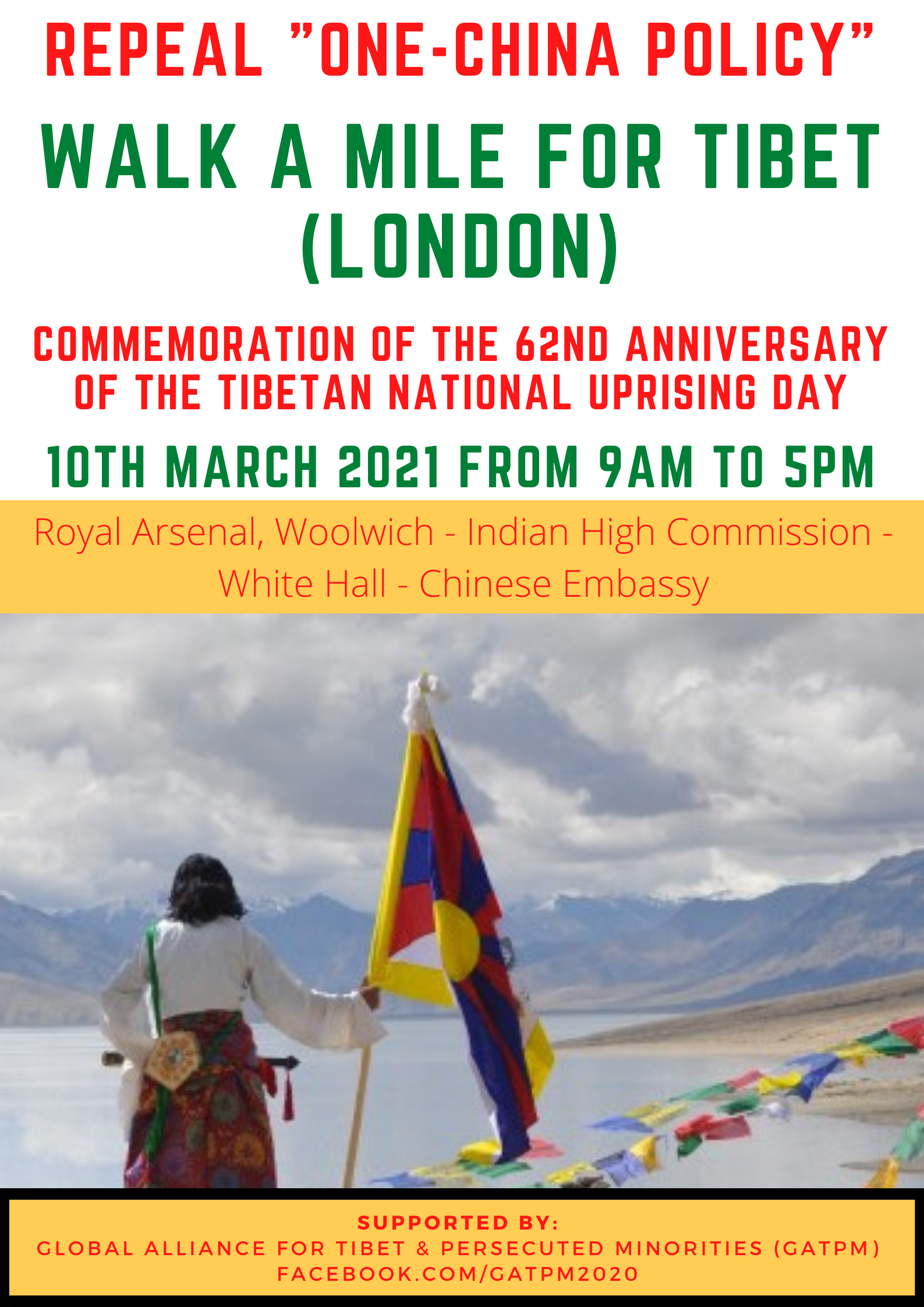
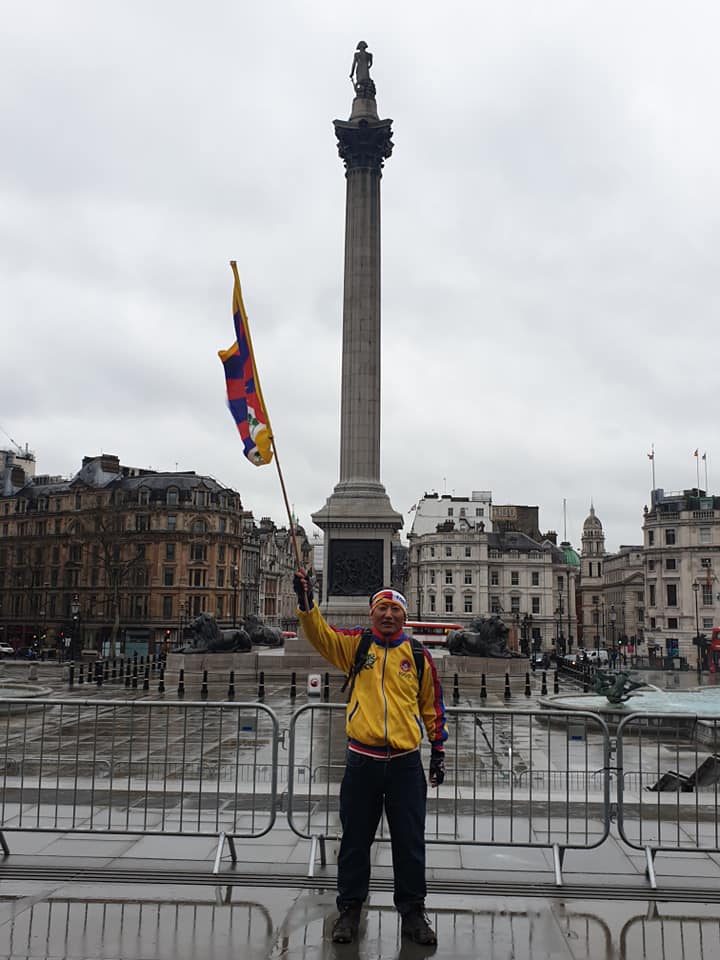
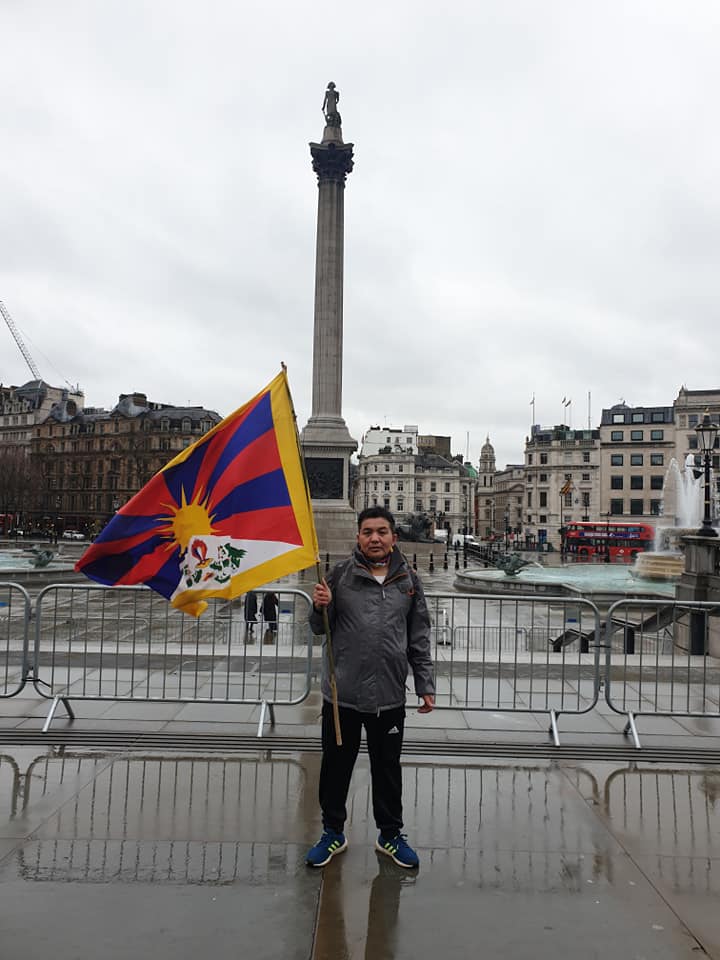
To coincide with the commemoration of the 62nd anniversary of the Tibetan National Uprising Day, on 10th March 2021, a group of eight Tibetans took part in the #WalkAMileForTibet in support of the Repeal “One-China Policy” campaign.
This campaign was initiated by Tenzin Tsundue, a Tibetan Youth Leader and Writer based in India. After launching an e-Petition to draw the attention of Indian PM Narendra Modi, Tsundue started his month-long campaign on Losar – Tibetan New Year – 12th February, from Dharamsala to Delhi, covering 500 kilometres distance on foot.
The “One-China Policy” is a diktat laid down by the Chinese Government (Communist Party of China – CCP) which denies any area currently under Chinese control the right ever to differentiate itself from China. Thus Tibet, Southern Mongolia, East Turkistan [Xinjiang], Manchuria and Hong Kong must – according to this diktat – accept that they are forever an integral part of China and can never break free of communist control. Taiwan – a democracy – is included in this diktat.
In his letter to the London-based Indian High Commissioner, ahead of the Tibetan commemoration anniversary, Tsering Passang, founder and convener of the Global Alliance for Tibet & Persecuted Minorities (GATPM), wrote, “On 10th March, Tibetans in diasporas commemorate the 62nd anniversary of the Tibetan National Uprising Day. Exactly 62 years ago, on 10th March 1959, tens of thousands of Tibetans rose up against the invading Chinese forces in Lhasa, Tibet’s capital. A week later, the Tibetan Leader, His Holiness the Dalai Lama left Lhasa and sought political asylum in India. Some 80,000 Tibetans joined the Dalai Lama.”
Whilst acknowledging India’s huge support to the Tibetan refugees and their freedom struggle, the Tibetan activist urged the Government of India to repeal the “One-China Policy” and work with “like-minded countries to challenge the Chinese regime”.
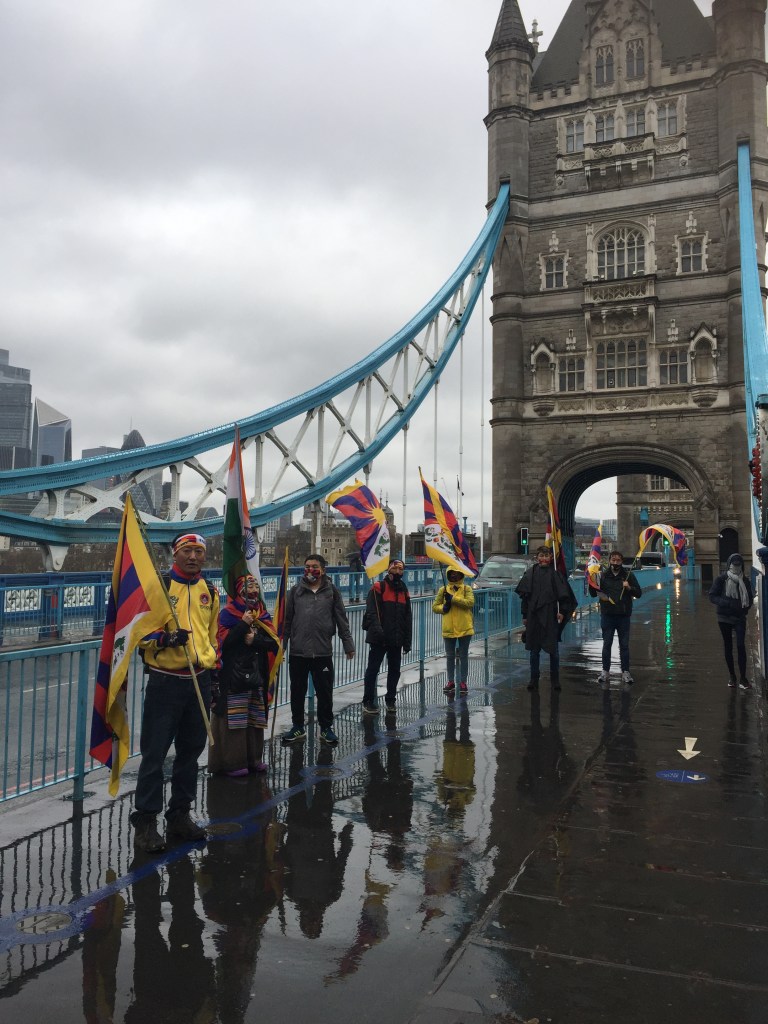
After passing through Greenwich Park, Tower of London and St. Paul’s Cathedral in the city, the peace marchers made a stopover outside the Indian High Commission. Passang stated that their stopover at the Indian High Commission was not a protest to India.
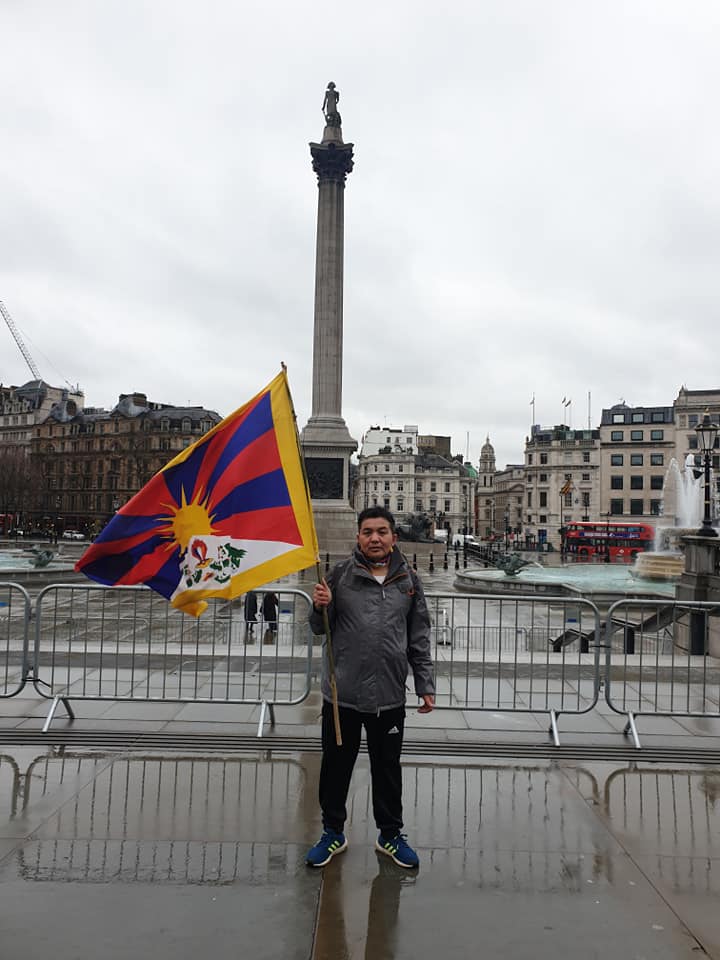
The group then headed towards the Chinese Embassy via the Whitehall, the heart of the British Government. When the group reached the White Hall, the police stopped them stating they were “caught on cameras”. England is currently under national lockdown due to Coronavirus pandemic. After the group’s explanation, the police advised them to go home to avoid fines, instead of heading to their destination – the Chinese Embassy. So, the group could not continue their walk to the Chinese Embassy. They had to cut short their commemoration event this year.
However, several Tibetan groups successfully staged protests outside the Chinese Embassy in London to observe the 62nd anniversary of the Tibetan National Uprising Day. The Tibetan Community in Britain and Tibet support groups held virtual commemoration events to mark this poignant anniversary in Tibetan history.
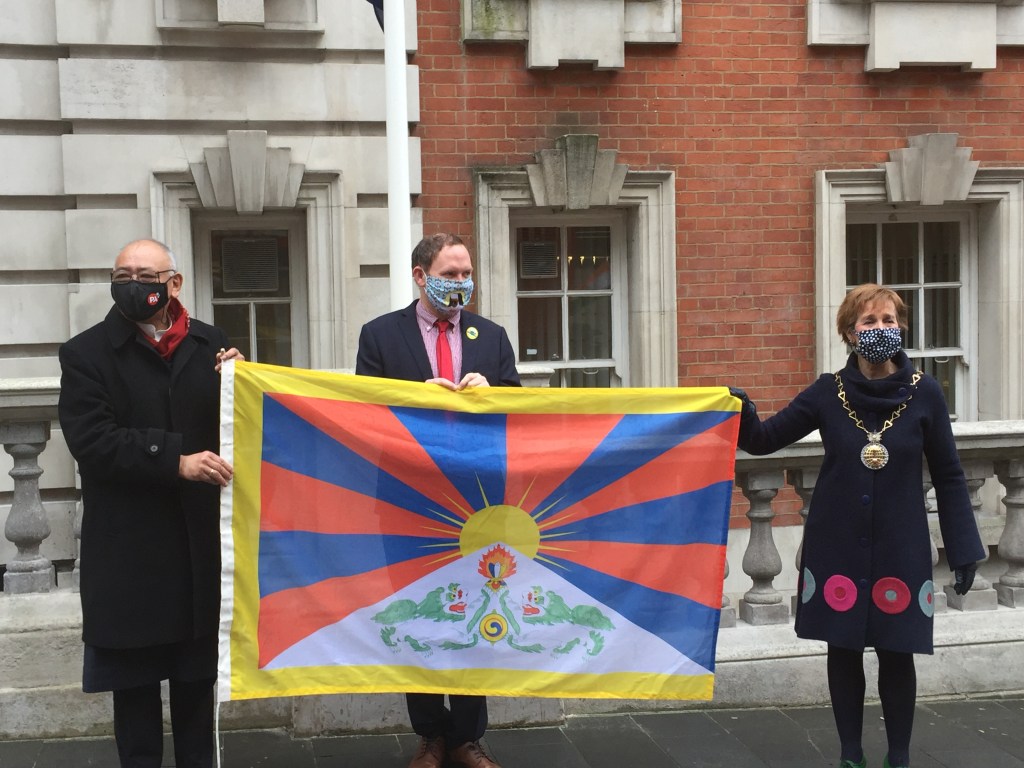
The 14-mile peace march kicked off from Woolwich Town Hall, the headquarters of Royal Borough of Greenwich (RBG), after the Tibetan National Flag was hoisted at the Town Hall again this year, to mark the 62nd Anniversary of the Tibetan Uprising. The simple ceremony was attended by Cllr. Linda Bird, The Mayor, Cllr. Danny Thorpe, The Leader of RBG and Representative Sonam Frasi from The Office of Tibet. Local residents and the Tibetan marchers witnessed the ceremony from a distance whilst observing the social distancing rules.
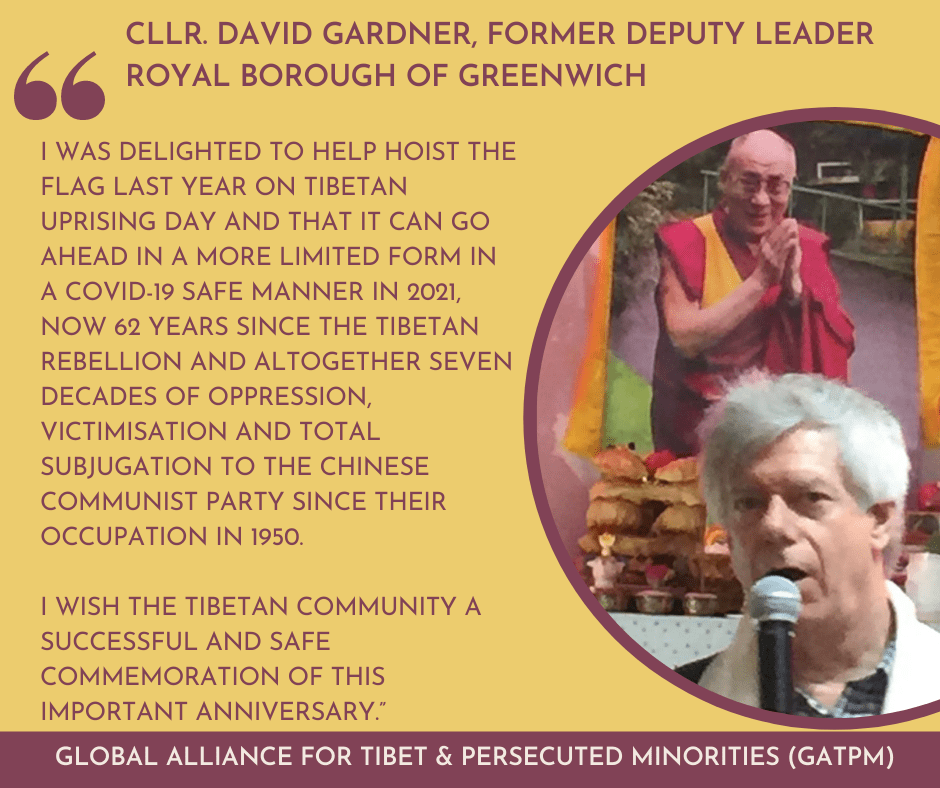
Cllr. David Gardner, former Deputy Leader of RBG, who helped to organise the flag hoisting ceremony, said, “The Tibetan community in exile has had a long association with our Royal Borough of Greenwich, and in my Woolwich Common ward in particular. I was delighted to help hoist the flag last year on Tibetan Uprising Day and that it can go ahead in a more limited form in a Covid-19 safe manner in 2021, now 62 years since the Tibetan rebellion and altogether seven decades of oppression, victimisation and total subjugation to the Chines Communist Party since their occupation in 1950.
“Now the Uighur community are also suffering as are democrats in Hong Kong as free speech, freedom of expression and universal human rights are trampled on across China. But this day is about Tibetans who are a peaceful people seeking merely the universal rights we all take for granted in Europe and to be able to freely visit their families back in Tibet without reprisals. I wish the Tibetan community a successful and safe commemoration of this important anniversary.”
Women play important roles in our society. The Global Alliance for Tibet & Persecuted Minorities (GATPM) was delighted to host a discussion with Tenzin Sangmo on the Tibetan Women’s role in their National Freedom Struggle on the eve of the 62nd anniversary, 12 March 2021, of the Tibetan Women’s National Uprising Day.
On 12th March 1959, thousands of Tibetan women gathered on the ground called ‘Dri-bu-Yul-Khai Thang’ in front of the Potala Palace, His Holiness the Dalai Lama’s residence in Lhasa, Tibet’s capital.
This demonstration – Women’s Uprising Day – was the spark that initiated the Tibetan women’s movement for independence.
Tenzin Sangmo is a Tibetan mother and she lives in England. She is a Nurse by profession and volunteers with the Tibetan Community in Britain. Tenzin serves on the Council of Tibetan Community in Britain as the Regional Coordinator.
In August 2020, Tenzin organised and led a 5-day peace march – “Walk for Tibet” from Bristol to London, covering over 150 miles with three other Tibetans to raise awareness of China’s occupation of Tibet. She is passionate and advocates for the rights of Tibetans and others who are persecuted by the Chinese communist regime.
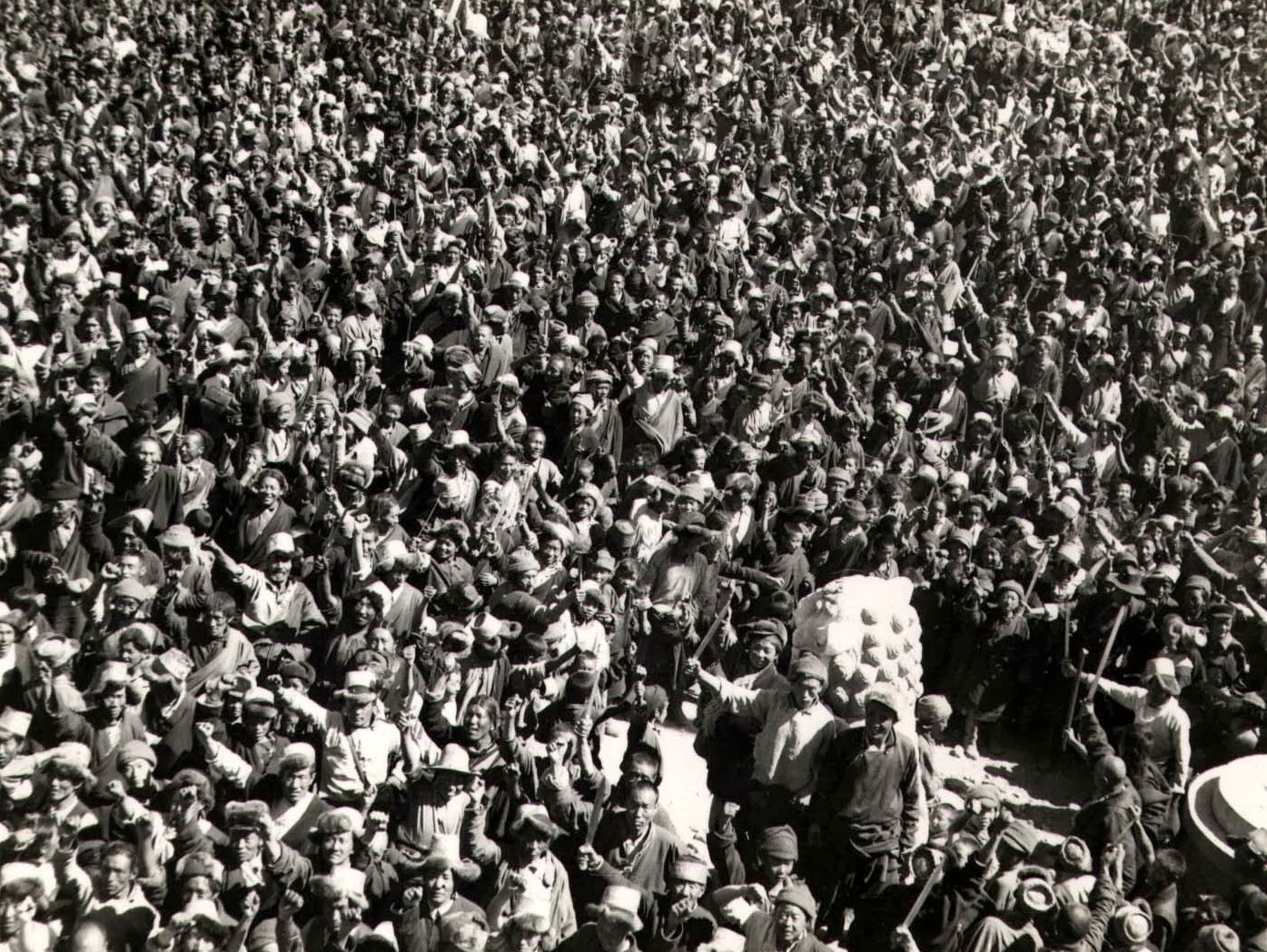
impassioned protest gathering at the stone lion’s (do senge lam) crossing in Lhasa, March 10, 1959
From the early 1950s The People’s Republic of China consolidated its 1949/’50 invasion of Tibet by constructing airfields, building roads leading to India’s border, stationing over 10,000 People’s Liberation Army troops in Lhasa, destroying monasteries, executing monks and sending thousands more to labour camps.
By 1957 Tibet’s eastern province, Kham, was in open revolt. Khampa raids on remote Chinese outposts and barracks provoked reprisals; tens of thousands of Khampas then marched towards Lhasa, doubling the capital’s population.
Enraged by the Khampa revolt and resistance, the Chinese generals in Lhasa – led by General Tan Guansan – put increasing pressure on the youthful Fourteenth Dalai Lama and his ministers to control their activities. In mid-February 1959 the Chinese discovered that promises of a “committee to discuss Khampa activities and report to the Chinese” was a fiction of the Tibetan Prime Minister, Surkhang, and his Cabinet. In reality, guns and ammunition were being distributed nationwide to prepare for armed revolt.
The defection of a key Chinese general on February 24 to the Tibetan resistance triggered open confrontation. “Under Communism I have no liberty,” General Chang Hwating confided to a Tibetan official. “The Communists treat all human beings like animals and I don’t believe we Chinese have any right to be in Tibet.” General Tan – a ruthless veteran of Mao’s Long March – ranted at the Cabinet that they had “one week to return the Chinese general. Otherwise …!” The week ended on March 3, 1959.
THE PEOPLE REVOLT
On March 4 the Dalai Lama was to take an oral examination for his geshe (doctorate) degree at the Jokhang – Lhasa’s main cathedral. But on March 3 a traitor scholar-monk facilitated an unscheduled meeting in the Jokhang between two PLA officers and the Dalai Lama to deliver General Tan’s invitation to a theatrical performance at the main Chinese army camp.
Within hours of this meeting, Peking Radio announced that the Dalai Lama had agreed to visit Beijing – an invitation which Tibet’s leader had carefully, in fact, been bypassing. Lhasa’s reaction was that the broadcast was a ploy to force the Dalai Lama to leave Tibet.
The mood for revolt was permeating Lhasa when, on March 7, the Dalai Lama agreed to attend the military’s theatrical performance on March 10. Violating standard protocol, on March 9 Tibetan security was ordered not to provide armed bodyguards to escort the Dalai Lama to the entertainment next day. The result? Rumours flew around Lhasa that their ruler was about to be kidnapped.
By sunset on March 9 thousands of citizens had ringed the yellow walls of the Norbulingka park and palaces – summer residence of the Dalai Lamas. In the city, a petition had been sent to New Delhi for help. As night fell over Norbulingka, patriotic songs rose from the crowd and shouts of “Tibet for Tibetans”. March 10 morning saw more than 10,000 Tibetans forming a human barricade against the Dalai Lama leaving his palace walls – thereby defying their leader’s own decision.
Seeing an imminent clash between the Tibetan people and Chinese army stationed in Lhasa, His Holiness the Dalai Lama left Lhasa on the night of March 17, quietly, without the knowledge of general public. He left for South Tibet to de-escalate the situation in Lhasa.
CITIZEN RULE
To lower the crowd’s anger, Surkhang invited them to choose representatives to talk to, and work with, those inside the Norbulingka. This gave birth to the Freedom Committee – a body of around 60 workers, peasants, traders and businessmen who then worked with the Cabinet during the crisis. Soon the patriotic crowd was issuing orders to security personnel and ministers via the Freedom Committee. Vehicles and pedestrians leaving or entering Norbulingka were stopped and searched by those vigilante citizens.
By late on March 10 Surkhang informed the Dalai Lama that his Cabinet had decided that he must “be prepared, if necessary, to set up his government outside Lhasa until help could come from India or the Western countries”. The escape plans began to formalize and by March 17, they were enacted. Disguised as one of his own bodyguard, bearing a rifle, the Dalai Lama marched away from his summer palace to a life of refuge in India.
THE WOMEN’S ASSOCIATION ROLE
The day of the Dalai Lama’s escape, as Tibetans prepared for certain bloodshed in Lhasa, 500 members of the Tibetan Women’s Association took out a major street demonstration. “… a solid phalanx of women came into view”, recalls a witness, “marching along the Yuthok Road … singing, carrying banners reading ‘Tibet for Tibetans’…”
The Association had been formed in the 1950s as a welfare organization, but its loyalties and activities were increasingly mistrusted by the Chinese occupation administration. In late February, General Tan had burst into a Women’s Association meeting, haranguing members and shouting: “Where there’s rotten meat the flies will gather. Get rid of the meat and the flies will case you no more trouble” – alluding to the Khampa guerrilla fighters as flies and the Dalai Lama as rotten meat.
THE LHASA UPRISING
March 20 – Bloody Friday At 2a.m. Lhasa was woken by artillery shells firing on the Norbulingka. By dawn battle began. The PLA had ringed the city with tanks and all exits were blocked. Street and alleys were barricaded and machine guns aimed down from rooftops and upper windows.
Meanwhile the 8,000-strong Tibetan Army was mainly deployed at strategic points around the city – 4,000 soldiers, alone, positioned to cover the Dalai Lama’s escape southwards. The defence inside the capital was mainly in the hands of civilians, “…ordinary simple people who had only asked to be left alone, who had hardly ever raised a finger in anger, had now been pushed so far that reason no longer counted,” writes war correspondent Noel Barber in From the Land of Lost Content*. “Lhasa had now reached that moment of the spirit when even victory was unimportant, when death and defeat were preferable to inaction.”
Women hauled sandbags and bales of wet wool to build barricades around the Jokhang so ammunition and arms could be supplied from the cathedral’s arsenal. Khampas, swords flashing, stormed Chinese positions to be mown down by machine gun fire. Chinese mortars thudded into the streets.
In the pitched battles of March 20, the Tibetans were dominant and inflicted heavy casualties on Chinese troops – on an estimated ratio of five Chinese for every dead Tibetan. But the day’s toll of dead civilian citizens is between 2-3,000 – including 20 women trapped in the Women’s Association building who were machine-gunned when they refused to surrender to a Chinese patrol. Writes the London Daily Mail’s Noel Barber: “The people of Lhasa, knowing only that their god was being hunted like an animal, were seized with a fury that made them utterly indifferent to the overpowering odds against them.”
MARCH 21 – THE DAY OF SAVAGE KILLING
By Day Two, the heart of Lhasa, the Jokhang area, was a besieged fortress, with Tibetans isolated and blocked off from reinforcements. In the afternoon an hour-long mortar bombardment killed every man defending the cathedral’s makeshift barricades.
Day-long battles – both military and civilian – raged in a dozen locations while merciless hand-to-hand fighting erupted in congested streets and narrow alleys. Guerrilla warfare tactics, using grenades and shells, were employed to make assaults on Chinese strongholds – the city’s requisitioned houses and PLA army camps.
Later morning the Norbulingka came under artillery bombardment, followed by machine gun and mortar fire, leaving devastating damage within the 10-ft high granite walls. The London Daily Telegraph correspondent, George Patterson, reported that “…800 shells were poured into the Norbulingka, destroying about 300 houses belonging to leading officials.” Chinese militia then checked every corpse to see whether their prime target, the “rebel leader, the bandit chieftain” had been eliminated.
With unlimited reserves of men, and modern weapons at hand, the Chinese occupation force annihilated Tibet’s spirited resistance fighter and by day’s end the dead joined the litter of empty mortar shells and bullet cases on Lhasa’s streets. Smoke smouldered from the petrol bombs made and hurled throughout the day by the women of Lhasa. As around 10,000 Tibetans crushed into the Jokhang Square that night, rumours circulated that Chinese tanks would be deployed there next morning.
MARCH 22 – FALL OF THE HOLY CITY
The bombardment to eliminate Tibetan resistance broke out at dawn when a Chinese mortar landed in the sacred Jokhang’s inner courtyard. So the final assault began, and by early afternoon probably half of the 10-15,000 Tibetan killed in these three bloody days of conflict had lost their lives.
Having pounded strongholds of resistance fighters to rubble, PLA tanks then turned their sights on the 7th century cathedral and its populated precincts. This final battle raged for three hours until, at around 2p.m., loudspeakers started blaring out across Lhasa.
The first voice was the military supremo, General Tan, telling the citizens that if they layed down their arms all would be forgiven. The next recorded message was from Ngabo Ngawang Jigme – a Tibetan Cabinet minister-turned- collaborator – ordering the fighting to halt in the name of the government. The Dalai Lama, he informed the silenced audience, was alive but “abducted against his will” by “reactionaries”.
With this unauthorized command, Ngabo brought the First Tibetan People’s Uprising to its finale. And the surviving resistance fighters shouldered their arms and possessions and melted away to the mountains, determined to fight another day.
Compiled by Jane Perkins |
*From the Land of Lost Content: The Dalai Lama’s fight for Tibet by Noel Barber: 1969, Collins, London. (A reconstruction of events based on eye-witness accounts).
A group of Tibetans in London are taking part in #WalkaMileForTibet on 10th March 2021 in support of Tibetan independence activisit and writer – Mr Tenzin Tsundue. India-based Tsundue started his month-long Peace Walk from Dharamsala to Delhi (500 kilometres distance) on Losar – Tibetan New Year – on 12th February to raise awareness of China’s continued colonisation of Tibet as well as the border clashes between India and China.
Tsundue’s mission is simple: he wants India to Repeal “One-China” Policy and hopes to expand this campaign around the world. The Tibetan activist is expected to submit his online Petition to the Indian Prime Minister Narendra Modi after completing peace walk on 10th March.
Tsering Passang of the Global Alliance for Tibet & Persecuted Minorities (GATPM) said, “We are soon going to launch a parallel campaign – Repeal “One-China” Policy here in the UK. It is time we build stronger alliances with like-minded causes and countries and, then exert increased pressure on China to abide by international norms. We must stop China’s global expansionist drive now.”
10th March 2021 marks the 62nd Anniversary of the Tibetan National Uprising Day. On 10th March 1959, tens of thousands of Tibetans rose up against the invading Chinese forces in Lhasa, Tibet’s capital. A week later, on 17th March 1959, Tibet’s temporal and spiritual leader, His Holiness the 14th Dalai Lama left Norbulinka, his summer palace in Lhasa and then went into exile to India. He established the Tibetan Government-in-exile (aka Central Tibetan Administration) after arrival in India. Dharamsala is the home of the Tibetan Government-in-exile since 1960.
China’s occupation of neighbouring countries such as Tibet and East Turkistan (Xinjiang) continues. The Chinese regime’s brutal suppression of peoples in China and the neighbouring countries is beyond the pale to say the least.
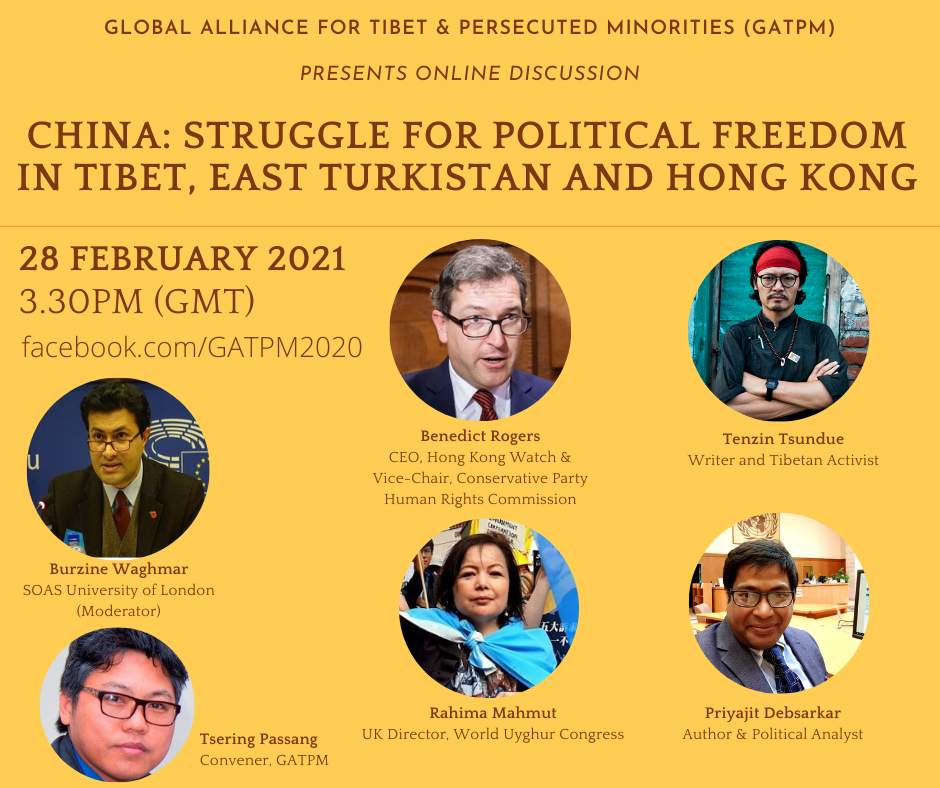
A panel of experts shared their thoughts on the freedom struggle of Tibet, East Turkistan and Hong Kong during a special virtual seminar, hosted by the Global Alliance for Tibet & Persecuted Minorities (GATPM), on 28 February 2021.
Panellists included:
Benedict Rogers, Journalist & Human Rights Activist (CEO of Hong Kong Watch and Vice-Chairman of the Conservative Party Human Rights Commission)
Rahima Mahmut, UK Director, Uyghur World Congress
Tenzin Tsundue, Writer and Tibetan Activist from India
Priyajit Debsarkar, Author & Political Analyst
Burzine Waghmar, Scholar, SOAS University of London
Tsering Passang, Global Alliance for Tibet & Persecuted Minorities (GATPM)
The seminar was hosted ahead of the Commemoration of the 62nd Anniversary of the Tibetan National Uprising in Lhasa, when tens of thousands of Tibetans rose up in protest against the invading Chinese Communist forces on 10th March 1959 in Tibet’s capital.
It also coincides with the month-long solo Peace Walk from Dharamsala (headquarters of the Tibetan Government-in-exile) to Delhi (500 kilometres distance) by Tenzin Tsundue, Writer and Tibetan Activist based in India, who leads his latest political campaign – Repeal “One-China” Policy. Tsundue started his Peace Walk on 12th February – Losar – Tibetan New Year and is expected to finish on 10th March 2021.
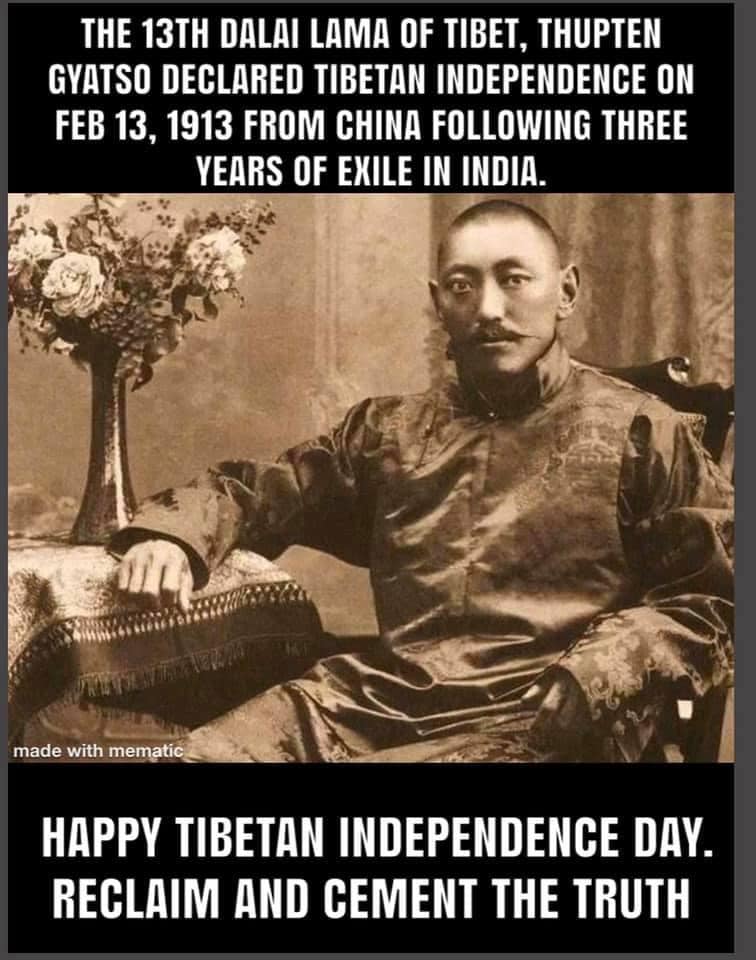
On 13th February 2021, Tibetans in diasporas commemorated the 108th anniversary of the Proclamation of the Tibetan Independence by the Great Thirteenth Dalai Lama of Tibet, on 13th February 1913.
In Tibet’s history, foreign powers invaded this Buddhist landlocked country from time to time. The previous 13th Dalai Lama had to flee Tibet and went into exile, to India in 1910 and stayed there for over two years. After the Manchu dynasty collapsed in the course of the Chinese revolution and, with the remaining Chinese representatives expelled from Tibet, the 13th Dalai Lama declared Tibetan independence.
For nearly forty years afterward, Tibetans enjoyed self-rule – only for it to come to an end in 1949, after Mao Tsetung, the founder of the Chinese Communist Party, declared the “peaceful liberation” of Tibet from foreign imperialists. In March 1959, the current 14th Dalai Lama fled Tibet and went into exile to India after Communist China invaded Tibet.
To discuss the historical development of China’s colonisation of Tibet and the Proclamation of Tibetan Independence by the 13th Dalai Lama, the Global Alliance for Tibet & Persecuted Minorities (GATPM) were delighted to conduct an interview with a British scholar – Mr. Burzine Waghmar from the School of Oriental & African Studies (SOAS), University of London.
This online discussion was conducted by Tsering Passang of the Global Alliance for Tibet & Persecuted Minorities (GATPM) on 21 February 2021.
In his Proclamation of the Tibetan Independence, on 13th February 1913, the Thirteenth Dalai Lama, declared: “Tibet is a country with rich natural resources; but it is not scientifically advanced like other lands. We are a small, religious, and independent nation. To keep up with the rest of the world, we must defend our country. In view of past invasions by foreigners, our people may have to face certain difficulties, which they must disregard. To safeguard and maintain the independence of our country, one and all should voluntarily work hard. Our subject citizens residing near the borders should be alert and keep the government informed by special messenger of any suspicious developments. Our subjects must not create major clashes between two nations because of minor incidents.”
The proclamation was made after the Great Thirteenth Dalai Lama returned to Tibet from exile in India, in January 1913. At the time of the Dalai Lama’s return to his landlocked Tibetan Kingdom, the Manchu dynasty had been dissolved in the course of the Chinese revolution. For nearly forty years afterwards, Tibetans enjoyed self-rule – only for it to come to an end in 1949, after Mao Tsetung declared “peaceful liberation” of Tibet from foreign imperialists.
For Tibetans, Mao’s declaration was not only a brutal attack on Buddhist religion and the Tibetan culture but an illegal occupation of their peaceful nation by Communist China. The Tibetan people have a proud history of independence with the successive Dalai Lamas enjoying spiritual patronage over Mongols and Chinese emperors.
Just as it did more than a thousand years ago, today, a doring (pillar) stands outside the Jokhang Temple in Lhasa, Tibet’s capital city. On its stone sides the Tibet-China Treaty of 821-822 AD is carved, signifying the legacy of a free and independent Tibet.
“Tibetans shall be happy in the land of Tibet, and Chinese shall be happy in the land of China,” reads a key text in the treaty, clearly describing the borders between Tibet and China.
Tibetan blogger – Ugyen Gyalpo
A New York-based Tibetan blogger, Ugyen Gyalpo, on his social media posting, “It’s such a paradox to say Happy Independence Day when our country is still under colonization. But what is not paradoxical is when we don’t take ownership of our historical past which is the basis of our fight. We must own our past and not suppressed it. We have compromised enough.
“We celebrate 4th of July like it is our own. We celebrate 15th of August like it is our own. We celebrate Canada Day, like it is our own. But we are hesitant to celebrate and reclaim our historical proclamation of independence on this day in 1913 by the 13th Dalai Lama. Are we living and embracing the world of alternate distorted facts. The only thing that separate our fight with China is the truth and if we are trying to be politically correct by denouncing anything to do with Independence, we are stabbing yourselves to death,” Gyalpo added.
Tibetan rangzen (Independence) activist and writer, Tenzin Tsundue in India launched his month-long Peace March from Dharamsala to Delhi on the Losar, Tibetan New Year – 12th February.
On the eve of one-man’s 500 kilometres Peace March, Tsundue posted on his social media, “I am going on a March from tomorrow, Dharamshala to Delhi to highlight the issue of Tibet as a missing link in the India-China conflicts.”
Tibetan independence activist and writer – Tenzin Tsundue
Tsundue’s mission is clear: “To fully appreciate the complexities of the Sino-Indian border conflict, the people of India must understand the issue of Tibet. The Indian government and its people must understand very clearly that India’s border will be permanently secure only when the Tibetan issue has been resolved”.
Tsundue will be asking the people he meets on the road “to sign an online petition asking the Government of India to repeal its One-China policy”. He also hopes that his “campaign will converge with a global campaign asking governments to repeal their One-China Policy.”
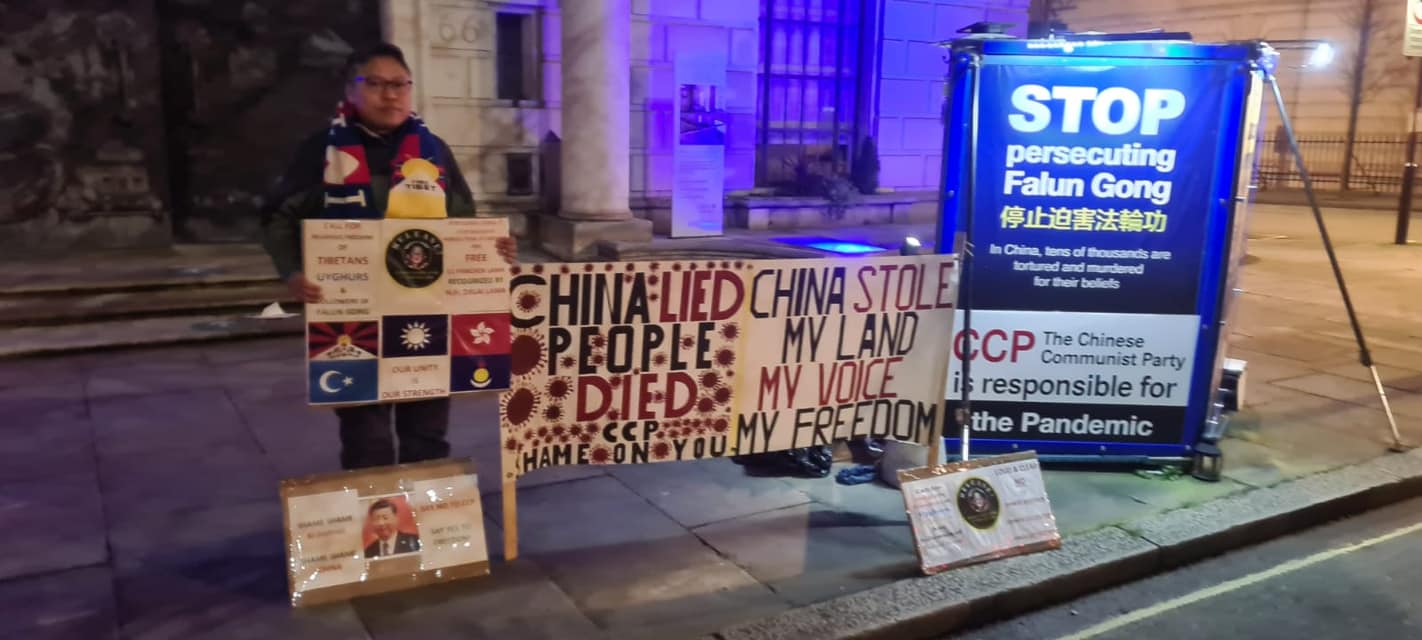
Tsering Passang, Convener at The Global Alliance for Tibet & Persecuted Minorities (GATPM), who after recently taking part in the weekly vigil outside the Chinese Embassy, on 10th February, to mark the 108th anniversary of the Proclamation of the Tibetan Independence by the 13th Dalai Lama, said, “China must relinquish its grip on Tibet and allow Tibetans to exercise their basic rights including their freedom of speech. Tibetans have the rights to self-determination for Tibet, and China being a Permanent Member of the United Nations, it must upheld the founding principle of the world’s body that affect the Tibetan people.”
Tsering Passang, outside the Chinese Embassy on 10th February 2021 with Tibetan protester “Ignyen”
For those who haven’t read the Proclamation of Independence Issued by the Great 13th Dalai Lama, please see below:
PROCLAMATION ISSUED BY H.H. THE DALAI LAMA XIII, ON THE EIGHTH DAY OF THE FIRST MONTH OF THE WATER-OX YEAR (1913)
Translation of the Tibetan Text
“I, the Dalai Lama, most omniscient possessor of the Buddhist faith, whose title was conferred by the Lord Buddha’s command from the glorious land of India, speak to you as follows:
I am speaking to all classes of Tibetan people. Lord Buddha, from the glorious country of India, prophesied that the reincarnations of Avalokitesvara, through successive rulers from the early religious kings to the present day, would look after the welfare of Tibet.
During the time of Genghis Khan and Altan Khan of the Mongols, the Ming dynasty of the Chinese, and the Ch’ing Dynasty of the Manchus, Tibet and China cooperated on the basis of benefactor and priest relationship. A few years ago, the Chinese authorities in Szechuan and Yunnan endeavored to colonize our territory. They brought large numbers of troops into central Tibet on the pretext of policing the trade marts. I, therefore, left Lhasa with my ministers for the Indo-Tibetan border, hoping to clarify to the Manchu emperor by wire that the existing relationship between Tibet and China had been that of patron and priest and had not been based on the subordination of one to the other. There was no other choice for me but to cross the border, because Chinese troops were following with the intention of taking me alive or dead.
On my arrival in India, I dispatched several telegrams to the Emperor; but his reply to my demands was delayed by corrupt officials at Peking. Meanwhile, the Manchu empire collapsed. The Tibetans were encouraged to expel the Chinese from central Tibet. I, too, returned safely to my rightful and sacred country, and I am now in the course of driving out the remnants of Chinese troops from DoKham in Eastern Tibet. Now, the Chinese intention of colonizing Tibet under the patron-priest relationship has faded like a rainbow in the sky. Having once again achieved for ourselves a period of happiness and peace, I have now allotted to all of you the following duties to be carried out without negligence:
Peace and happiness in this world can only be maintained by preserving the faith of Buddhism. It is, therefore, essential to preserve all Buddhist institutions in Tibet, such as the Jokhang temple and Ramoche in Lhasa, Samye, and Traduk in southern Tibet, and the three great monasteries, etc.
The various Buddhist sects in Tibet should be kept in a distinct and pure form. Buddhism should be taught, learned, and meditated upon properly. Except for special persons, the administrators of monasteries are forbidden to trade, loan money, deal in any kind of livestock, and/or subjugate another’s subjects.
The Tibetan government’s civil and military officials, when collecting taxes or dealing with their subject citizens, should carry out their duties with fair and honest judgment so as to benefit the government without hurting the interests of the subject citizens. Some of the central government officials posted at Ngari Korsum in western Tibet, and Do Kham in eastern Tibet, are coercing their subject citizens to purchase commercial goods at high prices and have imposed transportation rights exceeding the limit permitted by the government. Houses, properties and lands belonging to subject citizens have been confiscated on the pretext of minor breaches of the law. Furthermore, the amputation of citizens’ limbs has been carried out as a form of punishment. Henceforth, such severe punishments are forbidden.
Tibet is a country with rich natural resources; but it is not scientifically advanced like other lands. We are a small, religious, and independent nation. To keep up with the rest of the world, we must defend our country. In view of past invasions by foreigners, our people may have to face certain difficulties, which they must disregard. To safeguard and maintain the independence of our country, one and all should voluntarily work hard. Our subject citizens residing near the borders should be alert and keep the government informed by special messenger of any suspicious developments. Our subjects must not create major clashes between two nations because of minor incidents.
Tibet, although thinly populated, is an extensive country. Some local officials and landholders are jealously obstructing other people from developing vacant lands, even though they are not doing so themselves. People with such intentions are enemies of the State and our progress. From now on, no one is allowed to obstruct anyone else from cultivating whatever vacant lands are available. Land taxes will not be collected until three years have passed; after that the land cultivator will have to pay taxes to the government and to the landlord every year, proportionate to the rent. The land will belong to the cultivator.
Your duties to the government and to the people will have been achieved when you have executed all that I have said here. This letter must be posted and proclaimed in every district of Tibet, and a copy kept in the records of the offices in every district.
From the Potala Palace.
(Seal of the Dalai Lama)”
Source (and further reading): Tibet: A Political History, Tsepon W.D. Shagapda, New Haven, 1967, pp. 246-248.
2021 Preliminary Election Results of the Tibetan Parliament in Exile
‘Mang-tso’ or democracy is one of the major gifts to the Tibetan people by His Holiness the Great 14th Dalai Lama. Tibetans in exile have been enjoying democracy whilst experimenting with this new concept over the past 60 years. We still have a lot of good learning to do in the years ahead, in my view.
As per the Charter of the Tibetans in Exile, there are currently 45 parliamentary seats for grabs – 40 in India/Nepal, 2 in Europe & Africa, 2 in North and South Americas, and 1 in the Australasia regions. The Tibetan parliamentary elections are held every five years.
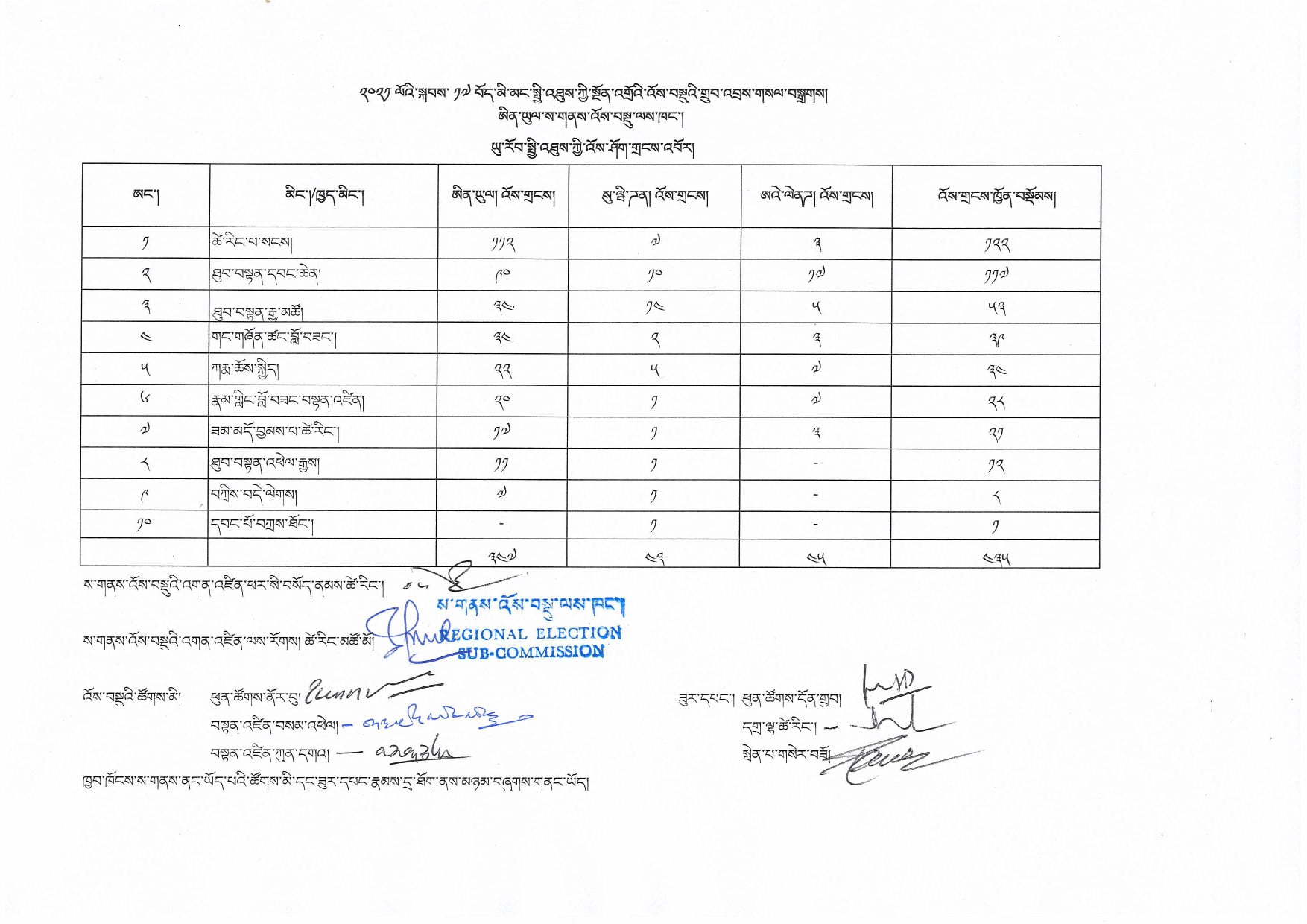
On 2nd and 3rd January, the preliminary round of the parliamentary election was conducted in the UK despite the difficult circumstances due to the COVID-19 restrictions. A week later, on 9th January, the Regional Election Sub-Commission for Northern Europe announced the latest election results – votes cast by Tibetans in the UK, Ireland, and Sweden.
This latest announcement from the Regional Election Sub-Commission for Northern Europe clearly shows that I have secured the highest votes amongst the parliamentary candidates for Europe & Africa constituency. I am deeply humbled and thankful for placing me into the highest pedestal in my home country. Regrettably, these votes are not adequate for me to be in the next and final round in April.
In Europe, the vote banks are based in countries such as Switzerland, France, Belgium, and Holland where the Tibetan populations are much higher than in the UK. So, in short, I will not be going into the final round.
During these past six weeks, I have come across some amazing people, whom I had not previously met, supporting my 2021 Chithu election campaign based on my service records, potentials, and for being issue-oriented. Many of these individuals include former and current responsible Tibetan community leaders, professionals, and Tibetans from Tibet who are residing in various European countries, the US, Canada, India, Nepal, and Australia. And of course, there are my core supporters here in the UK. I will cherish their genuine support, trust and honest conversations for our shared interest in Tibet and the Tibetan people’s just cause.
I wish to take this opportunity to express my sincere appreciation and thanks to all those who have supported me with their votes and encouragement in the preliminary round. I also would like to extend my warmest congratulations and best wishes to all the candidates including those who will be going into the final round.
As a concerned Tibetan, I will continue to work for Tibet and the Tibetan cause, which I have been doing over the past two decades. For me, it’s a great honour to take part in the 2021 Tibetan parliamentary election to represent the Tibetan communities in Europe & Africa and more importantly, to be a voice for the Tibetans inside Tibet. I am also immensely proud to have engaged in a positive and clean election campaign.
To conclude, our country, Tibet, is still under illegal occupation by a foreign country – China. Fellow Tibetans, we must all unite and direct our energy, resources, and efforts to challenge the Chinese regime to restore freedoms and justice in Tibet. Bhod Gyalo!
This is part of an interview series with new candidates of the 2021 Tibetan Parliament in Exile (17th TPiE). Interview with new Australasia and EU candidates for the 2021 Tibetan Parliament in Exile.
Kasur Gyari Dolma la made it a point to virtually meet and interact with the Chithue aspirants from Europe and Australasia as she did with those from North America to overcome the communication challenges posed by the COVID-19 related travel restrictions.
The Europe continent has over 44 countries. This rich continent is currently home to at least 14 Tibetan Communities with 30,000 Tibetans (rough estimation).
Five foreign missions of the Central Tibetan Administration (CTA) are based in Europe – Brussels, Geneva, London, Moscow and Paris.
The Africa continent has over 50 countries and currently home to one foreign CTA mission, based in South Africa. China has huge/active economic and trade interests as well as diplomatic/political engagements in these two continents. Naturally, China’s engagements in these two continents have impacts on the China-Tibet Conflict which is yet to be resolved. So, what are the roles of Europe and Africa Chithu? How significant is this platform to advance the Tibetan cause?
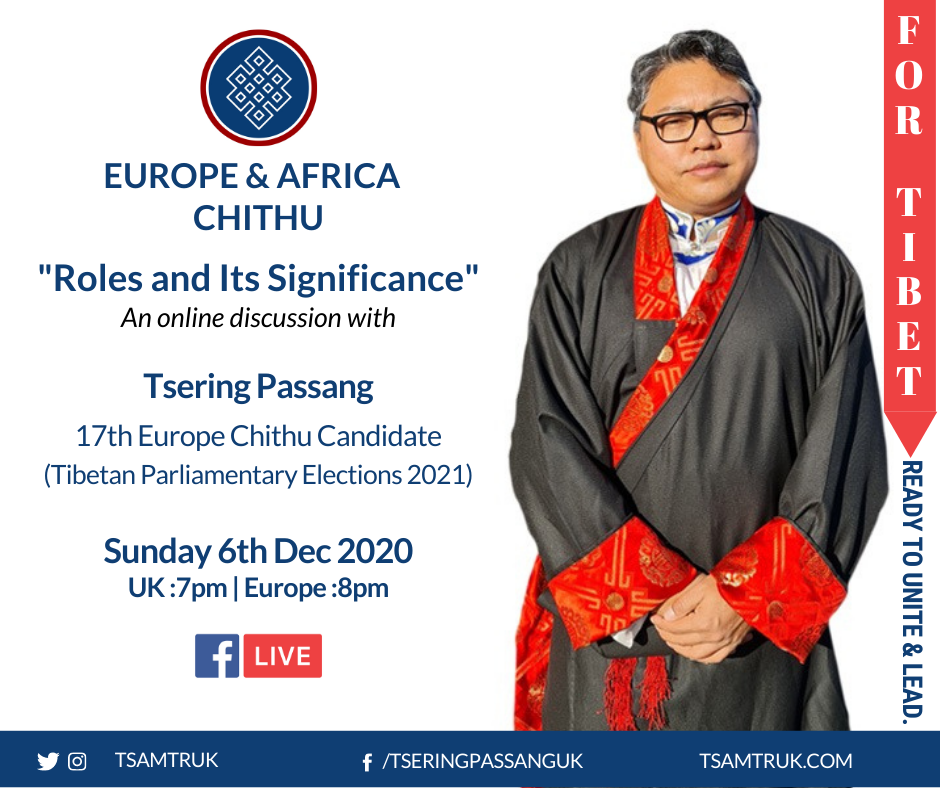
Tsering Passang, 2021 Europe Chithu Candidate from London will speak live on these vital issues via his social media platform. He will also welcome comments and answer any questions from the public.
Please tune in!Sunday 6th December 2020Time: 7pm UK | 8pm Europe















 Global Alliance for Tibet & Persecuted Minorities (GATPM)
You must be logged in to post a comment.