
London | 5 August 2026 | Tsering Passang |
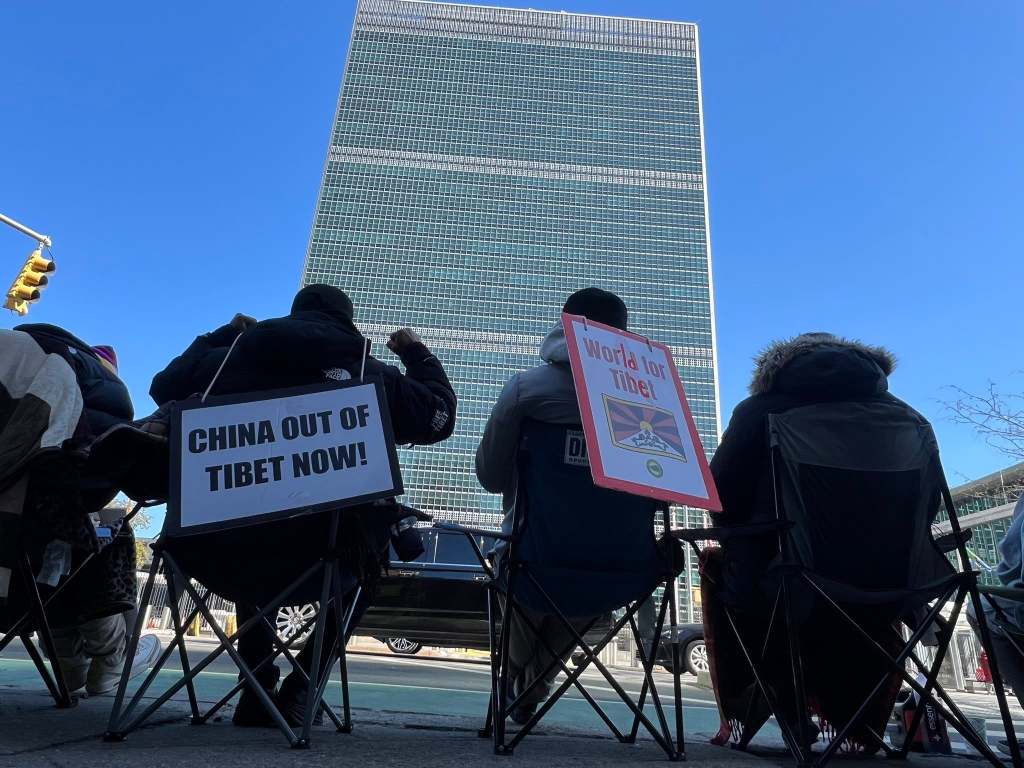
One month has passed since Tibetan activist Lobga Rangzen set himself on fire outside United Nations Headquarters in New York on 2 July 2026, dying from his injuries that same evening. His protest came just one day after Beijing’s Ethnic Unity and Progress Law took effect, placing Tibet once again at the centre of the world’s conscience. It should never have required such an act to draw attention to a crisis decades in the making.
Lobga Rangzen’s final message was not one of despair but of resolve: a plea to Tibetans everywhere to hold fast to their homeland, language, culture and identity – all of which the new law is explicitly designed to erase into a single state-mandated “national identity.” To see his death only as tragedy is to miss its purpose. He named a system, and that system remains fully in place today.
He is not the first Tibetan driven to this most desperate act to be heard. The first self-immolation took place in Delhi in April 1998, when Pawo Thupten Ngodup set himself alight during an indefinite hunger strike protesting China’s occupation of his homeland. Since 2009, that agony has been repeated more than 160 times, as Tibetans inside occupied Tibet have chosen this path rather than continue living under the Chinese Communist Party’s rule. Apart from a handful of nations, the United Nations and its member states have largely met this toll in silence. The Tibetan people, who have always walked the path of peace, deserve far better from the world’s largest body.

Who was Lobga Rangzen?
Born Lobsang Palden in 1974 in Karze, Kham, eastern Tibet, he grew up amid decades of political crisis under Chinese rule since the People’s Liberation Army (PLA) troops invaded Tibet in 1950. Ordained young as a monk, he lived within the very religious and cultural institutions Beijing has since sought to control. In the mid-1990s he fled to India rather than submit to restrictions on his faith and identity, completing over a decade of monastic education at Gaden Jangtse Monastery before moving to the United States around 2005–2006. Settling in Queens, New York, he deepened his advocacy, serving in community organisations, eventually becoming President of the Tibetan National Congress NYNJ, and devoting himself to peaceful, non-violent action exposing the realities inside Tibet.
His voice carried weight because he spoke from lived experience: occupation as a child, flight as a young man, and two decades in exile watching the same policies he had fled intensify rather than ease. He saw how worship was policed, how Tibetan language was sidelined in schools, how communities were reshaped without consent. He was not reporting on others’ suffering. He was speaking for his family, his homeland and his people.

Since his death, weekly commemorations have been held across some twenty countries. The Tibetan Parliament-in-Exile has issued a renewed global appeal warning that the Ethnic Unity and Progress Law accelerates forced assimilation, subordinating Tibetan identity to a state-defined “unity.”
Beijing frames the law as essential for unity and progress; however, the same rhetoric has been used for years to justify policies replacing Tibetan language in classrooms, bringing monasteries under state control, and relocating populations without consultation or agreement. This rhetoric does not change the reality: a law that demands a people surrender their distinct identity is not equality. It is erasure by another name. Genocide.
This poses the question the international community has long avoided: can a state’s claim to sovereignty shield it from scrutiny of how it treats its own people? Sovereignty was never meant to grant impunity, and the United Nations was founded in part to uphold that principle. On Tibet, it has largely failed to do so.
A Question Shelved, Not Settled
Tibet is often called forgotten. It has in fact been deliberately sidelined. Between 1959 and 1965, the UN General Assembly adopted three resolutions expressing alarm at human rights violations and calling for respect for the Tibetan people’s fundamental freedoms – a landmark recognition that what befell Tibet mattered to all nations.
That consensus did not fade because conditions improved. It faded as China’s economic power, permanent Security Council seat and global diplomatic reach grew, making governments increasingly reluctant to raise the issue at all. Today Tibet is discussed mostly in quieter forums – Special Rapporteurs, treaty bodies – where concern can be registered without forcing political action. This shift was no accident. It was the result of a powerful state steadily narrowing the space in which its conduct might be challenged.
For Tibetans, this is not abstract. It asks whether the UN’s founding promise – that rights do not vanish simply because a powerful state claims authority – still holds.
Rights Without Borders
International law is clear. The Universal Declaration of Human Rights, the International Covenant on Economic, Social and Cultural Rights (which China has ratified), and the International Covenant on Civil and Political Rights (which it has signed) protect freedom of religion, expression, cultural life and identity. Amnesty International, Human Rights Watch and others have documented for decades how these rights are systematically restricted in Tibet, alongside the near-total denial of independent access to journalists, diplomats and UN monitors. That refusal itself speaks volumes: a government confident in its own account would not fear outside scrutiny.
Beijing points to infrastructure and poverty reduction as evidence of progress. These developments may be real, but they do not justify trade-offs that erase language, faith and self-determination. Development is not a substitute for rights. No amount of investment can restore a suppressed culture or return control of daily life to the people living it.
The UN at a Crossroads
The UN is constrained by its own structure, especially when a permanent Security Council member is implicated. That reality does not excuse over six decades of near-silence from its highest political bodies. Expert mechanisms have value, but they cannot replace the political will that only the General Assembly and Human Rights Council can generate. Tibet does not lack forums. It lacks member states willing to use them. If the UN is to uphold universal rights, it cannot allow a state’s size or influence to decide which peoples are heard. A double standard maintained for over sixty years remains a double standard.
Whatever paralysis grips the Security Council, the past month has shown that governments, parliaments and civil society are far from indifferent, making the UN’s own silence all the more striking.
Across the United States, bipartisan senators moved to condemn the Ethnic Unity and Progress Law weeks before it took effect, and senior members of Congress issued a joint statement denouncing it the day it entered force. New legislation has since been tabled to strengthen US engagement with the Central Tibetan Administration, Tibet’s government-in-exile, and to call for the law’s repeal, whilst lawmakers have written directly to Beijing’s ambassador urging its withdrawal or fundamental revision.
Rejection of the law has echoed globally. The Inter-Parliamentary Alliance on China (IPAC) condemned Beijing’s latest legal measure, calling it a campaign of state-mandated assimilation aimed at systematically dismantling the distinct linguistic, cultural and religious identities of Tibetans, Uyghurs and other ethnic minorities within China.
The UK’s All-Party Parliamentary Group (APPG) on Tibet labelled it an instrument of forced assimilation. Germany’s Foreign Ministry voiced alarm at the risk of transnational repression reaching Tibetans in Europe. The European Parliament adopted a critical resolution months in advance. And voices within the UN Human Rights Council itself have called for the law’s repeal – proof that even inside the organisation, experts are willing to state plainly what its political bodies have avoided saying for generations.
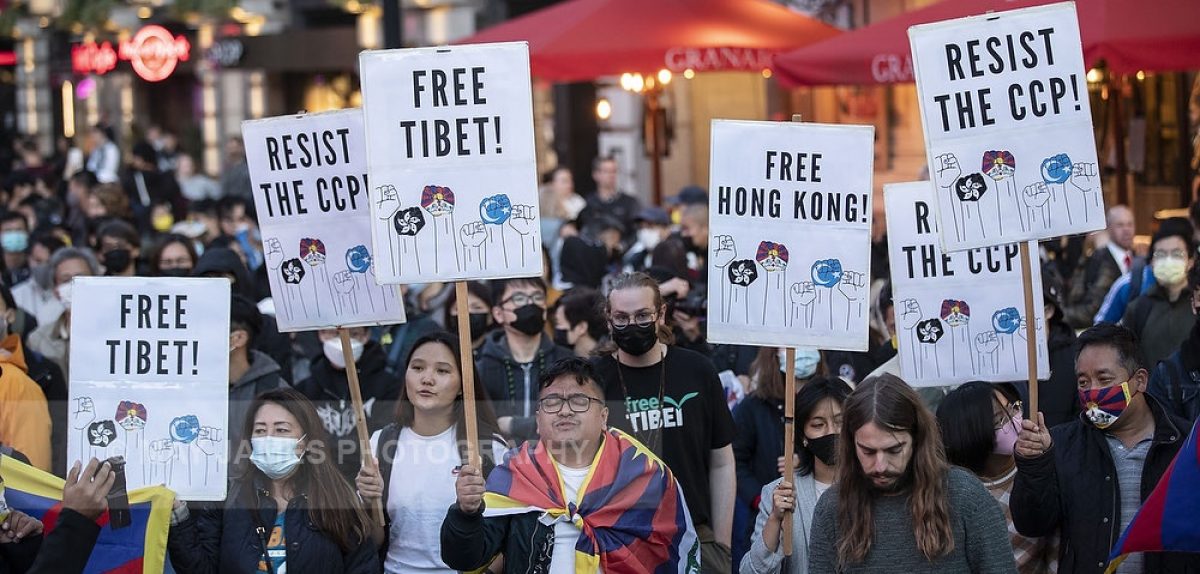
Civil society has matched this momentum. On 1 August, Tibetans and allies gathered again in New York, joined by activists from Hong Kong, East Turkestan, Southern Mongolia and Taiwan – a reminder that Tibet’s struggle is part of a wider pattern of state-imposed identity erasure. Actor and advocate Richard Gere told the crowd that Lobga Rangzen’s sacrifice should spur action, not despair, closing with the words that defined the activist’s life: “I am Tibetan.”
This outpouring confirms that concern for Tibet has not faded. It has simply moved outside the institution meant to lead on it. The question is no longer whether the world cares. It is why the UN lags behind its own members.
Context and Debate
The Ethnic Unity and Progress Law is no sudden measure. It is the culmination of decades of policy designed to dilute Tibetan identity through education, language rules and population shifts. Beijing calls this harmony. Tibetans who live it call it what it is: state-enforced assimilation, with cultural erasure as its endpoint.
For decades, the Central Tibetan Administration has pursued the Middle Way Approach – seeking genuine autonomy within the PRC Constitution rather than independence, a path championed by His Holiness the Dalai Lama and offered in good faith. Yet formal contacts ended in 2010, with no substantive dialogue since. An offer left unanswered for nearly two decades is not a stalemate. It is one side refusing to engage, facing no consequence for doing so. That some Tibetans now question whether patience has been met with anything but further encroachment is not a sign of division. It is the natural response of a people who have watched moderation yield only more of the same.
Power, Principles and the Future
China’s growing economic and technological influence has made governments cautious, not less concerned. These are distinct things, and the UN was built to uphold universal principles above commercial or strategic calculation. Sovereignty and human rights are not opposites: sovereignty protects states from external interference; human rights protect people from abuse by any authority. When the two conflict, the UN Charter itself affirms that fundamental rights and human dignity must prevail.
Lobga Rangzen’s death should not become a footnote. It is a reminder of the same plea the General Assembly heard sixty-seven years ago, one that geopolitics pushed aside but that has never gone away. The tools for action exist: renewed General Assembly debate, a Human Rights Council resolution, a dedicated Special Rapporteur mandate, demands for full independent access, and pressure to restart meaningful dialogue between Beijing and the Dalai Lama’s representatives. What has been missing is not process but will. And as the past month shows, that will is already alive in parliaments, communities and ordinary people everywhere.
More than six decades after the first UN resolution, the core questions remain unchanged: will the Tibetan people be allowed to keep their language, faith and way of life? Will the international community defend universal rights even when the violator is powerful? More than 160 lives have been laid down since Pawo Thupten Ngodup’s cry in 1998 first went unanswered. Lobga Rangzen paid with his life to ensure these questions could not be ignored any longer. The measure of the UN’s relevance now is whether his sacrifice finally leads to action, or is added to the long list of names the world has chosen to forget.
Tsering Passang is a London-based Tibetan writer and human rights campaigner, and founder-chair of the Global Alliance for Tibet & Persecuted Minorities. For over two decades he has campaigned internationally for justice, freedom and peaceful, lasting solutions for Tibetans and other persecuted communities living under authoritarian rule. His writing appears at www.Tsamtruk.com.
Useful Links:
Tibetan Parliament-in-Exile: https://tibetanparliament.org/a-global-appeal-open-letter-from-the-tibetan-parliament-in-exile-on-the-peoples-republic-of-chinas-ethnic-unity-and-progress-law/
Ethnic Unity and Progress Law: https://www.chinalawtranslate.com/en/ethnic-unity-and-progress-law
UN Special Rapporteurs: https://spcommreports.ohchr.org/TMResultsBase/DownLoadPublicCommunicationFile?gId=30922
US Congress Resolutions: https://www.congress.gov/bill/119th-congress/senate-resolution/791/text
European Parliament: https://www.europarl.europa.eu/delegations/en/new-chinese-law-on-ethnic-unity-and-prog/product-details/20260502DPU41892
Germany Foreign Ministry: https://www.auswaertiges-amt.de/de/newsroom/regierungspressekonferenz-2776316#content_1
Inter-Parliamentary Alliance on China (IPAC): https://x.com/ipacglobal/status/2072320303947026560
UK All-Party Parliamentary Group on Tibet: https://tibet.net/uk-all-party-parliamentary-group-on-tibet-condemns-chinas-ethnic-unity-and-progress-law-as-an-instrument-of-forced-assimilation/
Human Rights Watch: https://www.hrw.org/news/2025/09/28/china-draft-ethnic-unity-law-tightens-ideological-control
Amnesty International: https://www.amnesty.org/en/latest/news/2026/06/china-new-ethnic-unity-law-set-to-entrench-assimilation-of-minority-groups/
George W. Bush Presidential Center: https://www.bushcenter.org/publications/chinas-ethnic-unity-law-threatens-human-rights-around-the-world
Central Tibetan Administration: https://tibet.net/sikyong-penpa-tsering-calls-chinas-new-ethnic-law-a-legal-assault-on-tibetan-language-culture-and-identity/
International Campaign for Tibet: https://savetibet.org/un-experts-challenge-chinas-ethnic-unity-and-progress-law-citing-numerous-rights-violations/
Tibet Action Institute: https://tibetaction.net/statement-self-immolation-protest-by-lobsang-palden/
Internaional Tibet Network: https://tibetaction.net/statement-self-immolation-protest-by-lobsang-palden/
United Nations Digital Library – Question of Tibet: https://digitallibrary.un.org/record/205653?ln=en&v=pdf
International Resolutions and Recognition on Tibet: https://tibet.net/wp-content/uploads/2022/01/Final-E-book.pdf
Global Day of Actions – Protests in the USA, United Kingdom and France – Three Permanent Members of the United Nations Security Council

