London, GATPM | 2 July 2026
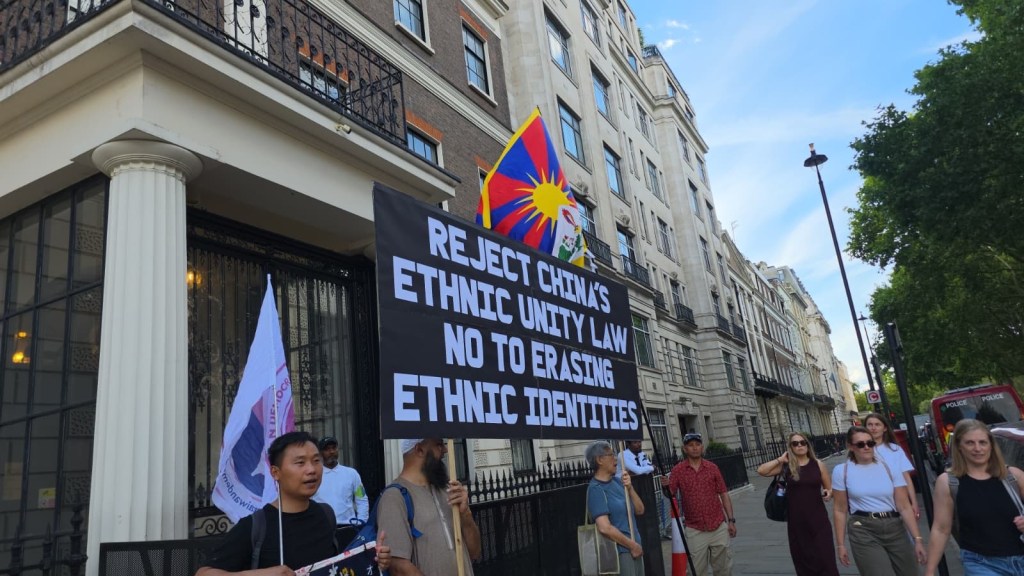
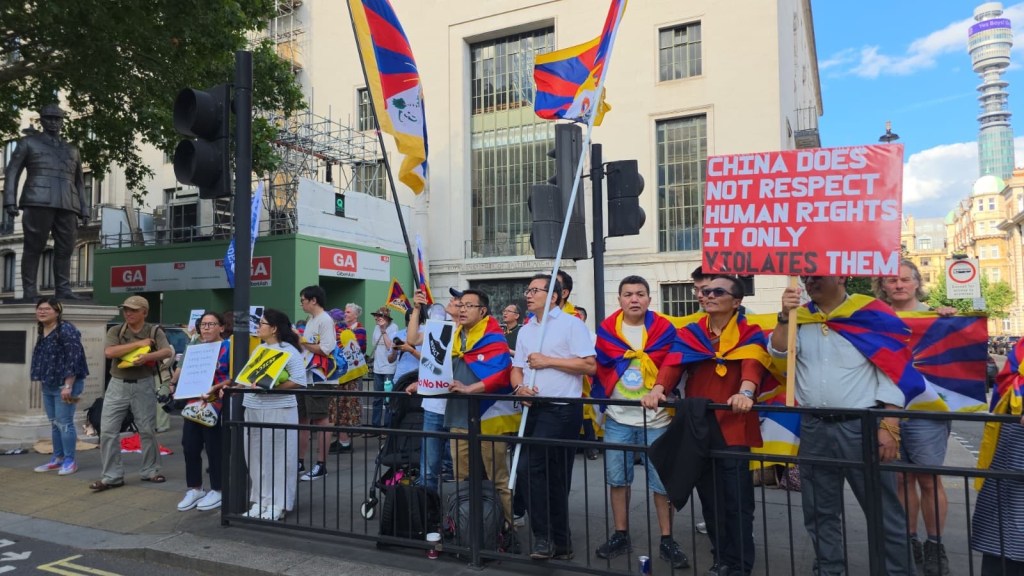
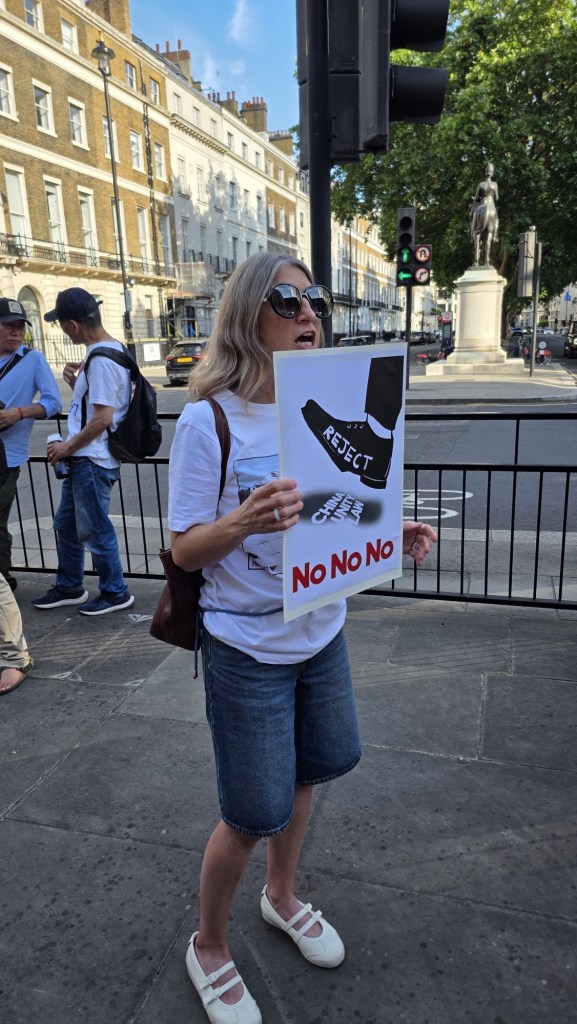
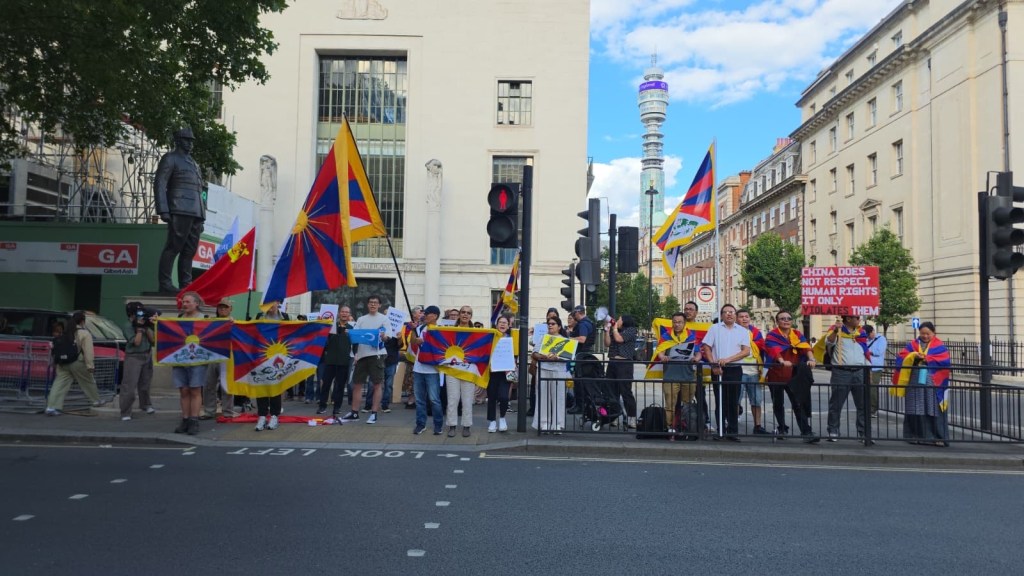
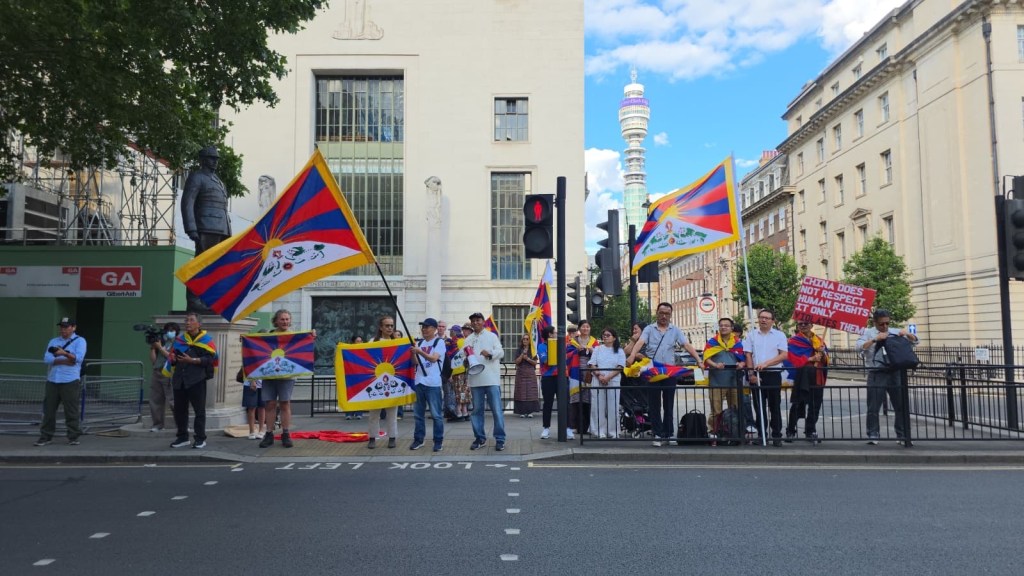
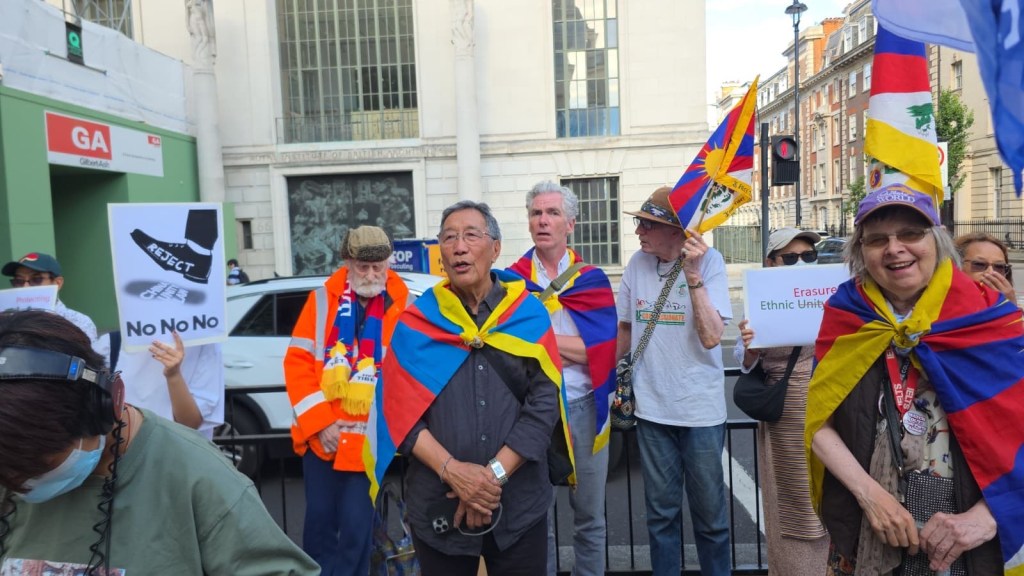
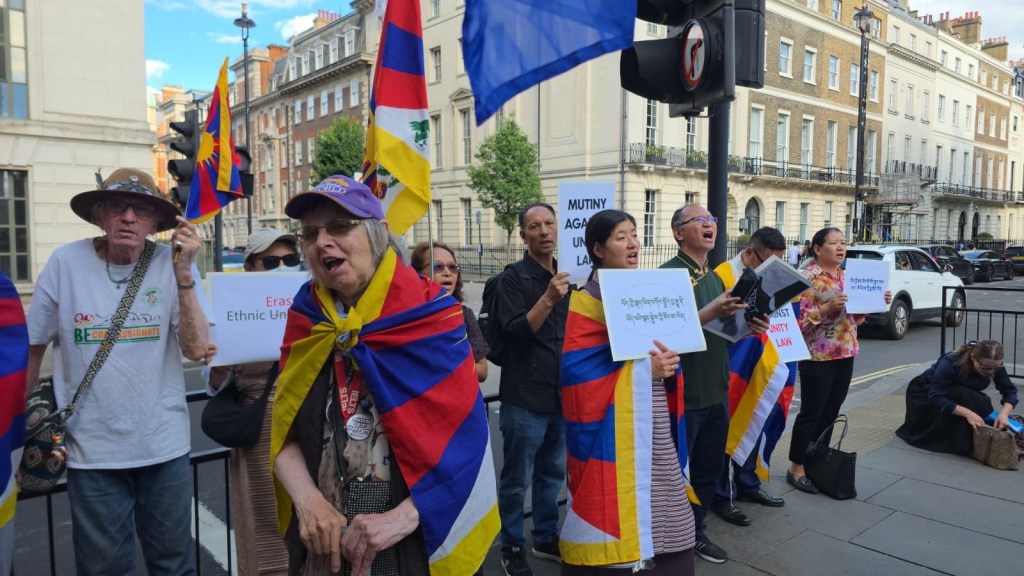
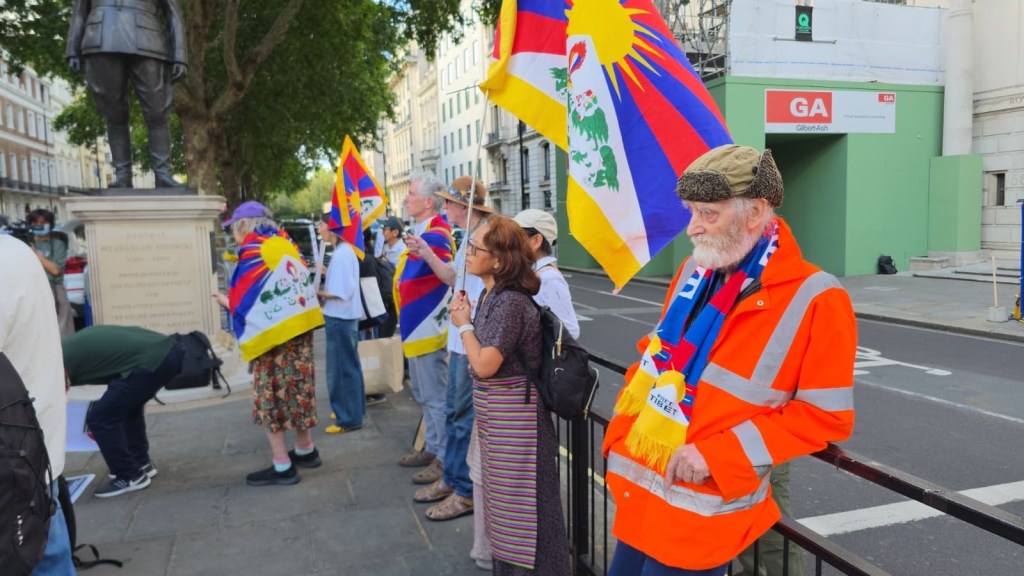
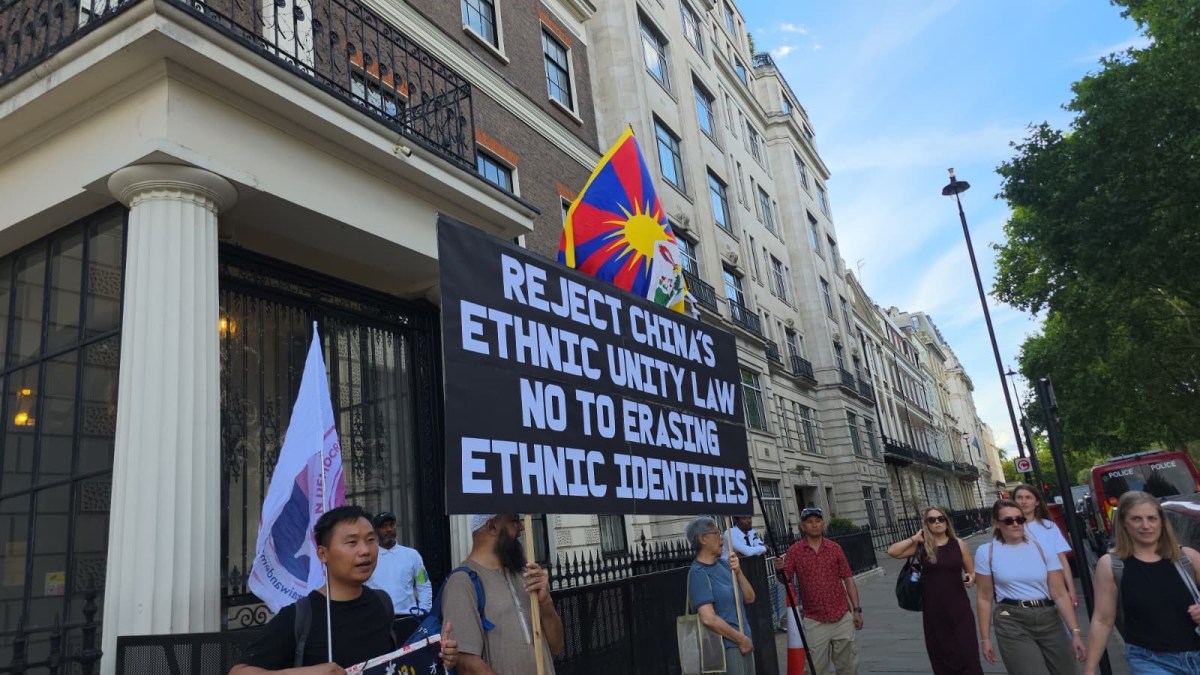
Tibetans, Uyghurs, Taiwanese, Hong Kongers, supporters and human rights advocates gathered outside the Embassy of the People’s Republic of China on the evening of 1 July 2026 to protest China’s Law on Promoting Ethnic Unity and Progress, which came into force that day.
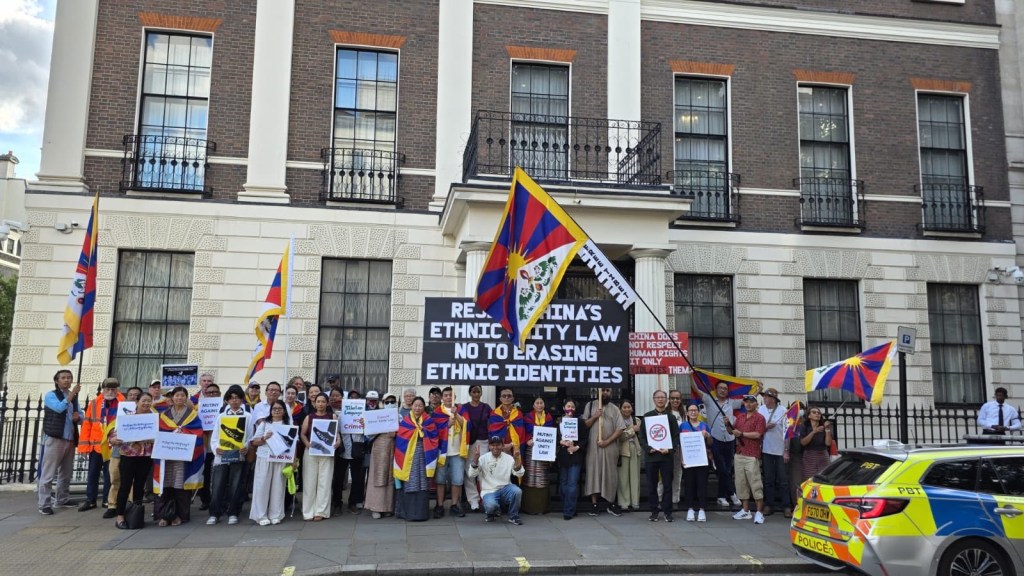
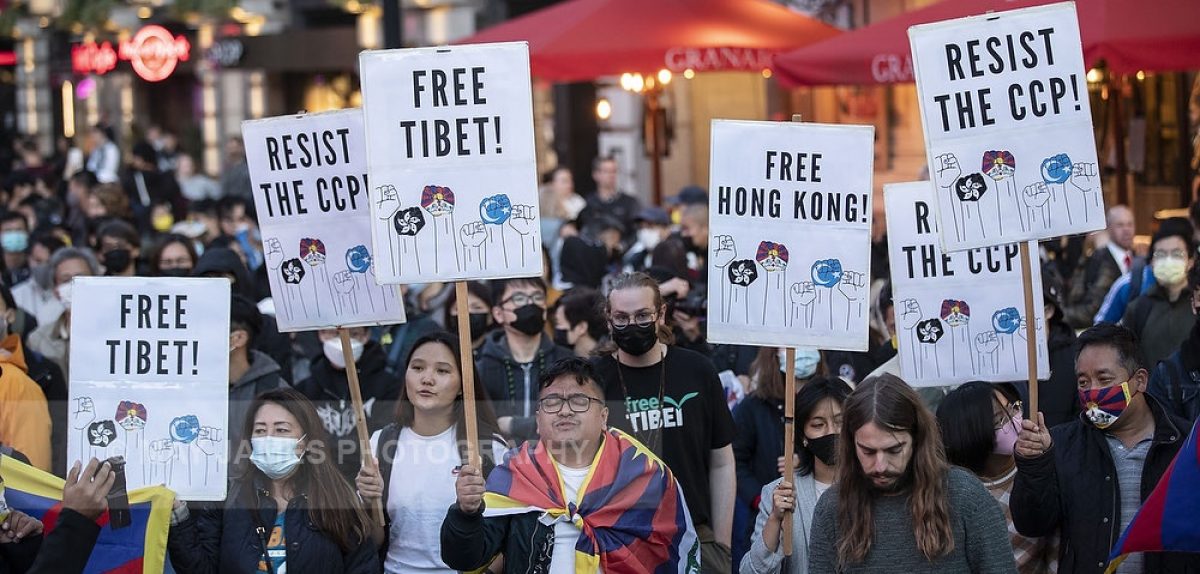
The peaceful 90-minute demonstration, organised by the Tibetan Community in Britain (TCB), brought together representatives from Tibetan, Uyghur, Hong Kong and Taiwanese communities, alongside human rights organisations and supporters, to condemn what they described as a dangerous escalation in the Chinese Communist Party’s campaign to erase the distinct identities, languages, cultures and religions of Tibetans, Uyghurs and other peoples living under Chinese rule.
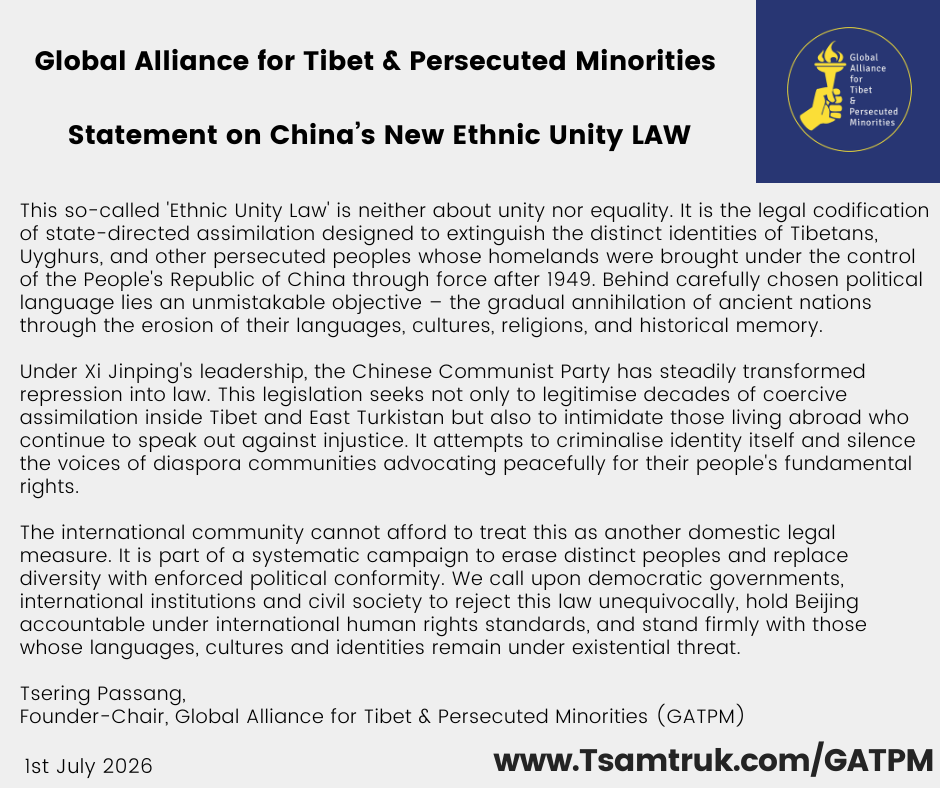
The demonstration followed growing international concern over the law, adopted by China’s National People’s Congress (NPC) on 12 March 2026. Tibetan organisations, parliamentarians and human rights groups warn that it creates an expanded legal framework to accelerate assimilation policies by restricting cultural, linguistic, religious and educational freedoms while criminalising peaceful expressions of ethnic identity.
International Calls for Action
The protest echoed concerns expressed by the Tibetan Parliament-in-Exile, whose resolution, proposed by the administration of Sikyong Penpa Tsering, warned that the legislation undermines constitutionally guaranteed autonomy and further threatens Tibet’s distinct cultural, linguistic and religious identity.
Sikyong Penpa Tsering, President of the Central Tibetan Administration, warned that the law represents another stage in Beijing’s long-standing efforts to dismantle Tibet’s national identity and urged democratic governments to take coordinated action before irreversible damage is done to Tibet’s language, religion and cultural heritage.
In a coordinated global initiative led by the International Tibet Network (ITN), 151 Tibet organisations jointly urged foreign ministers to oppose the legislation and press for its repeal, warning:
“China’s new law marks a dangerous new escalation in Beijing’s campaign to erase the distinct identity of the Tibetan people. Behind the language of ‘unity’ lies a powerful legal framework through which Tibetans can be punished for exercising fundamental rights: speaking their language, practising their religion, preserving their culture, and peacefully expressing their identity. It is the codification of policies that strike at the heart of Tibetan survival as a distinct people.”
The organisations urged governments to act collectively, warning that silence “will be remembered as acquiescence” and calling on democratic nations to use their collective influence to oppose the law and resist the export of authoritarian influence.
Parliamentary and International Responses
Chris Law MP, Chair of the All-Party Parliamentary Group (APPG) on Tibet, highlighted the importance of international solidarity and parliamentary scrutiny in responding to policies that threaten the rights and identity of Tibetans.
In a statement issued on 30 June, the APPG on Tibet described the legislation as:
“a dangerous legal instrument that entrenches the Chinese government’s policy of forced assimilation.”
The statement warned that the law threatens the languages, cultures, religions and identities of Tibetans, Uyghurs, Southern Mongolians and other ethnic nationalities through compulsory Mandarin education, surveillance, demographic engineering and ideological control. It also expressed concern that Article 63 could be used to target individuals and organisations overseas alleged to have “undermined ethnic unity”, raising serious implications for Tibetans, researchers, parliamentarians and human rights defenders in the United Kingdom.
The APPG concluded:
“The All-Party Parliamentary Group on Tibet unequivocally condemns this law and calls on the UK Government to formally convey its opposition to the Chinese Government, reject the implementation of this legislation, work with international partners to resist transnational repression, and urge its repeal in line with international human rights standards and the values of freedom, democracy and the rule of law.”
The Inter-Parliamentary Alliance on China (IPAC) likewise condemned the law, stating:
“What Beijing describes as ‘sinicisation’ is nothing less than a campaign of aggressive, state-mandated assimilation designed to systematically dismantle and erase the distinct linguistic, cultural and religious identities of Tibetans, Uyghurs and other ethnic minority groups within China.”
IPAC added that the legislation provides further legal cover for systematic repression, including forced labour affecting Uyghurs and the separation of more than one million Tibetan children into state-run boarding schools designed to assimilate them.
Voices of Solidarity
Opening the rally, Phuntsok Norbu, Chairman of the Tibetan Community in Britain, outlined the purpose of the demonstration:
“We have gathered here today to reject and call for the repeal of China’s Ethnic Unity Law, to condemn cultural assimilation, to demand an end to the CCP’s colonial-style boarding schools in Tibet, and to urge the Chinese government to stop erasing the identities, indigenous languages and cultures of the Tibetan, Uyghur, Southern Mongolian and Taiwanese peoples.”
He reaffirmed the right of all peoples to preserve their heritage, adding:
“We strongly oppose this law and firmly believe that Tibetans and all ethnic minorities have the right to protect and preserve their language, culture and heritage.”
Highlighting the demonstration’s significance as part of a coordinated global campaign on Tibet, he said:
“Today is a Global Day of Action. A total of 151 Tibet support groups from around the world have signed a joint letter calling on foreign ministers to reject China’s assimilation law. Along with other groups, the TCB also sent this joint letter to the UK Secretary of State at the Foreign, Commonwealth and Development Office earlier this week.”
Speaking on behalf of the UK Uyghur Community, Maira Aisa emphasised that the legislation was not the beginning of repression but “the continuation of one that has lasted for decades.”
She told the crowd:
“China calls this law the Ethnic Unity Law. But we know exactly what it means when an authoritarian state speaks of ‘unity’ — it often means uniformity. When it speaks of ‘stability,’ it often means silence. And when it speaks of ‘integration,’ it often means assimilation by force.”
Aisa warned that the legislation seeks not only to regulate behaviour but to erase identity itself:
“This law is not only about controlling behaviour. It is about controlling memory. It tells children what they should believe. It tells families what language they should speak. It tells an entire people that their identity must gradually disappear for the benefit of the state.”
Calling for continued solidarity, she concluded:
“Every time Tibetans, Uyghurs, Hong Kongers, Mongolians and Chinese democracy activists stand together, we prove that solidarity is stronger than repression. The Chinese government may pass laws. But no law can erase a nation, a language or a people’s memory.”
Rahima Mahmut, Executive Director of Stop Uyghur Genocide, Pempa Samuels, former General Secretary of the Tibetan Community in Britain, and Hsuan-Yi Li of Taiwan Democracy also addressed the demonstration, stressing that the legislation must be viewed within the broader context of Beijing’s systematic campaign of coercive assimilation, transnational repression and the erosion of the fundamental freedoms of Uyghurs, Tibetans and other persecuted communities.
The demonstration concluded with peaceful speeches, the singing of the Tibetan national anthem, chants of solidarity and calls for democratic governments to oppose the implementation of China’s Law on Promoting Ethnic Unity and Progress, support its repeal, and strengthen international efforts to defend the human rights, cultural freedoms and distinct identities of Tibetans, Uyghurs and all persecuted peoples.
Useful Links