People of Monyul Tawang Stand with His Holiness the 14th Dalai Lama – Over 10,000 call for public apology over baseless “child abuse” allegation against their spiritual leader

By Tsering Passang, GATPM, London; 22 April 2023

Media houses worldwide are on the firing line after running a false story based on a “doctored” video clip clearly masterminded by CCP agents, which insinuates that the Dalai Lama is a “child abuser”. 

Followers of His Holiness the 14th Dalai Lama are not going to forego this unprecedented level of baseless allegation against their spiritual leader until media houses issue public apologies for their shortcomings, including the absence of investigative journalistic work given the serious nature of the allegation.

This past week, the Tibetan diaspora and followers of the Dalai Lama worldwide have been demanding public apologies from media and celebrities for their misreportings and accusations on this serious charge against their spiritual leader. They demand the media to put the record straight by taking corrective action and issue an apology.

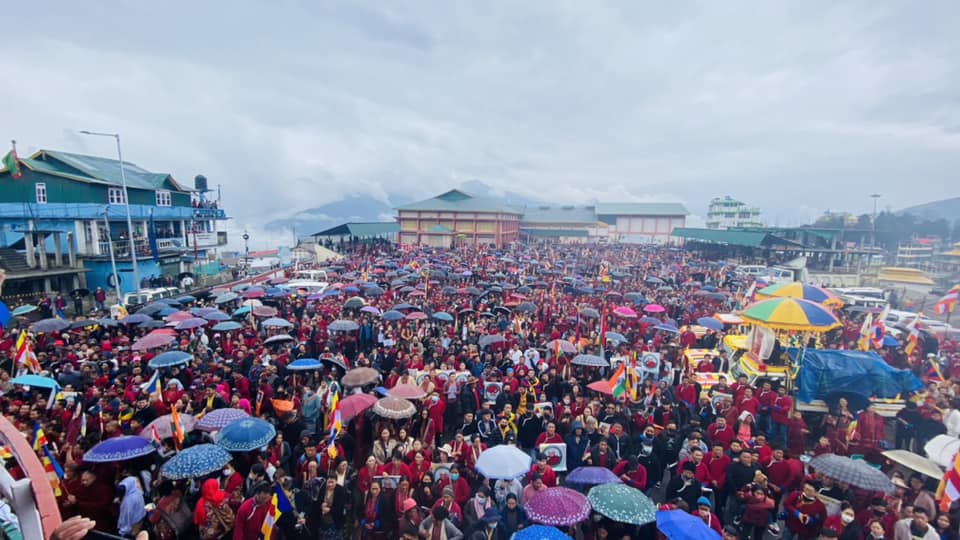
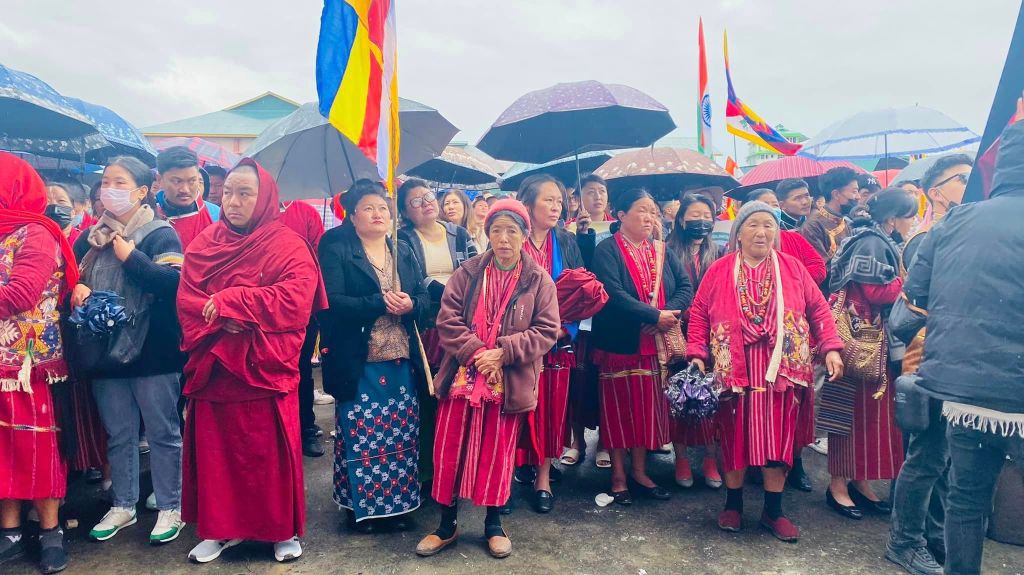
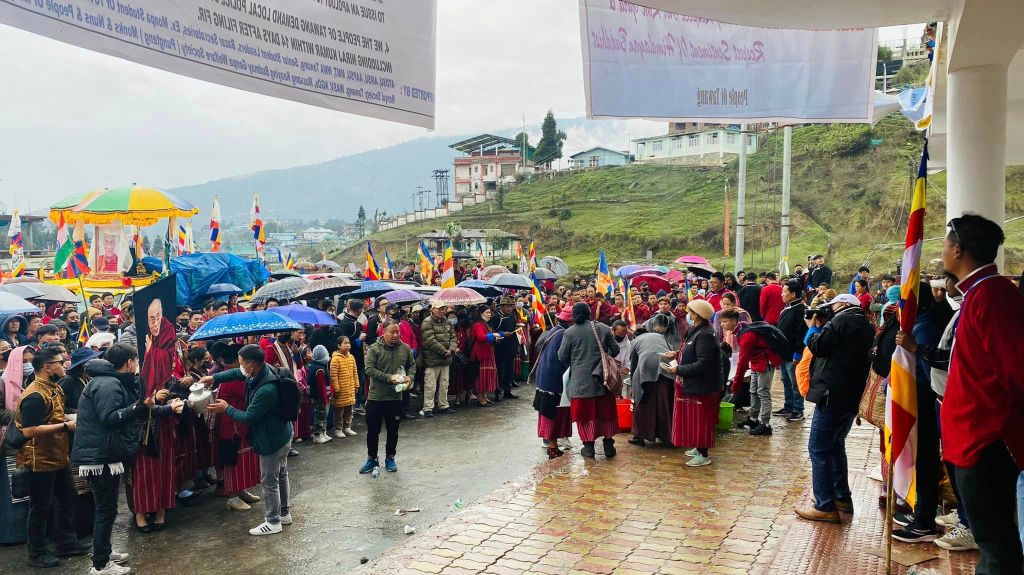
Earlier today, in the far flung of north-eastern India, Tawang – home to over 100,000 Monpas, at least 10,000 took to the streets to rally support for their spiritual leader Dalai Lama who is 87-years old. 

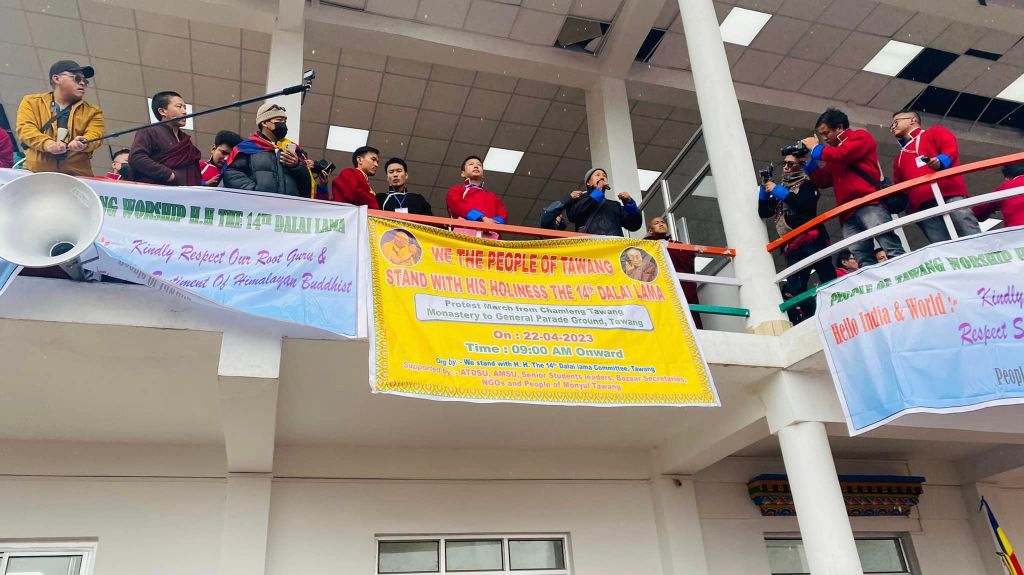
The Tawang Rally on 22nd April was organised by ‘We Stand With His Holiness the 14th Dalai Lama Committee’, which comprised of at least 15 NGOs and civil societies including ATDSU, AMSU, AAPSU, MMT, WWA Tawang, Senior Student Leaders, Bazar Secretaries, Ex. Monpa Student of TCV, CST Schools, Monyul Society Tawang, WASV, NGOs, Massage Keaying Budmay Gonpa Welfare Society (Pungteng), Monks & Nuns & People of Monyul Tawang.

The mass protesters marched from Chamleng, Tawang Monastery to the Parade Ground in the heart of Tawang town centre. In addition to calling for a media apology, the people of Tawang are now considering legal actions taken against those who engaged in defaming their spiritual leader. They chanted “Long live His Holiness” and “We Stand with His Holiness”. A social media posting reads: “Their defamation has seriously hurt the sentiments of millions of Buddhist people and His Holiness followers. The message is Loud and Clear till Justice is served. The Indian Buddhist people will continue to fight.” The organisers were going to submit a Memorandum to their MPs Shri Kiren Rijiju and Jamyang Tsering Namgyal.

Thupten Jampa, a native of Tawang, who now lives in London, told this author: ”The people of Mon Tawang and Tibet have enjoyed a long historical relationship over many generations especially that we share the same Buddha Dharma and our culture. And then there is the close relationship between the Dalai Lama Institution and the Monpas, especially the 6th Dalai Lama, Tsangyang Gyatso, who was born in Mon Tawang. As it is the case of a true spiritual bond between the Lama (teacher) and his disciples, whenever there are baseless allegations and lies spread, the disciples are bound to speak up and defend their Lamas. Baseless allegations must not be tolerated. This is what happened in Tawang today.”

Earlier in the week, massive protests were held in Ladakh, Sikkim and Darjeeling, the foothills of the Himalayas in support of the Nobel Peace laureate. In Ladakh, the authorities even banned concerned Indian media houses from covering the forthcoming G20 Summit. They also banned those celebrities from filming work in Ladakh, who made serious baseless allegations against the Tibetan spiritual leader. Some celebrities started issuing apologies for their ignorance, misunderstanding and hurting the sentiments of the Tibetans and other Buddhist communities.

Academic scholars of Tibetan Studies call on the media for “careful investigation” over the Dalai Lama Incident – Statement

A group of academic scholars of Tibetan Studies from around the world have called on the media to “consider context carefully before projecting a highly charged interpretation onto something about which they have little knowledge”.

Statement of Dalai Lama Incident

21 April 2023

We, the undersigned academic scholars of Tibetan Studies, express our dismay over recent media coverage of an exchange between Tenzin Gyatso, exiled fourteenth Dalai Lama of Tibet, and a young boy in India at a public event. This included an edited video of the exchange that was created to give the impression of sexual misconduct on the part of the Dalai Lama, cynically misusing the momentum of the #metoo movement for its own ends. But on the basis of watching a fuller video of the event, along with the representation of what happened by the boy himself as well as his mother, we are not seeing here an incident of sexual misconduct.

We urge news reporters to consider context carefully before projecting a highly charged interpretation onto something about which they have little knowledge. It is well known that the current Dalai Lama is physically playful with many of the people he meets, of all statuses and ages and genders, including when he embraced and tickled Bishop Desmond Tutu under the chin with humor and in friendship. We would also add that we have heard from a wide range of Tibetan specialists, colleagues, and friends that it is far from unusual for old folks in Tibetan societies to interact with children in many commonly-recognized joking ways, including as the Dalai Lama did. These are not incidents of sexual abuse.

Indeed there have been recent, and very troubling and painful, cases of Tibetan lamas committing sexual abuse, as has also occurred in other world religions repeatedly and for decades. We adamantly support the important work for justice and healing for children and other people who are the survivors of such abuse. But the current incident with the Dalai Lama is not an instance of sexual abuse, and it is harmful to everyone to claim that it is. Among many other things, to do so diminishes the voices of survivors who have courageously shared their stories and shined a light on systemic abuse, both in religious and many other contexts.

The Dalai Lama has been a dedicated leader for his people and his nation over many decades of hardship and struggle. He has been an inspiring teacher of Buddhist compassion and an advocate for world peace, recognized with the Nobel Peace Prize. It is possible for anyone to act inappropriately or out of character. But in this instance, knowing the context of the particular incident, the personality of the Dalai Lama, his commitment to his monastic vows, and the many aspects of Tibetan culture at work in the event, we view that as highly unlikely. Instead we understand the manipulated video and its dissemination to be an ill-intentioned attack on the authority of the Dalai Lama in his old age. Indeed, it is an attack on the global Tibetan and Himalayan community as a whole, and on the international standing of Tibetan Buddhism.

We stand with the Tibetan community both inside and outside China today, who have been demonstrating with dignity and restraint, but still in anger and deep sadness, about what they see as a deliberate and strategic effort to tarnish the institution of the Dalai Lama. With them, we urge global news networks to be cautious before making snap judgements, bowing to prejudice and buying into salacious stories, and to make the careful investigation of the sources of their information on such sensitive matters their highest priority.

Geoffrey Barstow – Associate Professor, School of History, Philosophy, and Religion, Oregon State University

Daniel Berounsky – Associate Professor, Institute of Asian Studies, Charles University (Univerzita Karlova)

Benjamin Bogin – Associate Professor of Asian Studies, Skidmore College Katia Buffetrille – École pratique des hautes études, Paris

Jose I. Cabezon – Dalai Lama Professor of Tibetan Buddhism and Cultural Studies, University of California Santa Barbara

Cathy Cantwell – Associate Faculty Member, Faculty of Asian and Middle Eastern Studies, University of Oxford

Hildegard Diemberger – Research Director, Mongolia and Inner Asia Studies Unit, University of Cambridge

Jacob Dalton – Khyentse Foundation Distinguished University Professor in Tibetan Buddhism, University of California Berkeley

James Duncan Gentry – Assistant Professor, Department of Religious Studies, Stanford University

David Germano – Professor of Tibetan Buddhist Studies, University of Virginia

Janet Gyatso – Hershey Professor of Buddhist Studies and Associate Dean for Faculty and Academic Affairs, The Divinity School, Harvard University

Catherine Hartmann – Assistant Professor of Religious Studies, University of Wyoming Hanna Havnevik – Faculty of Humanities, University of Oslo

Lama Jabb – Lecturer in Tibetan, Oxford University

Sarah Jacoby – Associate Professor, Northwestern University

Matthew Kapstein – Directeur d’études, émérite, Ecole Pratique des Hautes Etudes Samten Karmay – Director of Research emeritus, Centre national de la recherche scientifique

Donald Lopez – Arthur E. Link Distinguished University Professor of Buddhist and Tibetan Studies, Department of Asian Languages and Cultures, University of Michigan

Robert Mayer – University of Oxford

Carole McGranahan – Professor of Anthropology and Chair of the Department of Anthropology, University of Colorado

Anna Morcom – Mohindar Brar Sambhi Chair of Indian Music, Herb Alpert School of Music

Giacomella Orofino – Professor of Tibetan Studies and President of the Centre for Buddhist Studies, Department of Asian, African and Mediterranean Studies, University of Naples

Françoise Pommaret – Director of Research Emeritus, Centre de recherche sur les civilisations de l’Asie orientale

Andrew Quintman – Associate Professor, Religion Department, Wesleyan University

Charles Ramble – Research Professor (Directeur d’études) in Tibetan History and Philology, Ecole Pratique des Hautes Etudes, Paris Sciences et Lettres University

Françoise Robin – Professor of Tibetan Language and Literature, Institut national des langues et civilisations orientales

Ulrike Roesler – Professor of Tibetan and Himalayan Studies, The Oriental Institute, Oxford University

Peter Schwieger – Principal Investigator, Institute of Oriental and Asian Studies, Bonn University

Heather Stoddard – Professor Emerita, Institut national des langues et civilisations orientales; Wolfson College & Oriental Institute, University of Oxford

Dominic D. Z. Sur – Associate Professor in Religious Studies, Department of History, Utah State University

Andrew Taylor – Assistant Professor, Religious Studies, The College of Saint Scholastica

Tsering Topgyal – Department of Political Science and International Studies, University of Birmingham

Gray Tuttle – Leila Hadley Luce Professor of Modern Tibetan Studies, Columbia University

Nicole Willock – Associate Professor of Asian Religions, Old Dominion University

Emily Yeh – Professor, Department of Geography, University of Colorado Boulder

A Tibetan perspective on the Dalai Lama and that ‘kiss’- Call for media public apology to put the record straight

Members of the audience posing for a group photo with His Holiness the Dalai Lama at the end of the program in the courtyard of the Main Tibetan Temple in Dharamsala, HP, India on February 28, 2023. Photo by Tenzin Choejor | Office of The Dalai Lama

In his response concerning the coverage of His Holiness the Dalai Lama’s compassionate greeting with an Indian student, on 18th April, Richard Best, The Independent’s Managing Editor, wrote to Tsering Passang:

I am sorry if you have been offended by our coverage – that was certainly not our intention.”

Tsering Passang was then offered to submit his Tibetan perspective on the disinformation, which The Independent published on 20th April.

Writing in The Independent, Tsering Passang, Founder and Chair of Global Alliance for Tibet & Persecuted Minorities, calls on the media houses to take corrective actions following their dissemination of disinformation on the Tibetan spiritual leader His Holiness the 14th Dalai Lama.

A Tibetan perspective on the Dalai Lama and that ‘kiss’

“Western media houses, including The Independent and the BBC, must reject the dissemination of fake news in the form of a serious allegation insinuating the Dalai Lama is a “child abuser” and “paedophile”. A public apology is needed to put the record straight.

When at least 55 media houses in the UK gave coverage to a few seconds of a viral video clip on social media, did they realise that they were supporting China’s disinformation campaign against the Tibetan spiritual leader?

The few seconds of the video clip showing the Dalai Lama “kissing” a young Indian student was first posted on 8 April on a fake social media account before British media ran the story two days later. Prior to this, for the first time, Chinese authorities allowed the spread of the same video carrying the Dalai Lama’s picture freely across Chinese social media platforms including in China’s occupied Tibet for weeks. Many Tibetans were very pleased to see a glimpse of their spiritual leader’s image, which is otherwise banned in Tibet.

The original clip was from a public event with over 120 M3M Foundation students and staff, held on 28 February. The playful, compassionate greeting between the Dalai Lama and the Indian student happened in the presence of his parents. The student asked the Dalai Lama for a “hug” during a Q&A session. The boy’s mother, Dr Payal Kanodia, who is the chairperson and trustee of the M3M Foundation, said afterwards: “We’re totally totally blessed to have got these blessings from His Holiness.”

The pure unadulterated acts of love, faith, and compassion by the Tibetan spiritual leader should not be compared to child abuse scandals as have happened in the churches of the UK, the US and beyond. In this instance, the two first exchanged “Oo-thuk” – foreheads touching – that represents pure love, respect in Tibetan culture. Then a “po” – a kiss on the lips, which is common in our culture until one superimposes one’s own hypersexualised views. As the Dalai Lama had nothing more to offer, he said “suck my tongue” – another translation would be “eat my tongue” (nge che le sa). Such a common, playful refrain by Tibetan elders is innocent-sounding in Tibetan, but not so when translated into English.

Genuine coverage of the Dalai Lama’s lifelong commitment to peace would be beneficial. We must not forget the nearly one million children in Tibet, who from the age of 4 to 18 are being forced into China’s colonial-style boarding schools with a long-term strategy of annihilating Tibetan identity, language and culture. Tibet is still under the illegal occupation by China, and a gross violation of human rights, including freedom of speech, is taking place.”

This Letter to The Independent by Tsering Passang, Founder and Chair of Global Alliance for Tibet & Persecuted Minorities, human rights activist and former Chair of Tibetan Community UK, was published on 20th April 2023.

VOICES OF DEFIANCE : A COMPILATION OF ARTICLS WRITTEN IN THE WAKE OF THE RECENT SOCIAL MEDIA DEFAMATION OF HIS HOLINESS THE 14TH DALAI LAMA

BBC urged “to provide genuine coverage” on Dalai Lama

By Tsering Passang, London

British Tibetans condemned China and its agents for deliberate attempt to tarnish the image of the Tibetan spiritual leader

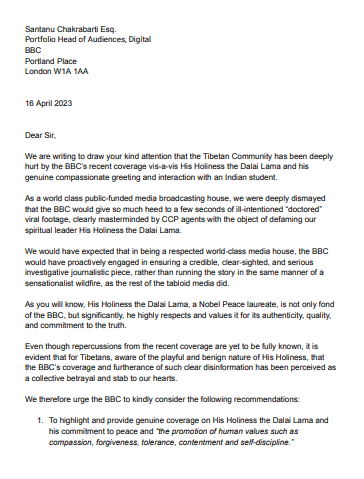
“As a world class public-funded media broadcasting house, we were deeply dismayed that the BBC would give so much heed to a few seconds of ill-intentioned “doctored” viral footage, clearly masterminded by CCP agents with the object of defaming our spiritual leader His Holiness the Dalai Lama,” wrote a group of former leaders of the Tibetan Community in Britain to the BBC’s Portfolio Head of Audiences, Digital on 16th April. 

They added, “We are writing to draw your kind attention that the Tibetan Community has been deeply hurt by the BBC’s recent coverage vis-a-vis His Holiness the Dalai Lama and his genuine compassionate greeting and interaction with an Indian student.

“We would have expected that in being a respected world-class media house, the BBC would have proactively engaged in ensuring a credible, clear-sighted, and serious investigative journalistic piece, rather than running the story in the same manner of a sensationalist wildfire, as the rest of the tabloid media did. 

“As you will know, His Holiness the Dalai Lama, a Nobel Peace laureate, is not only fond of the BBC, but significantly, he highly respects and values it for its authenticity, quality, and commitment to the truth. 

“Even though repercussions from the recent coverage are yet to be fully known, it is evident that for Tibetans, aware of the playful and benign nature of His Holiness, that the BBC’s coverage and furtherance of such clear disinformation has been perceived as a collective betrayal and stab to our hearts.” 

This Joint Letter was signed and submitted by Tsering Passang, Founder & Chair of Global Alliance for Tibet & Persecuted Minorities, (Tibetan Community UK – Chairman, 2014 – 2016), Dalha Tsering (Tibetan Community UK – Chairman 2018 – 2020) and Phuntsok Norbu (Tibetan Community UK – Vice Chairman, 2018 – 2020).

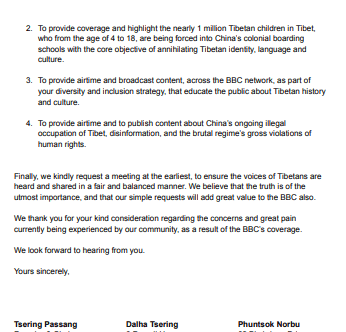
In their letter, the trio also urged the BBC to consider the following recommendations:

  1. To highlight and provide genuine coverage on His Holiness the Dalai Lama and his commitment to peace and “the promotion of human values such as compassion, forgiveness, tolerance, contentment and self-discipline.”
  1. To provide coverage and highlight the nearly 1 million Tibetan children in Tibet, who from the age of 4 to 18, are being forced into China’s colonial boarding schools with the core objective of annihilating Tibetan identity, language and culture.
  1. To provide airtime and broadcast content, across the BBC network, as part of your diversity and inclusion strategy, that educate the public about Tibetan history and culture. 
  1. To provide airtime and to publish content about China’s ongoing illegal occupation of Tibet, disinformation, and the brutal regime’s gross violations of human rights.

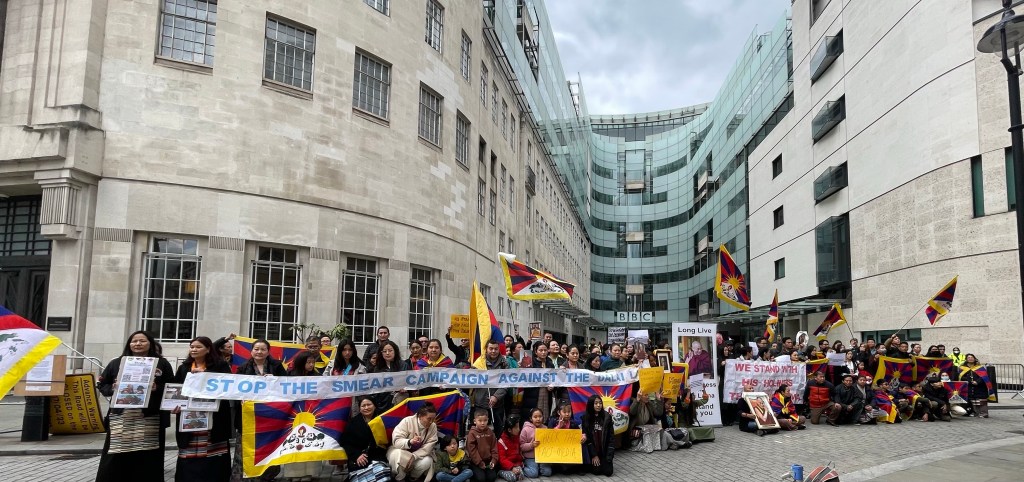
Outside the BBC building, which is not so far from the Chinese Embassy, co-organiser Phuntsok Norbu spoke on the significance of this urgent gathering. This was then followed by Tsering Passang reading the trio’s Joint Letter to the BBC and a recent Statement issued by a group of Tibetan leaders and activists from around the world.

Initiated by the Tibet Action Institute, on 14th April, a group of Tibetan leaders and activists from the around the world issued a Statement of Support for the Dalai Lama. An excerpt of the Statement reads:

“What has been most painful for Tibetans and our allies is witnessing the rush to condemn the Dalai Lama. Any attempt to understand Tibetan culture, the full context of the exchange, and this nearly 90-year-old icon of global peace has been shockingly absent from most media coverage and online discourse.”

Protest and Rally outside the Chinese Embassy, London

After the short presentation outside the BBC, the Tibetans headed to the Chinese Embassy where the Protest and Rally was held. Over 100 Tibetans attended it who have come from far across the country for this protest, organised at short notice.

Speakers also spoke in their own native languages in support of the Dalai Lama and urged the global media and the public to understand the full picture of what had happened and what the Tibetan spiritual leader represents as well as his contribution to the world rather than believing in China’s propaganda through its deliberate “doctored” video clip.

In his conclusion, a co-organiser Tsering Passang said, “This is clearly a deliberate attempt by China and its agents to tarnish the image of the Tibetan spiritual leader. They will also not succeed in their attempt to create a division between the people of India and the Tibetan refugees. They attempted this with the Tibetans in Tibet and the ordinary Chinese people back in 2008-09. As followers of His Holiness the Dalai Lama we firmly believe in our spiritual leader and nobody can create the division they desired and hoped for. The truth will come out in due course. We condemn the perpetrators for their malicious act against our spiritual guru.”

Click for photos and video coverage for this event.

Information:

www.tibetaction.net

www.Tsamtruk.com

Some Media Coverages:

Global Tibetan Leaders & Activists Issue Statement of Support for Dalai Lama

A group of Tibetan leaders and activists from across the globe issued the following statement today [14 April 2023], showing their solidarity and support for the Dalai Lama. The statement comes in the wake of a storm of media coverage around a video clip of his interaction with a child at an event in February. Included in the statement is a link to video footage of the child and his mother being interviewed about their experience immediately after the event.

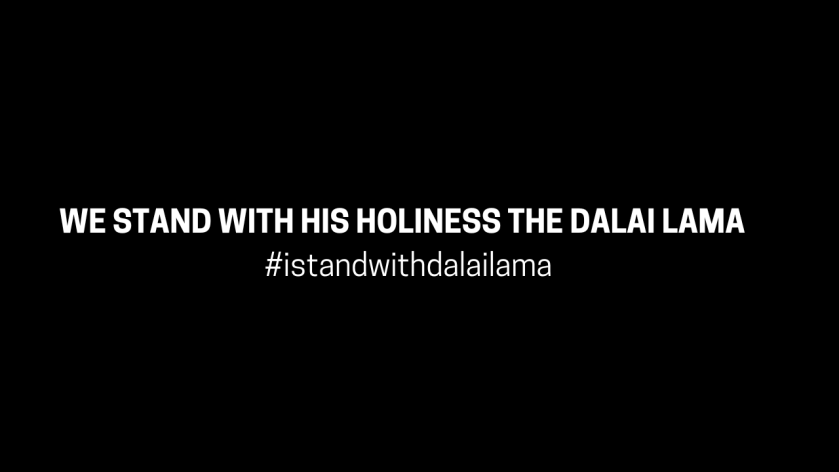
WE STAND WITH HIS HOLINESS THE DALAI LAMA

#istandwithdalailama

We are Tibetan leaders and activists writing to address the media storm surrounding His Holiness the Dalai Lama. 

Language, culture, and context define how people view any given situation. For Tibetans who see the video clip of the Dalai Lama’s interaction with a child at a public event in February, it is clear he is displaying his affection, warmth, and humor. It is through a lifetime of familiarity with the Dalai Lama that we understand his words and actions.

For some people who don’t know the Tibetan context, and especially because so many children suffer serious abuse at the hands of powerful people and religious institutions, the belief and assumption is that the act was malign and the child was harmed. We can say with absolute certainty that this is not what happened.

It is instructive to hear what the child and his family have said about their time with the Dalai Lama. The mother (seen sitting onstage next to the Dalai Lama) and the child both gave media interviews immediately after the event [footage available here]. While we know this won’t satisfy everyone with concerns, we hope their own words will help add some context and clarity to the question of how they feel about what happened.

What has been most painful for Tibetans and our allies is witnessing the rush to condemn the Dalai Lama. Any attempt to understand Tibetan culture, the full context of the exchange, and this nearly 90-year-old icon of global peace has been shockingly absent from most media coverage and online discourse.

The Dalai Lama has lived nearly all of his life in the public eye. He has engaged directly with countless thousands of people across the globe, and his life is remarkably unmarred by scandal or controversy—much to the chagrin of China’s leadership. On the contrary, he has done what few leaders of his stature do. He has welcomed and embraced change. He has willingly given up political power. He has campaigned for religious harmony. He has forgiven and seeks compromise with the same Chinese leaders destroying Tibet. 

As movement leaders and activists, we are not surprised to see a massive operation by Chinese government operatives and trolls working to drive and amplify this story, maximizing views and outrage in order to distort reality. Their aim is to destroy the reputation of the Dalai Lama and the movement for Tibetan freedom. 

There is no secret Dalai Lama. He is who we know him to be—an 87-year-old Buddhist monk who has devoted his life to teaching, practicing, and meditating on wisdom and compassion for the world. We are immensely proud of his legacy of selfless service to humanity, and we stand by him at this distressing time. 

Tibetans in Tibet need us to stay focused on exposing the reality of China’s genocidal, colonial occupation of our country. Tibet is one of the least free places on earth. China has forced and coerced one million Tibetan children into colonial boarding schools, millions of nomads off of their grasslands, and has terrorized countless people for having the Dalai Lama’s photo and praying for his long life. 

We will keep focused on fighting for Tibet’s freedom, and we will never give up. 

Long live His Holiness the Dalai Lama. Long live Tibet. 

Signatories:

Lhadon Tethong, Director, Tibet Action Institute, Boston, USA
Jigme Ugen, Executive Vice President, SEIU Healthcare Minnesota, Minneapolis, USA
Tenzin Tsundue, Poet, Writer, & Activist, Dharamsala, India
Bhuchung D. Sonam, Poet/Writer, Dharamshala, India
Dr. Lobsang Yangtso, Asia Program & Environment Coordinator, International Tibet Network, Dharamsala, India
Dorjee Tseten, Member of the Tibetan Parliament-in-Exile, Dharamsala, India
Lobsang Gyatso Sither, Member of the Tibetan Parliament-in-Exile, Mundgod, India
Lobsang Tseten, Program Associate, Students for a Free Tibet, New York, USA
Pema Yoko, Digital Media Specialist, London, UK
Rinzin Thonden Alling, Tibetan-American Youth Leader, New York, USA
Sherap Therchin, Executive Director, Canada Tibet Committee, Toronto, Canada
Tashi Lamsang, Activist & Former General Secretary, Tibetan Youth Congress, New York, USA
Tenzin Choedon, Manager of Educational Initiatives, Tibet Action Institute, Toronto, Canada
Tenzin Chokey, Activist, Dharamsala, India
Tenzin Dorjee, PhD Candidate, Columbia University, New York, USA
Tenzin Kunga, Advocacy Officer, Free Tibet, London, UK
Tenzin Kunsel Rinchen Dorjee, President, Students for a Free Tibet Rotterdam, Rotterdam, Netherlands
Tenzin Lekdhen, Campaign Director, Students for a Free Tibet India, Dharamshala, India
Tenzin Lobsang Wangkhang, Chartered Professional Accountant, Belleville, Canada
Tenzin Myinlek, Grassroots Director, Students for a Free Tibet, New York, USA
Tenzin Rabga Tashi, Digital Communications Officer, Free Tibet, London, UK
Tenzin Yangzom, Campaign Manager, Students for a Free Tibet, New York, USA
Topjor Tsultrim, Communications Director, Students for a Free Tibet, New York, USA
Tsering Passang, Founder and Chairman, Global Alliance for Tibet & Persecuted Minorities, London, UK
Ugyan Choedup, PhD Candidate, Pennsylvania State University, State College, USA
Youdon Tenzin Tsamoshang, Board Member, Students for a Free Tibet Canada, Toronto, Canada

Link: https://tibetaction.net/2023/04/14/we-stand-with-his-holiness-the-dalai-lama-istandwithdalailama/

“Don’t leap to judgment in a few seconds based on a doctored clip,” urges British Human Rights advocate on the recent viral video on Tibetan spiritual leader Dalai Lama

These past few days, Tibetans around the world were horribly distraught and hurt by the gross media onslaught against their Spiritual Leader His Holiness the 14th Dalai Lama, as the world almost watched in awe and disbelieve.

Lobsang Yeshi, a former Member of Tibetan Parliament-in-Exile and former Vice President of Tibetan Youth Congress, wrote: “None realised the truth that it was yet another vicious Chinese conspiracy to tarnish the impeccable image of the world’s most popular Peace Icon.”

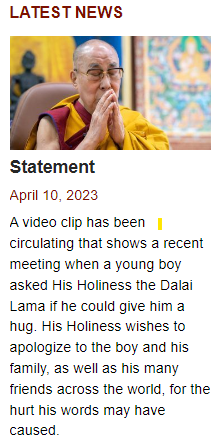
The Office of His Holiness the Dalai Lama released a written statement on its website on 10th April, after a cleverly spliced video clip went viral.

The Statement:

“A video clip has been circulating that shows a recent meeting when a young boy asked His Holiness the Dalai Lama if he could give him a hug. His Holiness wishes to apologize to the boy and his family, as well as his many friends across the world, for the hurt his words may have caused.

His Holiness often teases people he meets in an innocent and playful way, even in public and before cameras. He regrets the incident.”

Many Tibetan followers of the Nobel Peace laureate did not see the need to issue such a statement from the Dalai Lama’s Office as they believe that their spiritual leader had done nothing wrong.

Tsering Passang, Founder and Chair of the Global Alliance for Tibet & Persecuted Minorities, said: “This is clearly a deliberate attempt by China and its agents to tarnish the image of the Tibetan spiritual leader. They will also not succeed in their attempt to create a division between the people of India and the Tibetan refugees. They have attempted this with the Tibetans in Tibet and the ordinary Chinese people back in 2008-09. As followers of His Holiness the Dalai Lama we firmly believe in our spiritual leader and nobody can create the division they desired and hoped for. The truth will come out in due course. We condemn the perpetrators for their malicious act against our spiritual guru.”

Benedict Rogers, Chief Executive/cofounder, Hong Kong Watch; Senior Analyst at Christian Solidarity Worldwide (CSW), cofounder and Vice Chair of the Conservative Party Human Rights Commission, who recently met with the Dalai Lama, wrote:

Benedict Rogers and his colleague Dean Baxendale with the Dalai Lama Photo: Benedict Rogers

“People have asked why I am silent about the controversy regarding His Holiness the #DalaiLama, which broke just over a week after I had privilege of an audience with him I’ve decided to comment now, in this thread, because of my love for His Holiness and #Tibet.

I have a simple but profound principle – I try never to comment on something unless and until I feel confident that I understand the full picture and context. In our day and age, especially in the West, we’re too quick to speak and too slow to think & reflect & try to understand.

A good friend and mentor to me had an expression: “I want to have open ears, open eyes, an open mind and an open heart, before having an open mouth”. I think that’s a good principle to have.

I try neither to condone nor condemn until I have a full picture. So over recent days I’ve followed the reports carefully, and tried to respect the emotions both of those who have jumped up and down in outrage and condemnation and of #Tibetans who understandably feel insulted.

As much as the initial image and quote, especially to a Western ear in our over-sexualised, sensualised and hyper-sensitive environment, seems indeed deeply disturbing and distasteful, I tried – unlike some others – not to jump to wrong conclusions.

I felt confident that the quote and footage being circulated did not represent one of the world’s most spiritual, compassionate, courageous, inspiring religious leaders – and therefore I wanted to understand more before commenting.

I was also certain that the footage was being misused deliberately by #China‘s brutal, mendacious #CCP regime which would do anything to undermine, attack or destroy the credibility and reputation of those who shine a light on the truth, and no one more so than His Holiness.

I watched this video and I found it incredibly helpful.

To anyone who is willing to spend just over 17 minutes to try to understand, this is well worth watching – and watching until the very end:

So I would simply say: look at the entirety of the story, the entirety of the picture. Don’t leap to judgment in a few seconds based on a doctored clip. Take time to gain a fuller understanding.

And try to understand the truth about #China #CCP‘s illegal occupation and repression of #Tibet. And let’s increase our efforts to stand with #Tibetans and work to #FreeTibet.”

Mr Lobsang Yeshi, a former Member of Tibetan Parliament-in-exile and former Vice President of Tibetan Youth Congress, who lives in a refugee settlement in south India, wrote a piece on the subject. Tsamtruk.com is pleased to publish his perspective.

The Latest Chinese Conspiracy against the Dalai Lama foiled, again!

For the last few days, Tibetans around the world were horribly distraught and pained by the gross media onslaught against their Supreme spiritual leader His Holiness the Dalai Lama, as the world almost watched in awe and disbelieve. None realized the truth that it was yet another vicious Chinese conspiracy to tarnish the impeccable image of the world’s most popular Peace Icon.  

A reality check on the Origin of this Vicious Onslaught against the Dalai Lama:

Within weeks of the Public event held at The Dalai Lama’s Main Temple Yard in Dharamshala on 28th February, where His Holiness met with 120 students and members of M3M Foundation, also participated by sizable media contingent, a maliciously edited and tempered video on His Holiness’s interaction with the Indian boy was circulated across China and Tibet by the Chinese cyber army, the netizens and the CCP stooges. According to Tibetans inside Tibet and China, this video was circulated widely in Chinese social media, fanned extensively by CCP Government agencies. 

For over a month, Chinese sponsored cyber goons toiled rigorously inside Tibet and China to tarnish the image of Dalai Lama by indicting for ‘sexual misconduct’. 

While this was going on in China and Tibet, a fake Twitter account in the name of ‘Yin Sun@NiSiv4’, a fake Youtube Account in the name of Robert Reed and a fake Facebook account in the name of ‘Deter Influencers from Child Abuse’ were opened on February 2023, 1st April and 9th April simultaneously. 

The first post (dated April 8th) in the fake twitter account of ‘Yin Sun@NiSiv4’, was the upload of the video on His Holiness’s interaction with the Indian boy. Similarly the first and the only post on the fake facebook account of ‘Deter Influencers from Child Abuse’ was also that video and the only post or video uploaded on the fake youtube channel of Robert Reed was the same truncated video. Meanwhile the fake facebook account of ‘Deter Influencers from Child Abuse’ posted a petition titled, “Save kids from Dalai Lama — let’s stop child abuse” in the renowned public forum of Change.org on 7th April. The ‘sensational’ news was then fed to some of the popular Indian news media, launching the video as ‘viral’ without any verification and fact checking. 

Almost every other Indian media group joined this frenzied bandwagon in a massive and maddening cacophony, breaching every code of ethic for journalism. 

Later on 10th April evening, ‘Yin Sun@NiSiv4’ boasted in his twitter post that “the world decided after watching the video…I think most people will agree with me that his xxxx has weird customs…I ruined his reputation forever.”

With this single tweet, the CCP agent -Yin Sun had revealed the fact that the entire scheme was sponsored, orchestrated and coordinated by the Chinese stooges for the bosses in Beijing. This Conspiracy was evidently aimed exclusively to damage the pristine reputation of His Holiness the Dalai Lama. The current vilification propaganda from China unfolded as yet another failed attempt to sacrilege the divine being of His Holiness.  

For God Sake! It was just an affectionate Peck… a divine expression of love, warmth and concern.

Anybody watching the entire event would acknowledge the fact that it was a spontaneous, open and natural moment of joy, blessing and positive energy between the visitors and the Dalai Lama. The event concluded peacefully and pleasantly with the delegates taking a group photo with His Holiness. The boy expressed great joy for having met and hugged His Holiness. He later told the RFA reporters that, “I really wanted to meet His Holiness, It was really good experience. It is inexplicable how blessed you feel when you get blessed by Him and especially able to hug Him. And I seeing Him this near is a blessing itself. He is very positive and he has a lot of positive energy. Overall, it’s a very good experience.” 

Following the unwarranted upheaval, the parents of the boy are stated to have written a letter to the office of Dalai Lama “assuring that their faith and respect for His Holiness remain intact”. 

Yes, it is a sad reality that we are living in an era, where even parents are trolled and condemned for a caring kiss and a peck on their children. We cannot forget how Victoria and David Beckham as well as Bollywood actor Chhavi Mittal were ruthlessly trolled for exhibiting photos of kissing their children in a loving gesture. Unfortunately, Tibetan people are expressive in love and concern for their children and siblings. His Holiness is particularly known for His warm and caring greetings and for the pure divine presence. Millions of visitors can vouch for the warmth, love and sanctity His Holiness embodies. 

Emphasising on the need of love and compassion, His Holiness often says that, “there is the critical period of brain development from the time of birth up to at least the age of three or four, during which time loving physical contact is the single most important factor for the normal growth of the child. If the child is not held, hugged, cuddled, or loved, its development will be impaired, and its brain will not mature properly. Since a child cannot survive without the care of others, love is its most important nourishment. Nowadays, many children grow up in unhappy homes. If they do not receive proper affection, in later life they will rarely love their parents and, not infrequently, will find it hard to love others. This is very sad”. 

Lo and Behold, now that the complete video-clip of the event were out in public domain, many prominent personalities have acknowledged mistake and offered apology for their trolls and criticism of His Holiness. Now that the mist have cleared and sanity returned, it’s time that the irresponsible Media houses undo the mess it has created in Haste and Apologize for the Blasphemous Onslaught on the character of His Holiness, and for Hurting the sentiments of millions of Tibetans, Buddhist followers and admirers of the Dalai Lama around the world.

While the world has the Dalai Lama, let’s cherish and Save Him from the Chinese Predators! Tibetans have been wronged many occasions, let’s not allow another! 

Peace, Love & Hugs!

Lobsang Yeshi, a Tibetan in Exile

China “continues to erode Hong Kong’s judicial independence and the rule of law”, says US Secretary of State

In his latest Press Statement on 31st March 2023, US Secretary of State Anthony J. Blinken said that the People’s Republic of China (PRC) “continues to erode Hong Kong’s judicial independence and the rule of law”.

The US top diplomat said, “This past year, PRC and Hong Kong authorities have further criminalized dissent, undermining the human rights and fundamental freedoms of people in Hong Kong and dismantling the city’s promised autonomy”.

The Hong Kong Policy Act report, which was released earlier today, documents “the facts of PRC and Hong Kong authorities’ ongoing crackdown on civil society, media, and dissenting voices”.

Blinken further added, “The Hong Kong government has persisted in its enforcement of the National Security Law and wielded a sedition law to silence perceived critics – with more than 1,200 people reportedly detained for their political beliefs, many of whom remain in pre-trial detention.

“We urge PRC authorities to restore Hong Kongers their protected rights and freedoms, release those unjustly detained or imprisoned, and respect the rule of law and human rights in Hong Kong.”

(See below for the full report.)

2023 Hong Kong Policy Act Report

REPORT

BUREAU OF EAST ASIAN AND PACIFIC AFFAIRS

MARCH 31, 2023

Consistent with sections 205 and 301 of the United States-Hong Kong Policy Act of 1992 (the “Act”) (22 U.S.C. 5725 and 5731) and section 7043(g)(3)(C) of the Department of State, Foreign Operations, and Related Programs Appropriations Act, 2023 (Div. K, P.L. 117-328), the Department submits this report and the enclosed certification on conditions in Hong Kong from April 2022 through January 2023 (“covered period”).

Summary

The Department of State assesses that during the covered period, the central government of the People’s Republic of China (PRC) took new actions directly threatening U.S. interests in Hong Kong and that are inconsistent with the Basic Law and the PRC’s obligation pursuant to the Sino-British Joint Declaration of 1984 (“Sino-British Joint Declaration”) to allow Hong Kong to enjoy a high degree of autonomy. There remain differences between Hong Kong and mainland China in some areas, including commercial and trade policy, internet freedoms, and freedom of religion, but PRC and Hong Kong authorities continued to use “national security” as a broad and vague basis to undermine the rule of law and protected rights and freedoms and continued to stymie any progress toward universal suffrage in elections for Hong Kong’s Chief Executive and Legislative Council as set out in Hong Kong’s Basic Law. In the Certification of Hong Kong’s Treatment under United States Laws, the Secretary of State certified Hong Kong does not warrant treatment under U.S. law in the same manner as U.S. laws were applied to Hong Kong before July 1, 1997.

During the covered period, PRC authorities continued to deny people in Hong Kong the ability to play a meaningful role in the city’s governance, including for the first time permitting only one candidate to run for Hong Kong Chief Executive. Hong Kong authorities, under the supervision of the PRC central government, continued to use the National Security Law (NSL) that the central government imposed on Hong Kong in June 2020 to further erode the rule of law in Hong Kong and the human rights and fundamental freedoms of people in Hong Kong. In December 2022, the PRC National People’s Congress Standing Committee (NPCSC) issued its first “interpretation” of the NSL stating that the Chief Executive and Committee for Safeguarding National Security in Hong Kong have the authority to issue legally binding certificates and decisions on issues related to national security that are not subject to judicial review. According to legal experts, this interpretation could significantly increase the authority of Hong Kong’s executive branch over the judiciary.

Hong Kong authorities continued to arrest and prosecute people for peaceful political expression critical of the local and central governments, including for posting and forwarding social media posts. While Internet access remained widespread and generally open, local authorities criminally charged people engaged in online political speech.

Authorities continued to reportedly undermine the rights of defendants in cases designated as involving national security, including by denying them bail and subjecting them to lengthy periods of pretrial detention; stripping them of the right to a trial by jury under domestic law and requiring that their cases be overseen by a judge specially designated by the Beijing-endorsed Chief Executive to hear national security-related cases; and restricting their choice of legal counsel. In cases where authorities assert a nexus with national security, there is little to no expectation of a fair trial or associated fair trial guarantees and other applicable legal protections.

Hong Kong and PRC authorities continued to target civil society groups, media companies, activists, journalists, political parties, labor unions, and other individuals and organizations that they accused of being connected to Hong Kong’s prodemocracy movement or otherwise critical of the local or central government. Authorities arrested Cardinal Joseph Zen, the former Catholic Bishop of Hong Kong, and other trustees of a now-dissolved humanitarian fund that supported individuals arrested or injured during the 2019 pro-democracy protests, on suspicion of “collusion with foreign forces.” In a separate but related case, Zen and the fund’s other former trustees were convicted and fined for failing to register the fund as a society, in what the defendants described as an infringement of their freedom of association.

Hong Kong officials prosecuted editors and executives of now-closed media outlets Apple Daily and Stand News, including Apple Daily founder Jimmy Lai, for alleged national security-related offenses, and accused Stand News of sedition for publishing news articles related to pro-democracy politicians. Authorities continued to employ legal procedures under the NSL in cases with non-NSL charges, such as sedition and commercial fraud. Independent media outlets continued to close, citing Hong Kong’s restrictive political environment. Under direction from the PRC, Hong Kong authorities continued to restrict political expression in schools and universities, impose “national security education” in all publicly funded institutions, and penalize teachers and academics who expressed dissenting opinions.

The UN Human Rights Committee, during its periodic review of Hong Kong’s compliance with its obligations under the International Covenant on Civil and Political Rights (ICCPR), urged Hong Kong and PRC authorities to repeal the NSL and the Hong Kong sedition law and to ensure that any new national security legislation conforms with the ICCPR and is passed via an inclusive and transparent legislative process.

Impact on Democratic Institutions and Universal Suffrage

During the covered period, PRC and Hong Kong authorities deliberately acted to restrict the ability of Hong Kong voters to elect representatives of their choosing, and PRC officials played an unprecedented role in directing the outcome of the Hong Kong elections. In May 2022, John Lee was the sole candidate for Chief Executive of Hong Kong after the PRC central government indicated that it would not support any other nominations. Only the 1,500 members of the Hong Kong Election Committee, a body consisting almost entirely of Beijing loyalists, were eligible to vote on Lee’s candidacy, despite provisions in the Basic Law that describe the election of the Chief Executive via universal suffrage as the “ultimate aim.”

Pro-Beijing lawmakers occupied all but one of the 90 seats in the Legislative Council during the covered period, after electoral changes in 2021 drastically reduced the number of seats filled by direct election and required all candidates running for the Council to receive the approval of the Beijing-dominated Hong Kong Election Committee. Hong Kong authorities took no actions during this period to advance the election of all members of the Legislative Council by universal suffrage, which, as with the election of the Chief Executive, the Basic Law also describes as its “ultimate aim.” Activists and local media reported that since the electoral changes, the Legislative Council has become less responsive to public input, particularly from marginalized and underrepresented groups.

Impact on Police and Security Functions

Hong Kong authorities used the NSL, which the National People’s Congress Standing Committee (NPCSC) imposed on Hong Kong in June 2020, to conduct politically motivated arrests and prosecutions against people and groups expressing views critical of the PRC or Hong Kong authorities or affiliated with the pro-democracy movement. During the covered period, based on publicly available information, authorities arrested at least 38 people in connection with alleged offenses that Hong Kong authorities designated as involving “national security,” including pursuant to the colonial-era statute on “sedition” and the offenses listed in the NSL (secession, subversion, terrorist activities, and collusion with a foreign country or external elements to endanger national security). According to open source reports, authorities filed charges against at least 13 individuals in connection with alleged “national security”-designated offenses. During the covered period, at least eight individuals were found guilty of violating the NSL or the sedition statute at trial, and none were acquitted, while at least 30 individuals pled guilty to violating the NSL or the sedition statute. In addition, 31 of the 47 politicians and activists charged with conspiracy to commit subversion for their involvement in the July 2020 unofficial pan-democratic primary election indicated that they plan to plead guilty to that charge. With few exceptions, the individuals arrested and prosecuted were exercising freedoms guaranteed in the Basic Law and recognized in the ICCPR.

The NSL grants the Hong Kong Police Force (HKPF) broad authorities to conduct wiretaps, electronic surveillance, and searches without warrants in national security-related cases, and to require internet service providers to provide or delete information relevant to these cases. During the covered period there were credible reports that PRC security services and the Office of Safeguarding National Security (OSNS) monitored pro-democracy and human rights activists and journalists in Hong Kong.

During the UN Human Rights Committee’s periodic review of Hong Kong’s compliance with its obligations under the ICCPR in July 2022, the experts on the committee wrote that they are “deeply concerned” that the NSL prevails over Hong Kong local laws and thus “overrides fundamental rights and freedoms protected by the Covenant.” They also wrote that the committee is “deeply concerned about the overly broad interpretation of and arbitrary application” of the NSL. The committee urged Hong Kong and PRC authorities to repeal the NSL and Hong Kong’s sedition law and to ensure that any new national security legislation conforms with the ICCPR and is passed via an inclusive and transparent legislative process.

Impact on Judicial Independence and the Rule of Law

The Sino-British Joint Declaration, as well as Hong Kong’s Basic Law, provide for an independent judiciary, but during the covered period PRC and Hong Kong authorities repeatedly took actions that eroded the judiciary’s independence and ability to uphold the rule of law in cases that Hong Kong authorities designated as involving national security.

The NSL states the NPCSC — not Hong Kong courts — has the power to interpret the NSL, and any such interpretations are not subject to review in Hong Kong’s courts. In November 2022, Chief Executive John Lee requested the NPCSC to issue an inaugural interpretation addressing whether defendants in national security-related cases may be represented by foreign lawyers not ordinarily licensed to practice in Hong Kong. Commentators described Lee’s request as intended to overturn Hong Kong courts’ decisions that Apple Daily founder Jimmy Lai was entitled to be represented in his upcoming trial for alleged “foreign collusion” by UK-based lawyer Timothy Owen. In December 2022, the NPCSC issued an interpretation stating that the Chief Executive has the authority to issue “certificates” designating whether any act involves national security or any evidence involves state secrets, and that the Committee on Safeguarding National Security (a body established by the NSL that is chaired by the Chief Executive and reports directly to Beijing) can make “judgments and decisions” on issues related to national security that are not subject to judicial review. The interpretation effectively empowers the Hong Kong executive branch to overturn or preempt judicial decisions related to national security, which experts noted can include topics such as finance, culture, or energy.

In 2021, the Hong Kong government removed defendants’ right to choose their own legal counsel in cases where they receive government-funded legal aid. Instead, the Hong Kong Legal Aid Department assigns lawyers to these cases. Activists reported that the changes could lead defendants in these cases to be represented by lawyers who do not specialize in the issues at stake in the case or who may be susceptible to influence from Hong Kong authorities. Some defendants in NSL cases reportedly declined legal aid during the covered period for this reason, instead paying to hire their own lawyers or choosing to represent themselves.

Under the NSL, defendants charged with national security-related offenses may not be granted bail unless a judge has sufficient grounds to believe the defendant or suspect will not continue to commit acts endangering national security. This is a higher standard than in normal criminal cases, with the burden shifted onto the defendant. A report from the Center for Asian Law at Georgetown Law School described this standard as “an impossibly high bar that most defendants cannot overcome,” while a report from the UK-based organization Hong Kong Watch found that approximately three quarters of the individuals charged with these offenses since 2020 were denied bail. Under this higher threshold for bail, many defendants charged under the NSL remain in custody months or years after their initial detention. In several cases during the covered period, pro-democracy activists were denied bail and detained for longer than the maximum sentence of the charge for which they were accused. Some human rights groups called pre-trial detention in national security-designated cases a “form of indefinite detention without trial.”

Local authorities implemented an NSL provision requiring that the Hong Kong Chief Executive establish a list of judges to handle any cases concerning national security-related offenses. Although Hong Kong’s judiciary selects the specific judge(s) from this list to hear any individual case, legal scholars argued this unprecedented involvement of the Chief Executive weakens Hong Kong’s judicial independence. During the covered period, Hong Kong authorities continued to refuse to disclose the membership of this list of judges or the criteria under which they were selected.

Under the NSL, Hong Kong authorities may direct that a panel of three specially designated national security judges will hear a case instead of a jury. During the covered period, the Hong Kong Secretary for Justice ordered that at least three such national security-related cases be heard in front of such a panel instead of a jury. These include the cases of the 47 politicians and activists charged with subversion for their involvement in the 2020 unofficial pan-democratic primary election; of Apple Daily founder Jimmy Lai; and of three former leaders of the Hong Kong Alliance in Support of Patriotic Democratic Movements of China, which organized the city’s formerly annual June 4 Tiananmen Square massacre vigil with the permission and consent of the Hong Kong government.

The NSL provision that authorizes the Office for Safeguarding National Security to exercise jurisdiction over a case and for the Supreme People’s Court in mainland China to designate a court to adjudicate it was not used during the covered period.

During the covered period, two local media outlets that act under the direction of the PRC central government’s liaison office in Hong Kong targeted lawyers for alleged connections to Hong Kong’s pro-democracy movement, including for representing prominent activists in court. In April 2022, human rights lawyer Michael Vidler departed Hong Kong after these newspapers in Hong Kong accused him of being a “black hand anti-China lawyer.” Vidler subsequently told the media that he saw the reports as a “call to action by the national security police.” In multiple cases since the imposition of the NSL, following reports of this type, Hong Kong police have arrested the targets of the accusations.

Impact on Freedom of Speech or Expression

Hong Kong law provides protections for freedom of speech, but the government arrested and prosecuted individuals under the NSL or sedition law for speech critical of the PRC or local governments or their policies, including on social media. Hong Kong officials characterized this type of speech as “inciting hatred against the government” or “promoting feelings of ill will or enmity between different classes.” During the covered period, individuals were charged with sedition for merely forwarding social media posts containing slogans related to the 2019 pro-democracy protest movement, including “Liberate Hong Kong, Revolution of Our Times,” which prosecutors argued contained an inherent meaning of support for Hong Kong independence.

In July 2022, activist Koo Sze-yiu was convicted of “attempted sedition” for planning to stage a protest against the Beijing Winter Olympics outside the PRC central government’s liaison office in Hong Kong. During Koo’s trial, prosecutors argued that Koo had brought “hatred and contempt” against the PRC and Hong Kong governments. The presiding judge sentenced Koo to nine months in prison, ruling that slogans critical of the NSL that Koo planned to use during the protest could “weaken people’s confidence in the judicial administration.”

In October 2022, a court convicted two people of sedition for disrupting the proceedings in a January 2022 court hearing by applauding the defendant in that case. One of those two people, Protestant pastor Garry Pang, was convicted of a second charge of sedition for uploading videos to YouTube between 2020 and 2022 in which he commented on proceedings in Hong Kong’s courts. Pang was sentenced to twelve months in prison for the two charges.

Hong Kong legislation also prohibits acts deemed to abuse or desecrate the PRC flag or anthem, including acts online, as well as inciting others not to vote in elections or to cast blank ballots. During the covered period, the Hong Kong government regularly arrested and prosecuted individuals under this legislation. For example, in November 2022, an individual was sentenced to three months in prison after pleading guilty to insulting the anthem. In December 2022, an individual was given a two-month suspended prison sentence for sharing a Facebook post from an overseas activist calling for voters in the December 2021 Legislative Council election to submit blank ballots.

Hong Kong authorities also arrested and prosecuted individuals for publishing books that they claimed included “seditious content.” In September 2022, a court sentenced five leaders of the now-dissolved General Union of Speech Therapists to 19 months in prison for publishing a series of children’s picture books that purportedly referred to the 2019-2020 protest movement. Prosecutors claimed that the books were an attempt to “infiltrate [children’s minds with] seditious ideology,” and officials earlier accused the books of “poisoning” children against the local and central governments. In January 2023, police arrested six people on suspicion of sedition for allegedly publishing and selling a book about the 2019-2020 protest movement.

In July 2022, local media reported that the annual Hong Kong Book Fair, organized by the government’s trade promotion body, did not allow three independent publishers, who published content about the city’s pro-democracy movement, to participate. The publishers claimed the decision was politically motivated. According to media reports, the book fair did not contain any books discussing sensitive topics, including Hong Kong’s 2019 pro-democracy protests or the 1989 Tiananmen Square massacre.

Under Hong Kong law, authorities can revoke a film’s license if it is “found to be contrary to national security interests.” Those who present an unlicensed film are liable for up to three years’ imprisonment. In August 2022, Hong Kong’s Office for Film, Newspaper, and Article Administration denied public screening permission to a short film, Losing Sight of a Longed Place, containing a brief scene showing a protest during Hong Kong’s 2014 Umbrella Movement.

Impact on Freedom of the Press

The Basic Law provides for freedom of the press, which is also guaranteed under the Sino-British Joint Declaration, but PRC and Hong Kong authorities repeatedly violated this freedom. Hong Kong authorities targeted media that expressed views or reported news it construed as not pro-government. A poll jointly conducted by the Hong Kong Public Opinion Research Institute, an independent polling firm, and the Hong Kong Journalists Association (HKJA) found that 97 percent of respondents said press freedom had gotten “much worse” in the past year, with “the government” cited by 93 percent of respondents as the cause. Reporters Without Borders ranked press freedom in Hong Kong in 2022 at 148 out of 180 countries and territories assessed, dropping from 80 out of 180 in 2021. Reports of media self-censorship and suspected content control continued.

Hong Kong authorities continued the prosecution of former editors and executives of now-closed independent media outlets Apple Daily and Stand News under Hong Kong’s sedition law, and also prosecuted Jimmy Lai and other former Apple Daily executives and editors under the NSL. During the trial of two former Stand News editors in December 2022 and January 2023, prosecutors argued that the newspaper committed sedition by publishing articles about and commentaries by prominent pro-democracy political figures, including candidates in the 2020 unofficial pan-democratic primary election and former lawmakers now in exile overseas. One of the defendants, former Stand News chief editor Chung Pui-kuen, testified that the media outlet included articles featuring both pro-Beijing and pro-democracy viewpoints. Chung argued that the media had the responsibility to cover newsworthy events like the 2020 unofficial pan-democratic primary election, even if the election was later “criminalized.” The trial continued through the end of the covered period.

During the covered period, six former Apple Daily executives pled guilty to sedition and collusion with foreign forces, an offense under the NSL, while Apple Daily founder Jimmy Lai pled not guilty. Lai’s trial on the sedition and collusion charges is scheduled to begin in September 2023. In August 2022, in preliminary motions related to these charges, a court ruled that police may search the content of two of Lai’s mobile phones. Lai had argued that the mobile phones contained journalistic materials, which are protected under Hong Kong law, but the court ruled that the NSL grants police additional powers to investigate offenses that overrule local law. An appeals court affirmed the ruling.

In October 2022, Lai was convicted of two counts of fraud related to a lease agreement for office space and was subsequently sentenced to five years and nine months in prison. Pro-democracy activists described the prosecution as part of a harassment campaign by Hong Kong authorities and noted that Lai’s alleged offense, subletting a small amount of office space, would historically have been resolved through civil courts or with a small fine rather than a prison sentence. In January 2023, Lai’s company Next Digital, the parent company of Apple Daily, was delisted from the Hong Kong Stock Exchange after Hong Kong authorities earlier froze the company’s assets using the NSL and ordered it liquidated.

In December 2022, a freelance journalist was sentenced to 15 months in prison for “possession of offensive weapons” (i.e., a multipurpose knife and laser pointer) after being arrested while filming a protest in November 2019 on assignment for a Taiwan-based media outlet.

PRC and Hong Kong officials, as well as Beijing-controlled media, repeatedly criticized the HKJA during the covered period and accused the organization of potential NSL violations. In April 2022, the HKJA held a special meeting to discuss the possibility of disbanding, citing growing safety concerns for the association and its members. The International Federation of Journalists released the Hong Kong Freedom of Expression Report in October 2022. This assessment of press freedom was previously published by the HKJA. In September 2022, police arrested HKJA chairperson Ronson Chan and charged him with obstructing police officers. Two plainclothes police officers reportedly asked Chan to show his identity card while he was reporting on a story. Chan allegedly asked to see their badges, after which the police arrested him.

Three political cartoonists emigrated from Hong Kong between April and June 2022, publicly citing concerns that the authorities might arrest them for their work. Several political commentators left their positions or Hong Kong entirely during the covered period, citing NSL-related fears. Local media reported in November 2022 that the Trust Project, an international group promoting greater accountability and transparency in news, froze its Hong Kong operations citing Hong Kong’s difficult environment for news. In October 2022, local media reported that two reporters and an editor resigned from a high-profile English-language daily in 2021 following the decision by senior executives to ax a multi-part series on human rights violations in the PRC’s Xinjiang region.

In April 2022, for the first time in 26 years, the Foreign Correspondents’ Club of Hong Kong (FCC) announced the suspension of its annual Human Rights Press Awards to avoid potential legal liability under the NSL. Media reported that Stand News would have received prizes at the ceremony. The Hong Kong government described an October 2022 FCC board statement expressing concern about the arrest of HKJA chairperson Ronson Chan as “slander.” In November 2022, the Hong Kong government renewed the FCC’s lease for its current premises, but added new clauses related to “national security” that if violated threaten to terminate the lease.

In June 2022, investigative online news outlet FactWire announced its closure, becoming the tenth Hong Kong news outlet to close since the imposition of the NSL. FactWire cited the “great change” for Hong Kong media in recent years as the reason for its closure.

During the covered period, Hong Kong authorities sent hundreds of complaint letters to foreign news outlets. These letters cited the outlets’ articles and editorials about the Hong Kong government, the NSL, and major events in Hong Kong. Often under the name of the Chief Executive or other high-level officials, the letters characterized the reporting and editorials as “grossly biased” or as containing “groundless accusations.”

As noted in previous reports, the Department of State has no information indicating Hong Kong agents, persons, or entities were involved in the extrajudicial surveillance, abduction, detention, or forced confessions of certain booksellers and journalists.

Impact on Internet Freedoms

Hong Kong authorities did not generally disrupt open access to the Internet, but there were numerous reports that Hong Kong authorities, exercising powers granted by the NSL, required private companies to block access to certain websites, provide user information, and remove political content. For example, in October 2022, authorities blocked access from within Hong Kong to the website of the U.S.-based Hong Kong Democracy Council.

While internet access remained widespread and generally open, local authorities charged individuals who engaged in online political speech, and otherwise deterred free speech online and in electronic communications. The NSL and its implementing regulations grant extensive powers to police to order the blocking and removal of content by message publishers, platform service providers, hosting service providers, and network service providers. Police can also intercept communications or conduct covert surveillance upon approval of the Chief Executive. When investigating NSL violations, police may also require a person who published information or opinions or the relevant service provider to provide information on the end users. In July 2022, the League of Social Democrats, a pro-democracy opposition party, announced that “under great pressure, [it] was forced to delete online posts that were allegedly violating the National Security Law.”

In August 2022, police arrested two administrators of the “Civil Servant Secrets” Facebook page on suspicion of violating the sedition law by publishing posts on the page that “promote feelings of ill-will and enmity.” Following the arrests, local media reported that at least eight similar Facebook pages, which allowed employees of certain government agencies or students at certain universities to post anonymously, shut down for fear of similar arrests. Local experts described the arrests as reinforcing self-censorship among Hong Kong residents. Local authorities also arrested and prosecuted individuals for sedition because of messages on social media (see above), including Facebook, Telegram, and other platforms.

Under Hong Kong anti-doxing laws, local officials have the authority to fine online platforms that do not comply with user information or content takedown orders and to arrest their Hong Kong-based staff.

In December 2022, Hong Kong officials requested that Google manipulate its search results for the phrase “Hong Kong national anthem” to place the PRC anthem ahead of the 2019 pro-democracy protest song “Glory to Hong Kong,” indicating that there could be legal consequences for Google if it did not comply. At the time of writing this report, Google had not complied. Similarly, in May, Hong Kong officials discussed a complete ban on Telegram, an electronic messaging application that was popular among pro-democracy activists, following the sentencing of an administrator of a pro-democracy Telegram group to 6.5 years. As of the end of the covered period, Hong Kong officials had taken no public actions against Google or Telegram.

In December 2022, the Hong Kong government launched a three-month public consultation on crowdfunding regulations that would require all crowdfunding campaigns to receive prior government approval. Hong Kong prodemocracy groups and activists have relied on crowdfunding to support their activities and for protest-related legal and medical expenses. In October 2022, an online radio host reached a plea agreement of 2 years and 8 months along with an over 600,000 USD asset seizure, for charges that included multiple counts of money laundering based on his calls to support crowdfunding efforts to provide for protestors’ living expenses.

Impact on Freedom of Assembly

Hong Kong law provides for protection of freedom of assembly, but Hong Kong authorities violated this right during the covered period, especially for individuals and organizations associated with the pro-democracy movement. Under Hong Kong law, organizers of public meetings and demonstrations are required to apply for a “letter of no objection” from police, but the police did not issue any such letters to groups not affiliated with the PRC or Hong Kong governments during the covered period, effectively banning all protests. Authorities cited COVID-19 restrictions to refuse authorization for assemblies, although civil rights organizations said the intent of the denials was aimed at preventing political gatherings rather than promoting public health.

According to media reports, no NGO applied to hold a public protest at least through October 2022. No organization applied to hold a public event to commemorate the June 4 anniversary of the 1989 Tiananmen Square massacre. Police arrested at least six people on June 4, 2022, in what media described as an effort to thwart attempts to commemorate the event.

Hong Kong authorities continued to prosecute activists, opposition politicians, and individuals for their involvement in the 2019 pro-democracy protest movement. As of October 2022, authorities arrested 10,279 individuals since 2019 in relation to the protests, according to Hong Kong government statistics, of which 2,915 had completed judicial proceedings and 1,391 were convicted. Activists argued that many of those convicted of crimes like rioting, unlawful assembly, or possession of offensive weapons were not themselves involved in violence but were merely prosecuted because of their attire and presence at protests that later turned violent. In December 2022, Hong Kong Secretary for Security Chris Tang said that Hong Kong police had almost concluded investigations regarding about 6,000 people arrested but not charged in relation to the protests and would inform them “within weeks” whether they would be charged. As of the end of the covered period, Hong Kong authorities had not made any further announcements regarding this group.

In December 2022, an appeals court overturned the conviction of Chow Hang-tung, the former vice chair of the Hong Kong Alliance in Support of Patriotic Democratic Movements of China, for inciting others to commemorate the anniversary of the June 4 Tiananmen Square massacre in 2021. The court ruled that police erred in prohibiting the 2021 assembly without considering whether it could permit the assembly by imposing conditions to protect public health. Hong Kong authorities appealed the ruling.

In June 2022, the chairwoman of the League of Social Democrats, a pro-democracy opposition party, told media that police warned at least six league members not to hold any protest activities on July 1, 2022 — the 25th anniversary of Hong Kong’s handover to the PRC. The league subsequently announced it would not hold any protests on July 1.

Impact on Freedom of Association

PRC and Hong Kong authorities disregarded freedom of association as enshrined in the Basic Law and the ICCPR. PRC and Hong Kong authorities continued to use threats, investigations, arrests, asset freezes, and other actions to force the closure of groups they deemed a “national security” concern for their involvement in the pro-democracy movement. A June 2022 Amnesty International report stated that nearly 100 civil society organizations disbanded or relocated since the imposition of the NSL. Many groups cited increasing legal risks following the imposition of the NSL.

Hong Kong authorities continued to use the NSL, the Societies Ordinance, and the Trade Union Ordinance to repress independent unions and other civil society groups. During the covered period, according to Amnesty International, the government’s Registrar of Trade Unions reportedly conducted investigations into at least four labor unions and professional associations, including the Hong Kong Journalists Association and the Hospital Authority Employees Alliance, as to whether their activities were in line with the Trade Union Ordinance and the unions’ constitutions. In June 2022, the Hospital Authority Employees Alliance announced it would disband, stating that it faced “political opposition.” In September 2022, the Registrar of Trade Unions announced that any newly registered unions must declare that they will not engage in any acts or activities that “may endanger national security.”

Under the regulations implementing the NSL, Hong Kong police may require any group that is considered a “foreign agent” to provide information on its activities, personnel, and finances, with a maximum prison sentence of six months for failure to comply. During the covered period, Hong Kong authorities prosecuted three former leaders of the Hong Kong Alliance in Support of Patriotic Democratic Movements of China for failing to comply with a notice to provide this information. Prosecutors maintained that the Alliance was a “foreign agent” because it either gave to or received funds from at least six foreign organizations and individuals. The former leaders argued that the Hong Kong Alliance was not a foreign agent and so had no obligation to comply. Chow Hang-tung, the former vice chair of the Hong Kong Alliance and one of the defendants in the case, pointed out that the funds it received from one of these foreign organizations was used to purchase a property to house a now-closed museum on the June 4 Tiananmen Square massacre and amounted to a quarter of one percent of the money used for the purchase. The court is scheduled to issue a verdict in the case in March 2023.

In May 2022, acting under the NSL, police arrested the five former trustees of the now-dissolved 612 Humanitarian Fund, which provided financial and legal assistance to individuals arrested or injured during the 2019 pro-democracy protests, on suspicion of conspiracy to collude with foreign powers under the NSL, and for failing to register the fund as a “society” under Hong Kong’s Societies Ordinance. The five included former lawmakers Margaret Ng and Cyd Ho, prominent activist Denise Ho, academic Hui Po-keung, and retired Catholic Bishop of Hong Kong Joseph Cardinal Zen. They and the fund’s former secretary were subsequently found guilty and fined approximately $500 each for violating the Societies Ordinance, which their lawyers for the defendants argued was an unconstitutional infringement on their right to association. In December 2022, the five filed an appeal against their convictions. They have not been formally charged with conspiracy to collude with foreign powers but remain under investigation and unable to travel without court approval.

Beijing-controlled media outlets in Hong Kong regularly accused organizations, including political parties and civil society groups, of being “anti-China” or violating the NSL because of their political opinions. In July 2022, these media outlets accused the opposition Democratic Party of planning to use a fundraising gala to spread “anti-China messages.” In August 2022, they accused 11 environmental organizations of supporting protesters during the 2019 prodemocracy protests.

In July 2022, Hong Kong government officials refused to state if Hong Kong-based civil society organizations could be prosecuted under the NSL for participation in the UN Human Rights Committee’s periodic review of Hong Kong’s compliance with the ICCPR.

Impact on Freedom of Movement

Hong Kong law provides for freedom of movement, including internal movement, foreign travel, emigration, and voluntary return, but during the covered period the government restricted this right for certain individuals. Hong Kong law enforcement nevertheless continued to use a provision of the NSL to seize travel documents from democracy activists and opposition politicians arrested under the NSL, even without filing charges.

According to local media reports, Hong Kong authorities maintain an exit ban “watchlist” of residents who will be intercepted if they attempt to leave Hong Kong. In May 2022, police arrested cultural studies scholar Hui Po-keung, a former trustee of the 612 Humanitarian Fund, as Hui was preparing to leave the city.

There were reports that authorities denied entry to individuals based on perceived links to the 2019 pro-democracy protests, international human rights organizations, or journalists seen as critical of the Hong Kong government. In December 2022, Hong Kong authorities denied entry to a Japanese freelance photographer who had previously hosted an exhibition of photographs taken during Hong Kong’s 2019 prodemocracy protests. The photographer stated that immigration authorities interrogated her about the exhibition before denying her entry to Hong Kong.

Impact on Education and Academic Freedom

During the covered period, Hong Kong authorities, under direction from the PRC, continued to restrict political expression in schools and universities and to threaten or penalize teachers and academics who expressed dissenting opinions.

In accordance with the NSL, the Hong Kong Education Bureau has implemented a national security education curriculum at all grade levels in government-funded schools, as well as, to a lesser extent, in international and private schools. Under Education Bureau guidelines, schools are required to prevent and suppress any curriculum and activities that are in breach of the NSL, the Basic Law, or other Hong Kong law; to limit political expression and activities on school campuses; and to support periodic reports regarding their implementation of “national security education.” In October 2022, fourteen high school students were suspended for three days for allegedly disrespecting the national anthem and PRC flag during a flag-raising ceremony. In December 2022, the Education Bureau published new guidelines for primary and secondary school teachers that bars them from encouraging speech that “violates the social order” and from promoting “biased values,” and requires teachers to have a “correct understanding” of the NSL.

As of the 2022-2023 academic year, all eight publicly funded universities in Hong Kong require undergraduate students, including international students, to complete mandatory “national security” courses to graduate, according to government documents. At least three private universities will also require the courses.

Public libraries, schools, and universities culled their holdings, including archives, to comply with the NSL. For example, in June 2022, media reported that several public high schools removed books from their libraries after the Hong Kong Education Bureau requested school authorities to review books that might violate the NSL. The University of Hong Kong required library users to register to access “politically sensitive” books.

Impact on Freedom of Religion or Belief

Hong Kong authorities generally respected freedom of religion or belief. During the covered period, most religious leaders and advocates stated the NSL did not negatively impact religious practitioners’ ability to worship in line with their religious norms and without government interference. However, religious leaders reported that they increasingly practice self-censorship, including by avoiding political topics in their sermons and not appointing clergy deemed to be critical of the government. Multiple Catholic Church leaders, including Bishop Stephen Chow, said the space for freedom of expression in Hong Kong was “diminishing.” In May 2022, the Catholic Diocese of Hong Kong announced that no Catholic Churches in the city would hold memorial masses for the victims of the 1989 Tiananmen Square massacre on June 4, citing concerns that the masses could violate the NSL. This was the first time since 1989 that no Catholic church in Hong Kong held such a memorial mass.

Hong Kong authorities arrested and prosecuted religious leaders for activities and nonviolent political expression related to the prodemocracy movement. In October 2022, Protestant pastor Garry Pang was convicted of violating the sedition law and sentenced to twelve months in prison (see above). In November 2022, former Catholic Bishop of Hong Kong Cardinal Joseph Zen was convicted of violating Hong Kong’s Societies Ordinance for his role as a trustee of the now-dissolved 612 Humanitarian Fund and fined about $500. Some religious leaders, including Zen himself, described these arrests as connected to these individuals’ political activities rather than their religious roles. However, activists and other religious figures expressed fears that the arrests could further discourage religious leaders and organizations from speaking out on political issues.

Impact on U.S.-Hong Kong Exchanges

U.S. institutions conduct a wide range of academic, cultural, educational, and scientific exchanges with Hong Kong counterparts. The COVID-19 pandemic paused most international programs on Hong Kong campuses as well as in-person, ECA-funded exchange programs with Hong Kong. International exchange programs have resumed on almost all Hong Kong campuses in the 2022-2023 school year and for many ECA-funded exchange programs.

Impact on U.S. Citizens

In 2021, an estimated 85,000 U.S. citizens lived in Hong Kong. However, that number is now estimated to be approximately 70,000. U.S. citizens departed Hong Kong in 2022 due to a variety of factors including COVID-19 mitigation policies and, for some teachers, the national security education policies that led to restrictions on academic freedom. Non-residents were not generally permitted to visit Hong Kong for much of 2022 due to COVID-19 travel restrictions. Once travel resumed, however, some U.S. citizens with ties to people or organizations that have been critical of the Hong Kong or PRC central governments were held and questioned by immigration authorities upon entering Hong Kong regarding their local contacts.  Since the imposition of the NSL in June 2020, the PRC increasingly exercised police and security power in Hong Kong, subjecting U.S. citizens who are publicly critical of the PRC to a heightened risk of arrest, detention, expulsion, or prosecution in Hong Kong. The Department of State has highlighted these risks to U.S. citizens in its travel advisories for Hong Kong. In January 2021, the HKPF arrested a U.S. citizen under the NSL, though he has not been detained or formally charged.

U.S.-Hong Kong Cooperation and Agreements

The United States and Hong Kong continue to maintain several bilateral agreements regarding issues such as taxation, parcel delivery, and air transportation services. In 2020, Hong Kong authorities notified the U.S. government of their purported suspension of an agreement concerning mutual legal assistance in criminal affairs. Subsequent official requests that the U.S. government made for mutual legal assistance under the UN Convention against Transnational Organized Crime and UN Convention against Corruption have had no success during the covered period, and the U.S. government made no new requests under these conventions during the covered period.  U.S. law enforcement had no engagement with the HKPF National Security Department, but U.S. law enforcement agencies continued to cooperate with other Hong Kong law enforcement counterparts to counter trafficking in persons, trade fraud, wildlife trafficking, child exploitation, drug trafficking, IPR theft, financial crimes, money laundering, and international terrorism.

Sanctions Engagement

The United States communicated with Hong Kong authorities through demarches and notifications on issues involving sanctions implementation, including actions taken by the Department of the Treasury against several Hong Kong-registered entities under sanctions authorities related to China and counterterrorism. In October 2022, Chief Executive John Lee told international media that Hong Kong would only implement UN sanctions, not “unilateral” sanctions such as U.S. designations.

Actions Taken by the U.S. Government

Since the imposition of the NSL, the U.S. government has imposed financial sanctions on 42 PRC and Hong Kong officials under E.O. 13936, 39 of whom were identified pursuant to section 5(a) of the Hong Kong Autonomy Act (HKAA) in connection with actions or policies that threaten the peace, security, stability, or autonomy of Hong Kong. Under Section 7 of the E.O., those designated for financial sanctions and their immediate family members are also subject to visa restrictions. The U.S. government did not impose sanctions on any new individuals under these authorities during the covered period. However, on December 9, on the eve of the UN Human Rights Day, the Department of Treasury designated a Hong Kong-based PRC citizen, Zhuo Xinrong, as well as Hong Kong-based companies under his control, for serious human rights abuses related to illegal, unreported, and unregulated fishing. On September 29, the Department of Treasury also sanctioned an international network of companies involved in facilitating financial transfers and shipping of Iranian petroleum and petrochemical products, including several front companies in Hong Kong.

In January 2023, President Biden directed the extension of Deferred Enforced Departure for Hong Kong residents physically present in the United States for another two years.

At various times during the covered period, in response to PRC and Hong Kong authorities’ actions, the United States issued statements, often with likeminded partners, raising concerns and calling for those authorities to respect Hong Kong’s promised high degree of autonomy. In July 2022, the Department of State released its annual Investment Climate Statement for Hong Kong, which highlighted the increased risks to U.S. business operations and activities as a result of the PRC’s actions to undermine Hong Kong’s autonomy and rule of law. The Department of Commerce also highlighted these risks in its 2022 Country Commercial Guide.

Officials from the U.S. Consulate General in Hong Kong and Macau regularly attended court hearings and trials of defendants charged with offenses designated as involving “national security.” The U.S. Consulate General in Hong Kong and Macau maintains a list, based on publicly available sources, of all individuals and organizations in Hong Kong arrested, charged, or found guilty in connection with offenses designated as involving “national security.”

Areas of Remaining Autonomy

Even though the PRC took repeated actions to erode the rights and freedoms it promised for Hong Kong under the Basic Law and the Sino-British Joint Declaration, there remained some differences between Hong Kong and mainland China, including in the areas of internet access, freedom of religion, and freedom of association.

Hong Kong continued to exercise authority in the implementation of commercial agreements and practiced free and open trade, with negligible tariff or non-tariff barriers. The Hong Kong legal system continued to be based on common-law traditions, though the continued enforcement of the NSL, as well as the NPCSC’s December 2022 interpretation of the NSL, raised serious concerns about the judicial system’s continued independence. Property rights were well-protected in law and practice. Hong Kong maintained its own currency, pegged to the U.S. dollar. The Hong Kong Monetary Authority set monetary policy autonomously from the People’s Bank of China, and Hong Kong’s financial regulators continue to act independently from their mainland China counterparts.

Hong Kong sets its own data regulations and does not have any broad data localization requirements. Under mainland China’s cross-border data transfer requirements, Hong Kong is considered outside of China and is treated the same as foreign jurisdictions.

Hong Kong appears to have wide latitude in setting policies on climate and green finance and the city has set climate disclosure requirements that are stricter than mainland China’s and aligned with international best practices.

Hong Kong continues to have a separate vote from mainland China in a number of international organizations and multilateral entities, including the Financial Action Task Force, the Asia-Pacific Economic Cooperation forum, the International Olympic Committee, and the World Trade Organization, and participates autonomously in various green finance multilateral fora. The extent to which PRC authorities influence Hong Kong votes and actions is unclear.

Export Controls

Since December 23, 2020, the Commerce Department’s Bureau of Industry and Security (BIS) has reviewed transactions involving Hong Kong under the same export control policy as any other PRC destination. Between April 1, 2022, and February 1, 2023, BIS identified and designated 14 entities located in Hong Kong that provided support for a foreign military acting contrary to U.S. foreign policy and national security. As a result, a BIS license is required for certain exports, reexports, and in-country transfers when a party has knowledge that a military end user is a party to the transaction (e.g., as purchaser, intermediate consignee, ultimate consignee, or end user).

Hong Kong Policy Act Findings

In July 2020, then-President Trump issued E.O. 13936, which addressed the suspension of the application of Section 201(a) of the Hong Kong Policy Act to certain U.S. laws. E.O. 13936 remains in effect. There were no terminations under section 202(d) or determinations under section 201(b) of the Act during the covered period.

Link: US Department of State
This Day in History | 31 March 1959 Tibet’s Spiritual Leader Dalai Lama in Exile

India welcomes young Dalai Lama of Tibet after his escape from Communist China

The Dalai Lama arrived in India on March 31, 1959, who was granted political asylum by PM Nehru.

On 17th March 1959, a few minutes before ten o’clock in the evening, His Holiness the Dalai Lama disguised as a common soldier, slipped past the massive throng of people along with a small escort and proceeded towards the Kyichu river, Lhasa where he was joined by the rest of his entourage, including some members of his immediate family. A week earlier on 10th March 1959, tens of thousands of Tibetans surrounded Norbulingka, the summer palace of the Dalai Lama where he was staying at the time. Each year, Tibetans worldwide commemorate the Tibetan National Uprising Day on 10th of March. (Click here Why Tibetans worldwide commemorate March 1oth?)

His Holiness the 14th Dalai Lama fleeing Tibet into exile with Khampa (men from the Eastern province of Kham) bodyguards in March, 1959. (Photo courtesy: http://www.dalailama.com)

After several weeks of trek across the Himalayas, on 31 March 1959, His Holiness and his entourage reached the Indian border from where they were escorted by Indian guards to the town of Bomdila in the present day Indian state of Arunachal Pradesh. The Indian government had already agreed to provide asylum to the Dalai Lama and his followers in India. 

His Holiness the Dalai Lama received by PN Menon and other Indian officials at Bomdila, Indo-Tibet border in March 1959
His Holiness the Dalai Lama and late Prime Minister of India Jawaharlal Nehru
(Photo courtesy: Phayul)

Soon after his arrival in Mussoorie on 20 April 1959, His Holiness met with the Indian Prime Minister and the two talked about rehabilitating the Tibetan refugees.

His Holiness the Dalai Lama’s first press conference in India, in Mussoorie in 1959, repudiating the 17 Point Agreement which was signed under duress in Beijing on May 23, 1951. Photo courtesy: http://www.dalailama.com

Realising the importance of modern education for the children of Tibetan refugees, His Holiness impressed upon Nehru the need to create a Special Section for Tibetan Education within the Indian Ministry of Education. The Indian Government agreed to bear all the expenses for setting up the schools for the Tibetan children.

Thinking the time was ripe for him to break his elected silence, His Holiness called a press conference on 20 June 1959 during which he formally repudiated the Seventeen-Point Agreement. In the field of administration, too, His Holiness was able to make radical changes. He oversaw the creation of various new Tibetan administrative departments. These included the Departments of Information, Education, Home, Security, Religious Affairs and Economic Affairs. Most of the Tibetan refugees, whose number had grown to almost 30,000, were moved to road-building camps in the hills of northern India.

On 10 March 1960 just before leaving for Dharamsala with the eighty or so officials who comprised the Central Tibetan Administration, His Holiness made a statement on the first anniversary of the Tibetan People’s Uprising. “On this first occasion, I stressed the need for my people to take a long-term view of the situation in Tibet. For those of us in exile, I said that our priority must be resettlement and the continuity of our cultural traditions. As to the future, I stated my belief that, with truth, justice and courage as our weapons, we Tibetans would eventually prevail in regaining freedom for Tibet”.

Useful Links:

Office of the Dalai Lama: www.dalailama.com

Central Tibetan Administration: www.tibet.net

Tibet plays “significant role in China’s quest for dominance”, says Australian Environmental Expert Gabriel Lafitte

In his interview with Tibet TV’s Tenzin Chimey, Gabriel Lafitte explains how Tibet plays a significant role in China’s quest for dominance over mineral resources and the ways China’s recent intensified extraction in Tibet pose threat to Tibet’s ecology and consequently the lives of people in the downstream.

Gabriel Lafitte is a leading environmental expert on Tibet. He is also the Editor of www.rukor.org. Gabriel Lafitte has spent years living with Tibetans, in exile and in Tibet. Based in Australia, Lafitte researches the impacts of Chinese policies on the Tibetan Plateau, and regularly trains young Tibetan professional environmentalists and advocates. Decades of immersion in Tibetan culture, and a dozen6 journeys around China, have given him an insider/outsider perspective on two great civilizations in conflict. He is an experienced public policy adviser with expertise in development, biodiversity and resource management policy. Lafitte has authored numerous reports, submissions and a 2006 book on the Dalai Lama’s teachings Happiness in a Material World.

Watch here Gabriel Lafitte’s full interview with Tibet TV’s Tenzin Chimey:

Useful Links:

Central Tibetan Administration: www.tibet.net

Tibet TV: www.tibetonline.tv

Rukor: www.rukor.org

Joint Press Conference on Bicameral & Bipartisan Tibet Bill Held on Tibet Lobby Day

Joint press conference on bipartisan and bicameral Tibet bill at US Capitol House Triangle.
Photo: Tibet.Net

Washington DC: A joint press conference on the bipartisan and bicameral Tibet bill: Promoting a Resolution to the Tibet-China Conflict was organised at the US Capitol House Triangle following the US Congressional-Executive Commission on China’s (CECC) hearing on Tibet, Preserving Tibet: Cultural Erasure, Forced Assimilation and Transnational Repression, on 28 March 2023. 

As part of the Tibet Lobby Day 2023, the four bipartisan co-sponsors of the Tibet bill, House Foreign Affairs Committee Chairman Michael McCaul; House Committee on Rules Ranking Member Jim McGovern; CECC’s Co-Chair Senator Jeff Merkley; and member of the Senate Committee on Foreign Relations, Senator Todd Young, along with Richard Gere, the Chair of International Campaign for Tibet (ICT), spoke to the press about the bill which is aimed to support the long-standing goal of getting Tibetan and Chinese Communist Party leaders to resolve their differences peacefully through dialogue. 

The participants of Tibet Lobby Day, including Congresswoman Nicole Malliotakis and Congressman Michael Lawler, also joined the press conference and expressed their appreciation to the co-sponsors for their support. 

After the press conference, Richard Gere, accompanied by ICT interim President Bhuchung Tsering and Interim Vice President Tencho Gyatso, and Representative Namgyal Choedup with the Office of Tibet’s Chinese Liaison Officer Tsultrim Gyatso, met with Speaker Emerita Nancy Pelosi. The former Speaker was briefed during the meeting about Tibet Lobby Day and Tibet-related legislation matters. 

Similarly, Congressman Chris Smith arranged a meeting with the Speaker of the United States House of Representatives, Kevin McCarthy, at the Speaker’s office in the US Capitol. During the meeting, Richard Gere and Representative Namgyal Choedup briefed the Speaker about the ongoing situation inside Tibet and Tibet-related legislation matters. 

Coinciding with the two-day US Tibet Lobby Day in Washington DC, the CECC’s hearing on Tibet was held at the Rayburn House Office Building. During Sikyong Penpa Tsering’s visit to DC in February, the incoming CECC Chair, Chris Smith, promised to hold a hearing on China’s ongoing repression inside Tibet and invited Sikyong to speak at the hearing. Accordingly, Sikyong gave his testimony virtually to the hearing while ICT Chair Richard Gere, Tibet Action Institute’s Lhadon Tethong and Tenzin Dorjee presented their testimonies at the hearing. In addition, Chair Chris Smith, Co-chair Jeff Merkley, Congresswoman Michelle Steel, Congressman Zachary Nunn, and US Special Coordinator for Tibet Issues Under Secretary Uzra Zeya gave their opening remarks before the expert’s testimonies were presented.  

ICT Chair Richard Gere, Representative Namgyal Choedup, Bhuchung Tsering (ICT interim President), Tencho Gyatso (ICT Vice President), and Chinese Liaison Officer Tsultrim Gyatso also met with the new Democratic Leader Hakeem Jeffries after the hearing. The team updated Democratic Leader on the bicameral Tibet bill and apprised the situation inside Tibet. 

-Report filed by OoT, Washington DC

Source: Tibet.Net

USEFUL LINKS:

Office of Tibet, Washington DC

International Campaign for Tibet

Examining Human Rights and International Crimes in Tibet

A new webinar from American Bar Association (ABA) International Criminal Law Committee (ICLC) in partnership with the Global Alliance for Tibet & Persecuted Minorities (GATPM)

Wednesday, April 26, 2023 at 12:00 pm Eastern Time

In 1959 the International Commission of Jurists published its report “The Question of Tibet and the Rule of Law” documenting serious human rights violations and the policy of the People’s Republic of China in Tibet. In this groundbreaking report, the ICJ noted that the killing of Tibetans and forcible removal of Tibetan children — in addition to the destruction of the Tibetan religion and the nation itself — constituted violations of the 1948 Convention on Genocide

Unfortunately, despite seminal reports and commentary by Tibetan people and international lawyers throughout the decades, the Tibetan communities of 2023 face significant challenges in protecting their culture and identity as a result of policies imposed upon them by the leaders of the People’s Republic of China. This webinar will provide updates on the current situation involving human rights in Tibet and the rule of law. The speakers will focus on different areas and discuss, among other things, whether the International Commission of Jurists’ findings in 1959 remain pertinent and true today.

SPEAKERS:

Ms Tenzin Dechen is a registered lawyer under Bar Council of India and Tibetan Law and Custom Counsellor under Tibetan Supreme Justice Commission. She did her B.Com (Honors) from Shri Ram College of Commerce (SRCC ), University of Delhi and then she pursued LLB from Campus Law Centre, Faculty of Law, University of Delhi. After graduation, Ms. Tenzin Dechen joined Human Rights Law Network (HRLN) as a Junior Advocate and during her three-year tenure at HRLN, she worked on various initiatives of HRLN including cases of Women’s rights, Children’s rights, Prisoners rights, Housing rights, Reproductive rights and Health rights in the Supreme Court of India, High Court of Delhi , District Courts of Delhi and Juvenile Justice Board. During her tenure at the Human Rights Law Network, the “Legal Aid for Tibetan” initiative was formed. After her appointment as the General Secretary in 2019, Tenzin Dechen is currently serving as Senior Legal Counsel and President of the Tibetan Legal Association.

Dr. Gyal Lo received his PhD from the University of Toronto, and he taught at the Department of Tibetan Language and Culture at Northwest University for Nationalities for over a decade. He is the author of Social Structuration in Tibetan Society: Education, society, and spirituality (Lexington Books, 2016). 

Born in Amdo, Tibet, or what China calls Gansu Province, Dr. Gyal Lo attended school in his home region and then did a Master’s Degree in Tibetan Language and Culture Department at Northwest University for Nationalities in Lanzhou, China. In 1995, he was appointed Assistant Professor in the same department, where he taught for the next decade and undertook extensive research into Tibetan education. After leaving to obtain a PhD in Educational Sociology at the University of Toronto, he returned to China but was refused employment at his former department due to political sensitivities over his time studying in the West. He was then appointed a full professor at the Yunnan Normal University Institute for Studies in Education from 2017-2020. In 2020, as the political climate changed,  Dr. Gyal Lo’s 5-year contract at Yunnan Normal University was terminated on the grounds that he was a foreign Tibetan with a western background and thus a potential political liability in an increasingly authoritarian China. Dr. Gyal Lo left China on December 31, 2020 and has decided not to return because it has become too risky to make a meaningful contribution to the field of Tibetan education, and in order to alert the international community to the dire threats posed to the collective well being of the Tibetan people and society and the survival of Tibet’s language, religion, and culture. 

Tenzin Dorjee is an Associate Professor at the Department of Human Communication Studies at California State University, Fullerton. His expertise is in intergroup communication and intercultural communication. He was recognized as both a Distinguished Faculty Marshall of the College of Communications and a Distinguished Faculty Member of his department in the spring of 2017. In December of 2016, at the nomination by the Honorable Speaker Nancy Pelosi, the U.S. House of Representatives appointed Dr. Dorjee to the U.S. Commission on International Religious Freedom (USCIRF) and in the second term, commissioners unanimously elected him as Chair of the USCIRF. He has over four decades of translation experience including translations for His Holiness the Dalai Lama. Dorjee also received numerous recognitions and awards for his outstanding teaching, research and scholarly creativity, and community service on and off campus. He co-authored with Stella Ting-Toomey (2019) Communicating Across Cultures (Second Edition) published by the Guilford Press, New York, U.S.A.
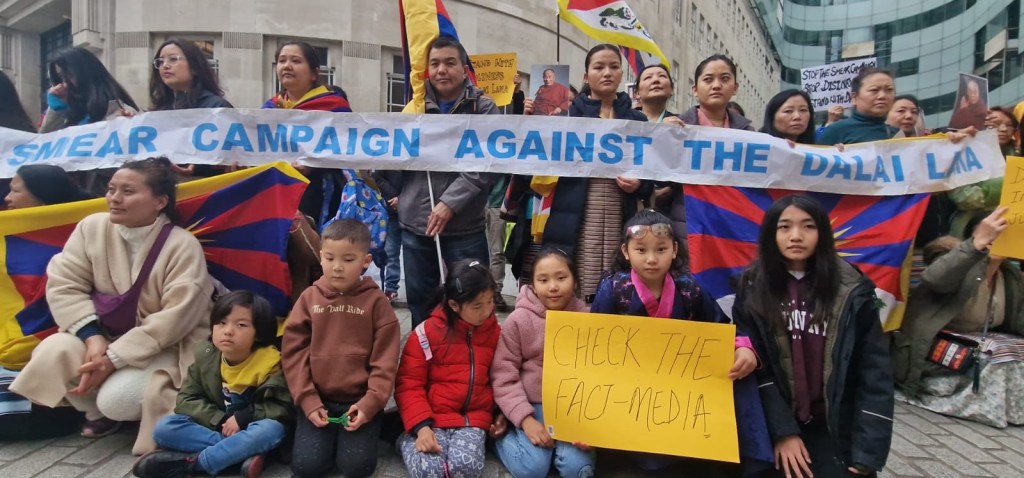
All are welcome to attend this free webinar. Register here:

https://us06web.zoom.us/webinar/register/WN_1TUtrH-dQW2kKbE-R51dFg

Links:

American Bar Association International Law Section

International Criminal Law Committee

Global Alliance for Tibet & Persecuted Minorities

From Massacres to Genocide: London Protest outside Chinese Embassy to Commemorate 33rd Anniversary of The Baren Uprising [East Turkistan under China’s Occupation]

Uyghurs and their supporters are staging yet another protest outside the Chinese Embassy in London to commemorate the 33rd anniversary of The Baren Uprising, which took place in Akto County, Kizilsu Kirghiz Prefecture, near Kashgar in East Turkistan, from 5th to 10th April 1990. 

This commemoration anniversary is organised by the World Uyghur Congress, UK Uyghur Community, Uyghur Solidarity Campaign and Stop Uyghur Genocide and it will be held on 5th April from 4pm to 5pm.

The Baren Uprising saw the loss of up to 3000 lives which subsequently resulted in the deterioration of human rights of the Uyghurs in their own country. 

On 5th April 1990, the first day of the Baren Uprising, local leader Zeydin Yusup led a group of around 200 Uyghur men and marched to the local government office in Akto County, demanding greater representation and speaking out against the significant influx of Chinese migrants into East Turkistan as well as the wider discriminatory policies and religious and cultural restrictions on the Uyghur people. By the end of 6th April, over 18,000 China’s PLA troops had been reportedly dispatched to the region to crackdown on the peaceful demonstrations. The population of Baren at the time was only about 19,000. Four days later, the demonstrations had been brutally dispersed, leading to the deaths of countless Uyghurs. 

Soon after the founding of the People’s Republic of China on 1st October 1949, the Chinese Communist Party (CCP) and its regime annexed and colonised East Turkistan. China refers to the occupied country as Xinjiang (New Territory), which is a highly offensive term to the people of East Turkistan. Throughout its unique history, East Turkistan has maintained a distinctive, sovereign, national and religious identity separate from China. 

Protest details:

Venue: Chinese Embassy, Portland Place, London W1B 1JL

Date: Wednesday, 5th April 2023

Time: 4pm to 6pm

Organisers:

World Uyghur Congress: www.uyghurcongress.org 

Uyghur Community UK: www.ukuyghurs.org

Uyghur Solidarity Campaign: www.uyghursolidarityuk.org

Stop Uyghur Genocide: www.stopuyghurgenocide.uk 

Special Tibet Hearing by US Congressional-Executive Commission on China – “Preserving Tibet: Combating Cultural Erasure, Forced Assimilation and Transnational Repression”

On Tuesday, 28th March 2023, a Special Hearing “Preserving Tibet: Combating Cultural Erasure, Forced Assimilation and Transnational Repression” was conducted in Rayburn House Office Building, Washington D.C. The two-hour Hearing was chaired by Representative Christopher Smith, Chair of the Congressional-Executive Commission on China (CECC). A panel of Tibet experts (from India and the US) presented their cases and answered questions from the US lawmakers.

The Congressional-Executive Commission on China was created by Congress in October 2000 with the legislative mandate to monitor human rights and the development of the rule of law in China, and to submit an annual report to the President and the Congress. The Commission consists of nine Senators, nine Members of the House of Representatives, and five senior Administration officials appointed by the President.

About the Special Hearing

Tibet faces new and worsening challenges from the Chinese Communist Party’s repressive rule. Threats to Tibet’s linguistic, religious, and cultural heritage have expanded in recent years, and now an estimated 80 percent of all children in the Tibet Autonomous Region are separated from their families and educated in a massive system of colonial boarding schools-a deeply troubling manifestation of the Party’s program of forced assimilation of ethnic and religious minority groups.  In recent years, police have conducted mass DNA collection and iris scanning programs in wide swathes of Tibetan society, including in monasteries and primary schools. Amid these threats to Tibetans in Tibet, the Chinese Communist Party are also seeking to extend their repressive reach abroad, targeting Tibetan diaspora communities in India, Nepal, Europe, and North America for surveillance and harassment.

In this hearing, the Commission will examine growing restrictions on linguistic and cultural rights in Tibet and transnational repression faced by Tibetans abroad. The goal is to explore the diplomatic and policy options for the United States and other like-minded countries to help preserve Tibetan cultural heritage and to defend against threats and intimidation targeting Tibetans in the United States and around the world. 

WITNESSES: 

Penpa Tsering, Sikyong, Central Tibetan Administration

Richard Gere, Chair, International Campaign for Tibet

Lhadon Tethong, Director, Tibetan Action Institute

Tenzin Dorjee, Senior Researcher and Strategist, Tibet Action Institute

USEFUL LINKS

Congressional-Executive Commission on China

Central Tibetan Administration

International Campaign for Tibet

Tibet Action Institute

Is Chinese Rule in Tibet Colonial?

While China claims that Tibet has been part of China since ancient times and speaks of having only liberated it, peacefully, Dr Gyal Lo* finds, based on the yardstick of an internationally accepted academic discourse, that its rule there is typically colonial.

Potala Palace in Lhasa, Tibet; Photo courtesy: Tibetan Review

Can China’s rule in Tibet be described as colonial? This is a topic of heated debate, but identifying and defining the status of colonization requires scientific evidence. Scholars who examine the characteristics and features of colonization have advanced the research on this subject through interdisciplinary investigation. Kennedy (1945) and Blauner (1969) provide a framework of the seven stages of colonization, a theory that has worldwide applicability in identifying the status of whether a nation is colonized or not in principle. Frieder’s and Gadacz’s (2009)[1] application of the seven stages model to Canada provides a reference point that contains strong parallels to China’s colonization of Tibet over the last seven decades. Of special relevance is China’s education policy in Tibet, with its mandatory boarding schools reminiscent of North America’s residential schools that sought to strip the indigenous peoples of their cultural identity and language.

On August 22, 2022, two Chinese scholars published a short article in the forum China & US Focus titled “Don’t Tar China with West’s School Abuses”. In the article, Wang Zhen and Ye Feng “confounds the truth and disregards the facts” by asserting “it has nothing to do with academic discussions but constitutes outright political disinformation”, and that opponents are “using the sinful or criminal discourse of Western colonialist education.” They claim that “contemporary boarding education in China is completely different from that practiced under Western colonialism” and further conclude that “the crimes of colonialist education cannot be laid on China in any case.” I argue, against the authors, that the characteristics and features of the seven stages of colonization are present in China’s relationship to Tibet. Below I will examine the evidence by using the theoretical lens of the seven-stages framework.

1) Forced penetration of the colonizing group. Defined as: entry of a colonizing group to a geographical area by force. The CCP penetrated into Tibet by military invasion[2] and brutal occupation[3]. However, China continues to lie to the international community, falsely labelling its invasion as ‘peaceful liberation’ of Tibet[4]. Despite these claims, Chinese scholar Li asserts that China deployed their army to invade Tibet, and Liu[5] writes that Tibet was never been a part of China.

2) Social Destructiveness. Defined as: rapid degradation of the internal group’s social and cultural institutions, and overall well-being as a result of contact with the external group. The Chinese government has forcefully destroyed social capacity and monastic institutions of Tibet through three reform movements[6]: 1) Socialist reform, 2) ‘Democratic’ reform, 3) Cultural Revolution[7]. As a result, these two reforms and the revolution fundamentally allowed the Chinese government to remove Tibetan people from the governing system of their homeland society, from 1951 to the present.

3) External Political Control. Defined as: sovereignty partially or completely taken over by an external group, leading to reduced or eliminated political control by the internal group. As an external group, China’s military invasion and deceptive tactics completely took over the sovereignty of Tibet. On May 23, 1951 the Treaty of 17-Point Agreement was signed under duress in Beijing under military threat and political coercion. Just eight years after signing, China breached the terms of this agreement. Due to the Tibetans’ opposition to the occupation and subsequent military threat, the Dalai Lama and the Government of Tibet fled into exile and sought asylum in India. Within these eight years, the Chinese eliminated the Tibetan postal system, banks, schools, media, cultural activities, and government offices of Tibet. In particular, the Tibetan currency was eliminated and diplomacy ceased completely between 1950–1959.

4) Economic Dependence of Internal Groups. Defined as: economic activity dependent on interaction with the external group; partial or complete loss of control of economic decision-making. Through the three reforms mentioned under stage 2, China strategically manipulated Tibet’s economic activity to become completely dependent on the external group in 6 steps. The first step involved depleting natural resources (completely wiping out forests, or fully controlling sources of water and salt); the second step was to set up Chinese banking systems throughout Tibetan society to enforce control on the internal group’s economic system; the third step was to develop invasive infrastructure which in turn resettled masses of Chinese construction related employees and other state mandated migrants into Tibet, causing radical change in the social fabric of Tibet; the fourth step was the “One Child Policy”, which disproportionately affected the Tibetan population’s growth rate and lowered the social capacity of Tibet; the fifth step was to establish economic hegemony and completely marginalize the productivity of Tibetan people in both nomadic and agricultural regions, rapidly increasing their dependency on economic activity on urban areas, all of which are in China; the sixth step was to entirely take over Tibetan people’s economic activity, which cut off Tibetans from having any economic agency in their native society[8].
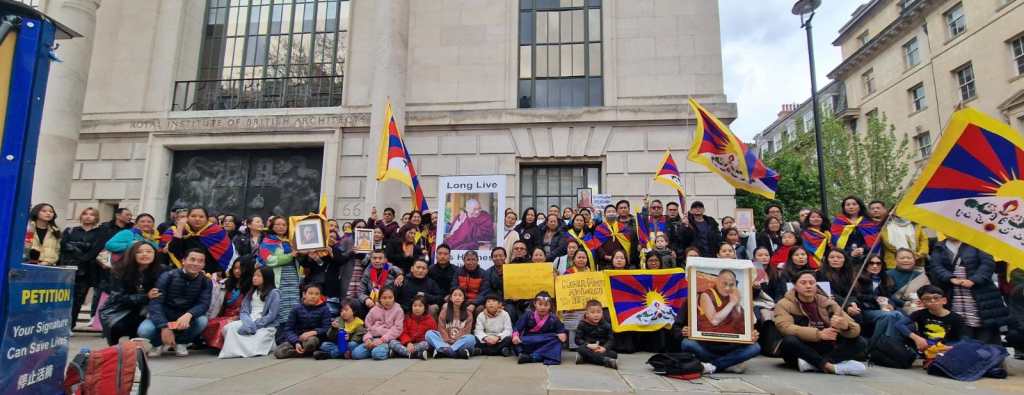
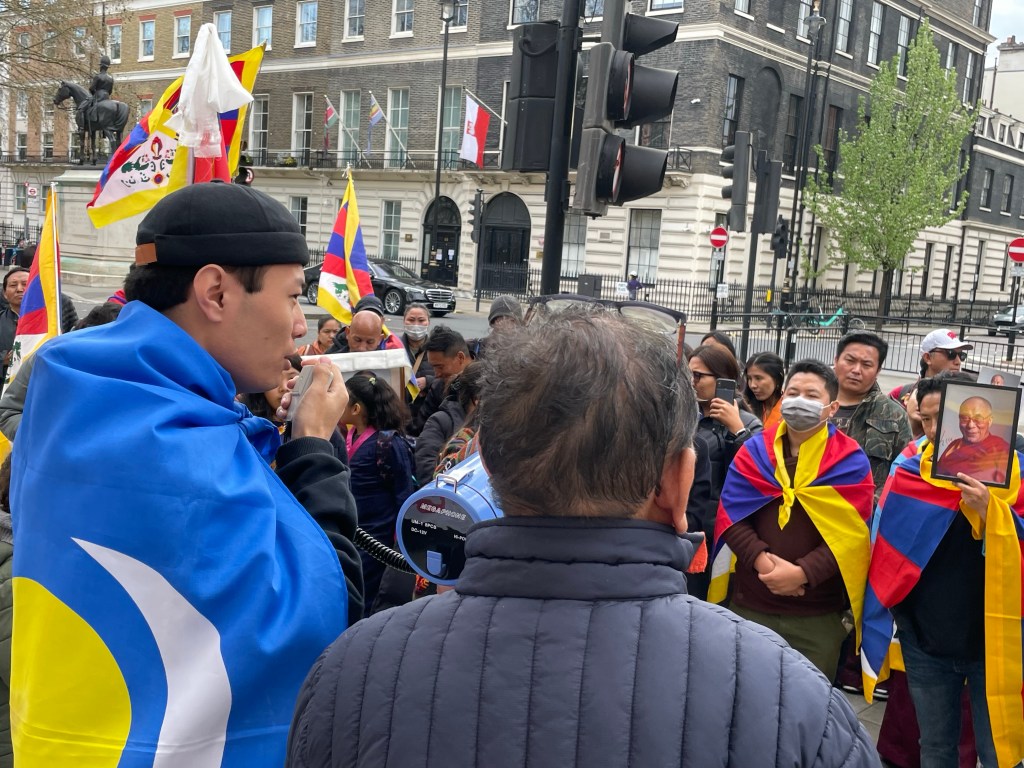
5) Sub-Standard Social Services. Defined as: the external group exclusively provides services such as health and education, yet delivers them at substantially lower standards of quality than they provide to their own group. Health and education are two major services provided by the Chinese government. In terms of healthcare, it is delivered with subquality professionals and facilities in Tibet. For example, serious illness requires travelling to Chinese cities to either get treatment that is not accessible in Tibet or higher quality of care. In terms of education, China leverages it as a key tool of colonial transformation. The role of school education has shifted from a Tibetan school education to a purely Chinese dominated colonial school across Tibet (since 2018). The features of these colonial schools are as follows: 1) China’s ‘hidden curriculum’, 2) curriculum that is made by China with contents deemed important for Tibetan students by China, 3) politicization of school curriculum (limited Tibetan knowledge in content of textbook only 15% to 25%),  4) the politics of knowledge categorization (excluded Tibetan knowledge system from academic discipline), 5) ideological dominance (filled with the history and mission of the Communist Party), 6) revocation of higher education institutions, leading to cessation of intellectual productivity and learning/teaching Tibetan culture, 7) coercing parents to send age 4-6 children to colonial boarding preschool where the teaching of mother tongue and Tibetan culture is banned since 2016, 8) Forcefully replacing Tibetan language with Mandarin Chinese as the state’s common language from 2018 onward.

Despite claiming “education is a fundamental human right for every citizen,” the experience of school education in Tibet sufficiently proves that “the boarding schools in China play an essentially different role” of assimilative and cultural genocide. Furthermore, in securing the role, “the government has implemented a 15-year free education plan from preschool to high school in the region.” Aiming for the utter colonization of Tibet, the Chinese government invested 223.97 billion yuan from 1951 to 2020 for school education. As a result of undergoing China’s colonial education, generations of Tibet have been alienated from their own cultural community and they can neither enter the mainstream Chinese society nor return to the traditional Tibetan community of their birth. Based on the implementation of China’s compulsory education policy, “the net enrollment rate of primary schools in rural Tibet is 99.93 percent, and the gross enrollment rate of junior high school and higher education are 106.99 percent and 56.14 percent,” will continue the role of school education in Tibetan society as a process of eradicating identity of Tibet.
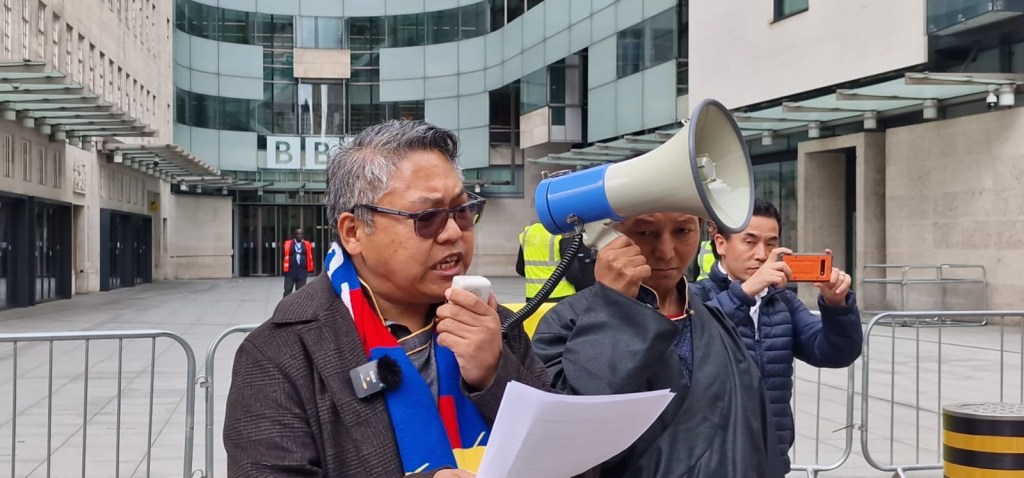

6 & 7) Social Stratification. Defined as: the external group sets standards of normality and quality which the internal group cannot meet; the traditionally internal group is viewed as inherently inferior; more recently, systemic racism treats groups as potentially unequal, and systemic social barriers prevent internal groups from realizing social equality. Since under China’s control, Tibet has been fragmented and subdivided into various administrative domains under Chinese provincial authority systems[9]. This allowed China to minimize the collective power of Tibet. At the same time, China implements stratified policy to target primary social groups and culturally fertile regions of Tibet. For instance, the Chinese government has fragmented Kham and Amdo into four Chinese provinces (Yunnan, Sichuan, Qinghai, Gansu) as ten prefectures and two counties. On August 28-29, 2020, Xi Jinping[10] hosted a central committee meeting on Tibet by asserting Kham and Amdo Tibetans as She Zang (Tibetan related/涉藏) not the Tibetan regions.

It is clear from the foregoing body of evidence that Tibet is colonized under China, though this fact has not yet been fully recognized by the international community and remains understudied in academia as a case of colonization. China continues to lie and repetitively claims ‘peaceful liberation’ instead of military invasion. Chinese leaders and pro-CCP scholars make the deceptive claim that Tibetans are in control of their society, while they have implemented severely eradicative policies over seven decades[11]. The experience of Tibet (1951-2022) under China’s control, so called “social and economic development” of Tibet, clearly reveals the same features and the same characteristics described in the seven stages of colonization.

***

Dr Gyal Lo received his PhD from the University of Toronto, and he taught at the Department of Tibetan Language and Culture at Northwest University for Nationalities for over a decade. He is the author of Social Structuration in Tibetan Society: Education, society, and spirituality (Lexington Books, 2016). 


[1] Frideres, J. & Gadacz, R. R. (2008). Aboriginal people in Canada. A division of Pearson Canada Inc., Toronto, Ontario

[2]Li, J. L. (2022). When the Iron Bird Flies: China’s Secret War in Tibet, Stanford University Press. (Tibetan version translated by Thaklha Gyal (2019) from Chinese version). The book provides details about how the Chinese Communist Party military invaded and cracked down on Tibetans from 1956 through 1962.

[3] Lezlee Brown, H., & Stefan, H. (2013). Tibet: An Unfinished Story, Oxford University Press, USA. “China’s People’s Liberation Army sought nothing less than to deconstruct traditional Tibet, unseat the Dalai Lama and absorb this vast region into the People’s Republic, and Lhasa succumbed to China’s invasion in 1950.”

[4] Szczepanski, Kallie. “Tibet and China: History of a Complex Relationship.” ThoughtCo, Jul. 29, 2021, thoughtco.com/tibet-and-china-history-195217.

[5] Liu H.C. (2019). Tibet has never been a part of China (Chinese version), Xue Yu Press, Taiwan.

[6] Jia, L. (2015). Reform as a social movement in Tibetan society: A form of social process, Lap Lambert Academic   Publishing.

[7] Barnett, R. & Akiner, S. (1993). Resistance and reform in Tibet, Indiana University Press.

[8] Fischer, Andrew Martin. (2014). The disempowered development of Tibet in China: A study in the economics of marginalization, Lexington Books.

[9] Jia, L., & Qie, P. (2021). A sociological analysis of Tibetan language policy issues in China, SN Soc Sci (2021) 1:89 https://doi.org/10.1007/s43545-021-00092-y

[10] On August 28-29, 2020, Xi Jinping says: “中央将继续加大对四省涉藏工作的支持力度.”   “同时, 对四川、云南、甘肃、青海省涉藏工作作出部署.”  This is first time mentioned this way, and since then all authority system documents and academic writing have to followed this way.

On August 24-25, 2015, during sixth meeting, Xi Jinping mentioned as “会议还对四川、云南、甘肃、青海省藏区…………。”  “今后一个时期,要在西藏和四省藏区…………. 。西藏和四省藏区要坚持自力更生…………。”  “习近平指出,实现西藏和四省藏区长治久安,……. 。”

On January 18 to 20, 2010, Hu Jintao host meeting, the title of meeting as: “第五次西藏工作座谈会:对四省藏区发展全面部署”; “推动四省藏区发展迈出新步伐,确保四省藏区到2020年……………..。”

[11] Jia, L., & Qie, P. (2021). A sociological analysis of Tibetan language policy issues in China, SN Soc Sci (2021) 1:89 https://doi.org/10.1007/s43545-021-00092-y

GATPM Note: The above piece by Dr Gyal Lo was first published in Tibetan Review on 14th October 2022.

USEFUL LINKS

Tibetan Review

Dr Gyal Lo’s Twitter Page

A Testimony by Southern Mongolian Dissident-Writer Lhamjab Borjigin

After being sentenced to two years prison term followed by indefinite surveillance, Southern Mongolian writer Lhamjab Borjigin escaped China and arrived in the independent country  of Mongolia.
Photo: SMHRIC

The following is an English translation of Southern Mongolian dissident writer Mr. Lhamjab Borjigin’s testimony given to the Southern Mongolian Human Rights Information Center on March 26, 2023. After being sentenced to two years prison term followed by indefinite surveillance, recently Lhamjab Borjigin managed to escape China and came to the independent country of Mongolia (English translation by SMHRIC):

“It was nice reconnecting with you. In Southern Mongolia, people like myself — branded as undesirable and blacklisted as reactionary — are under the authorities’ strict control, monitored and followed around the clock. We must show up wherever and whenever they summon us, and we must report in several times a day. No matter where we go, we are followed.

All Southern Mongolians are treated as targets for cleansing and extermination. What they [the Chinese authorities] want is our land and territory. As a people, we are considered nonexistent.

I am not allowed to meet with others like me. We spend our days, months and years under these restrictions — and even stricter policies imposed on us during the COVID-19 lockdown.

During the lockdown, a total of four doses of the vaccine were forced on each and every one of us. Realizing its ineffectiveness, many refused to receive the fourth round of inoculation. After a couple of years of vaccination, people realized the Chinese vaccine does not work at all. Despite this resistance, the authorities achieved their vaccination goal through a variety of means. For example, in Sunid Right Banner, the government issued a sack of flour or a bottle of milk to elderly citizens who agreed to being vaccinated. I have heard that in other locations, inoculated citizens were given 500 yuan.

As an 80-year-old man, I am against the Chinese vaccine, which has been proven ineffective over time, considering the government’s protracted period of vaccine administration. In fact, the negative effects of the vaccine are well known — but discussion of these side-effects is not allowed. It is a fact that many people have died as a result of the vaccine. Discussion of these deaths is also strictly forbidden. We must attribute these casualties to natural causes. It is said that those who have discussed vaccine deaths have been criminalized.

In cities, dispatchers in white hazmat suits walked door to door, forcefully vaccinating residents. In some cases, they even broke into people’s homes in order to administer the vaccine. I, however, have never allowed them inside my home. I recall on several occasions they came to my place of residence with an army of police officers and security personnel. I told them that diseases are treated by doctors, not by the police. I said that my body was given to me by my parents — not by the party, nor the government. I have the right to decide what to do and what not to do with my body.

I also told them that with this vaccine they were not trying to save my life but were in fact attempting to take it from me. In this manner, I categorically rejected the vaccination, yet I still haven’t contracted COVID-19, thanks to my natural immunity. Some of my acquaintances who were vaccinated either died or fell victim to worsening conditions.

During the language protest, many teachers died. Those parents who refused to send their children to school were either removed from their positions or fired from their jobs. Many of their family members and relatives were implicated as well. Many Mongolians lost their lives. Some Mongolian officials who supported the protest have mysteriously died or disappeared. Again, it is a taboo to talk about these cases. This is a form of genocide, executed by the Chinese in Southern Mongolia under the guise of protecting citizens from COVID-19.

Similarly, under the pretext of the COVID lockdown, roads and highways were often blocked and sealed. Having obstructed citizens’ mobility, the authorities then quietly moved their police and paramilitary forces into Mongolian areas — fully equipped with heavy machinery — under the cover of darkness, and with the goal of tightening surveillance.

And there was much to surveil. We Mongolians are prohibited from communicating with outsiders — especially foreigners. Those who broke these rules were searched, arrested, detained and jailed. Their phones were confiscated, hacked and analyzed thoroughly. After all personal information and communication records were accessed and copied, some devices, but not all, were returned to their owners. The so-called “rule-breakers” were warned about who they were allowed to communicate with, as well as those who were strictly prohibited. They are monitored and followed around the clock. For instance, the entire city of Shiliin-hot was patrolled by heavily armed police and SWAT teams in black vehicles who monitored residents’ every single move. And our literal movement was restricted as well. They [the authorities] even tried to confiscate my passport. I was able to avoid surrendering my passport by telling them that I had misplaced it. In lieu of relinquishing my passport and therefore my freedom to travel, I was ordered to check in at the local police station twice a day to report my status and sign a statement of compliance. 

When COVID restrictions relaxed slightly, I managed to escape and come to Mongolia with the help of friends. Like a wild animal, I broke through the shackles and ran for my freedom. I do not want to go back, only to be shackled again. It is my dream to live in peace and to enjoy my basic human rights in a free country, for the few remaining years of my life. My other goal is to publish my books here in Mongolia.

Generally speaking, Southern Mongolia is under Chinese control. At the regional level to the lowest level of villages, the Chinese dominate everything, all the way from high-level government offices to our schools. In schools, including kindergarten classes, all Mongolian teachers have been replaced by Chinese instructors hailing from the interior provinces of China. For example, in Shiliin-hot, the Shiliin-gol League Mongolian High School (established in the 1930s) has been converted to the No.3 Chinese High School. The Mongolian teachers who taught there are now unemployed.

Moreover, Mongolian textbooks and other publications have been removed from bookstores and libraries. Some teachers managed to keep a few Mongolian books by hiding them in nooks and crannies. Even the most sacred book — Secret History of Mongolia — was confiscated and destroyed. Those books that escaped the search nevertheless cannot be shared with the public.

Mongolian students have not learned anything in the past two years, not only because of the deteriorating educational environment, but because of the early dismissal schedule, ostensibly necessitated by COVID-related restrictions. Those students who were forcibly returned to their homes effectively spread COVID-19 to their family members and rural communities.

For the time being, I live with my friend here in Ulaanbaatar. As there is no possible way for my books to be published in Southern Mongolia, it is my goal to publish them here in Mongolia.

Having enjoyed only a handful of days of freedom here, I can’t begin to describe how precious freedom is. Let me be frank. I do not want to go back. I do not want to lose the freedom that I have dreamed of for so long. I know I do not have a great many years ahead; still, I would like to live in freedom and die in peace.

If I did return to China, I would be severely punished, if not killed, for escaping to Mongolia without the government’s approval. As mentioned earlier, before my departure I had been placed under indefinite surveillance without any personal freedoms. The authorities must have been furious about my escape. As a result, it is extremely risky for me to go back. On the other hand, I really want to see, touch and feel this hard-won freedom.

In Southern Mongolia, this denial of freedom was only exacerbated by charges brought against me by the Chinese authorities. I was sentenced by the court of Shiliion-hot to one year in prison and one year serving outside prison. I completed the full sentence — but completion of my full sentence did not guarantee my full freedom. I still had to regularly report to the local Public Security Bureau. They decided where I was allowed to go and where I could not go, and who I was allowed to meet and who I could not. My residence was full of surveillance cameras, watching my every single move, like the Monkey King’s golden hoop remotely controlling the entirety of my daily life.

Having lived through the turmoil sustained by my people, I would be happy to share my experience with the outside world as a victim, survivor and witness. I abide by this simple principle: for the cause of my people, for justice and righteousness, I do not hesitate to stand up and tell the truth.

As you know, publishing books in the Mongolian language in Southern Mongolia has been completely outlawed. Even government and party propaganda are no longer published in Mongolian. Having worked on my books for years, I took the risky path to Mongolia armed with the hope of publishing them here and bequeathing them for posterity. Through my books, future generations will understand what our nation has endured, and how our people fought for survival.

The first book I am planning to publish is about Mongolian history, mainly focusing on the personal lives and achievements of more than 30 Mongolian Khans, in chronological order. The estimated word count is roughly 100,000 after editing.

The second book is entitled The Record No. 1981 and focuses on the Mongolian Students’ Movement of 1981. The first draft is about 200,000 words.

The third book is a historical account of the Chinese Communist Party’s occupation of Southern Mongolia, primarily focusing on when and how the Chinese Communist Party took control of the Shiliin-gol region, how they occupied Mongolian land and territories, how they confiscated and destroyed Mongolian properties, the nature of the political movements they launched, and how they carried out mass killings and other atrocities. The estimated word count of this book is 150,000.

These three books could be published in relatively short order, as first drafts are already complete. In addition to these manuscripts, I have also brought with me a fair amount of first-hand materials that will require some sorting and time and effort prior to publication.These are my plans — should I be lucky enough to live a few more years in peace without being followed, monitored and questioned, until being called by Karl Marx to join him in heaven.”

For more information on the case of Lhamjab Borjigin, please visit here:

http://smhric.org/news_651.htm

https://www.rfa.org/english/news/china/mongolian-historian-07232018123931.html

https://pen.org/press-release/lhamjab-borjigin-historical-inquiry-on-trial/

USEFUL LINKS

Southern Mongolian Human Rights Information Center

Voice of Southern Mongolia

An Exiled Tibetan’s “Open Letter” to Xi Jinping

This Open Letter by Tenzin Tsultrim was first published in Phayul on 13th March 20223.

Illustration: Stellina Chen

An Open Letter to Xi Jinping

Dear President Xi Jinping,

Tashi Deleg for Tibetan Losar 2150 Year (Water Hare)

First, I would like to wish you a successful third-term.

I think you are the first top leader of the People’s Republic of China (PRC) after (late)Jiang Zemin, to visit Tibet. I believe, the 2021 visit was your third visit to Tibet. From the Chinese official media, I found out that you have also visited Lhasa, the capital of Tibet.

On 19 July 2011, when you visited Lhasa as a Vice-President of the PRC, you mentioned, “The fine traditions of the Tibetan culture are preserved and promoted…Like other regions in the country, Tibet is showing the dynamism of development that points to a prosperous future.”

For the past few years, there have been increasing crackdowns in Tibet. The demolitions of Gaden Rabten Namgyaling school in Kardze and Buddha statues in Kham are further creating an environment of fear and distrust inside Tibet. It also highlights Chinese leaders’ mismanagement in Tibet. Increasing the number of surveillance cameras and police posts might give the communist officials in Tibet a sense of control over the Tibetan people. In short, allowing your sycophant officials to bring further restrictions on the Tibetan people would generate further alienation and may impede your dream of rejuvenation of the Chinese nation.

On 17 August 2021, during the 10th meeting of the Central Committee for Financial and Economic Affairs, you talked about “Common prosperity”, where you stressed the need to “adhere to a people-centered development philosophy and called for efforts to achieve common prosperity through high-quality development.” I think common prosperityis also about treating everyone with equal respect and giving them equal rights.

 In your Report of 2022 to the 20th National Congress of the Communist Party of China, you again mentioned “Common Prosperity”. You said, “We have ensured a more complete and lasting sense of fulfillment, happiness, and security for our people, and we have made further progress in achieving common prosperity for all.” However, in Tibet, for the past few years, many uncommon events have happened.

For instance, Tibetan people were restricted from visiting monasteries during the new year. In the name of the bilingual education policy, young Tibetan children were barred from learning their mother tongue. Research findings from Tibet Action Institute reveal that countless young Tibetan children were sent to faraway boarding schools to educate them in the Chinese language and culture. I think there cannot be “Common Prosperity” if the common Tibetan people are not treated with equal respect and rights. Hence, it is not by coincidence that rights groups such as Human Rights Watch, Amnesty International, and Freedom House across the world are highlighting the growing repression and curtailment of basic human rights in Tibet. By curbing human rights and restrengthening the surveillance systems in Tibet, you can monitor their movements and eavesdrop on their conversations and but you cannot monitor their sentiments.

In your latest Report, you also declared that “…We must strengthen the great unity of the Chinese people of all ethnic groups and the great unity of all the sons and daughters of the Chinese nation at home and abroad. By doing so, we will create a powerful collective force working with one heart and one mind to realize the Chinese Dream.”

One cannot expect unity by eradicating the identities of a few. For instance, the geographical topographies of Tibet, East Turkestan, and Southern Mongolia are different from that of China, one cannot just re-engineer to make it similar to that of China’s topography. If one tries to pursue this, then the result would be a man-made disaster. For the Tibetan people, Uyghurs, and people from Southern Mongolia, culture is very close to their hearts, and without respecting their culture, it is very difficult to win their hearts and minds.

Since you are around 70 years old, I think it would be routine for you to do health check-ups, including your heart rate. Instead of collecting DNA, I think it is also high time to check the grievances rate in Tibet, East Turkestan, and Southern Mongolia. The implementation of a few months Zero-Covid policies in Tibet, particularly in Lhasa, the Capital of Tibet has led to outcry and protests from hundreds of Chinese migrant workers. Imagine the decades of bottled-up grievances of Tibetan people, Uighurs, and Southern Mongolian people. China has already spent billions of Yuan on roads, bridges, housing, and on surveillance mechanisms.

I think it is time to spend on human capital and improve human rights conditions without any Chinese or Socialist characteristics. The countless amount of money Communist China has spent for many decades on its image-building exercise within China and outside has been completely thrown out of the window. Covid-19 proved to be the final nail in the coffin. If China sincerely believes in upping its image, I think the time has come for it to give genuine rights and freedom to the oppressed people from Tibet, East Turkestan, and Southern Mongolia to decide their future.

I believe this is my second letter to you. The first letter I sent to you is through the Apple Daily of Hongkong, now defunct and its founder Jimmy Lai jailed.

Next time, when you are in India, please visit Dharamshala, there is a direct flight from Delhi. The Tibetan amchis(doctors) from Men-Tsee-Khang are known to tell the root causes of many diseases by reading the pulse. In short, many problems in the world could be solved effectively if you know the source of the problems.

Sincerely,

Tenzin Tsultrim (A Tibetan living in exile)

(Views expressed are his own)

The author is a research Fellow at the Tibet Policy Institute, a think tank under the Central Tibetan Administration in Dharamshala, India

 P.S. I request anyone who knows the Chinese language to translate the above letter.

Foreign Policy Analysis: UK quietly shifts China policy as trust between countries erodes

By Dan Sabbagh Defence and security editor

15 March 2023 |The Guardian

British stance edges closer to the US, but many MPs want government to go further and designate China as a threat

There has been a significant shift in policy from ‘golden era’ of cooperation hoped for by David Cameron in 2015.Photograph: Arthur Edwards/The Sun/PA

While Britain’s conflict with Russia is playing out on the battlefield of Ukraine, escalating tensions between London and Beijing are largely unfolding a little more discreetly at home: in universities, among researchers and in hi-tech and other strategic businesses.

It may not be a high-profile drama of poisonings and deadly weapons supply, but hundreds of Chinese researchers have been turned away from British projects over the last couple of years, as trust between the two countries has been eroded.

A further 50 researchers, already in the UK, have also been quietly asked to leave the country, accused of being linked to the China’s People’s Liberation Army.

It already reflects a significant shift in policy from “golden era” of cooperation hoped for by David Cameron in 2015 at the time of state visit to the UK by China’s president, Xi Jinping – long before the publication of Monday’s refreshed integrated review of defence and foreign policy.

Ironically, the refresh was put in train by the short-lived premiership of Liz Truss, with the purpose of ratcheting up Britain’s hostility to China, changing the UK’s overall stance from “systemic competitor” to “threat” – a position rejected by Rishi Sunak.

Ultimately the document fought shy of the threat designation, choosing to define Beijing as posing an “epoch-defining and systemic challenge with implications for almost every area of government policy”. But it allows the UK to come a little closer to the US, which increasingly sees China as its long-term, defining competitor.

A review by the Pentagon last year described China as a “pacing challenge”, and a “comprehensive and serious challenge to US national security” – anxieties that underline Monday’s confirmation that Australia will get nuclear propulsion technology from the UK and US so its submarines can match Beijing’s in the Indian and Pacific Oceans.

Policy experts say escalating the rhetoric dramatically would only serve to unnecessarily increase existing tensions at a time when there is western concern about whether Beijing is prepared to supply weapons to Russia for the war in Ukraine.

Charles Parton, a former British diplomat with 22 years of China experience, said there was nothing extra to be gained, adding: “It doesn’t make for good policy. They are a threat, but we have to cooperate on areas like climate change, which we never had to do with the Soviet Union. But we also have to recognise that Beijing sees itself in an existential struggle with western capitalism.”

The analyst pointed to a 2013 speech, re-published in 2019, in which the Chinese leader spoke of “the eventual demise of capitalism and the ultimate victory of socialism” in what would inevitably be “a long historical process”.

Reflecting such thinking, Britain’s intelligence community has emphasised its concern that authoritarian China could one day take control of critical technologies such as artificial intelligence. Last October Jeremy Fleming, the boss of spy agency GCHQ, said China wanted to “gain strategic advantage by shaping the world’s technology ecosystems”.

After a long period of laissez-faire, a handful of takeovers of British firms by Chinese companies have being blocked under the recently passed National Security and Investment Act, including the purchase of Newport Wafer Fab, the UK’s largest silicon chip factory.

Chinese espionage activities in the UK are often subtle and long term – and nefarious activity difficult to spot. In an exceptional case, MI5 did issue a warning in January last year about lobbyist Christine Lee, accusing her of seeking to improperly influence MPs and peers, using money she was said to have raised from “foreign nationals” in Hong Kong and China.

But Lee was not prosecuted either, partly reflecting the UK’s effort to proceed discreetly and what the intelligence community insists is outdated legislation. When three Chinese spies posing as journalists were expelled in 2020, the story did not emerge until the following year because their removal was hushed up.

The problem for the government is there is political frustration with any perceived gradualist approach. Conservative MPs repeatedly rebelled with Labour support, demanding tougher sanctions, when the government tried to restrict the use of Huawei equipment in British phone network.

An attempt to force the UK to reconsider trade deals with a regime defined in a UK court as genocidal – aimed at Beijing – failed by 11 votes in 2021.

High-profile critics, such as former Conservative party leader Iain Duncan Smith, complained on Monday that the UK “did not kick out the Chinese officials who beat people up on the streets” – referring to the UK response to an incident in October when a pro democracy protester was beaten Chinese officials outside the country’s consulate in Manchester. Six diplomats left two months later, without agreeing to be questioned by UK police.

Meanwhile, Labour’s Stephen Kinnock called for an “in-depth strategic audit” of the UK’s relationship with China and “no return to the utterly failed ‘golden era’ strategy” – indicating that politicians still want to go further than officials or experts are recommending.

This article was publised in The Guardian.

Journey of an Exile Tibetan Leader: From Harvard to Dharamsala

The Global Alliance for Tibet & Persecuted Minorities are pleased to re-share a very candid interaction of Dr. Lobsang Sangay, former Sikyong, President of the Central Tibetan Administration (CTA), from 2011 to 2021 (aka Tibetan Government-in-exile), with his academic audience at Harvard University Asia Centre, as part of the Tsai Lecture Series.

Dr. Lobsang Sangay,
Photo: Harvard University

Sangay’s latest public engagement is believed to be an open account of his personal aspiration, challenges, opportunities as well as securing solutions to China-Tibet conflict as top elected leader of the Tibetan Government-in-exile, since leaving his two-terms in office as the Sikyong.

Watch this full speech delivered on March 8, 2023, at the Harvard University Asia Center, by Dr. Lobsang Sangay, Former Sikyong (President) of the Central Tibetan Administration and Senior Visiting Fellow, East Asian Legal Studies Program, Harvard Law School.

About the Lecture Series: The Tsai Lecture Series, established in 2000 with a generous endowment from Felix Tsai, allows the Asia Center to invite notable leaders in academia, government, business, and other professions to Harvard. The annual lecture is open to the public, and it offers perspectives from a range of disciplines and different regions in Asia. Past speakers have included the late Surin Pitsuwan, former Secretary-General of ASEAN, Pritzker Prize-winning architect and humanitarian Shigeru Ban, internationally renowned human rights lawyer, and advocate Asma Jahangir, the Honorable Caroline Kennedy, and the Honorable Kathleen Stephens. 2021 Nobel laureate Maria Ressa delivered the most recent Tsai Lecture in May 2022.

Biography of the speaker: Lobsang Sangay is a Senior Visiting Fellow at East Asian Legal Studies Program, Harvard Law School. He was a democratically elected Sikyong (President) of the Central Tibetan Administration and served two terms (2011-21). Lobsang completed his BA and LLB from Delhi University. He did his LLM ’95 and SJD ‘04 from Harvard Law School and received Yong K. Kim’ 95 Memorial Prize for excellence in dissertation and contributions to the understanding of East Asia at the Harvard Law School. While at Harvard, akin to track III, he organized seven rounds of meetings/conferences between Tibetan, Western and Chinese scholars most notably, the first ever meeting between HH the Dalai Lama and 25 Chinese scholars and students.

He was a researcher for the report “Tibet: Human Rights and the Rule of Law”, published by the International Commission of Jurists in Geneva, Switzerland (2008). He also published Legal Autonomy of Tibet: A Tibetan Lawyer’s Perspective, in the Journal of East Asia and International Law and “Education Rights for Tibetans in Tibet and India,” in John D. Montgomery, ed. Human Rights: Positive Policies in Asia and the Pacific Rim, SOKA University Press. He wrote an article, Tibet: The Exile’s Journey published in the Journal of Democracy (2004). He was selected as one of the twenty-four Young Leaders of Asia by the Asia Society (2006). He has spoken at international conferences such as Forum 2000, Halifax Security Forum, and Oxford Union. He has written numerous Op-eds in major newspapers including The New York Times, The Washington Post, The Wall Street Journal, and appeared on many international TV networks like BBC and CNN.

He was awarded the Gold Medal for Outstanding Contribution to Public Discourse, College Historical Society (CHS), Trinity College, Dublin (2014) and Salisbury University Presidential Medal for Distinguished Community Leadership (2015). He has visited various capitals and parliaments around the world and played an important role in the passage of Tibetan Policy and Support Act 2020 signed by the United States Government.

He was most recently a lecturer at the Harvard Law school in the Fall of 2022, teaching a class on China and Tibet and presently teaching a reading group on Tibet at the Harvard Kennedy School.

Source: Harvard University Asia Centre

UK-based Chinese Dissident Dr. Shao Jiang presents “an opportunity for Tibetans and Chinese to fight together against the tyranny of the Chinese Communist Party and to fight for our freedoms shoulder to shoulder”

At the invitation of Tibetan Community UK, Chinese dissident Dr. Shao Jiang addressed the 64th commemoration anniversary of the Tibetan National Uprising Day at the Indian YMCA in London on 10th March 2023. He said, “CCP’s invasion and occupation of Tibet have brought much suffering to the Tibetan people. These include not only suppression of civil and political rights, religious freedom and cultural genocide, but also the economic exploitation of millions of Tibetans”.

Dr. Shao Jiang addressing the 64th commemoration annual of the Tibetan National Uprising Day event in London

Jailed for his role as Student Leader during the 1989 pro-democracy movement in Beijing’s Tiananmen Square, Dr. Shao Jiang highlighted Communist China’s “economic exploitation on three levels: land seizure, the plundering of resources, and labour exploitation” in Tibet. He added that “the discussion of these issues may provide new perspectives for finding a way out for the Tibetan people.”

The Chinese dissident also stated that the recent White Paper movement in China saw the active involvements of “a number of Tibetan students and workers, especially women”. He said that “Tibetan students and workers who are still in detention are all women, including Tsering Lhamo, Zamkar, Dechen, Kalsang Dolma and Delha”.

The dissident-scholar noted that most of those Chinese arrested were also women, adding, “Women are leading new round of movement. The White Paper movement including class, nationalities and gender issues, has provided an opportunity for Tibetans and Chinese to fight together against the tyranny of the Chinese Communist Party and to fight for our freedoms shoulder to shoulder”.

For full speech please watch this video.

Dr. Shao Jiang addressing the 64th commemoration anniversary of the Tibetan National Uprising Day at Indian YMCA in London, organised by Tibetan Community UK

Dr. Shao Jiang:

“Today marks the 64th anniversary of the Tibetan uprising. CCP’s invasion and occupation of Tibet have brought much suffering to the Tibetan people. These include not only suppression of civil and political rights, religious freedom and cultural genocide, but also the economic exploitation of millions of Tibetans. Today I want to highlight this economic exploitation on three levels: land seizure, the plundering of resources, and labour exploitation. I hope that the discussion of these issues may provide new perspectives for finding a way out for the Tibetan people.  

Since the occupation of Tibet, the CCP carried out two rounds of looting of Tibetan land and resources. The first round was from the 1950s to the early1980s, the second round is from 2000 to the present. In the 1950s, in the name of ‘land reform’, the CCP confiscated the land traditionally used by Tibetans for farming and grazing, forcing farmers and nomads to join communes. The command economy led to long-term poverty and famine among Tibetan farmers and nomads. The Tibetan land was used by the CCP as a strategic foundation to build military bases, third-line factories, forest farms and agricultural farms to exploit resources in Tibet.  

The second round of land seizure in Tibet started around 2000 and is still ongoing. The implementation is in the name of ‘relocation and resettlement’, ‘national parks’, ‘border villages’, ‘poverty alleviation’ and so on. The land-grabbing goes hand in hand with the plundering of natural resources including grasslands, forests, minerals and water resources. Industrialisation and urbanization have not benefited the Tibetan people but turned Tibet into a vital source for the supply chains of the world factory that China has presented itself to be. Many companies and politicians in the West have been complicit in this process.  

Over the past 20 years or so, the CCP has driven more than two million Tibetan farmers and herders out of their land. Some of them have become unemployed, while others have become ‘cheap labour’ in the gig economy. Since Tibetans are forced to use Chinese in both education and work, not only are they at a disadvantage in finding a job, but even Tibetans with the same or higher skill levels are paid only one-third of the wages of the Han Chinese. This is one of the reasons why the proportion of Tibetans living in poverty is much higher than that of the Chinese.

Workers in the gig economy are inevitably subjected to further exploitation due to their scattered and disorganized status. Only by developing independent labour organizations can Tibetan workers protect their rights. Under CCP’s tight control, it is very difficult for Tibetans in Tibet to form independent trade unions, and this is where Tibetan exiles can play an important role. There is a lot we can learn from the experiences of workers’ organizations in other countries including the UK and Ireland, to build a broader alliance with the international labour movement. 

Last November, the White Paper movement erupted in China. A number of Tibetan students and workers, especially women, had been actively involved. From what we know so far, Tibetan students and workers who are still in detention are all women, including Tsering Lhamo, Zamkar, Dechen, Kalsang Dolma and Delha. This is similar to the situation of Chinese participants. Most of those arrested were also women. Women are leading this new round of movement. The White Paper movement including class, nationalities and gender issues, has provided an opportunity for Tibetans and Chinese to fight together against the tyranny of the Chinese Communist Party and to fight for our freedoms shoulder to shoulder.”

Please click here to visit Dr Shao Jiang’s blog.

Thousands across Europe to gather in Rome to call on Chinese Communist regime to end the illegal occupation of Tibet – Europe stands with Tibet

The Europe-wide Joint 10th March Rally will be held in Rome, Italy on Friday, 10th March 2023.

This pan-European rally is organised by the Tibetan Community Italy, with a full cooperation of the Tibetan Communities in Europe. In addition to Tibetans, supporters and invited speakers, Europe-based elected Tibetan MPs and representatives from the Offices of Tibet are also joining the official rally.

This political and solidarity rally is believed to be the largest Tibet gathering in Europe since the COVID-19 pandemic, which originated in Wuhan, China.

Details of the Rome Rally:

Starting place: LARGO CORRADO RICCI

Manifestation Place: PIAZZA DELLA MADONNA DI LORETO

Rally Route: Gathering – 13:30 / rally 14:00 from Largo Corrado Ricci – Via Fori Imperiali Arrival – Piazza della Madonna di Loreto

The rally is supported by Associazione Italia-Tibet, Swiss-Tibetan Friendship Association and International Campaign for Tibet.

From Archive: Europe stands with Tibet – Paris Rally in 2015

Each year, Tibetans worldwide commemorate March 10th as the anniversary of the Tibetan National Uprising of Lhasa in 1959. Read Tsering Passang’s detailed account on Why Tibetans worldwide commemorate March 10th

On this day, hundreds of towns and cities across Europe will also be raising Tibet’s National Flag to show their support and solidarity with the Tibetan people. In London, the Mayor of the Royal Borough of Greenwich (RBG) will raise the Tibetan National Flag at the Woolwich Town Hall on the same day.

From Archive: Tibet Flag Raising ceremony at Woolwich Town Hall, London; 10th March 2022

Tibet was illegally invaded by the Chinese Communist Party regime soon after it came to power on 1st October 1949, establishing the People’s Republic of China. On Mao Tsetung’s order, the People’s Liberation Army (PLA) troops invaded Tibet from the eastern frontiers in 1950 and thereafter. Tibetans fought back and strongly resisted the foreign invasion for many years but there was no match against China’s well equipped and organised military troops. This fateful illegal invasion of Tibet by China occurred after the founding of the United Nations in 1948.

Tibetans continue to call for freedom, justice and human rights in China’s occupied Tibet and around the world. A few weeks leading to the 10th March each year, the Chinese authorities put additional security measures in Lhasa, Tibet’s capital, to prevent protests. Tibetans in Lhasa as well as in other parts of Tibet have told their their contacts overseas not to call them especially during these few months.

During this year’s 64th anniversary of the Tibetan National Uprising protests across the globe, over 100,000 Tibetans are expected to take to the streets who will be chanting “UNO – Where are you?”, “UNO – We want justice”, “Free Tibet, China out of Tibet”, “China: Stop Killing Tibetans” and “Human Rights in Tibet.”

For this year’s London protest details, please click here.