Sir Geoffrey Nice QC, Chairman of the Uyghur Tribunal delivers the Uyghur Tribunal’s judgment from central London.
Useful Links:
Global Alliance for Tibet & Persecuted Minorities (GATPM)
Human Rights | Freedom | Justice | Equality | Democracy
Sir Geoffrey Nice QC, Chairman of the Uyghur Tribunal delivers the Uyghur Tribunal’s judgment from central London.
Useful Links:
David Ball is an organiser of the Uyghur Solidarity Campaign (UK), who convenes the monthly Uyghur Solidarity protests outside the Chinese Embassy in London.
David Ball is an organiser of the Uyghur Solidarity Campaign (UK), who convenes the monthly Uyghur Solidarity protests outside the Chinese Embassy in London.
David is a member of the Labour Party. He wrote the Emergency Motion in support of Uyghur Human Rights and Freedom which was carried overwhelmingly at the Labour Party Conference 2019.
He also organised the campaign for support for the Uyghur people’s rights to be included in Labour Party’s 2019 General Election manifesto, resulting in the first ever mention of the “Uighurs in China” in any major party election manifesto in the UK.
As a trade unionist, David is active in Unison and the National Education Union. He has been working to win support for human rights, freedom and democracy for the Uyghurs, Tibet and Hong Kong as well as for workers’ struggles across China.
David works in a Primary School in London, where he first became aware of the Uyghur people’s plight and struggle, through an Uyghur family at the school.
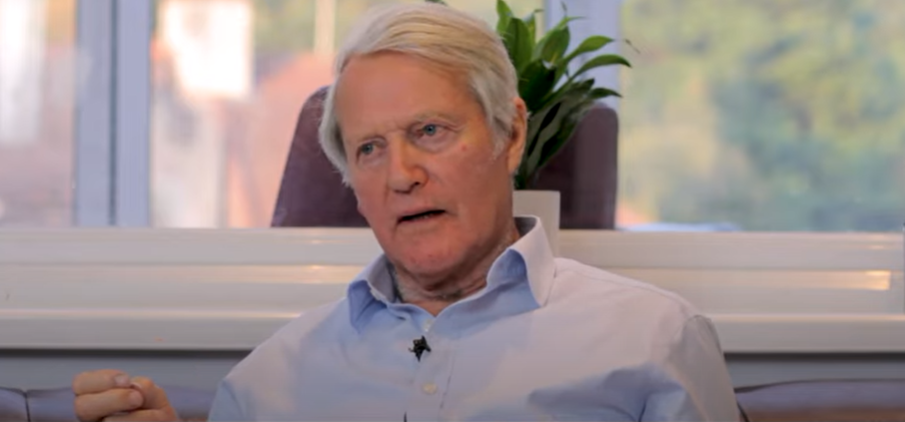
In this conversation with Tsering Passang, Founder of the Global Alliance for Tibet & Persecuted Minorities, David Ball shares how he got involved with the Uyghur solidarity campaign and his engagements with the Labour Party to secure support for the Uyghur cause.
David also shares his thoughts on the Uyghur Tribunal hearings which were held in April, September and November this year. The final ruling (or the Judgement) is expected on 9th of December 2021, on the eve of the Human Rights Day.
Like David, millions of grassroots campaigners around the world are helping with highlighting the appalling abuse of human rights by the Chinese Communist regime which continues to persecute Uyghurs, Tibetans and Hongkongers amongst others in China and its occupied territories.
The Global Alliance for Tibet & Persecuted Minorities would like to acknowledge and sincerely thank all for your continued support.
Useful Links:
A GATPM Report Launch – 100 Atrocities Committed by Chinese Communist Party (CCP)
As the Communist Party of China (CCP) celebrates its 100th founding anniversary this year, the Global Alliance for Tibet & Persecuted Minorities (GATPM) wishes to put on record the top 100 atrocities committed by the Chinese regime over the past 100 year.
The report will be launch on 10th December with a Welcome Message from British MP Tim Loughton, Chair of the All-Party Parliamentary Group for Tibet (AGGPT) and a Member of Inter-Parliamentary Alliance on China (IPAC).
Human Rights Day – London Protest
On the 10th of December, on International Human Rights Day, Tibetan, Uyghur and Hongkonger advocacy groups will come together for a series of actions to protest the repression, surveillance and genocide our communities have experienced at the hands of the Chinese Government.
Rally and march from Piccadilly Circus to the Foreign, Commonwealth and Development Office
10th December 2021, for 18:00 – 20:00
Location: Marching from Piccadilly Circus (W1J 9LL) to the FCDO (SW1A 2EG)
Tibetan, Uyghur and Hongkonger groups will be marching in unified protest against the Chinese Regime’s numerous and relentless human rights abuses. We are marching to the FCDO to demand they do not send diplomats and ministers to an Olympic Games hosted by the architects of the repression and genocide enacted upon our communities.
Speakers will include Dolkun Isa, President of the World Uyghur Congress, Tibetan activist and filmmaker Dhondup Wangchen, who was arrested in 2008 for capturing the sentiments of brave Tibetans in the run up to the 2008 Beijing Olympics.
Also speaking will be Can, representing Hong Kong Aid, and Tenzing Ragba from the Tibetan Community in Britain.
For more information contact:
Free Tibet: john@freetibet.org
Tibetan Community UK: pemayoko@gmail.com
Stop Uyghur Genocide: edie@stopuyghurgenocide.co.uk
World Uyghur Congress: I.Rodrigues@uyghurcongress.org
Global Alliance for Tibet & Persecuted Minorities (GATPM): info@gatpm.com
John Billington from Montgomery submitted his letter to The Daily Telegraph’s Editor on 2nd December in response to British MP Andrew Rosindell‘s call for help the people of Hong Kong. Since this letter was not published, the GATPM is delighted to make it available to our readers and supporters.
“Dear Sir,
I wholeheartedly endorse Andrew Rosindell’s call that we in the free world should stand by Jimmy Lai, democracy and the rule of law, and demand an end to authoritarianism in Hong Kong. But it is not just Hong Kong. A self-governing Tibet was forcibly annexed in 1950 by a triumphalist communist army and has been held by force and ruthless repression for more than seventy years — ignored by the outside world despite over 155 self-immolations by desperate Tibetans whose former religion, culture and freedoms, like those of the neighbouring Uighur peoples, continue to be endlessly eroded.
It is some consolation for us in the free world that the malign intentions of the CCP (Communist Party of China) have finally been rumbled by our over-credulous leaders but it must be stressed that it is not the Chinese people — subject themselves to the most intrusive Orwellian survelliance of any nation on earth — that we should oppose. Rather we must help our Chinese friends to overthrow the oppression of the communist party that denies them the freedoms that we enjoy.”
Joint Tibetan, Uyghur and Hongkonger International Human Rights Day actions to highlight the human rights violations routinely committed by the Chinese government

On the 10th of December, on International Human Rights Day, Tibetan, Uyghur and Hongkonger advocacy groups will come together for a series of actions to protest the repression, surveillance and genocide our communities have experienced at the hands of the Chinese Government.
The Chinese Communist Party (CCP) is one of the world’s greatest human rights abusers. From violently crushing calls for democracy in Hongkong, to erasing Tibetan identity, to committing genocide against the Uyghurs – they represent a global threat to international standards of human rights. Despite this, the Chinese government has once again been awarded the international honour of hosting an Olympic Games – this time for the Beijing 2022 Winter Olympics. Our actions on Human Rights Day will therefore be focused on protesting this moral failing – and on calling on the UK to demand accountability for the Chinese authorities’ crimes.
Joint petition handed to the British Olympic Association calling for a full boycott of the Beijing 2022 Winter Olympics
When: 10th December 2021, 16:00
Location: British Olympic Association, 101 New Cavendish St, London W1W 6XH Free Tibet and allied organisations, the World Uyghur Congress, the Tibetan Community in Britain, the Global Alliance for Tibet & Persecuted Minorities and Hong Kong Aid will hand a joint petition to the British Olympic Association calling for a boycott of the 2022 Beijing Winter Olympics.
Rally and march from Piccadilly Circus to the Foreign, Commonwealth and Development Office
When: 10th December 2021, for 18:00-20:00
Location: Marching from Piccadilly Circus (W1J 9LL) to the FCDO (SW1A 2EG) Tibetan, Uyghur and Hongkonger groups will be marching in unified protest against the Chinese Regime’s numerous and relentless human rights abuses. We are marching to the FCDO to demand they do not send diplomats and ministers to an Olympic Games hosted by the architects of the repression and genocide enacted upon our communities. Speakers will include Dolkun Isa, President of the World Uyghur Congress, Tibetan activist and filmmaker Dhondup Wangchen, who was arrested in 2008 for capturing the sentiments of brave Tibetans in the run up to the 2008 Beijing Olympics. Also speaking will be Can, representing Hong Kong Aid, and Tenzing Ragba from the Tibetan Community in Britain.
For more information contact:
Free Tibet: john@freetibet.org
Tibetan Community UK: pemayoko@gmail.com
Stop Uyghur Genocide: edie@stopuyghurgenocide.co.uk
World Uyghur Congress: I.Rodrigues@uyghurcongress.org
Global Alliance for Tibet & Persecuted Minorities (GATPM): info@gatpm.com
Zara Fleming shares her Tibetan and Himalayan encounter with Chok Tsering, who interviewed this veteran Tibet supporter for Londonney. Zara, a current Trustee of Tibet Relief Fund, served as Chairman of Tibet Society & Tibet Relief Fund of the UK for many years, who is well recognised English lady within the Tibet circle in the UK.
The interview was filmed and edited by Ngawang and directed by Dalha Tsering. LondonNey is a London-based Tibetan production company which conducts interviews with Tibetans and non-Tibetans who have contributed to the Tibetan cause.
Zara Fleming is an independent art consultant, lecturer, tour guide and exhibition curator with specialist knowledge of Buddhist art; focusing on the art and culture of Tibet and the Himalayas.
Lecturing experience includes the Arts Society (formerly NADFAS), the School of African and Oriental Studies, the V & A, Merseyside County Museums, the Oriental Museum in Durham, the Royal Academy, the Brunei Gallery, Asia House and to schools, universities and various study groups. She has also lectured in Europe, Australia and New Zealand.
Initially based at the Victoria & Albert Museum, with general responsibility for the Tibetan, Himalayan and Burmese Collections (1974-81); Zara was then affiliated with the Central Asian Department at Bonn University cataloguing the Tibetan and Mongolian collections of all UK Museums and private collections, part of a larger cataloguing project throughout Europe (1981-88) and was the Assistant Projects Director in Europe for the Orient Foundation (1984-5).
She has curated several exhibitions including “Man and Environment in Harmony“ for Vistech International, London (1992), “In the Steppes of Genghis Khan” at the October Gallery in London, 2003; “Asia – Body, Mind, Spirit” for the Wellcome Library and Asia House, 2004 and “The Tiger in Asian Art” at Asia House, 2010. And prepared the educational material for the “Sacred Art of Tibet – Wisdom and Compassion” exhibition at the Royal Academy in London (1992).
Art consultant and Curatorial Advisor for the Worlds Culture Gallery (Buddhism), the National Museums and Galleries on Merseyside (2001-4); Art consultant and British Advisor for the Centre for Cultural Heritage in Ulaan Baatar, Mongolia (on a catalogue of Mongolian Buddhist art) and Art Consultant for the Orient Foundation (Classical Tibetan Arts website.)
Zara has been travelling in Asia since 1973 and has been the tour guide and guest lecturer on numerous trips to Bhutan, Ladakh, Zanskar, Spiti, Nepal, Mustang, Burma, Tibet ; and led the first British tour to Tibet in 1981.
She co-edited “Masterpieces of Mongolian Art; Vol 1” (published in 2011) and has contributed articles for art and travel publications, and journals specialising in Buddhist art and culture.
For more details, please visit: www.zarafleminguk.com
(A joint statement to address the safety and security concerns of Hongkongers and other minoritised groups by Hong Kong-led civil society groups and allies)
As organisations representing and/or serving and supporting Hongkongers and broader East and Southeast Asia (ESEA) communities in the UK – including groups comprising asylum seekers, refugees and migrants – and allies, we are writing to express our grave concerns about the safety and security of Hongkongers and fellow minoritised groups in the UK. This statement follows a violent attack that took place after last week’s “TIME TO ACT – Stop Racism, No to New Cold War” rally on 27th November, an event organised by The Monitoring Group, Min Quan and the Federation of Fujian Chinese; and multiple threats and tactics of intimidation used by different groups against Hongkongers and other members of ESEA communities.
In general, we are concerned that calls for unity against anti-Asian racism – including that invoked by the “Stop Racism, No to New Cold War” rally organisers – have been used to silence legitimate criticisms of the Chinese Communist Party (CCP) and its repressive regime, which have committed grave atrocities and human rights violations against Uyghur Muslims and other minoritised groups in Xinjiang, as well as against Tibetans and Hongkongers, among others. Surely this, too, is racism, even though it does not take place in the UK. This racial violence of course has global ramifications, including resulting in displacement and forced migration, with impacts on ESEA diaspora communities.
What has prompted this statement in particular is the violent attack against numerous Hongkongers who organised a peaceful counter-protest to highlight the hypocrisy of this rally. Moreover, we have become aware of messages circulating on WeChat (an instant messaging app) putting a bounty on two Hong Kong activists (Simon Cheng and Nathan Law), offering £10,000 to anyone who could offer their UK addresses. Last weekend, we saw messages seeking to create vigilante groups to attack any Hong Kong groups supporting Hong Kong independence. These tactics of intimidation not only threaten the safety and security of Hongkongers (and supporters of Hongkongers’ struggles), they infringe on Hongkongers’ fundamental right to freedom of expression.
Since the advent of the draconian National Security Law, many Hongkongers have migrated to the UK to seek sanctuary. Hongkongers deserve to feel safe and secure as they build their new home.
We call upon the support of everyone in the UK to secure long-term protection and support for Hongkongers – and broader ESEA communities – in the UK, including through resourcing community centres, legal aid clinics, and other civic organisations. We also call on our allies to stand with us in the fight against racism and authoritarian state violence in all forms, wherever it occurs.
Co-Signatories:
Cambridge Stands With Hong Kong
Conservative Friends of Hong Kong
Democracy for Hong Kong – D4HK
Fight for Freedom. Stand with Hong Kong.
Good Neighbour Church England
Hackney Chinese Community Services
Hong Kong Affairs Association of Berkeley (HKAAB)
HKG International
Hong Kong in Chester
Hongkongers in London
Hong Kong Liberation Coalition – HKLC
Hong Kong Liberty
Hong Kong Professional Network (HKPN)香港協會
LIBERKONG
Reading UK Stands with Hong Kong
Southampton Stands With Hong Kong
Sutton Hongkongers
Umbrella Formations
Signatories in solidarity:
Cornell Society for the Promotion of East Asian Liberty – SPEAL
End Violence and Racism Against ESEA Communities
Global Alliance for Tibet & Persecuted Minorities – GATPM
In Common Breath
Victoria Harbor Group
World Uyghur Congress (WUC)
Yet Again UK
(Scroll up for Chinese version)【港人社區組織及其他族裔夥伴就其人身安全憂慮發表聯合聲明】聯署連結 Link to co-sign:https://forms.gle/YfxMVf99LwPUiy9X8作為支援在英亞裔及港人(包括庇護申請人、難民、及移民) 的社區、組織及夥伴,我們僅此嚴正關切在英港人及其他少數族裔的人身安全。 本份聲明事緣於十一月二十七日由英國監察組、倫敦民權法律中心、英國福建華僑華人聯合總會主辦「停止種族主義,拒絕新冷戰」集會之後所發生的暴力襲擊事件,以及一些團體不約而同地發動針對港人及亞裔社群的恐嚇及威脅。我們憂慮一些反種族歧視的正當訴求,被中共及一些獨裁政體的宣傳伎倆所利用和騎劫, 就像今次主辦方所推動的「停止種族主義,拒絕新冷戰」集會般,將批評中國專制政權的言論視為是針對華裔人士的偏見, 捏造成歧視亞裔人士的根源,企圖混淆英國當地公眾的視聽;對於新疆、西藏、香港及其他不同族裔人士被中共政權有系統地歧視及迫害,造成大量人口流離失所,對亞裔流散社區影響深遠的事實,卻視而不見。而促使我們發表此聯合聲明的,是因為有數名港人以和平方式抗議上述「反種族歧視」集會的立場虛偽且誤導時,遭到與會人士的暴力襲擊。更令我們關注的,是近日微信正流傳一則懸紅,指任何人若能提供香港社運人士鄭文傑及羅冠聰的英國地址,就能獲得一萬英鎊獎金。我們亦留意到有其他微信訊息,顯示有人正組織團隊,打算向任何支持香港獨立的港人組織施襲。這些恐嚇手段不僅威脅到香港人(及其他港人的支持者)的人身安全,更嚴重侵犯了香港人的基本言論自由。自嚴苛的《港區國安法》在香港生效後,不少港人移居英國尋求庇護。香港人在英國開展新生活時,應感到安全及受保障。我們呼籲英國民眾支持港人、東亞及東南亞人士,確保大家在英國都能透過社區資源中心、法律援助中心和其他公民組織等,獲得長遠的保障和支援。同時,我們呼籲各盟友攜手對抗在任何地方發生、一切形式的種族主義及獨裁國家暴力。
This year, Hong Kong has suffered severe crackdown of human rights. Many significant symbols of Hong Kong freedom were dismantled by the Chinese Communist Party (CCP).
10th December is the International Human Rights Day.

Hongkongers and their friends are organising a protest in central Manchester (St. Peter Square) on 11th December from 1pm to 4pm to highlight the CCP regime’s brutal crackdown in Hong Kong.
The Global Alliance for Tibet & Persecuted Minorities join in forces with Hong Kong Spirits TG (1) Calling on the Hong Kong Government to release all political prisoners, and to respect Hong Kong’s promised freedom and democracy; (2) Urging the Chinese Communist government to stop oppressing Hongkongers’ human rights, to stop spreading fears, to stop suppressing dissidents, and to stop interfering the freedom of press in Hong Kong. (3) To nominate British citizen Jimmy Lai for Nobel Peace Prize, in order to honour Jimmy Lai’s footlong achievements to advocate the value of democracy and freedom, especially the freedom of press.
Please come and join this peaceful protest. Further details available via: https://hkspirits.weebly.com/
A coalition of rights groups, Tibetan, Uyghur and Hongkonger communities are coming together on the Human Rights Day to remind the Chinese regime that all is not well in China and its occupied territories. They are calling on the UK Government to boycott the 2022 Beijing Winter Olympic Games.

The Chinese Communist Party has been given the privilege of hosting the 2022 Winter Olympics – with Beijing becoming the first city in sports history to host both the summer and winter games.
For over 70 years, the CCP has instigated crackdowns on freedom, democracy, and human rights; targeting those who speak out against the regime, and who do not conform to a state-enforced ‘Chinese’ identity.
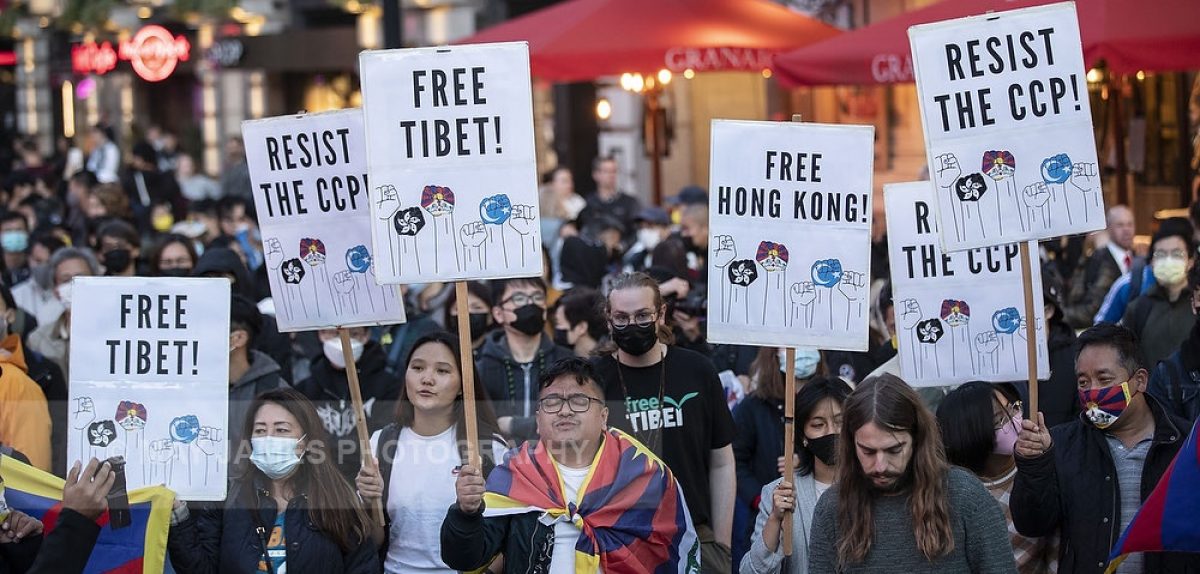
Protesters are first meeting at Piccadilly Circus (Piazza) at 6pm. After a short rally at the Piazza, the protesters will march to the Foreign, Commonwealth & Development Office (FCDO) in White Hall via Haymarket, Trafalgar Square and White Hall. The protest will end at 8pm after speeches in White Hall.
All are welcome to join this peaceful protest. China’s Wuhan Virus is still causing danger to the lives of people around the world. With this latest Omicron variant, organisers are advising the participants to follow the government guidelines/rules during the rally.
“Together We Resist CCP” protest in London is organised by:
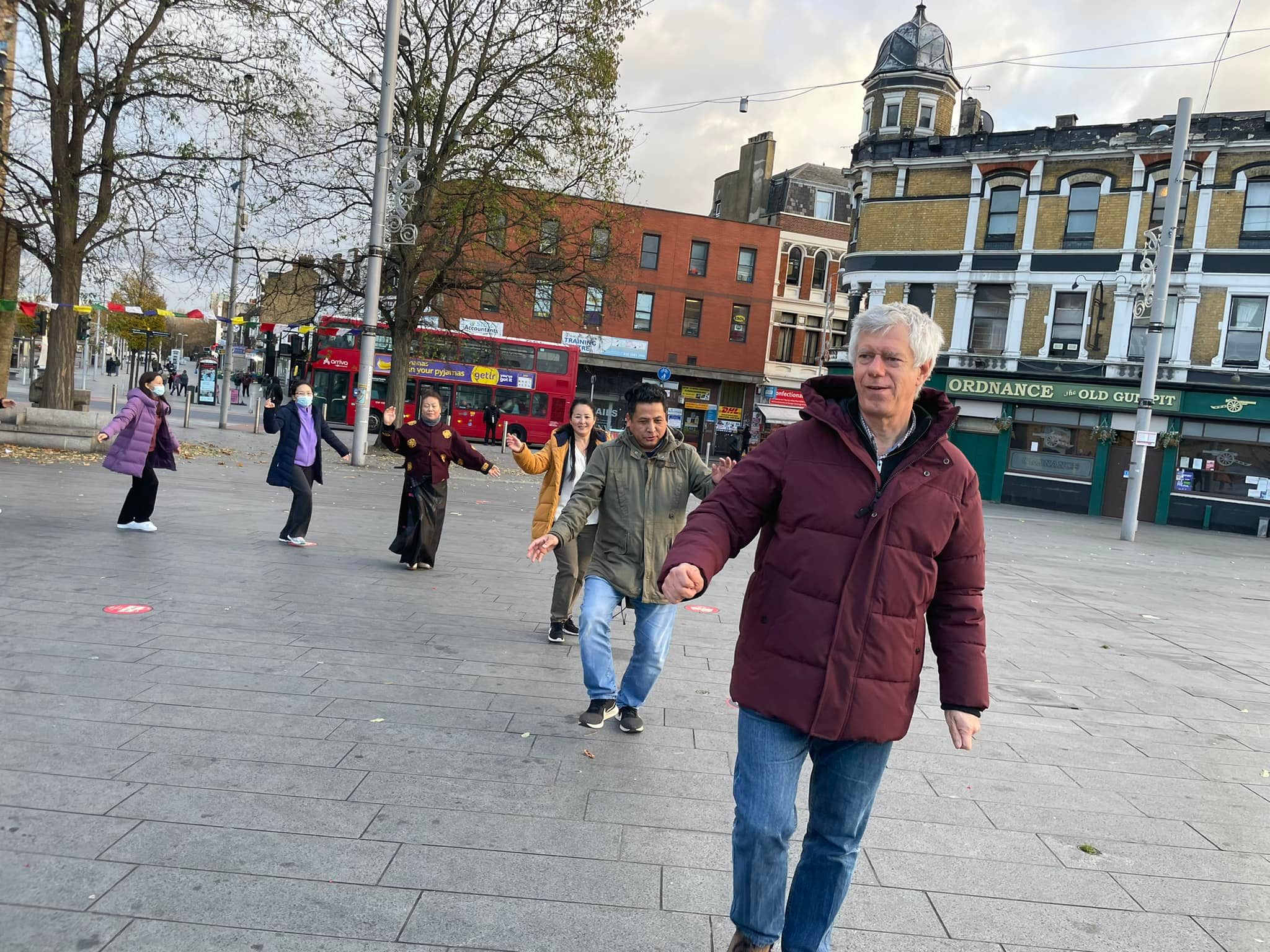
Despite the cold British weather about 40 Tibetans and their friends took part in Lhakar UK’s debut “Gorshey: Tibetan Circle Dance” in Beresford Square, Woolwich, London SE18 6BB on Sunday, 21st November.
Lhakar UK is a network of like-minded community members who engage in the preservation of peaceful Tibetan culture. “Lhakar” in Tibetan refers to the soul day བླ་གཟའ། of the Tibetan Spiritual Leader. His Holiness the Great 14th Dalai Lama, the recipient of 1989 Nobel Peace Prize, is a leading moral leader in the world. The 86-year old Tibetan Leader continues to promote peace, love and compassion from Dharamsala, the headquarters of the Central Tibetan Administration (aka Tibetan Government-in-exile), Dharamsala, northern India.
Woolwich has a long history with Tibet dating back to 1913. One of the four Tibetan “Rugby Boys”, named Sonam Gonppa Gongkar, who came on a Government Scholarship to study in the UK, in 1913, during the reign of His Holiness the Great 13th Dalai Lama, attended the Royal Military Academy, Woolwich in London. Gongkar was also attached to the Northumberland Fusiliers for a short period.
Currently, Woolwich is home to over 100 Tibetans. Several eateries are also run by Tibetans in this booming town of London. There are about 800 Tibetans living in the UK. The Tibetan Community in Britain, which celebrated 50th founding anniversary earlier this year, organises regular cultural and socio-political events for its community members and friends of Tibet.
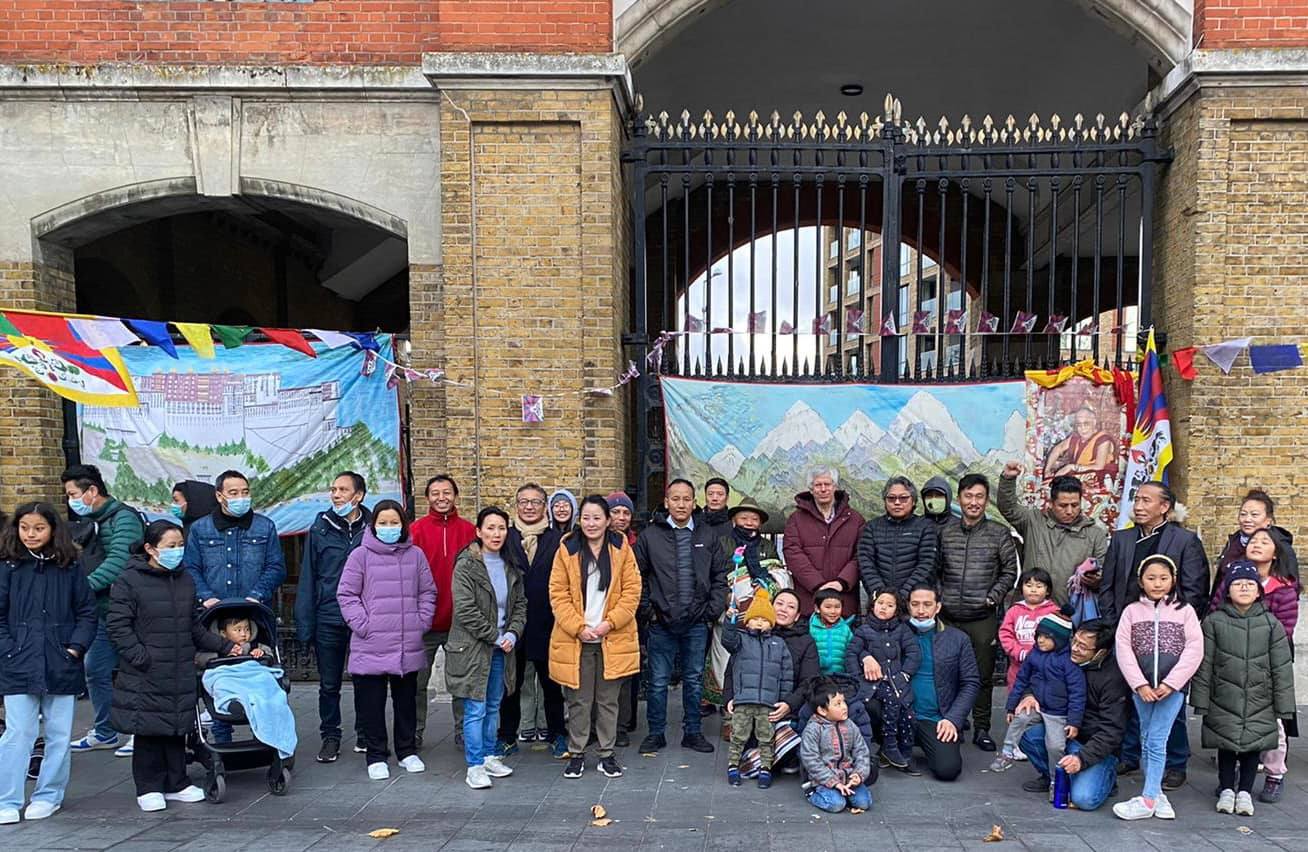
Tsering Passang, a co-organiser of this cultural initiative acknowledged the support given by the Royal Borough of Greenwich. He thanked Cllr. David Gardner, a former Deputy Leader of the borough, for his continued support for Tibet and the Tibetan people. Passang said that with Cllr. David Gardner’s help, this latest cultural project, initiated by Ugyan Norbu, an elder Tibetan resident in the Royal Borough of Greenwich, was materialised.
After taking part in the Tibetan circle dance, Cllr. Gardner said that he was pleased to see the Tibetan culture being preserved and thriving locally in the borough. Every weekend, a Tibetan language class for young children is being held in the Walpole Estate where Cllr. Gardner serves on its Management Board. He added that it was important to support the Tibetan residents to preserve their unique culture.
On 10th March 2021, the Royal Borough of Greenwich once again hoisted the Tibetan National Flag, attended by the Mayor, Leader of the Council and their colleagues. Cllr. Gardner added that the Council is able to continue with hoisting the Tibetan Flag annually as a show of support and solidarity with the Tibetan people who face persecutions for their fundamental beliefs in the free speech as well as universal rights in their home country, Tibet, which is still under occupation of the People’s Republic of China.
The Tibetan National Flag was first hoisted in the Woolwich Town Hall on 18th September 2015 to honour the arrival of the Dalai Lama to the Royal Borough of Greenwich. The Tibetan Spiritual Leader gave public talks at The O2 Centre the following day where the then Mayor of the borough met with the Nobel Peace laureate.
The next “Gorshey” session is being planned for Sunday, 5th December 2021 at the same place from 2pm to 4.30pm. As the weather is predicted to be colder in December organisers urge the participants to come prepared!

(By Tsering Passang, Founder of Global Alliance for Tibet & Persecuted Minorities)

Like many other international organisations, Interpol serves a vital purpose in tracking down criminals worldwide and bringing them to justice. The International Crime Police Organisation (commonly known as Interpol) is the world’s largest international police organisation with membership from some 194 countries. It is an inter-governmental organisation second in size to the United Nations.
Interpol, based in France, provides investigative support, expertise, and training to law enforcement bodies worldwide, coordinates networks of police and experts between countries and allows access to their database for information on crimes and criminals. Member countries designate officers in their national agency who liaise with the Interpol for cooperation.
In recent years, the Chinese government has been making strenuous efforts to deploy its delegates in higher positions within international organisations of which China is a member. It has now become clear that China uses these international organisations to promote its domestic agenda.
When Meng Hongwei, China’s delegate to Interpol, served as its President from 2016 to 2018, Red Notices were selectively served to repatriate Chinese nationals wanted by the authorities in China for engaging in political and religious activism or views contrary to the Communist Party. For China, the Red Notice system forms a vital part of the Chinese regime’s repatriation strategy. It not only freezes all international bank accounts of its victims but increases travel restrictions for the designated individuals.
Serious abuser countries such as China must be stopped from misusing Interpol’s prominent platform. China’s misuse of Red Notices as a tool of its domestic agenda to forcibly return dissidents is well-documented. Dolkun Isa, President of the World Uyghur Congress, who was subject to such a Red Notice for almost 20 years before it was deleted in 2018 is a classic example of China’s wrongdoing.
In the coming days, the three vacancies available for countries in Asia at Interpol are due to be filled by candidates from the four countries whose candidates are listed below. China has been lobbying heavily to ensure its delegate is anointed.
The Global Alliance for Tibet & Persecuted Minorities (GATPM) has joined forces with other leading activists and advocacy groups around the world, calling on member countries to refrain from voting for Hu Binchen, the Chinese delegate. If Hu Binchen is voted in, he is likely to become the President of this international police organisation in the very near future.
It is important to know why we object to Hu Binchen in particular. Binchen was the Head of Security during the 2008 Beijing Olympics. He is also supervising security during the 2022 Beijing Winter Olympics. Hu Binchen was responsible for the evictions and demolishing of homes near the 2008 Beijing Olympics sites that smoothly paved the way for infrastructure building.
Silencing Chinese citizens who expressed concerns about the Olympics in relation to human rights abuses, through intimidation, imprisonments and the use of house arrests, were among Hu Binchen’s abuse of his powers. In addition to providing key technical and security guidance to the Chinese leadership, Binchen also provides support on digital surveillance tools to foreign governments during training programmes.
There is no doubt that should Hu Binchen be appointed to the prominent Interpol platform, he would faithfully serve Xi Jinping and fully cooperate with the Chinese regime’s work of crushing the voices of Hong Kongers, Uyghurs, Tibetans, Taiwanese, and Chinese human rights activists as well as other persecuted minorities. Member countries of Interpol must not allow this to happen.
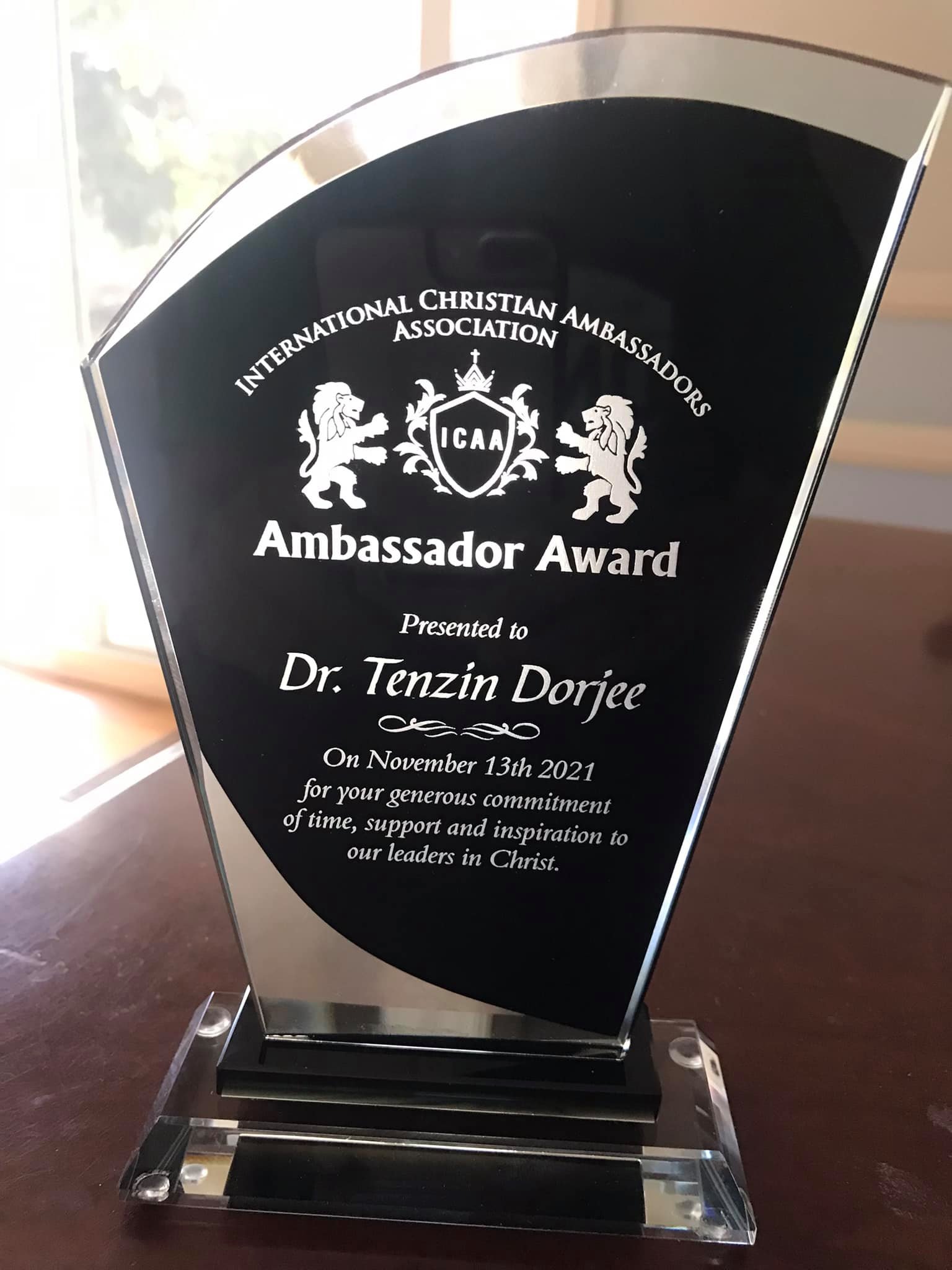
Dr. Tenzin Dorjee, a former Chairman of the United States Commission of International Religious Freedom (USCIRF), was recognised for his service by the International Christian Ambassadors Association on 13th November. The Tibetan scholar was presented the “Ambassador Award” during the 1st International Christian Leadership & Religious Freedom event in Orange County, California.
The special event was addressed by prominent speakers including, former US Ambassador At-Large for International Religious Freedom (2017-2021), Governor Sam Brownback, who had met the Tibetan Spiritual Leader, His Holiness the Dalai Lama.
Dr. Tenzin Dorjee was first appointed to the US Commission of International Religious Freedom on December 8, 2016, by Speaker Nancy Pelosi, when she was the House Minority Leader. He was reappointed to the Commission by Leader Pelosi on May 10, 2018. On June 12, 2018, Dr. Tenzin Dorjee was unanimously elected Chair of the Commission.
He is the first Tibetan to take the prominent role in the US.
Background:
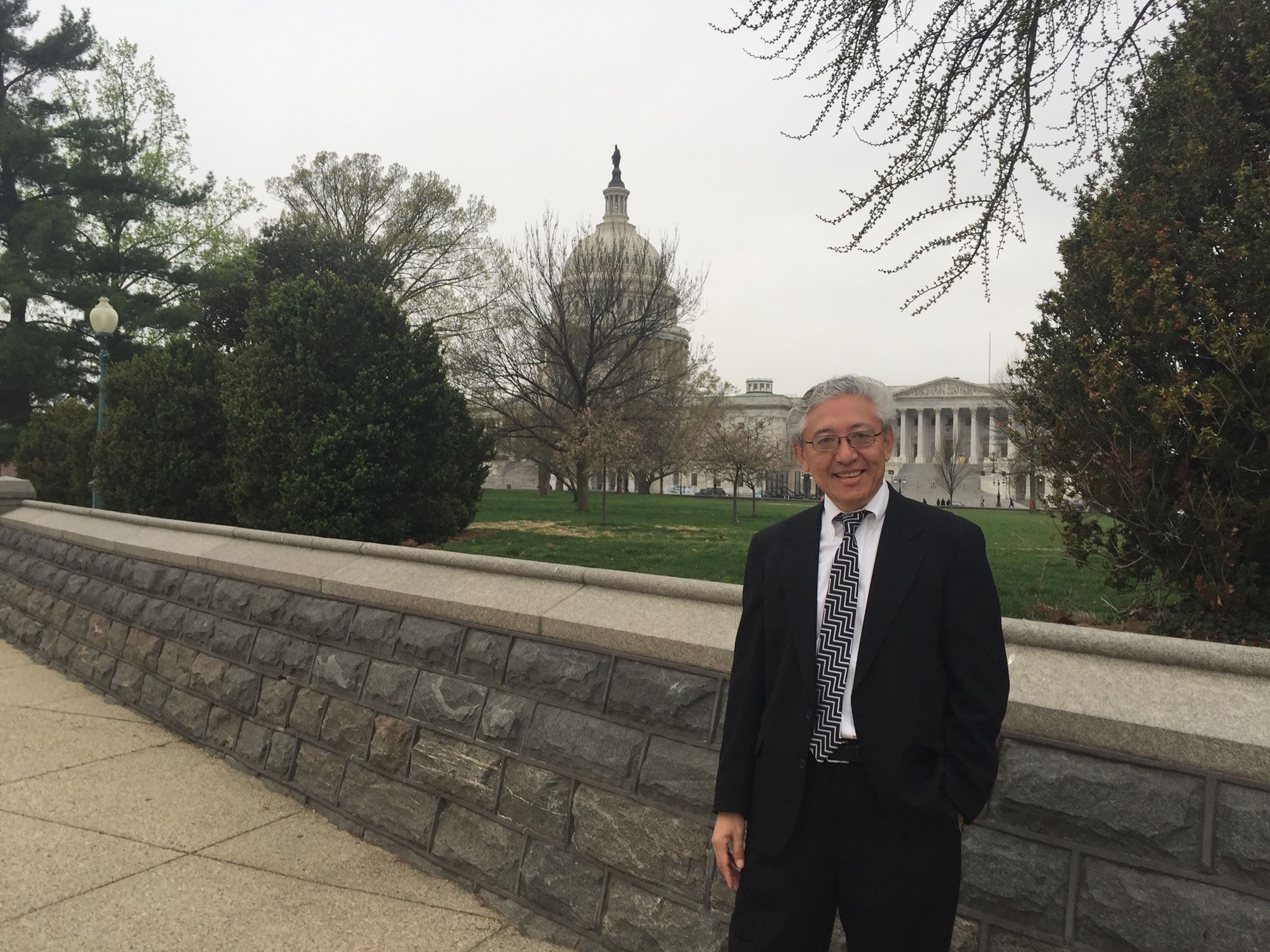
Tenzin Dorjee (Ph.D., University of California, Santa Barbara, UCSB) is Associate Professor at the Department of Human Communication Studies, California State University, Fullerton (CSUF). His primary teaching and research interests are intergroup, intercultural, and intergenerational communication, identity issues, peacebuilding, and conflict resolution. At CSUF campus, he has received faculty recognition awards for outstanding achievements in teaching (2011), research (2013), and community service (2015).
He has authored and co-authored peer-reviewed articles and invited chapters on Tibetan culture, identity, nonviolence, and middle way approach to conflict resolution including Sino-Tibetan conflict, intercultural and intergroup communication competence, intergenerational communication context, and others. Based on his dissertation, he co-authored with Giles, H., and Baker, V. (2011): “Diasporic communication: Cultural deviance and accommodation among Tibetans in exiles in India,” Journal of Multilingual and Multicultural Development, 32(4), 343-359. Most recently, he co-authored Communicating Across Cultures (second edition) with Stella Ting-Toomey (2019) and published by The Guilford Press, New York. He also guided students to present papers at annual regional, national, and international communication conferences and co-authored peer-reviewed journal articles with them.
Dr. Dorjee received the 2017 Distinguished Faculty Marshall of the College of Communications and Distinguished Faculty Member of the Department of Human Communication Studies awards. Tibetan Association of Southern California (TASC) honored him in 2018 with Appreciation Award for his USCIRF service on behalf of all Tibetans. Dr. Dorjee is a prominent translator who studied at Sera Jey Monastic University, South India, and the Institute of Buddhist Dialectics, and worked in the Translation and Research Bureau of the Library of Tibetan Works and Archives (LTWA), Dharamsala, India, for over 13 years. For over 20 years, he has been a volunteer translator for Gaden Shartse Thubten Dhargye Ling Tibetan Buddhist Center in Long Beach, CA, founded by late His Eminence Geshe Tsultim Gyeltsen. He is also a published author of articles and translated works of Tibetan Buddhism and culture into English. He had the honor to translate for many preeminent Tibetan Buddhist Professors including His Holiness the Dalai Lama in India and North America. He served as a former Member-At-Large in the Executive Council of the Western States of Communication Association (WSCA), Chair of WSCA’s Distinguished Teaching Award Committee, Basic Course Director of the Department of Human Communication Studies, CSUF, and Vice President and President of the Tibetan Association of Southern California.
His service record is extraordinary. To further freedom of religion, he travelled to Burma and Iraq to monitor religious freedom conditions there. He testified before U.S. Congress about the religious freedom conditions in China, including Tibet, and Long Arm of China in the U.S. academic institutions. He spoke at various venues, such as USCIRF events and Parliament of the World’s Religions, about Tibet, Buddhism, Tibetan culture and Sino-Tibetan relations. He has served on many community-based committees. At the invitations of the Office of His Holiness the Dalai Lama, and Tibetan institutes in India, including the College of Higher Tibetan Studies, the Dalai Lama Institute for Higher Education, the Library of Tibetan Works and Archives, and the Tibet Policy Institute, he taught intercultural communication, social science research and methodology, teaching pedagogy, and translations techniques.
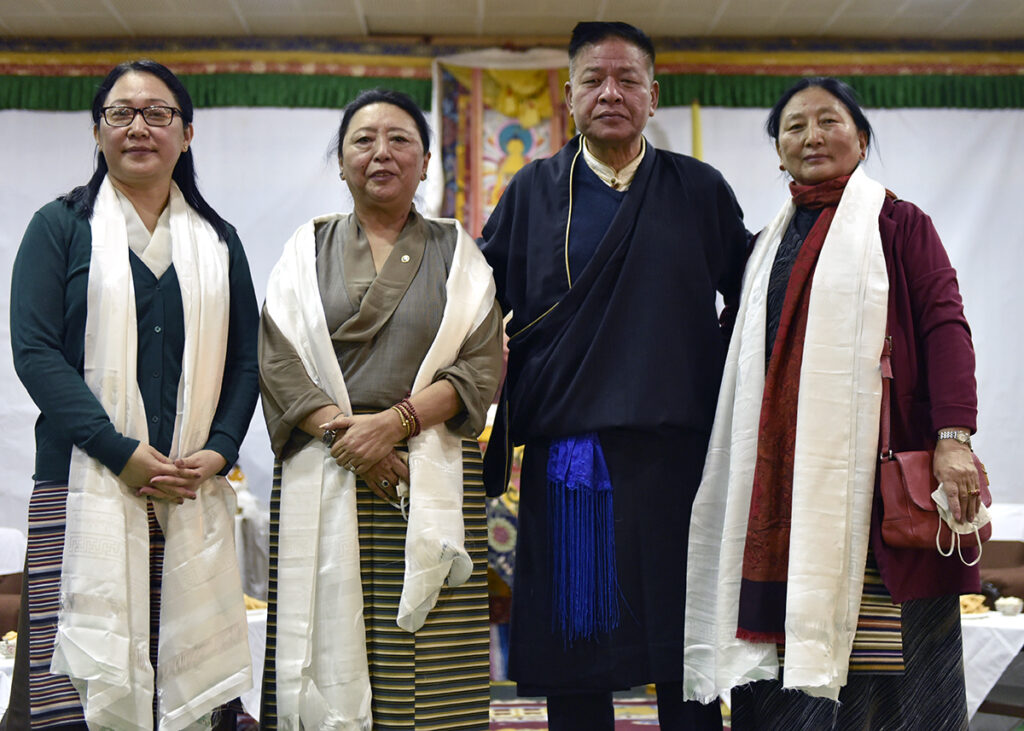
Change is coming. A positive Change. It is coming to Dharamsala – the Headquarters of the Central Tibetan Administration (aka Tibetan Government-in-exile). It is coming in the form of Women Leadership.
For the first time in the Central Tibetan Administration’s six decades history, 75% of Cabinet Members are Women. They are (1) Kalon Gyari Dolma (2) Kalon Changra Tharlam Dolma and (3) Kalon Norzin Dolma.
Tibetans informally referred to them as the “Three Taras” (or Dolmas) in Sikyong Penpa Tsering’s Administration.
The three Women Kalons of the 16th Kashag were nominated by Sikyong Penpa Tsering. They were recently approved by the 17th Tibetan Parliament-in-exile. This morning, the three Women Kalons were officially sworn-in at a ceremony held at the Sikyong Auditorium in Gangchen Kyishong, the seat of the Central Tibetan Administration.
The oath-taking ceremony was attended by Honourable Sikyong Penpa Tsering, members of the 17th Tibetan Parliament, Justice Commissioners, heads of the autonomies bodies and the Secretaries of the various departments of the Central Tibetan Administration.
Kalon Norzin Dolma was appointed as Minister for the Department of Information and International Relations (DIIR) – equivalent to Foreign Office.
Kalon Changra Tharlam Dolma became Minister for the Department of Education.
Kalon Gyari Dolma was appointed as Minister for the Department of Security.
Brief background of the new Kalons (Ministers):

Kasur Gyari Dolma completed her school at CST Darjeeling in 1981. She received her BA degree from Panjab University in Chandigarh in 1985. She pursued B.A LLB from Delhi University’s prestigious Faculty of Law from 1985 – 1988.
At school, she was a recipient of the Best Girl award conferred by the Department of Education. She also founded a student organisation for social service and served as its founding president. This was the first Tibetan student-led organisation dedicated to student welfare and co-operation. In college, she served as the president of the Foreign Students Association of Government College for Girls, Panjab University. She was also a board member of the regional Tibetan Youth Congress at the time. During her student days in Delhi, she established contacts with the youth leagues of various Indian political parties and began the celebration of Tibet Day in Indian colleges.
From 1986 – 1991, she served as a member of the central executive committee of the Tibetan Youth Congress (TYC). She also served as an advisor to the Regional Tibetan Women’s Association (RTWA) of Delhi and the Central Tibetan Women’s Association in Dharamshala, along with many other non-governmental responsibilities.
In 1991, following the democratisation of the Tibetan Parliament by His Holiness the Dalai Lama, she was elected to the 11th Tibetan Parliament-in-Exile (then known as Association of Tibetan People’s Deputies). At the age of 26, she was the youngest person to be elected to the Tibetan Parliament. Since then, she has been elected to the 12th, 13th and 14th Tibetan Parliament-in-Exile as one of the representatives from Dotoe province. She is also the first female Deputy Speaker of the Tibetan Parliament-in-Exile and served in that role for two consecutive terms in the 13th and 14th Tibetan Parliament-in-Exile.
From 2011 – 2016, she served as Kalon for the Department of Home in the 14th Kashag. She was also one of the candidates for the Kalon Tripa elections in 2011 and the Sikyong elections in 2021.

Former Parliamentarian Changra Tharlam Dolma completed her schooling at Gangtok, Bylakuppe, and Nirmala Convent school in Mysore. She received her Bachelor of Arts degree from Teresian College and Master of Arts (Economics) from Mysore University in 1975. She completed her B.Ed degree from St. Joseph’s in Mysore.
Tharlam Dolma has served for over 37 years in Tibetan schools including 14 years as a teacher in both primary and senior secondary schools. From 1991 – 94, she served as the principal of CST Dalhousie, and from 1994 – 2003, and again from 2005 – 2009, she served as the Principal of CST Bylakuppe. From 2009 – 2010, she served as the Principal of CVP school in Dekyi Larso, Bylakuppe. From 2003 – 2005, and again from 2010 – 2013, she served as the principal of CST Mundgod. She retired from active service in 2013.
Tharlam Dolma also served as the Core committee member of the regional Tibetan Women’s Association of Bylakuppe and as a board member of Dalhousie Public School and Dalhousie Hill Top School. In 2013, she received the prestigious National Award for Teachers from President Abdul Kalam.
Since 2011, she is a member of the Department of Education’s Education Council and Advisory Committee and is also a governing council member of the Dalai Lama institute based in Bengaluru.

Born in Kollegal on 28 November 1975, Kalon Norzin Dolma began her education at CST Kollegal and CST Shimla. She holds a BA in English, History, and Sociology from Teresian College and MA in English Literature from Mysore University, India. Under the Tibetan Scholarship Program, she earned MA in Law and Diplomacy (MALD), focusing on international organization and international negotiation & conflict resolution from Fletcher School, Tufts University, USA, with cross-registration from Harvard University’s GSAS and KSG. Later, she also obtained a BA in Library and Information Science from Mysore University.
She has consistently received prizes and awards for academic excellence, including All-Mysore Iyengar Memorial Award, Mother Euphrasia Award, and Tauro Memorial Award.
Norzin previously worked as a research officer, senior program officer, acting executive director, and board of directors at the Tibetan Center for Human Rights and Democracy (TCHRD). After her US education, she returned to India and served as the head of UN, EU & Human Rights Desk at CTA’s Department of Information and International Relations (DIIR). She later worked as a development officer at The Tibet Fund (TTF), New York.
She has advocated Tibet issues at international conferences, including the 59th and 61st sessions of the United Nations Commission on Human Rights, Geneva; World Social Forum, Mumbai; UN-Civil Society Relations, Bangkok; and World Summit on Sustainable Development conferences, Bali and Johannesburg. Norzin has authored and edited books and reports, including 2008 Uprising in Tibet: Chronology and Analysis (DIIR 2009), Unjust Sentencing of Tulku Tenzin Delek (TCHRD 2004), Destruction of Serthar Institute (TCHRD 2002), 35 Years: Special Report (TTF 2015), and Nepal Earthquake: Rebuilding Efforts in Tibetan Community (TTF 2016).
(Further info: www.tibet.net)
(Fredrick Hyde-Chambers OBE, 12th May 1944 – 31st October 2021)

Within hours of learning the sad news of the passing of their dear friend, Mr Fredrick Hyde-Chambers OBE – popularly known as “Riki”, the Tibetan Community in Britain started praying for the deceased soul.
Tibetan children, teachers and parents recited Buddhist prayers for “Riki” during the morning school assembly on Sunday, 31st October at the London School of Tibetan Language & Culture (LSTLC) in east London. Tibetan teacher Ms Kunsang Chodon said that Tibetans had lost a good friend today. They recited Buddhist mantras “Om Mani Padme Hung”.

After the news unfolded, the Council of Tibetan Community in Britain held an urgent meeting earlier in the day. A Community Circular was then released to the Tibetan members and supporters, which reads: “It is with great sadness that we share with you the news of the sudden demise of our long time friend and supporter Riki Hyde-Chambers this morning. Riki was a well known and long time supporter of Tibet who spent much of his time working on the Tibetan freedom struggle. We, on behalf of the Tibetan community, extend our sincerest condolences to Riki’s family at this difficult time.
“Please join us this evening at 6:00 pm via Zoom to remember Riki’s life and pray for his quick rebirth. The prayer will be led by His Eminence Lelung Rinpoche of the Lelung Dharma Centre. We really appreciate your presence for this important prayer session.”
Nearly 40 households attended the virtual prayer meeting, which started shortly after 6pm. His Eminence Lelung Rinpoche, Spiritual Director of the Lelung Dharma Centre, led the Buddhist prayers.

Rt. Hon Norman Baker, a former British Minister and former President of the Tibet Society, also a close friend, spoke highly of Riki. He also highlighted Riki’s contributions to Tibet and the Tibetan cause through the Tibet Society including, helping with organising the first visit by His Holiness the Dalai Lama to the UK in 1973.
Acknowledging the contributions made by Riki, Ms Tsering Tsomo, Secretary at The Office of Tibet, London expressed condolences to his family on behalf of the Tibetan people on this very sad loss. The Tibetan Community and the Office of Tibet are planning more community gatherings to honour Riki’s contributions. They have also extended their support to his family.
Throughout the day, I got in touch with some former colleagues and friends of Riki. Everyone was shocked and saddened by this untimely demise.
John Billington, a former Chairman of the Tibet Society and Tibet Relief Fund of the UK, said, “Riki was a key-stone in the Tibet Society and the support for Tibet. His long contact with Buddhism and with influential figures in London when there were still people around who knew Tibet and India from service in the Colonial Office (before 1947) gave him authority when speaking on Tibet issues. And his work for the Parliamentary Trust brought him into contact with MPs and overseas visitors so that he had a wide circle of influential friends and the valuable skill of negotiating compromises. At a time when the Tibet issue is on the rise again Riki’s measured advice will be much missed.”
Zara Fleming, a former Chairman of Tibet Society & Tibet Relief Fund of the UK, said, “…thinking about his passing this morning, I was remembering when we first met. I joined the Society in 1974 and became a volunteer working in the office (nr Victoria) with Rosemary Squires, and it was Riki who filled me in on so much – particularly the political situation by introducing me to the newsletters from the Czech refugee Josten. Then in 1976, he asked me to be on the Council – so for me he has always been the lynchpin of the society, the glue that held things together and he did an enormous amount for Tibet particularly through his parliamentary and Buddhist connections. He had some rough patches in his life, but always managed to rise above them with tolerance and acceptance and with a smile; he was a true gentleman full of kindness and compassion and will be much missed. May he rest in peace…”
It is well known within the small Tibetan Community in UK that their Spiritual Leader His Holiness the Dalai Lama had shown his fondness of Riki and often referred to him as an “old friend of Tibet”.
“The passing away of Riki Hyde-Chambers, OBE, during the early hours of 31st October, is a great loss for Tibet and the Tibetan people. As someone who has known and worked closely with Riki during my time at the Office of Tibet, London, and later at the Tibet Society, I know that he was not only a very staunch supporter of the just cause of Tibet and but also was extremely helpful especially in reaching out to parliamentarians and maneuvering the complex and historic British parliament building. He will be greatly missed. I wish him peace and my heart goes out to his family and close friends,” Tsering Tashi, a former Representative of His Holiness the Dalai Lama at The Office of Tibet, London said.
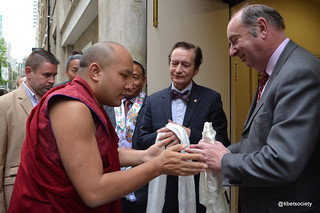
Throughout the day, social media was flooded with tributes for Riki.
India-based Tibetan parliamentarian, Migyur Dorjee, who was a former Representative of His Holiness the Dalai Lama at The Office of Tibet, London, wrote on his Facebook page, “I am saddened to learn untimely demise of my very dear friend Riki Hyde-Chambers. He was all weather a true friend of Tibet for decades and visited Dharamsala on many occasions with high level UK Parliamentary delegations. He was always first person to receive any Tibetan delegations from India to U K. I have no hesitation to say that he was instrumental in taking up many of Tibet related issues both in the UK and European Parliament when I was posted in London and Brussels. My heartfelt condolence to his family members. I will conduct a special Buddhist prayer service for his soul and urge every Tibetan to remember him in their prayers.”
Phuntsog Wangyal, founder of now-closed Tibet Foundation, who was also a former Tibetan MP and the first Representative of His Holiness the Dalai Lama based at The Office of Tibet in London, wrote, “Riki Hyde-Chamber was such a kind person, a real gentleman and special person who has done so much for so many people. He was a great supporter of Tibet and was the longest serving member of the Tibet Society of the UK.
“Riga and I have known Riki since 1973. We became good friends. Riki became a committed member of the Tibet Foundation. He has participated in many of Foundation events including recent Tibet Foundation documentary, “Getza -Helping Others”. He will be missed by all of us. We pray for him and send our condolences to his relatives and friends.”
During the afternoon, prayers were also recited at the Nepalese Buddhist Community Centre in Aldershot, where Riki served as an adviser.

Khenpo Tsewang Samdup, Spiritual Leader of the Buddhist Community Centre UK, wrote, “Riki Hyde-Chambers was such a kind person, a real gentleman and special person who has done so much for so many people. I have known Riki since 2007, We became good friends. He will be missed by all of us. We pray for him and send our condolences to his relatives and friends.”
Fredrick Hyde-Chambers OBE died on 31st October 2021, aged 77, at St. Thomas Hospital in London.
(Tsering Passang has worked with Riki Hyde-Chambers at Tibet Relief Fund and Tibet Society from 2007 to 2018).
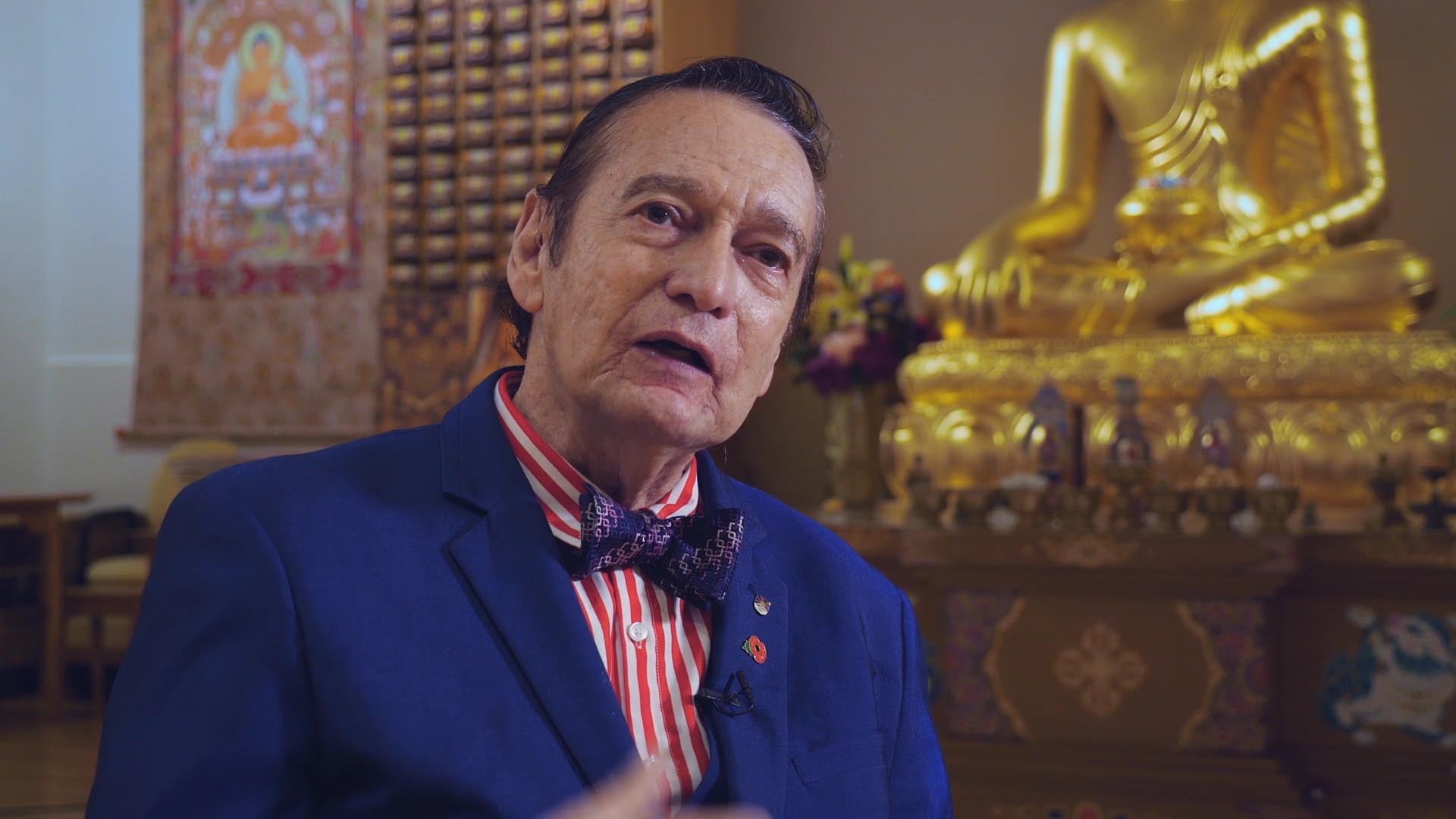
A Mission for Tibet – An interview with Fredrick R Hyde-Chambers OBE
To H.E. Mario Draghi, Prime Minister of Italy in the capacity as president of the G20
RE: Joint diplomatic boycott action of the 2022 Beijing Winter Olympics
We, a coalition of over 240 global campaign groups representing Tibetans, Uyghurs, Hongkongers, Chinese, Southern Mongolians, Taiwanese, and other affected and concerned communities. We are writing to you, ahead of the G20 Summit concerning the Beijing 2022 Winter Olympic Games, to urge for a joint diplomatic boycott of the Games in light of China’s extreme and worsening human rights situation.
The attendance of world leaders and diplomats at the Beijing 2022 Winter Olympic Games will put governments at serious risk of being complicit in China’s plan to ‘sport wash’ their human rights abuses and embolden the actions of the Chinese authorities.
As you descend on the G20 Summit we urge you to take the opportunity to commit to taking strong multilateral action by way of a joint diplomatic boycott of the 2022 Beijing Winter Olympic Games.
The Chinese government has publicly stated that Beijing 2022 will be “open and inclusive”, create a “harmonious world” and promote “social progress” – just as it did ahead of the Beijing 2008 Summer Games, but to no avail. For those living under China’s oppressive rule, daily life is anything but; it is instead characterized by a merciless crackdown on individual and collective rights and freedom, an all-out assault on cultural diversity, and a tearing apart of community cohesion through sophisticated methods of surveillance and control.
The Uyghur people are facing active genocide, with at least two million Muslims – including Uyghurs, Kazakhs, and Uzbeks – locked in “re-education camps” undergoing systematic torture and political re-education. The situation in occupied Tibet has dramatically deteriorated and in 2021 it was ranked by Freedom House as the least free place in the world for civil and political rights, alongside Syria. In Hong Kong, where Beijing has implemented a draconian National Security Law that bans acts of “splittism, subversion, foreign intervention, and terrorism”, freedom and democracy are under attack, and youth activists are being rounded up and imprisoned en masse. In China, the Chinese authorities routinely disappear government critics, feminists, and academics, as they attempt to stifle all forms of peaceful dissent. At the same time, Beijing has intensified its decades-long tactics of bullying and military threats and intimidation of democratic Taiwan.
Much like in 2008, the International Olympic Committee (IOC) has attempted to counter concerns about human rights abuses in China by asserting that the Games will positively affect China’s rights record. The IOC also pledged to take action should China fall short in meeting its human rights promises. Subsequent developments showed this faith to be misplaced as the Chinese government repeatedly backtracked on the human rights pledges it made to secure the right to host the Games and there was no accountability by the IOC and the international community. Instead, China was given a free pass to wantonly violate human rights and fundamental freedoms.
Given the failure of the IOC to provide any due diligence around the preparations for the 2022 Beijing Olympics, or evidence on how to manage the human rights risks connected to the Games – despite having multiple opportunities when Beijing 2022 progress reports were being conducted – it falls on governments to prove that the political will to stand up against China’s despicable human rights abuses is enacted.
We, therefore, call on like-minded governments to urgently commit to a joint multilateral diplomatic boycott of Beijing 2022.
Yours sincerely
Mandie McKeown, Executive Director, International Tibet Network – on behalf of:
Dorjee Tseten, Students for a Free Tibet
Dolkun Isa, World Uyghur Congress
Frances Hui, We The Hongkongers
Teng Biao, China Against the Death Penalty
Rushan Abbas, Campaign for Uyghurs
Jenny Wang, Keep Taiwan Free
John Jones, Free Tibet
周锋锁 Zhou Fengsuo, Humanitarian China
Tashi Shitsetsang, Tibetan Youth Association Europe
Bhuchung Tsering, International Campaign for Tibet
Dr Zoe Bedford, Australia Tibet Council
Mattias Bjornerstedt, Swedish Tibet Committee
Lhadon Tethong, Tibet Action Institute
Omer Kanat, Uyghur Human Rights Project
Enghebatu Togochog
Southern Mongolian Human Rights Center
and the following organisations:
Action Free Hong Kong Montreal
Aide aux Refugies Tibetains
Alberta Uyghur Association
Amigos de Tibet, Colombia
Amigos del Tíbet, Chile
Amigos del Tíbet, El Salvador
Anterrashtriya Bharat – Tibbet Sahyog Samiti
AREF International Onlus
Asociación Cultural Peruano Tibetana
Asociación Cultural Tibetano Costarricense
Association Cognizance Tibet, North Carolina
Association Drôme Ardèche-Tibet
Associazione Italia-Tibet
Association of the New School for Democracy
Atlas Movement
Australia China Watch
Australian East Turkestan Association
Australian Uyghur Association
Australian Uyghur Tangritagh Women’s Association
Austria Uyghur Association
Bath District Tibet Support Group
Bay Area Friends of Tibet
Belgium Uyghur Association
Bharrat Tibbat Sahyog Manch, India
Boston Tibet Network
Boston Uyghur Association
Briancon05 Urgence Tibet
Bristol Tibet
Burst the Bubble UK
Canada Tibet Committee
Canadian Coalition Against Communism
Captive Nations Coaltion
Casa del Tibet – Spain
Casa Tibet México
Centro De Cultura Tibetana, Brazil
China Alarm
Circle of Friends (Philippines)
Citizen Power Initiatives for China
Comité de Apoyo al Tibet (CAT)
Comité pour la Liberté à Hong-Kong
Committee of 100 for Tibet
Core Group for Tibetan Cause, India
Cornell Society for the Promotion of East Asian Liberty
Covenants Watch
Czechs Support Tibet
DC Chapter of China Democracy Party
DC4HK – Washingtonians Supporting Hong Kong
Defend Democracy
Dream for Children, Japan
Dutch Uyghur Human Rights Foundation
East Turkistan Association in Finland
East Turkistan Association of Canada
East Turkistan Education Center in Europe
East Turkistan New Generation Movement
East Turkistan Nuzugum Culture and Family Organization
East Turkistan Press and Media Organization
East Turkistan Union in Europe
Eastern Turkistan Foundation
Eastern Turkistan Uyghur Association in Netherlands
EcoTibet Ireland
Étudiants Pour Un Tibet Libre
Euro-Asia Foundation: Teklimakan Publishing House
European Uyghur Institute
Federation for a Democratic China
Fight for Freedom. Stand with Hong Kong
Foundation for Universal Responsibility of H. H. the Dalai Lama
France-Tibet
Free Indo-Pacific Alliance
Free Tibet Fukuoka
FREE TIBET ITALIA
Friends of Tibet in Costa Rica
Friends of Tibet in Finland
Friends of Tibet New Zealand
Friends4Tibet
Germany Stands with Hong Kong
Global Alliance for Tibet & Persecuted Minorities
Grupo de Apoio ao Tibete, Portugal
Hong Kong Committee in Norway
HKDC
Hong Kong Affairs Association of Berkeley (HKAAB)
Hong Kong Forum, Los Angeles
Hong Kong Liberty
Hong Kong Outlanders
Hong Kong Social Action Movements in Boston
Hong Kongers in San Francisco Bay Area
Human Rights Solidarity
Human Rights Network for Tibet and Taiwan
Ilham Tohti Initiative
India Tibet Friendship Society
International Coalition to End Transplant Abuse in China (ETAC)
Institute for China’s Democratic Transition
International Pen Uyghur Center
International Society for Human Rights- Sweden
International Society of Human Rights, Munich Chapter
International Support for Uyghurs
International Tibet Independence Movement
International Uyghur Human Right and Democracy Foundation
Isa Yusup Alptekin Foundation
Israeli Friends of the Tibetan People
Japan Association of Monks for Tibet (Super Sangha)
Japan Uyghur Association
Jewish movement for Uyghur freedom
Justice 4 Uyghurs
Justice For All Canada
Kazakhstan National Culture Center
Le Club Français, Paraguay
Les Amis du Tibet – Belgium
Les Amis du Tibet Luxembourg
Liberal Democratic League of Ukraine
Lions Des Neiges Mont Blanc, France
Lungta Association Belgium
Maison des Himalayas
Maison du Tibet – Tibet Info
Mavi Hilal Humanitarian Organization
McGill Hong Kong Public Awareness and Social Service
National Campaign for Tibetan Support, India
National Democratic Party of Tibet
Netherlands for Hong Kong
Never Again Right Now
Northern California Hong Kong Club
Norwegian Uyghur Committee
NY4HK
Objectif TibetPasseport Tibetain
Ontario Hong Kong Youth Action (OHKYA)
Perth Anti-CCP Association
Phagma Drolma-Arya Tara
Power to Hongkongers
RangZen:Movimento Tibete Livre, Brazil
Regional Tibetan Association of Massachusetts
Roof of the World Foundation, Indonesia
Sakya Trinley Ling
Santa Barbara Friends of Tibet
Save the Mongolian Language
Save the Persecuted Christians
Save Tibet Foundation
Save Tibet, Austria
Shukr Foundation
Sierra Friends of Tibet
Society for Threatened Peoples International
Society Union of Uyghur National Association
STAND Canada
Stand With Hong Kong Vienna
Stop Uyghur Genocide Canada
Students for a Free Tibet – Canada
Students for a Free Tibet – UK
Students for a Free Tibet – Denmark
Students for a Free Tibet – India
Students for a Free Tibet – Japan
Students for a Free Tibet – Taiwan
Sweden Uyghur Education Union
Swedish Tibet Committee
Swiss Tibetan Friendship Association (GSTF)
Switzerland East Turkestan Association
台灣永社 Taiwan Forever Association
Taiwan Friends of Tibet
Taiwan East Turkistan Association
Taiwan New Constitution Foundation
Taiwan Association for Human Rights
Taiwan Labour Front
Tashi Delek Bordeaux
The Norwegian Tibet Committee
The Youth Liberation Front of Tibet, Mongolia and Turkestan
Tibet Action Group of Western Australia
Tibet cesky (Tibet in Czech)
Tibet Committee of Fairbanks
Tibet Group, Panama
Tibet Initiative Deutschland
Tibet Justice Center
Tibet Lives, India
Tibet Mx
Tíbet Patria Libre, Uruguay
Tibet Rescue Initiative in Africa
Tibet Society of South Africa
Tibet Support Committee Denmark
Tibet Support Group Adelaide
Tibet Support Group Kenya
Tibet Support Group Kiku, Japan
Tibet Support Group Netherlands
Tibet Support Group Slovenia
Tibetan Association of Germany
Tibetan Association of Ithaca
Tibetan Association of Northern California
Tibetan Association of Philadelphia
Tibetan Community Austria
Tibetan Community in Britain
Tibetan Community in Denmark
Tibetan Community in Ireland
Tibetan Community of Italy
Tibetan Community of Victoria
Tibetan Community Sweden
Tibetan Community, Queensland
Tibetan Cultural Association – Quebec
Tibetan Programme of The Other Space Foundation
Tibetan Women’s Association (Central)
Tibetans of Mixed Heritage
Tibetisches Zentrum Hamburg
TIBETmichigan
Toronto Association for Democracy in China
Torontonian HongKongers Action Group
U.S. Tibet Committee
Uigur Society of the Kyrgyz Republic
Umer Uyghur Trust
United Nations for a Free Tibet (UNFFT)
US Hongkongers Club
Uyghur Academy
Uyghur American Association
Uyghur Association of Victoria
Uyghur Association of France
Uyghur Center for Human Rights and Democracy
Uyghur Cultural and Education Union in Germany
Uyghur Education Union
Uyghur Projects Foundation
Uyghur Refugee Relief Fund
Uyghur Research Institute
Uyghur Rights Advocacy Project
Uyghur Support Group Netherlands
Uyghur Transitional Justice Database
Uyghur U.K. Association
Uyghur Youth Union in Kazakhstan
Uzbekistan Uyghur Culture Center
Vancouver Hong Kong Forum Society
Vancouver Society in Support of Democratic Movement
Viktoria Uyghur Association
Voces Tibet
World Uyghur Congress Foundation

As the Chinese Communist Party (CCP) celebrates its 100th founding anniversary (1921 – 2021) this year, the Global Alliance for Tibet & Persecuted Minorities (GATPM) wishes to invite you, the public, to submit examples of what you believe to be the most evil acts committed by the CCP over the past century.
We will carefully compile the top 100 evil contributions made by the CCP and publish them on 10th December 2021, the UN Human Rights Day.
Submissions can be emailed to: info@gatpm.com
To coincide with this year’s 72nd founding anniversary of the People’s Republic of China, the Global Alliance for Tibet and Persecuted Minorities (GATPM) organised a webinar with a panel of distinguished China-Tibet experts, former minister and human rights advocates. The Chinese Communist Party (CCP) also marks 100th anniversary of its founding this year.
Since Xi Jinping came to power in 2012, his regime made no secret of its global expansionist ambition. China’s Belt and Road Initiative (BRI) projects have now become debt traps for developing countries. The Hambantota port in Sri Lanka is a typical example. This port located in the Indian Ocean is of great strategic interest to China. As Sri Lanka could not repay its debt, Beijing secured a 99-year lease of the port. There are indications that Beijing might deploy its military installations in this strategic location.
The political instability caused by Beijing, after its claims over the international waters in the South China Sea, is the tipping point of serious concern that pushed the AUKUS (Australia, UK and US) Nuclear Submarine deal to counter China.
China’s flexing of its military muscle in the Himalayan borders through territorial claims against India, Bhutan and Nepal is yet another dangerous game that could spark a major war between the two Asian giants.
To discuss whether China poses a real threat to global peace and security, the GATPM invited a panel of experts to share their thoughts on these vital issues. The panel concluded that China does pose a real threat. Please watch the video in full.
Panellists:
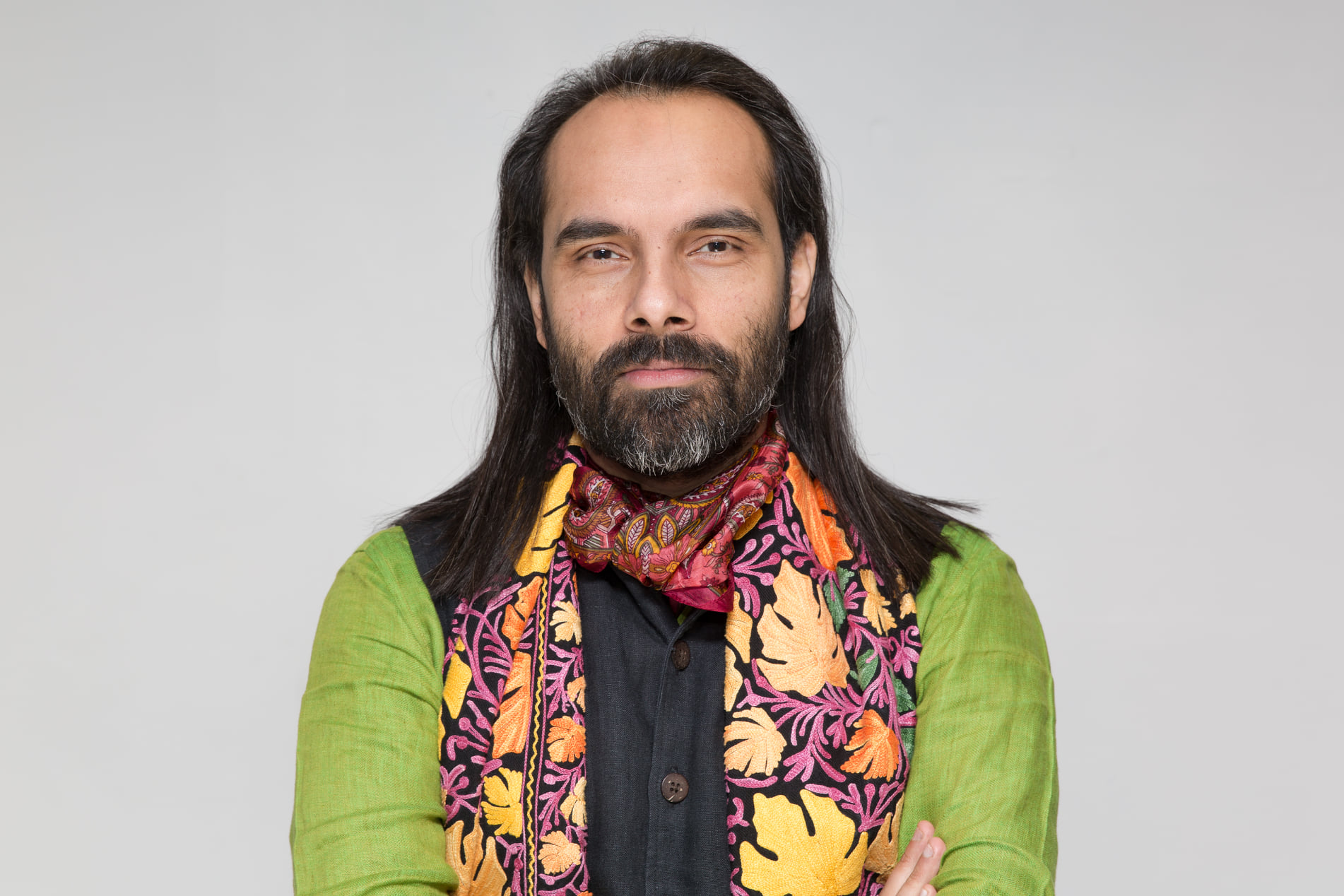
Professor Dibyesh Anand is an Associate Professor at London’s Westminster University, an expert on majority-minority relations in China and India, and the author of Geopolitical Exotica: Tibet in Western Imagination.
Professor Anand has written extensively in international journals and papers. He has also given lectures in universities and think tanks around the world. He is a well recognised in the Tibet circle.

Kasur Lobsang Nyandak is a former Minister for the Central Tibetan Administration (aka Tibetan Government-in-exile) from 2001 to 2006.
He served as the Dalai Lama’s Representative to North America based at The Office of Tibet in New York. He was also an elected Tibetan MP in the Tibetan Parliament in Exile from 1996 to 2001.
A Leader of the Tibetan Youth Congress, Lobsang Nyandak founded and served as the Executive Director of Tibetan Centre for Human Rights in Democracy.
Currently, he is the President of The Tibet Fund, a New York-based NGO that raises funds and supports the Tibetan community primarily in India and Nepal through education, healthcare and community development projects.

Steven Schaerer is the author of “Surviving Chinese Communist Detention”.
Steven Schaerer survived communist Chinese incarceration, torture, and deportation.
Steven is a proud first generation American from California’s Bay Area, and is the proud bi-racial son of immigrant parents from Switzerland and Mexico.
He was the first person in his family to attend university earning a degree in chemistry from Sonoma State University in Northern California. In addition to English, Steven also speaks Mandarin, Spanish, and successfully co-founded a business in Beijing in his mid-20’s.
Steven is a staunch advocate for and defender of freedom, liberty, the Constitution, free-market capitalism, Human Rights and the American way of life.
Tsering Passang is Founder and Convener at Global Alliance for Tibet & Persecuted Minorities. Tsering’s blog – www.tsamtruk.com

A webinar with leading China-Tibet experts, former minister and human rights advocates, hosted by the Global Alliance for Tibet & Persecuted Minorities.
Exactly 72 years ago, Mao Tsetung declared the illegal invasion of Tibet and the Republic of East Turkistan. Mao called the illegal invasion of Tibet a ‘peaceful liberation’. That so-called ‘peaceful liberation’ has cost millions of lives of Tibetan and Uyghur people amongst others.
The Chinese government is hosting a week-long celebration of what it calls the “Golden Week” as 1st October marks the 72nd founding anniversary of the People’s Republic of China.
For the Tibetan and the Uyghur victims under the Chinese regime’s military occupation and repressive policy, there is nothing to celebrate so long as China continues to illegally occupy Tibet and East Turkistan.
For the people of Hong Kong, there is nothing to celebrate so long as Beijing disregards the UK-China Joint Declaration and the basic rights are not restored in Hong Kong.
For the people of Taiwan, there is nothing to celebrate when their democratic nation faces the imminent threat of military invasion from the Chinese regime.
There is nothing to celebrate so long as the Southern Mongolians cannot maintain their own language and Buddhist culture.
Certainly, there is nothing to celebrate so long as the Falun Gong, as well as other religious and faith communities, cannot practice their devotions. And the list goes on including the lack of political freedom, democracy and freedom of speech.
Since Xi Jinping came to power in 2012, his regime has made no secret of its global expansionist ambition. China’s Belt and Road Initiative (BRI) projects have now become debt traps for developing countries.
The political instability caused by Beijing, after its claims over the international waters in the South China Sea, is the tipping point of serious concern that pushed the AUKUS nuclear submarine deal to counter China. China’s flexing of its military muscle in the Himalayan borders through territorial claims against India, Bhutan and Nepal is yet another dangerous game that could spark a major war between the two Asian giants.
So, to discuss whether China poses a real threat to global peace and security, the GATPM has invited a panel of experts to share their thoughts on these vital issues.
(GATPM, London | 2nd October 2021)
Political and human rights activists from Hong Kong, Tibetan and Uyghur communities and NGOs slated the CCP regime as a real threat to global peace and security as China celebrates its 72nd founding anniversary of the People’s Republic of China in London.
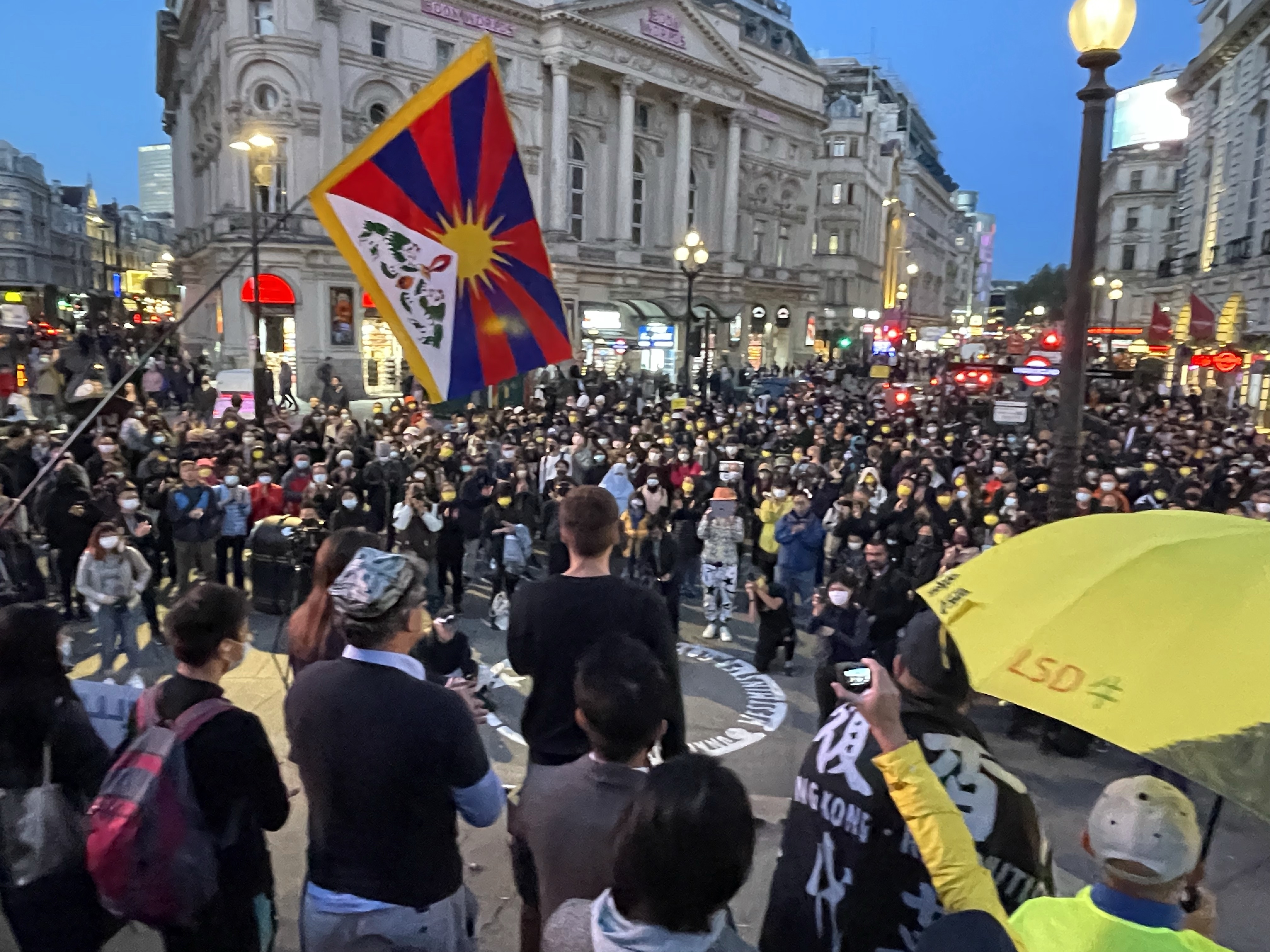
Resist the Chinese Community Party Day – Joint London Rally, was held in central London on 1st October, showing unity among British Hongkonger, Tibetan and Uyghur Communities in the fight for freedom, justice, human rights and democracy.
The protest started off in Piccadilly Circus and finished in front of the Chinese Embassy. Protesters chanted loud slogans of “Free Tibet”, “Free Hong Kong”, “Free East Turkistan” and “Shame Shame Xi Jinping”.

Prominent British, Hong Kong, Tibetan and Uyghur activists addressed the rallies.
Benedict Rogers, Co-founder and CEO of Hong Kong Watch, said, “It is time now for the free world, for our governments of democracies around the world, to stand up to the CCP, to take action to hold them to account, to sanction them, to stop trading with them, to stop kowtowing to them, and to do everything possible to end these 72 years of bloody repression.”
Andrea Venzon & Colombe Cahen-Salvador, co-founders of Atlas also spoke at the Piccadilly Circus rally. Andrea Venzon said, “A threat from an authoritarian regime impacts democracy at large. We have a duty to stand up for the hundreds of millions of people living in captivity under the CCP rule. Democracy is a fundamental right, and we will not back down.”
Finn Lau, Founder of Hong Kong Liberty, addressed the rally. He said, “We have witnessed genocide and severe crackdowns in East Turkestan, Tibet and Hong Kong in that Beijing is wiling to do whatever it would cost to sustain the one-party tyranny. The ambition of the CCP is also being reflected by its infiltration into the international academic, business sector and even intergovernmental organisations like the UN with the tactic called United Front. In light of its ascent as a global threat to human rights and universal values, the free world has to stand firm against the CCP.”
After the national anthems of East Turkistan, Hong Kong and Tibet were played, the protesters marched to the Chinese Embassy via Regents Street, Oxford Circus and the BBC. Some protesters burned a Chinese flag, a sign of defiance against the CCP regime for its actions right in front of the Chinese Embassy.
Speakers outside the Chinese Embassy:
In his opening remarks, Tsering Passang, Founder and Convener at the Global Alliance for Tibet & Persecuted Minorities, said, “Resistance against the CCP regime is growing within China and around the world.
“Exactly 72 years ago, the Chinese Communist Party and its regime under Mao Tsetung’s dictatorship, announced the illegal invasion of Tibet and the Republic of East Turkistan. Mao Tsetung called the illegal invasion of Tibet a “peaceful liberation”. That so-called “peaceful liberation” has cost millions of lives of Tibetan and Uyghur people amongst others.”
Passang further added, “For the Tibetan and Uyghur victims under the Chinese regime’s military occupation and repressive policy, there is nothing to celebrate so long as China continues to illegally occupy Tibet and East Turkistan.
“For the people of Hong Kong, there is nothing to celebrate so long as Beijing disregards the UK-China Joint Declaration and the universal basic rights are not restored in Hong Kong.
“For the people of Taiwan, there is nothing to celebrate when their democratic country faces the imminent threat of military invasion from the Chinese regime.
“There is nothing to celebrate so long as the Southern Mongolians cannot maintain their own language and Buddhist culture.
“Certainly, there is nothing to celebrate so long as the Falun Gong followers as well as other religious and faith groups cannot practice their devotions. And the list goes on… including lack of democracy and freedom of speech.”
Rahima Mahmut, UK Director of World Uyghur Congress and Executive Director of Stop Uyghur Genocide, addressed the rally. She said, “Today we marched against the persecution of Uyghur people over not just the past 5 years, but the entire 72 years of CCP Government. Celebrations in Beijing cannot drown out the pleas for freedom from across the world today, from communities that continue to be denied their human rights. Our people are facing torture, rape, and genocide – it is time for the international community to stand tall against the CCP’s crimes.”
Basil, Representative of Power to Hong Kongers, also spoke outside the Chinese Embassy in Cantonese language.
A 15-year old British Tibetan student from the Tibetan Community in Britain addressed the rally outside the Chinese Embassy. She said, “China hopes to eradicate Tibetan identity. It is robbing a generation of Tibetan children their rights to their language, culture, and heritage. This is cultural genocide. And we have seen what happens when those inside Tibet speak, even amongst themselves. China silences those voices, because they know that when people speak up about injustice, they can bring about change.”
Tom, from the Hong Kong Aid addressed the rally. He said, “The CCP is a friend of terrorism. The CCP is the threat to the whole world. We must keep on fighting for the freedom of Hong Kong. Step out! United and Resist!”
Sam Walton, CEO of Free Tibet, addressed the rally. He said, “Chinese Communist Party’s aggressive expansionism is a threat to democracy, human rights and freedom around the world. Bootlicking world leaders are as good as inviting China to wipe Tibet, Hong Kong and East Turkestan off the map, It’s time for everyone who cares about human rights to stand up to the Chinese Communist Party.”
National anthems of East Turkistan, Hong Kong and Tibet were played once again before Tsering Passang gave his concluding remarks. He said, “We know that the CCP regime poses a real threat to global peace and security.
“Xi Jinping and his regime must immediately end their brutal crackdown on innocent people across China and its occupied territories, who are entitled to basic rights as enshrined in the Universal Declarations of Human Rights. It is about time China ends the colonisation of its neighbours and discrimination against the minorities.
“As Mao Tsetung once said, “where there is oppression there will be resistance”. So, we the people of Tibet, East Turkistan, Hong Kong, Southern Mongolia, Taiwan as well as all those oppressed groups such as the Falun Gong practitioners, will continue to defy and resist the Chinese Communist regime and its repressive rule.”
This year protest was jointly organised by:
– Atlas
– Free Tibet
– Hong Kong Aid
– Hong Kong Liberty
– Power to Hongkongers
– Uyghur Community UK
– World Uyghur Congress
– Tibetan Community in Britain
– Global Alliance for Tibet and Persecuted Minorities
A coalition of UK-based Hong Kong, Tibetan and Uyghur communities staged a public protest in central London to highlight the CCP regime’s continued brutal crackdown and curtailment of freedom of speech and human dignity in their countries.
Rights groups and NGOs such as Atlas, Free Tibet, World Uyghur Congress and Global Alliance for Tibet & Persecuted Minorities supported these communities, who were calling for their basic freedom, human dignity and democracy.
Resist the CCP Day – Joint London Rally kicked off in Piccadilly Circus on Friday, 1st October at 6.30pm. Protesters chanted “Free Tibet”, “Free Hong Kong” and “Free East Turkistan”.
At 7pm, the protesters marched to the Chinese Embassy located at 49 Portland Place, London W1B 1JL (via Regent’s Street and Oxford Circus) where further rally was held at 8pm.
About 1000 people joined this year’s protest. Organisers of this year’s protest included:
– Atlas
– Free Tibet
– Global Alliance for Tibet and Persecuted Minorities
– Hong Kong Aid – Hong Kong Liberty
– Power to Hongkongers
– Stop Uyghur Genocide
– Tibetan Community in Britain
– Uyghur Community UK
– World Uyghur Congress
 Global Alliance for Tibet & Persecuted Minorities (GATPM)
You must be logged in to post a comment.