Tsering Passang | 29 March 2026 |
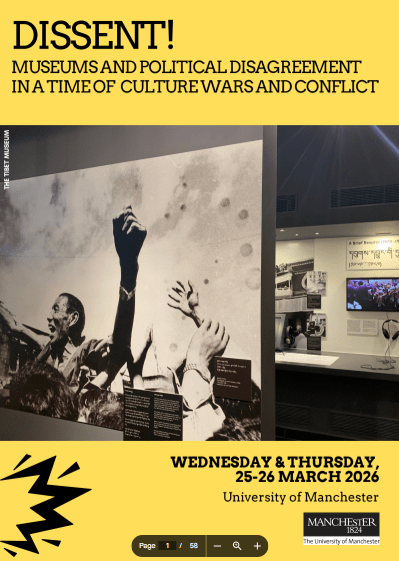
Following my recent participation in the conference “DISSENT! Museums and Political Disagreement in a Time of Culture Wars and Conflict” at the University of Manchester, from 25–26 March 2026, I have been reflecting on both the discussions we had and the wider implications for Tibet and other marginalised histories.
Shortly after the roundtable, Dr Emma Martin, an organiser of the conference, wrote to me: “Thank you so much for joining the panel yesterday. Your work drew a lot of conversation and people attending the conference were really inspired by the discussion. I look forward to continuing these discussions in the coming months.”
That message captures something important. This was not just an academic gathering – it was a space where ideas translated into urgency, and where museum practice was openly questioned.
Museums Are No Longer Neutral
The conference brought together a wide range of voices – scholars, curators, artists, activists, and researchers working across Tibet, Palestine, Iran, India, Australia, Bangladesh, and beyond. As Bhanu Ghalot, a Chevening Scholar and practice-based researcher from Delhi, reflected:
“Loved hearing perspectives on museum and heritage projects and practices from Palestine, Tibet, Bangladesh, Iran, and more, so many voices we don’t always get to hear.
We talk so often about building knowledge for the practices of the Global South, but too often the messiness, tensions, and contradictions of these perspectives and practices get left out. This conference really leaned into that messiness, staying true to the theme of dissent and highlighting unconventional approaches, contested histories, and the critical tensions that shape museum and heritage work today.”
Her reflection speaks directly to what made the conference distinctive: it did not attempt to simplify or smooth over disagreement. Instead, it created space for complexity – and for voices that are often marginalised within institutional narratives.
Across panels, one conclusion became unavoidable: museums are not neutral spaces.
They are institutions where:
– language is chosen
– histories are framed
– and political realities are either clarified – or quietly reshaped.
For communities like Tibetans, who do not have equal access to global platforms, these spaces matter profoundly.
The Tibet Roundtable: From Theory to Practice
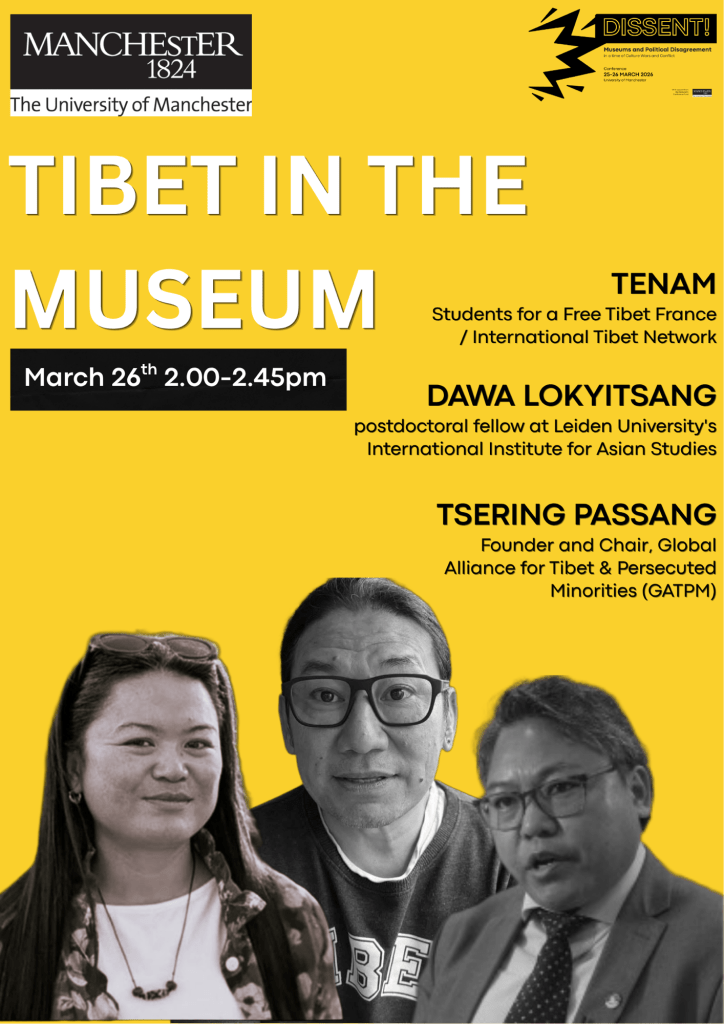
The Tibet roundtable, chaired by Dr Emma Martin, brought together:
– Dr Dawa Lokyitsang, International Institute for Asian Studies of Leiden University, The Netherlands
– Tenzin Namgyal (Tenam), International Tibet Network from Paris (online)
– and myself (online)
What stood out was how quickly the discussion moved beyond theory into lived and ongoing struggles.
Cultural Anthropologist Dr. Dawa Lokyitsang grounded the conversation in scholarly responsibility with her personal background as a Tibetan.
Tenam brought urgency through activism – particularly by highlighting the ongoing legal challenge involving the Guimet Museum in Paris, where the use of the term “Xizang” is being contested.
This is significant. It shows that the issue of naming Tibet is not isolated to one institution – it is systemic and transnational.
The Expanding Digital Dimension
The conference also pushed these questions beyond physical museum spaces into the digital realm. As Isabella Salsano, a legal scholar working on international law and cultural heritage, observed:
“Very glad to have kicked it off by speaking at the international conference – “DISSENT! Museums and Political Disagreement in a Time of Culture Wars and Conflict” at The University of Manchester.
My presentation looked at how algorithmic systems are increasingly shaping what becomes visible, sayable, and ultimately remembered in digital museum spaces. What might seem like a technical layer actually has significant implications for international law and human rights: when visibility is governed by opaque systems, certain narratives risk being pushed to the margins. This becomes especially delicate when we think about colonial collections, indigenous heritage, or the cultural expressions of communities living through occupation or conflict.
In these contexts, algorithmic mediation can inadvertently (or not…) reinforce existing asymmetries, raising questions that international cultural heritage law has only just begun to confront.
It also made me reflect on how international law and human rights are still catching up with all of this. We have strong frameworks to protect heritage and, to some extent, expression; but much less clarity when it comes to visibility, digital memory, and the quieter forms of exclusion that happen online.”
Her intervention is especially relevant to the Tibetan case. The politics of naming does not only unfold in gallery labels or exhibition texts; it is increasingly embedded in search systems, metadata, and digital archives.
In this sense, the issue is no longer just what museums say – but what is made visible, searchable, and retrievable in the first place.
My Intervention: The Politics of Naming Tibet
In my own contribution, I focused on a simple but urgent issue: how Tibet is being named in major institutions.
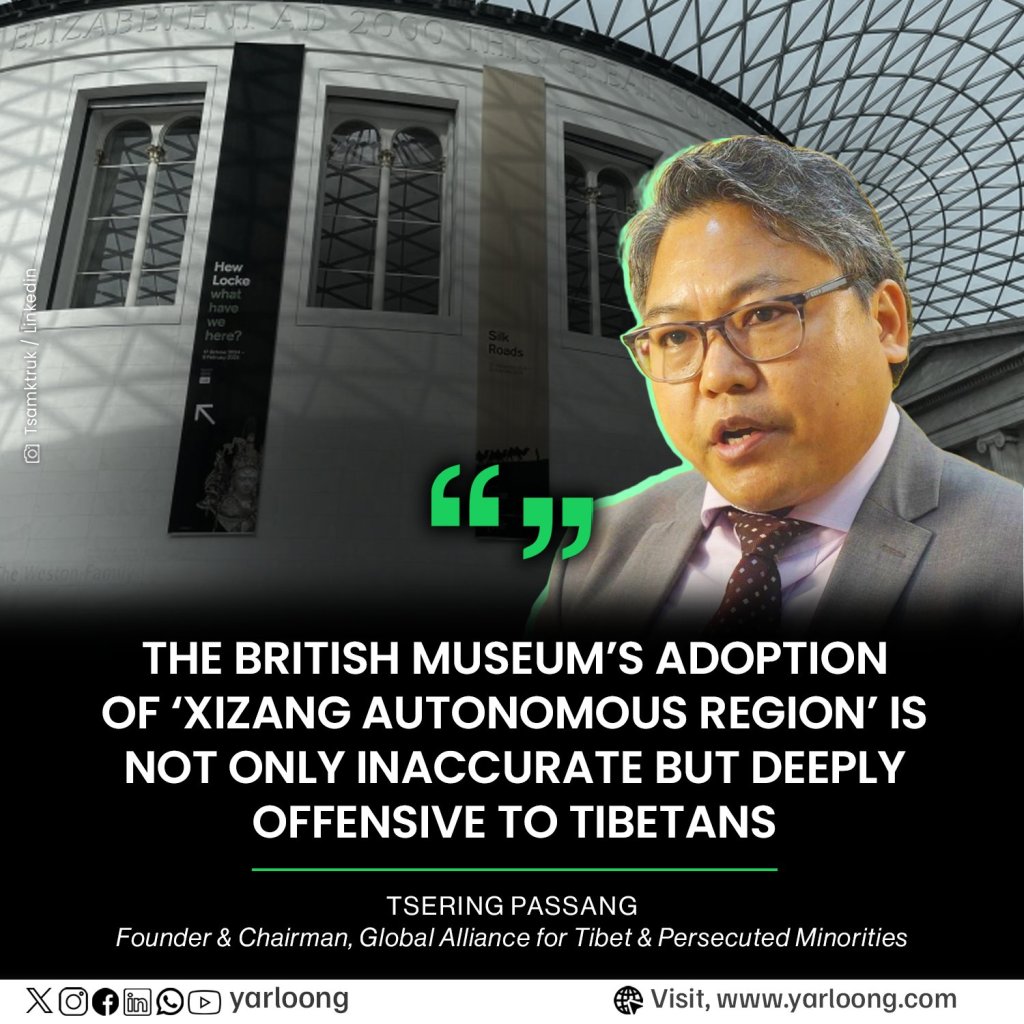
At the British Museum, Tibetan objects in the Silk Roads exhibition (Sept 2024 – Feb 2025) were labelled: “Tibet or Xizang Autonomous Region, China”.
The British Museum presented this as balanced. But from a Tibetan perspective, it is not.
“Xizang” is not a neutral term. It is a state-imposed designation, promoted by the Chinese government. Tibet was invaded by the People’s Republic of China in 1950, and the Tibet Autonomous Region (TAR) was established in 1965 after Beijing took full control of the Tibetan Buddhist nation. Its increasing use internationally, especially since Xi Jinping took office in Beijing, reflects power, not scholarly agreement.
For Tibetans, this is not semantics.
It is something much deeper: a gradual erasure of identity through language.
What I wanted to emphasise is this: terminology does not simply describe reality – it helps construct it.
Advocacy Can Work – But It Takes Pressure
Our response, through the Global Alliance for Tibet & Persecuted Minorities, was deliberate and sustained.
We engaged the institution through formal correspondence, Freedom of Information requests, and continued advocacy.
In the final weeks of the exhibition, the term “Xizang” was withdrawn.
This matters.
It shows that:
– institutions can change
– narratives are not fixed
– and advocacy – when persistent – can make an impact
But it also raises a harder question: how did such terminology enter museum practice in the first place?
The Harder Question: Influence Without Instruction
One of the most important discussions was about power operating indirectly. I described this as anticipatory compliance.
Institutions do not always need to be told what to do.
They adjust themselves based on what feels acceptable within:
– funding environments
– political sensitivities
– and geopolitical realities.
This creates a quiet alignment with powerful actors.

Reclaiming Tibetan History: A Different Outcome
Alongside these challenges, I also shared a more positive example.
Through our engagement with Bonhams, the Global Alliance for Tibet & Persecuted Minorities was able to secure the withdrawal of a historically significant 1947 correspondence between the Dalai Lama, the Tibetan Regent, and Sir Basil Gould.
These documents – from a time when Tibet was not under Chinese occupation – could easily have disappeared into private collections or state-linked archives.
Instead, they were repatriated to the Tibet Museum in Dharamsala, northern India, the seat of Tibet’s government-in-exile, the Central Tibetan Administration. Their return has already sparked meaningful discussion beyond the Tibetan community. Notably, Sir Basil Gould’s granddaughter, Mrs. France C. Cutler, is set to attend as a Special Guest at the Frontier Diplomacy: Britain, Tibet and Sir Basil Gould event hosted by the Tibet Museum in early April, alongside Sikyong Penpa Tsering, President of the Central Tibetan Administration, who will serve as Chief Guest.
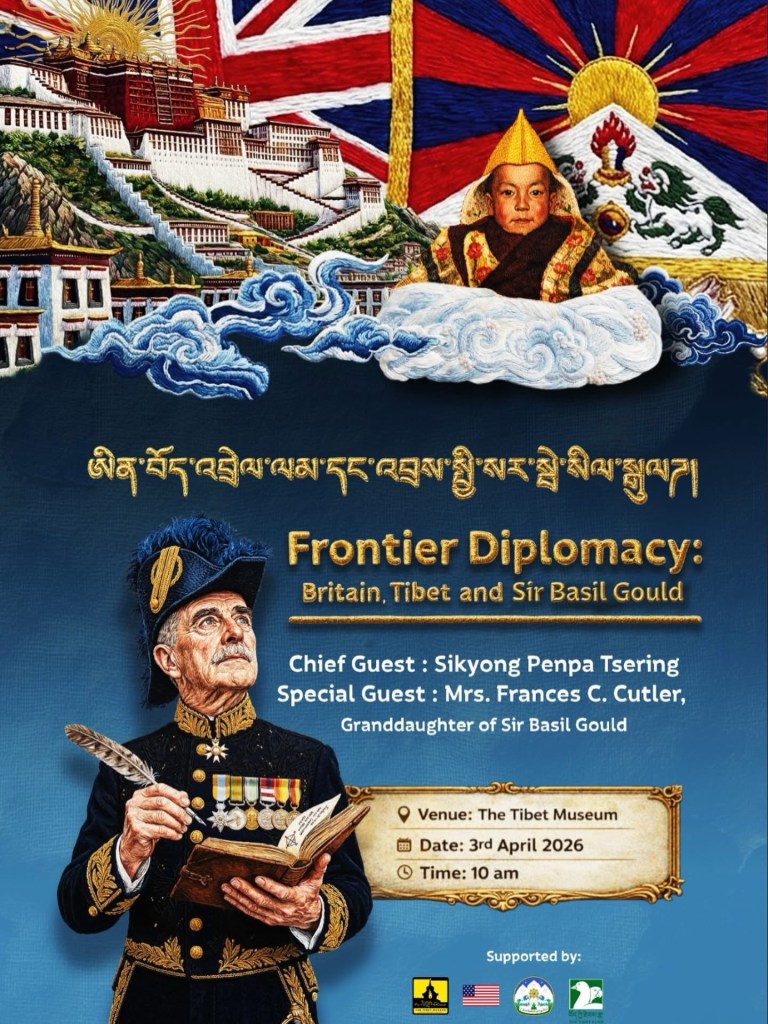
The Global Alliance for Tibet & Persecuted Minorities encouraged Sir Basil Gould’s family to donate these documents to the Tibet Museum to coincide with the 90th birthday of the 14th Dalai Lama as well as to visit Dharamsala to meet with the Tibetan spiritual leader – a moment designated by the Central Tibetan Administration as a Year of Compassion.
For us, this was not simply about preservation.
It was about historical evidential value – ensuring that Tibet’s past remains accessible and interpretable beyond state control.
Because ultimately, where history is held shapes how history is told.
What Museums Must Now Confront
Reflecting on the discussions in Manchester, I believe there are clear actions museums must take:
– Use historically grounded terminology, not politically expedient language
– Engage affected communities as participants, not afterthoughts
– Ensure transparency in funding and partnerships
– Recognise indirect forms of influence, not just explicit interference
Neutrality is often presented as the goal.
But in unequal contexts, neutrality can reinforce the status quo.
Final Reflection
The conference made one thing clear to me:
We are living in a time where museums are no longer just about preserving the past – they are actively shaping the political realities of the present.
For Tibetans, this is deeply personal.
When the name “Tibet” is replaced, diluted, or qualified, something more than language is at stake.
It is about whether a people can still be recognised on their own terms.
But there is also reason for cautious optimism:
– the removal of “Xizang” from a major institution
– the legal challenge in Paris
– the recovery of Tibetan historical documents
– and the growing presence of Tibetan voices in these spaces
These are signs of movement.
The question now is not whether museums are neutral.
It is this: Will they remain aware of the power they hold – and the histories they may be reshaping?
Tsering Passang is a London-based Tibetan blogger and the founder and chair of the Global Alliance for Tibet & Persecuted Minorities. A long-standing Tibetan human rights advocate, he works internationally to advance justice, freedom, and peaceful solutions for Tibetans and other persecuted communities living under authoritarian rule. His writing can be found at www.Tsamtruk.com.
 Global Alliance for Tibet & Persecuted Minorities (GATPM)