London | 15 December 2025
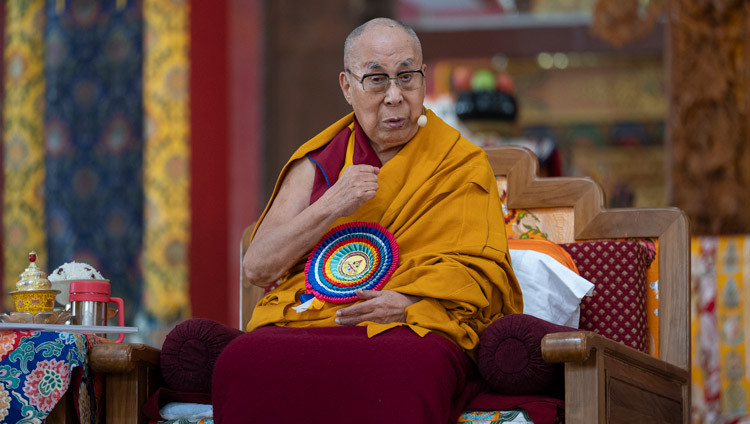
Drepung Monastery in Mundgod, south India, witnessed a deeply auspicious and historic observance of Ganden Ngamchö yesterday as His Holiness the 14th Dalai Lama presided over the annual ceremony commemorating the parinirvana of Jé Tsongkhapa, founder of the Gelug tradition of Tibetan Buddhism. The event was held at the request of the entire Gelug lineage and drew senior hierarchs, abbots, scholars, and more than 10,000 monks and devotees from across India, the Himalayan region and Bhutan.
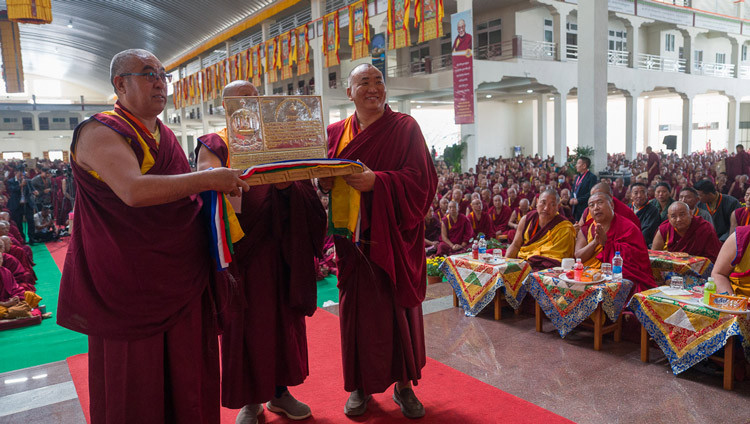
Marking the occasion, the Gelugpa Buddhist Cultural Society presented His Holiness with a commemorative award honouring the 51st anniversary of his formal conferment of the Geshé Lharampa degree – Tibetan Buddhism’s highest scholastic qualification (equivalent to PhD in Philosophy or Theology) – in recognition of his lifelong contribution to Buddhist learning and the preservation of the Gelug tradition in exile.
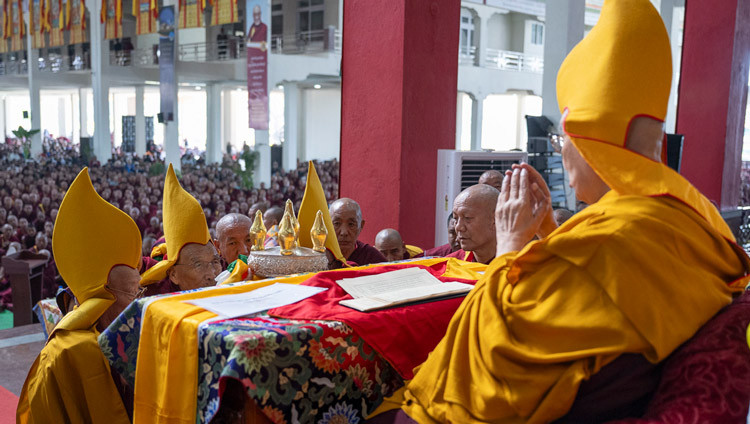
The ceremony unfolded with traditional rituals led by the Ganden Tripa, including the offering of a ceremonial khata, the recitation of Jé Tsongkhapa’s In Praise of Dependent Origination, and the Tsari Tsog Ganachakra offering according to the Sutra tradition. This was followed by the Thirty-Seven Heaped Mandala Offering presented by the Ganden Tripa, Jangtsé Chöjé and Sharpa Chöjé. Tea and ceremonial sweet rice were distributed to the vast assembly.
Explaining the significance of the award, Geshé Jangchub Sangyé, Abbot of Ganden Shartsé Monastery, stated that as His Holiness enters his 90th year, millions of devotees worldwide are observing the milestone with prayers and celebrations. The honour was also framed within what has been described as a “Year of Compassion,” marking the 66th anniversary of His Holiness’s Lharampa Geshé examination in Lhasa in 1959, the 51st anniversary of the formal presentation of his degree in 1974, and the 50th anniversary of the establishment of the Central Board Examination of Gelugpa Universities in India.
On this occasion, a newly crafted Lharampa Geshé Award, made of gold and silver on behalf of the Lhadhan Chötrul Monlam Chenmo Trust and the Gelugpa Buddhist Cultural Society, was formally presented to His Holiness in a gesture of deep gratitude and reverence.
Addressing the gathering at Drepung Gomang Monastery, His Holiness reflected on the significance of the large monastic assembly in exile. “This place where our Tibetan settlements are located lies to the south-west of Tibet,” he said. “Today, members of the monastic communities have gathered here in a joyful and heartfelt manner. What does this signify? It shows that the vast and profound Buddhist teachings of the sutras and tantras – the immaculate doctrine upheld by great scholars like Nagarjuna – are being preserved by us Tibetans.”
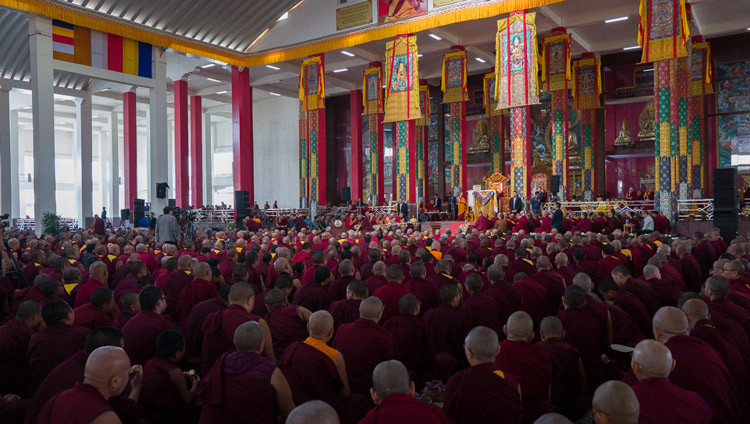
Despite the hardships endured in Tibet, His Holiness noted that devotion to religion and culture has remained resilient. “The essential point is that we Tibetans feel a deep sense of responsibility for the teachings of the Land of Snows,” he said, adding that respect for Tibetan Buddhism is steadily growing not only among Tibetans but also in China and around the world.
Highlighting contemporary relevance, His Holiness observed that while some may not approach Buddhism as a religion, there is strong interest in its methods of study, contemplation and inner development – particularly among younger generations. He also spoke of increasing dialogue with scientists, many of whom are drawn to Buddhist approaches for cultivating inner peace through a calm and disciplined mind.
Reflecting on the period following exile, His Holiness remarked that although the Dharma was nearly extinguished in Tibet, those who escaped worked tirelessly to preserve it. Today, he said, the Buddhist view, meditation and ethical conduct continue to attract global attention, demonstrating the enduring value of the Buddha’s teachings rooted in the three higher trainings.
The Ganden Ngamchö ceremony concluded with the recitation of traditional prayers, including praises to Jé Tsongkhapa and long-life prayers for His Holiness, followed by the Mig-tse-ma prayer. Carrying incense and khatas, senior lamas and abbots led a solemn procession escorting His Holiness to his private quarters.
His Holiness arrived at Drepung Monastery on 12 December after travelling from Dharamsala via Delhi to Karnataka, where he was accorded a warm reception by senior monastic leaders, civil authorities and thousands of devotees lining the roads to Mundgod.
The observance of Ganden Ngamchö at Drepung once again affirmed the enduring vitality of the Gelug tradition and His Holiness the Dalai Lama’s pivotal role in safeguarding, revitalising and sharing the Buddha’s teachings for the benefit of humanity.
The Tibetan spiritual leader went into exile in March 1959 and has since made India his home where he set up Tibet’s government-in-exile, officially known as the Central Tibetan Administration. Following the entry of the People’s Liberation Army into Tibet in 1950, His Holiness spent nearly nine years seeking a peaceful and constructive relationship with the Chinese central leadership in Beijing. Those efforts came to an abrupt end during the Tibetan national uprising, when heavy military force was used in Lhasa and tens of thousands of Tibetans gathered in a final attempt to protect their spiritual leader. As artillery fire struck the capital, His Holiness was compelled to flee Lhasa to ensure his own safety and to avert further bloodshed, beginning a life in exile dedicated to the preservation of Tibetan culture, religion and identity.
Further information available from:
Office of His Holiness the Dalai Lama: www.DalaiLama.com
Drepung Gomang Monastery: www.DrepungGomang.org
Central Tibetan Administration: www.Tibet.net
 Global Alliance for Tibet & Persecuted Minorities (GATPM)
U.N. Human Rights: Financial Crisis
−
On Mon, Dec 15, 2025 at 11:42 AM Global Alliance for Tibet & Persecuted
LikeLike