

Inspired by Brainy Monkey’s reporting on Columbia Sportswear’s bold new “flat Earth” challenge, Tsering Passang explores how Tim Boyle’s headline-grabbing dare offers an unexpected opportunity to shine a brighter light on Tibet. What begins as a playful marketing stunt becomes, in this reflection, a doorway to a far more urgent story – the story of a people, a culture, and a homeland whose truths still struggle to be seen, told, and heard on the world stage.
Every now and then, a news story pops up that is amusing on the surface but revealing at a deeper level.
Recently, Tim Boyle, the billionaire CEO of Columbia Sportswear, made headlines by offering his entire three-billion-dollar company to anyone who can prove the Earth is flat. His challenge – Expedition Impossible – invites believers to find the “edge of the planet” and bring back photographic proof. It’s all part of a daring marketing campaign, but the idea has caught global attention.
For Tibetans, though, the joke is an old one.
For thousands of years, Tibetans living on the Roof of the World have laughed about how everything below them looks flat. At over 4,000 meters above sea level – where horizons stretch endlessly and clouds drift beneath your feet – the world really does appear that way. And yet, Tibetans, like the rest of humanity, long ago accepted the scientific truth: the Earth is round, no matter how flat it may look from high above the plateau.
So if any modern flat-Earther decides to chase Boyle’s mega-prize, let me offer one piece of friendly advice:
Pack a very warm Columbia jacket before heading to the Tibetan plateau. You’ll need it.
But before you begin your “expedition,” I have one important request:
If you travel to Tibet, please also tell the world what you see happening there.
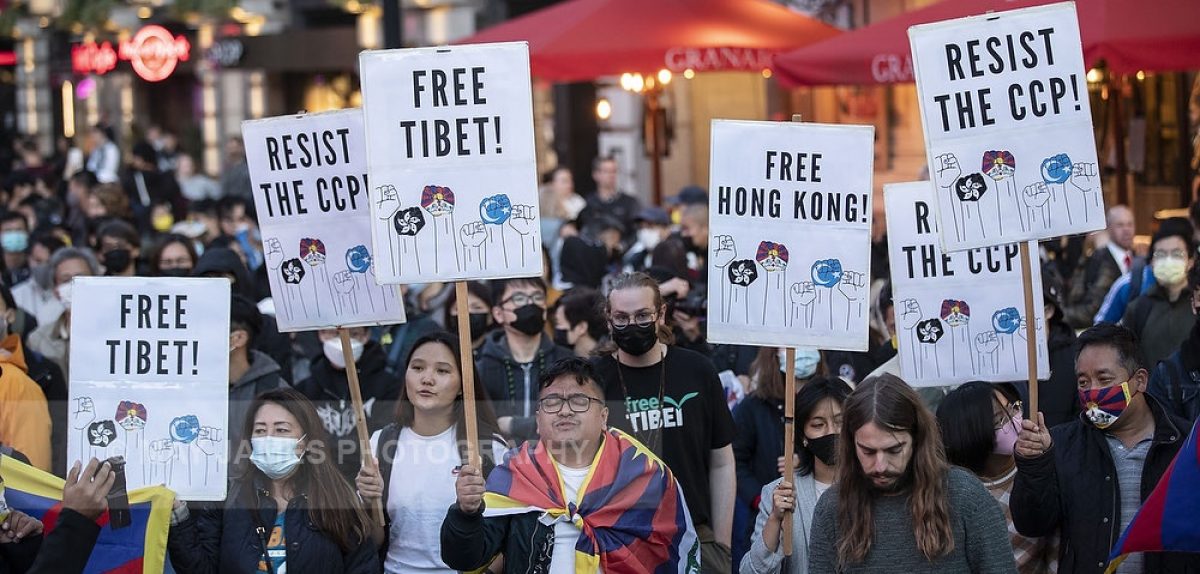
Share not only the mountains and monasteries, but also the reality of life for the native Tibetans, who have lived on their land for millennia yet cannot freely speak, think, or practice their culture. Since 1950, Tibet has been under the rule of the CCP, and Tibetans continue to face severe restrictions on movement, language, belief, and expression.
Behind the grandeur of the Himalayas lies a quieter truth – one that struggles to reach global ears:
Tibetans are denied basic freedoms in their own homeland.
Their story is still not widely known.
And their voices must not be erased.
If the world has time and curiosity to entertain flat-Earth challenges, then surely it has the capacity – and responsibility – to listen to a people whose culture, identity, and dignity are at risk of being silenced.
This is why the Tibetan story must be seen, told, and heard – not only for Tibetans today, but for the future of a culture that has illuminated humanity for centuries with its wisdom, resilience, and profound spirituality.
Let us keep that story alive.
Let us keep Tibet visible.
 Global Alliance for Tibet & Persecuted Minorities (GATPM)