

By GATPM | 20 November 2025
Hosted by The Buddhist Society in partnership with the Global Alliance for Tibet & Persecuted Minorities (GATPM)
An Evening of Insight, Reflection, and Resolve
More than 100 participants joined – both in person and online – on 19 November for an inspiring evening at The Buddhist Society, where Kasur Lobsang Nyandak, one of the most seasoned and respected Tibetan leaders of the past three decades, delivered a compelling address on the future of Tibet and the global significance of His Holiness the 14th Dalai Lama.
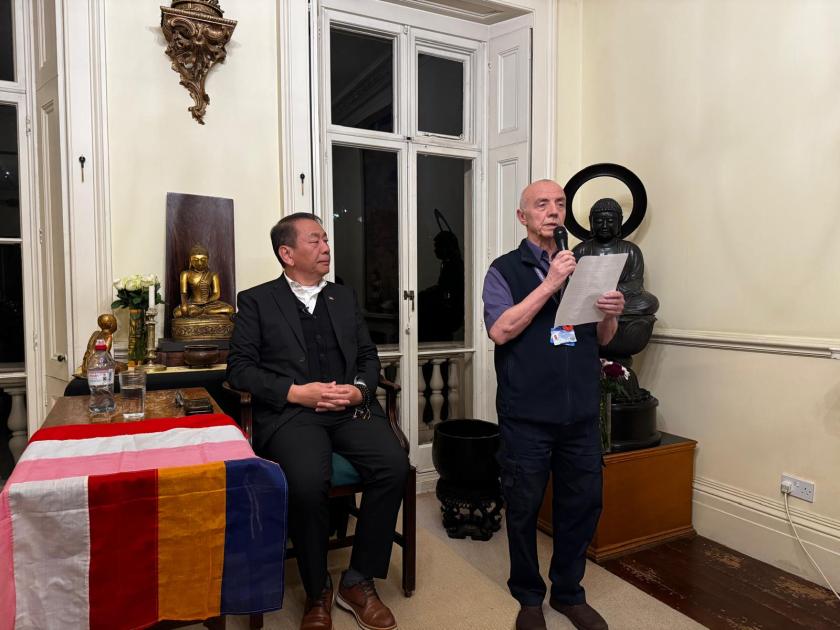
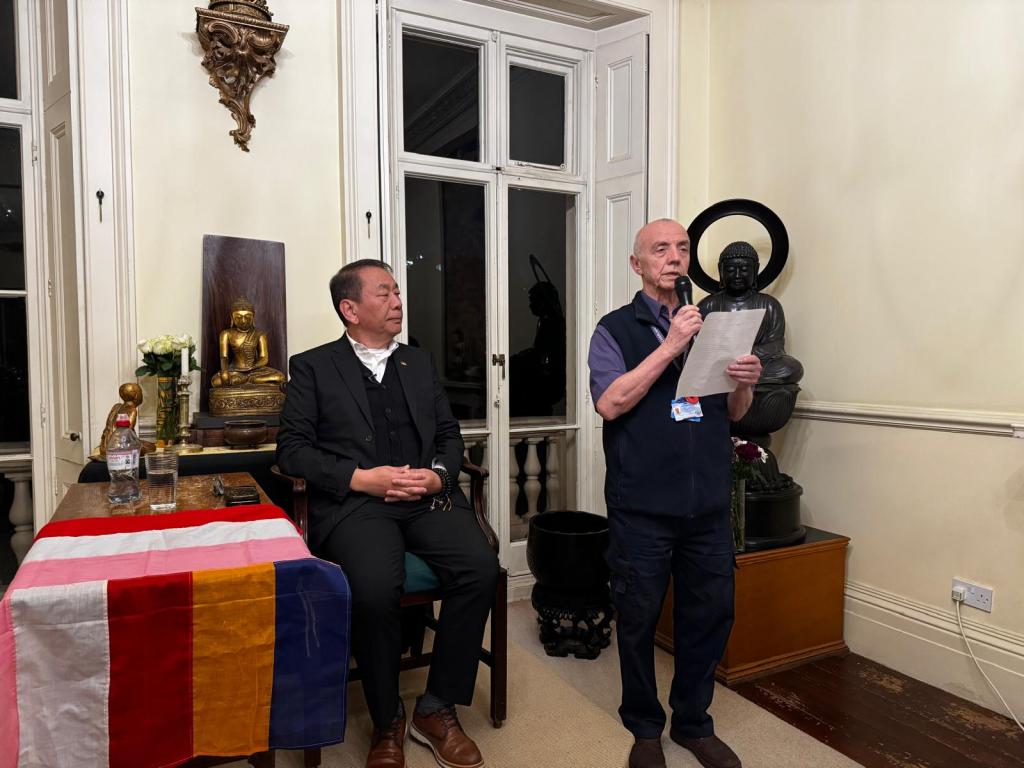
The Buddhist Society’s Chaplaincy opened the evening with a warm welcome and thoughtful introduction. Nyandak expressed deep appreciation for the Society’s “excellent and longstanding work” in supporting Tibet and upholding Buddhist values – setting the tone for a lecture rooted in gratitude, clarity, and shared moral purpose.
A former Minister in the Central Tibetan Administration and a prominent figure in Tibetan diplomacy, governance, and human rights advocacy, Nyandak drew upon decades of public service – from the Tibet Fund and the Tibetan Centre for Human Rights and Democracy (TCHRD) to his current role as Director of the Norbulingka Institute. His insights offered a rich, authoritative perspective on the crossroads Tibet faces today.

The Fragility and Resilience of Tibetan Civilisation
At the centre of Nyandak’s remarks was a stark warning: Tibetan civilisation – celebrated for its scholarship, compassion, and spiritual depth – is under severe and escalating pressure.
He highlighted the rapid expansion of China’s colonial-style boarding schools across Tibet, where close to a million Tibetan children are separated from their families and immersed exclusively in Mandarin-language curricula. The closure of community-led private Tibetan schools has intensified this erasure.
This, he stressed, is not simply a matter of education policy: Language loss is the severing of a people from their history, their spirituality, and their capacity to imagine a collective future.
In contrast, he praised His Holiness the Dalai Lama’s far-sighted vision in the early years of exile to establish Tibetan schools across India. These institutions, he said, have served for generations as sanctuaries of language, culture, and identity – proof that compassionate leadership can sustain an uprooted nation.
Institutions That Safeguard Tibet’s Future
Nyandak identified two pillars essential to Tibet’s continuity:
- The Dalai Lama Institution, carrying centuries of spiritual authority, moral leadership, and diplomatic wisdom.
- The Central Tibetan Administration, the democratic government-in-exile entrusted with preserving Tibetan identity, rights, and aspirations.
Both, he argued, must remain strong, relevant, and protected for Tibetans and for the wider world, which increasingly looks to His Holiness for ethical guidance.
Nyandak reminded the audience that the Dalai Lama has long been recognised globally – not only as a religious leader but as a statesman. Historically, Dalai Lamas mediated between Tibetan, Chinese, and Mongolian realms. He referenced the 1942 letter from President Franklin D. Roosevelt to the young Dalai Lama as an early testament to Tibet’s international relevance.
Hope, Courage, and the Dalai Lama’s Enduring Vision
Nyandak distilled His Holiness’s mission into three enduring commitments:
- to seek a peaceful resolution to Tibet’s political question,
- to protect the unique Tibetan culture, and
- to give hope to the Tibetan people.
The survival of Tibetan civilisation, he noted, depends on the generational protection of these values. Despite immense challenges – both inside Tibet and in exile – the Tibetan spirit continues to draw strength from them.

A Powerful Vote of Thanks: Compassion Translated into Action
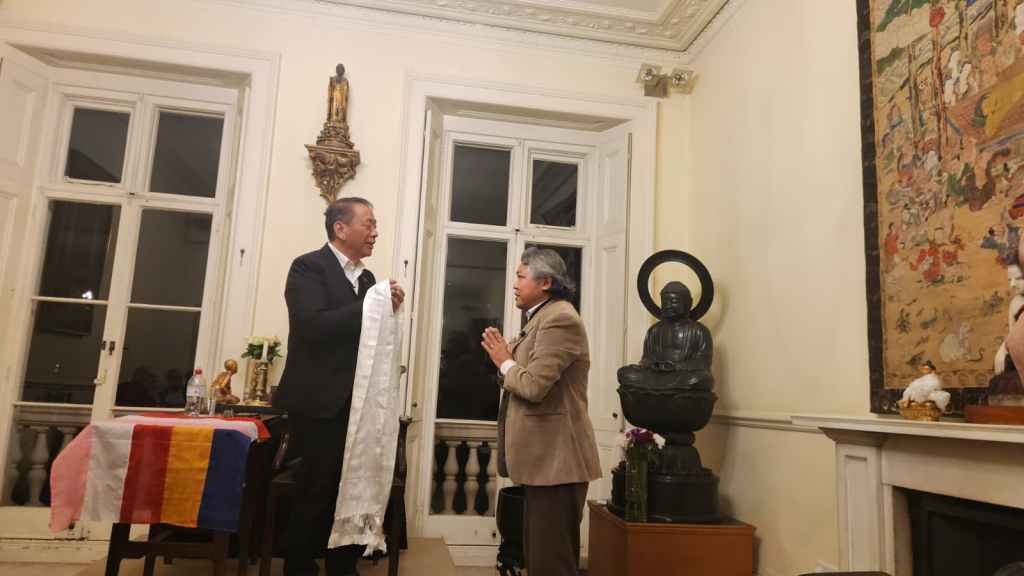
Following the lecture, Tsering Passang, Founder-Chair of GATPM, offered a heartfelt Vote of Thanks. He described the evening as “a transmission of courage, clarity, and hope”, emphasising that the Year of Compassion (July 2025 – July 2026) is not merely commemorative but an urgent call to action.
He honoured The Buddhist Society’s historic solidarity with Tibet. In 1959, during Tibet’s greatest crisis, the Society offered its basement as the first office of the newly formed Tibet Society & Relief Fund – the world’s first Tibet support organisation.
“From the very beginning,” he said, “The Buddhist Society stood with Tibet.”
A Story of Compassion in Action
Passang then shared the personal story that shaped his own life. In 1996, he arrived in the UK on a scholarship supported by the Tibet Society & Relief Fund. That opportunity existed because an English Buddhist, Mr David Elsey, had witnessed a Chinese soldier point a gun at a monk inside Tibet’s holiest shrine, the Jokhang Temple – an experience that shook him to his core.
Determined to respond, Mr Elsey persuaded his Principal at Weston College, Mr Gary Williams, to establish two scholarships for Tibetan refugees, later expanded to four. Working with Mr Patrick Nash, Director of Tibet Society & Relief Fund of the UK, he also helped arrange accommodation for the students.
Passang reflected: “This story reveals a fundamental truth: Tibet’s struggle has been shaped not only by institutions, but by individuals – ordinary people who refuse to ignore injustice.”
Safeguarding Tibet’s History: The Bonhams Auction Rescue
Passang also recounted the GATPM’s recent success in securing the safe repatriation of two historically significant 1947 letters from His Holiness the Dalai Lama and the Regent of Tibet – now preserved at the Tibet Museum in Dharamsala.
These priceless documents surfaced at a Bonhams auction in London in June 2025. Addressed to Sir Basil Gould, the British Political Officer for Bhutan, Sikkim, and Tibet, they were at imminent risk of vanishing into private or inappropriate hands – potentially lost to the Tibetan people forever.
Recognising the urgency, GATPM undertook quiet but determined advocacy. Through careful communication, the Bonhams team and members of the Gould family were persuaded not only to withdraw the items from sale, but to gift them to the Tibetan community.
Passang emphasised that this outcome was far more than the preservation of historical documents: it was a victory for cultural and historical justice – clear proof that principled action, timely intervention, and respectful engagement can protect Tibet’s legacy even today.
A Call to Conscience
In closing, he reminded the audience of Tibetans in Tibet, who continue to practise their faith in secrecy under oppressive conditions. He urged all who enjoy freedom to use it with responsibility and courage: “Movements endure not through numbers alone, but through the dedication of those who remain committed.”
Audience Feedback: A Call to Action That Resonated
The emotional impact of the evening extended far beyond the room. One online attendee, J Young, later reflected: “Excellent talk tonight, Tsering. Your words at the end were outstanding – moving and an inspirational call to action. Especially your reminder that even the action of one person can make a difference, as sometimes it doesn’t feel that way. Thank you for organising this. The work you do is incredible – thank you for your deep commitment, advocacy, and action.”
This heartfelt response captured a sentiment shared widely: that compassion, when expressed through action, can change lives and shape history.
Carrying the Message Forward
The evening offered a powerful reminder that Tibet’s future is not an abstract ideal – it is shaped every day by the courage of individuals, the commitment of institutions, and the unwavering solidarity of supporters across the world.
As Nyandak underscored, Tibetan civilisation endures because people choose to act: to protect language, to defend rights, and to stand with a nation struggling to preserve its identity.
As Tibetans and friends observe the Year of Compassion, one message rises above all others: Compassion is not simply an emotion – it is a responsibility. And when translated into action, it becomes a transformative force capable of shaping history.
A Shared Commitment to the Future
The evening concluded with a renewed sense of unity and resolve. The Buddhist Society, GATPM, and all who participated left with a shared understanding: safeguarding Tibet’s future requires both collective effort and the steady, principled actions of individuals.
This gathering stood as a testament to partnership, perseverance, and the enduring belief that compassion, translated into action, remains one of humanity’s greatest strengths.


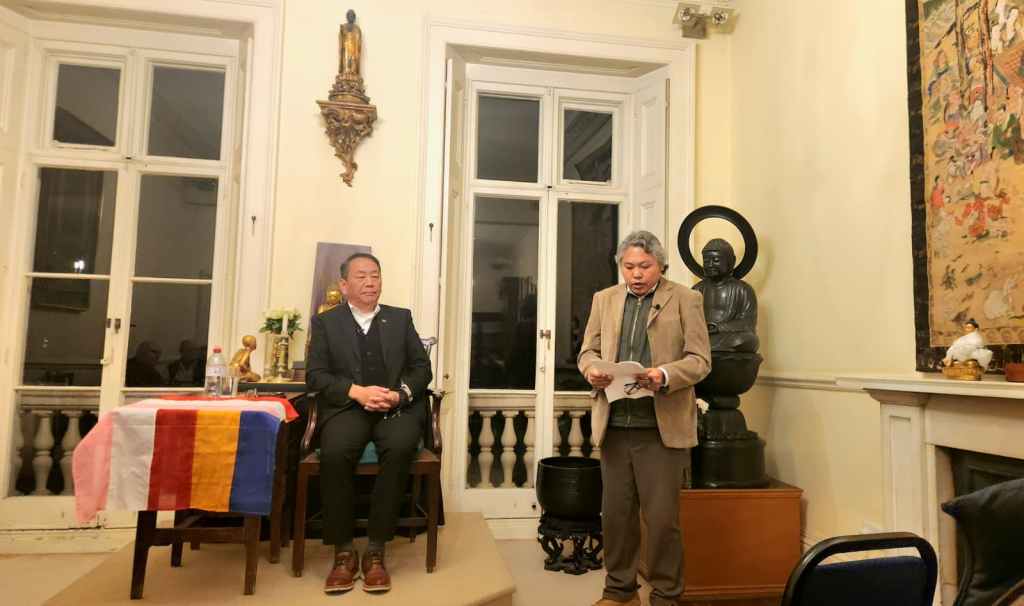
(Photos: Dawa, Karma and T Samphel)
 Global Alliance for Tibet & Persecuted Minorities (GATPM)
One thought on “A FUTURE SHAPED BY COMPASSION – Reflections on “The Dalai Lama and the Future of Tibet: A Vision for Compassion and Resilience””