
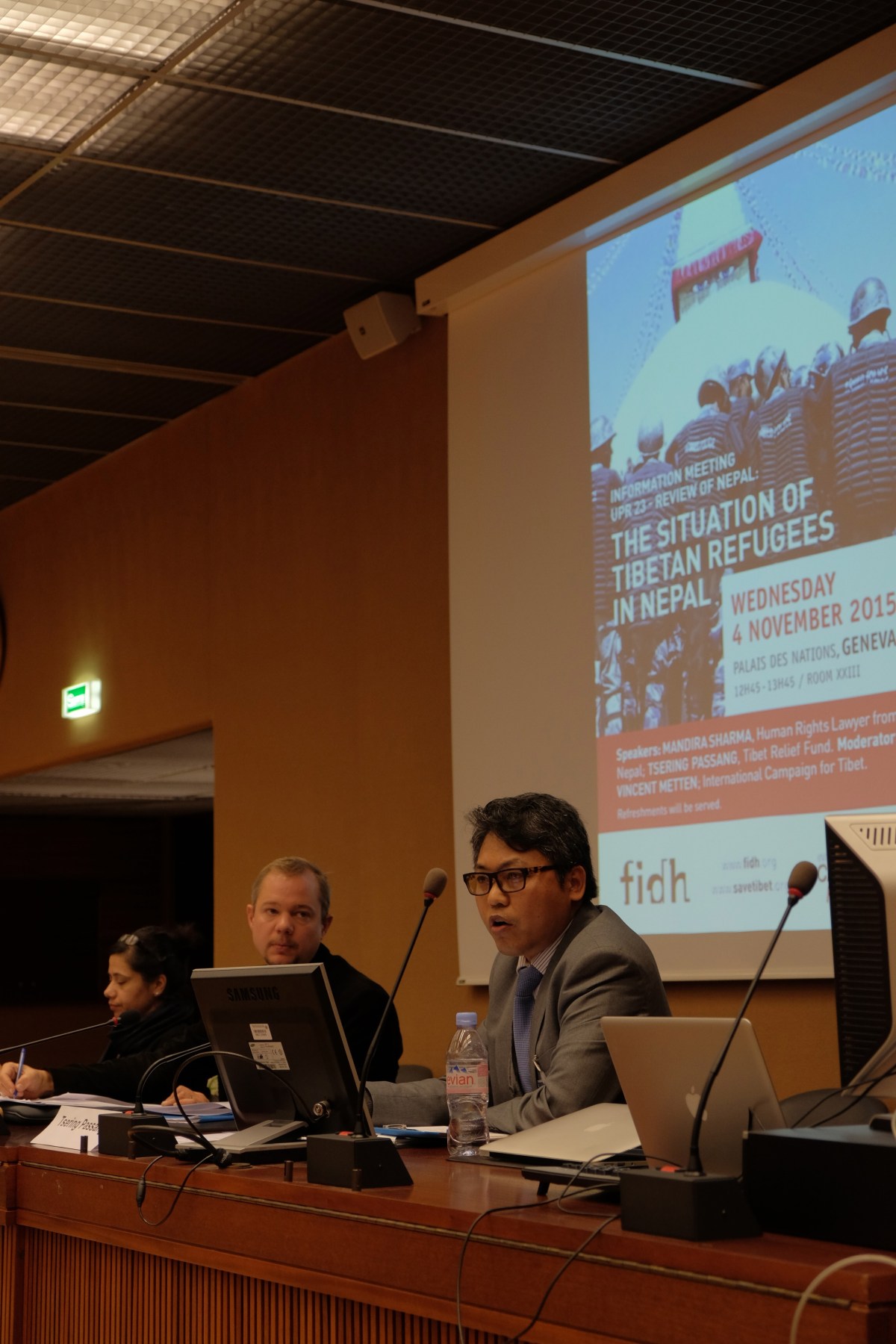
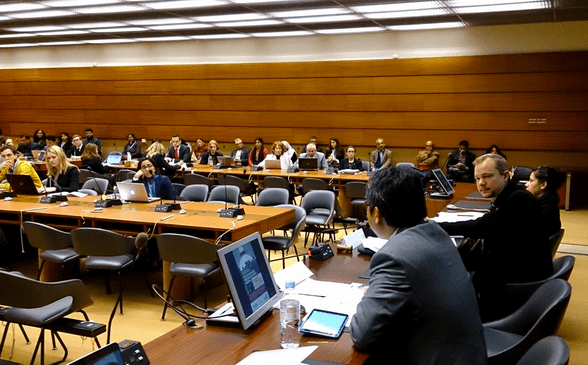
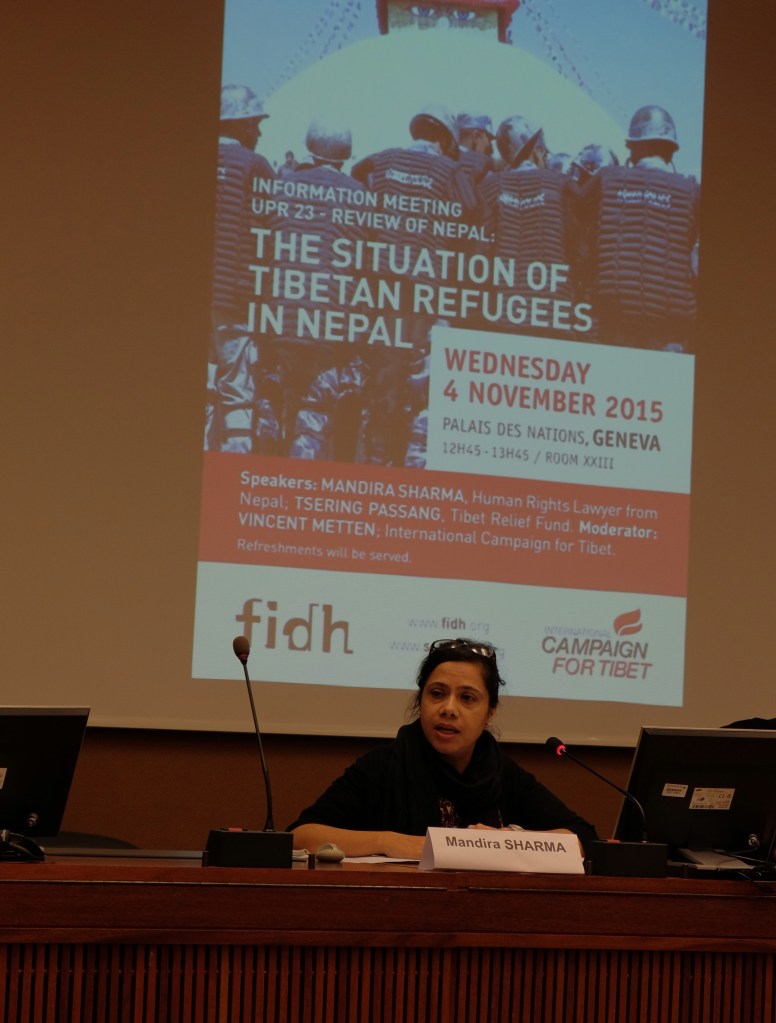
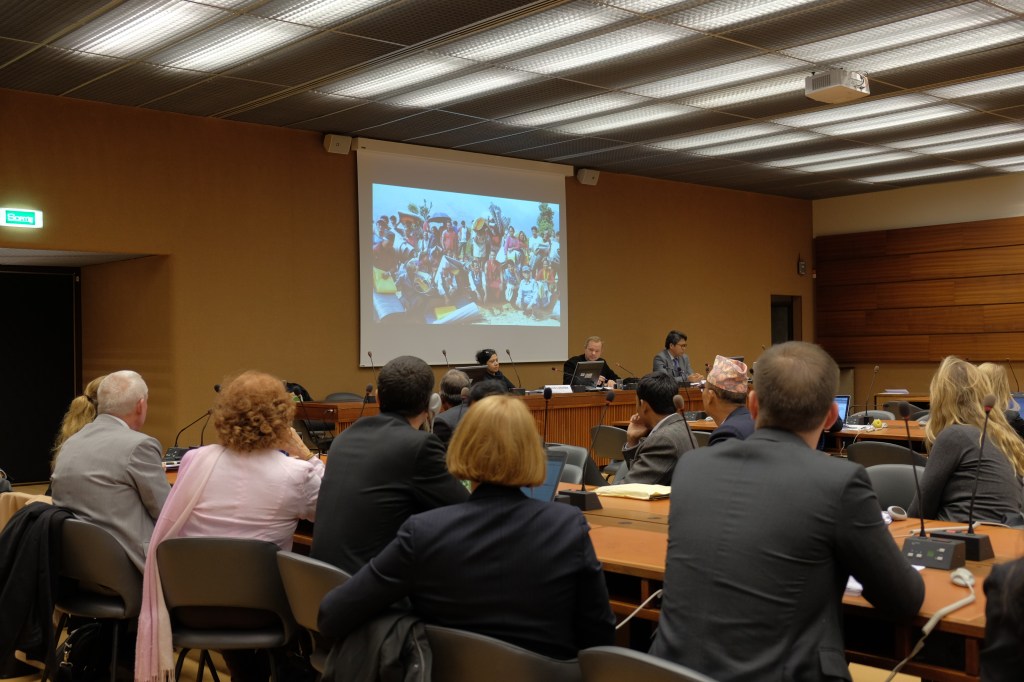
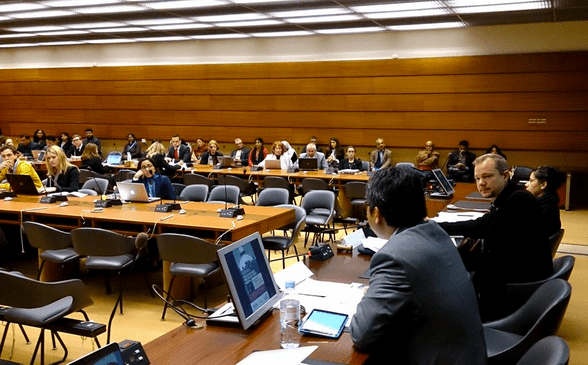
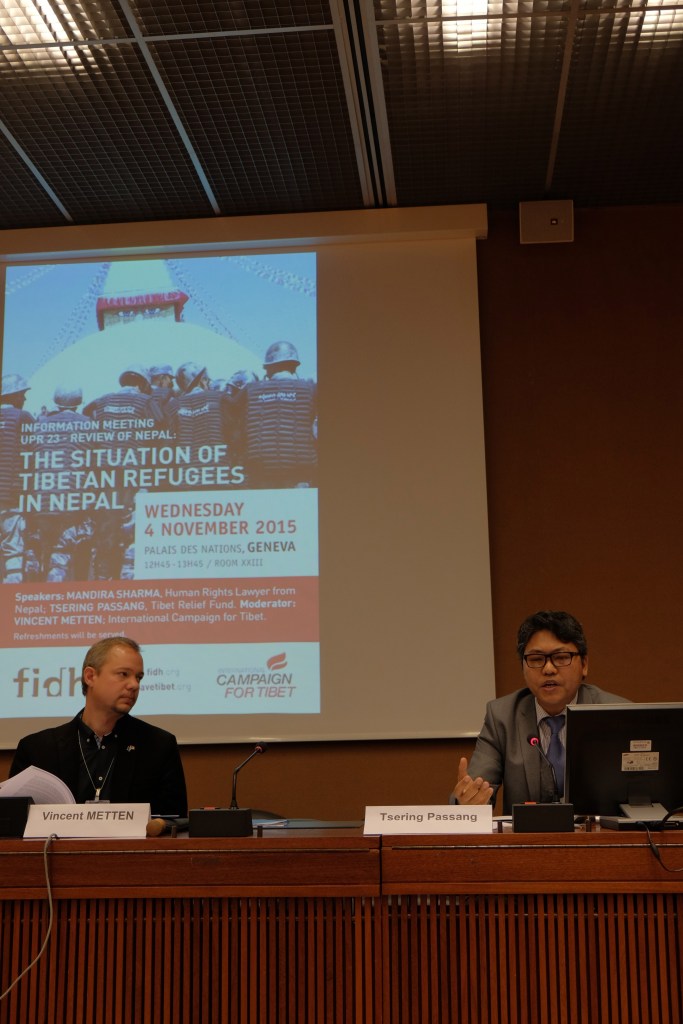
A decade ago, on 4 November 2015, I had the privilege of addressing a packed room at the Palais des Nations in Geneva during Nepal’s Universal Periodic Review (UPR) at the United Nations.
Organised by the International Campaign for Tibet (ICT) and the International Federation for Human Rights (FIDH), the side event focused on one of the most vulnerable yet least visible communities in the Himalaya: the Tibetan refugees in Nepal.
Representing the Tibet Relief Fund of the UK, I endorsed the powerful joint ICT–FIDH submission and highlighted the daily hardships faced by over ten thousands Tibetans living in Nepal – many without legal identity, fearful of refoulement, and caught between Kathmandu’s growing deference to Beijing and its own historic humanitarian tradition.
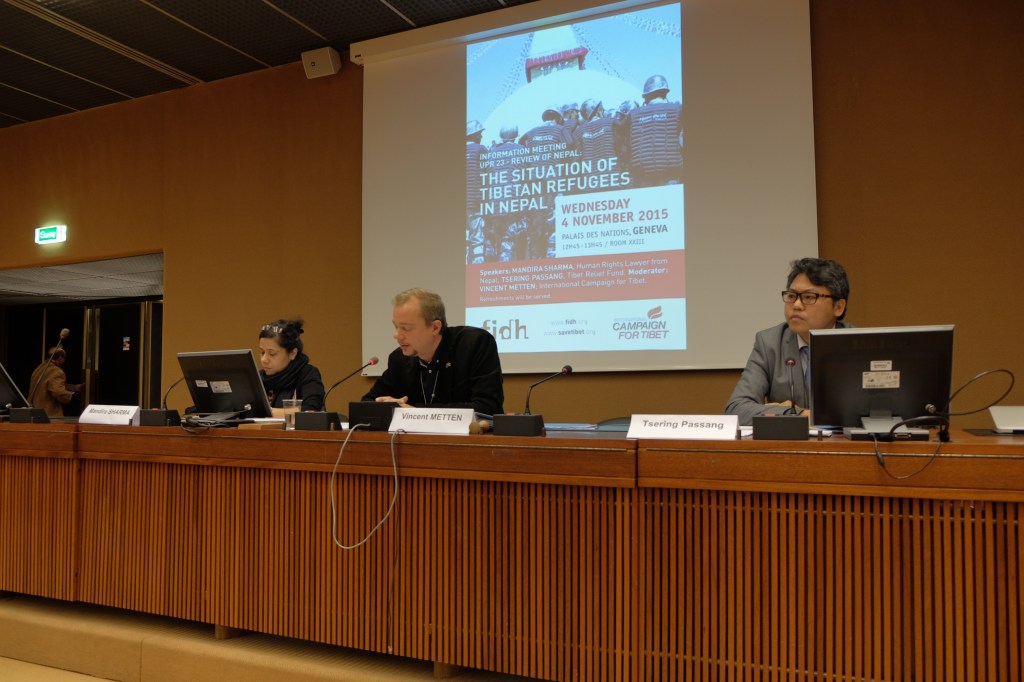
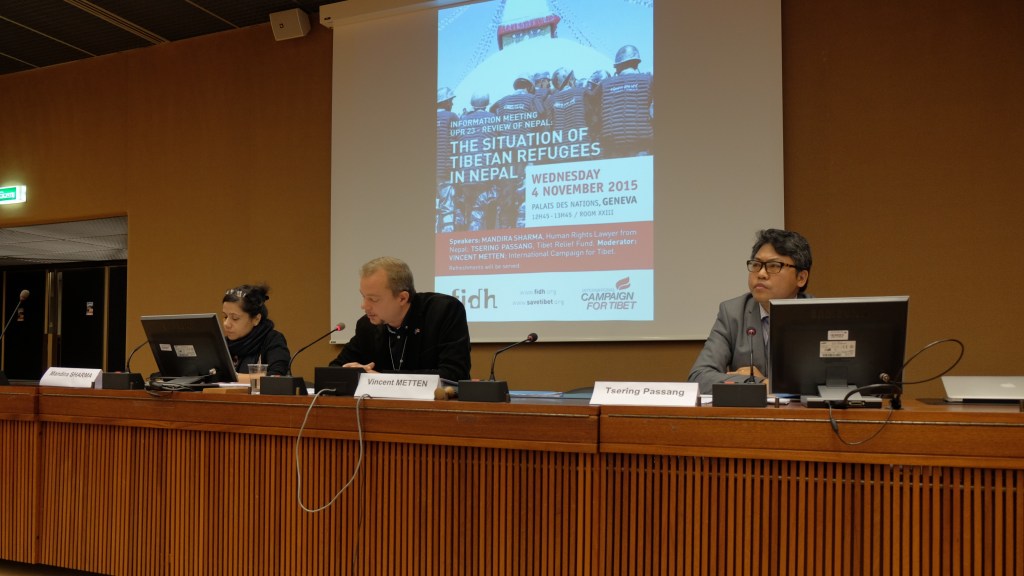
Sharing the panel was the courageous Nepali human-rights defender Mandira Sharma, President of Advocacy Forum–Nepal, who dissected the human-rights shortcomings of Nepal’s brand-new 2015 Constitution, especially its failure to offer clear protection to long-term refugees. The session was expertly moderated by Vincent Metten, ICT’s EU Policy Director.
Ten years later, the issues we raised that day remain painfully relevant. Nepal still has not regularised the status of most Tibetan refugees born on its soil. Although the number of new arrivals from Tibet has dwindled in recent years, those who still attempt the perilous journey across the high passes continue to risk their lives — only to face the ever-present threat of forced return at the border.
Meanwhile, the once-vital “Gentleman’s Agreement” with UNHCR — for decades a quiet but critical lifeline ensuring safe passage — has been steadily eroded by mounting political pressure from Beijing.
Yet that Geneva gathering also proved something enduring: when committed organisations and individuals come together – Tibetan voices, Nepali advocates, and international solidarity partners – even the most marginalised community can be heard inside the highest halls of global diplomacy.
This post is published simply as a historical marker and a quiet thank-you to everyone who made that intervention possible ten years ago, and to those who continue the work today.
The struggle for dignity and safety for Tibetan refugees in Nepal is far from over – but neither is the compassion that keeps their story alive.
Tsering Passang, Founder-Char, Global Alliance for Tibet & Persecuted Minorities (17 November 2025)
Tibetan Refugees in Nepal: Concerns Raised at UN UPR Side Event in Geneva (2015)
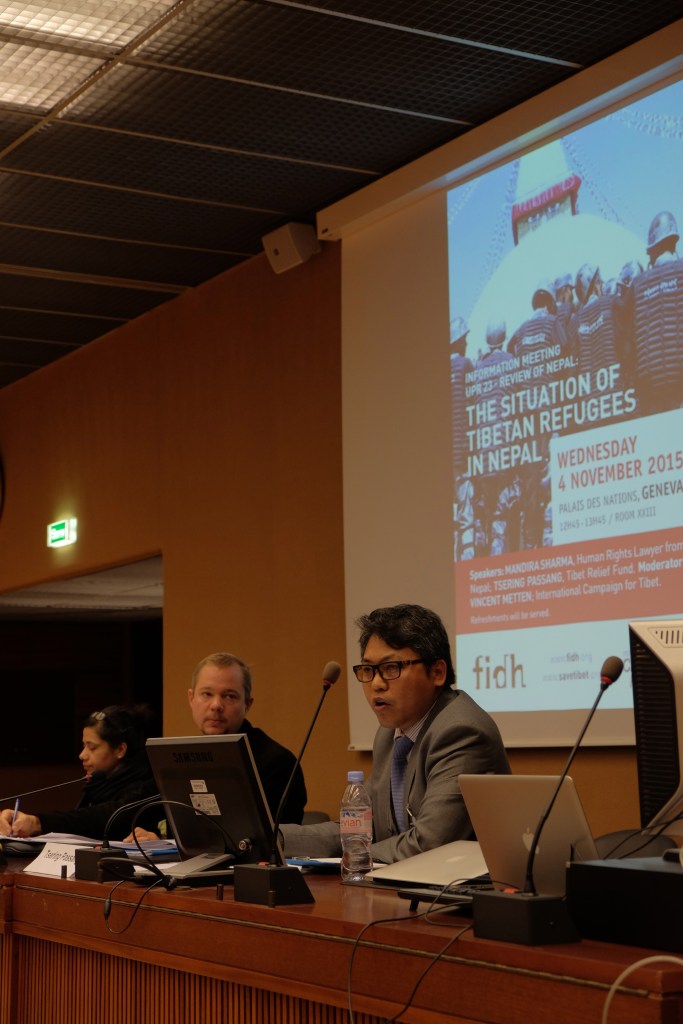
On 4 November 2015, at a side event hosted by the International Campaign for Tibet (ICT) and the International Federation for Human Rights (FIDH) at the Palais des Nations in Geneva, Tsering Passang, representing the Tibet Relief Fund of the UK, delivered a statement in support of the joint ICT–FIDH submission on the situation of Tibetan refugees in Nepal.
Joining him on the panel was the distinguished Nepali legal scholar and human-rights defender Mandira Sharma, President of Advocacy Forum–Nepal, who spoke powerfully on the human-rights implications of Nepal’s newly promulgated 2015 Constitution, particularly its impact on refugee protection and citizenship rights.
The session was skilfully moderated by Vincent Metten, EU Policy Director of the International Campaign for Tibet.
The intervention highlighted the continuing vulnerability of the Tibetan refugee community in Nepal and urged the Government of Nepal to honour its international obligations and longstanding “Gentleman’s Agreement” with UNHCR, ensuring safe passage and protection for Tibetans fleeing persecution.
Tsering Passang’s deliberation:
- Situation of Tibetans in Nepal and Chinese Influence
Tibetan refugees in Nepal feel unprotected and insecure. They face an uncertain future and to an extent they feel hopelessness. Nepal is an independent country. It must allow all peoples, including the Tibetan refugees to exercise their basic rights to free speech, freedom to assembly as well as be able to display their faith and respect in their Spiritual Leader His Holiness the Dalai Lama in public spaces without any restrictions. Tibetans in Tibet are banned from such rightful activities by the Chinese authorities. Nepal must not bow down to pressure from China.
I was born and brought up in a Tibetan refugee camp in western Nepal; my father fled Tibet and my mother was born in Mustang, near the Nepal-Tibet border. I did my schooling in Nepal. So, I am very familiar with the whole situation of Tibetans in Nepal.
Today, I speak in front of you with my own personal experience as well as a development practitioner having conducted many field trips whilst working for British Tibet NGOs in India and Nepal. Whilst welcoming everyone here this afternoon I make a special note of strong interests from our Nepalese delegates, who are visible in this room. I hope we can learn from the deliberations during this year’s UPR on Nepal this week and urge all parties concerned to implement upon return home.
First, I would like to acknowledge and thank the Government of Nepal for providing shelter to the Tibetan refugees in Nepal since 1959. There are so many Nepalese government officials and human rights activists as well as individual sympathetic Nepalese friends, who are very supportive and understanding of the situation of Tibetan refugees in Nepal.
I shall begin by citing quotes by several Nepalese human rights activists. At a public forum titled “49 Years of Tibetan Refugees in Nepal” on 3rd August 2008 in Pokhara, which was organised by The Sambhad Nepal, Mr Achut Acharya of the National Human Rights Commission (NHRC) of Nepal, Regional Office in Pokhara, said, “We have not been able to treat the refugees equally. We don’t pay much attention to the Bhutanese refugees because Bhutan doesn’t have much influence on Nepalese politics. Tibetan refugees should be able to access the justice system of Nepal, if needed.”
At the same forum, Mr Sudip Pathak, President of Human Rights Organisation of Nepal (HURON), said, “Refugees in Nepal are not treated equally. The Tibetan refugees are arrested and handed back (to the Chinese authorities) but not the Bhutanese. The Government helped the Bhutanese refugees to travel to the United States of America but in the case of Tibetans, they haven’t done so.” This is in reference to the US Government’s offer to accept certain Tibetan refugees from Nepal to the US on a third-country resettlement programme but the Nepalese authorities refused to issue exit permits due to pressure from China.
With no proper documentation, Tibetan students wanting to pursue college/university education in India face hardships as they’re often required to produce necessary paperwork. Due to lack of documentation, they are either charged higher fees at ‘foreign student’s rate in dollars, which refugee parents find it impossible to support, or an option to get admission at lower ranked institutions despite their superb academic results.
Often, they face hardships when crossing the Indo-Nepal border due to lack of paperwork. In my own case back in December 1995, with my friends we experienced physical abuse at the hand of Nepal border security force. At least I could speak both the Nepalese and English but Tibetans coming from Tibet who can’t speak both the languages, experienced even more hardship. We have cases of Tibetan women being sexually abused including a nun who was raped by the Nepalese border security personnel.
- Impacts of Earthquake in Nepal for Tibetans
The earthquake in Nepal earlier this year resulted in a huge loss of lives of nearly 9000 Nepalese, thousands of casualties, homes and livelihoods.
Whilst the loss of Tibetan lives is very minimal at 16 compared to our Nepalese friends, the natural disaster has affected the refugee community. We are constantly in touch with our contacts in Nepal. In recent days and just this morning I was speaking to our contacts there.
What we have learned is that the school children were deeply affected. Psychological counselling, offered by UNHCR and various NGOs are proving to be very beneficial in addition to the necessity of urgent supplies of food, medicine and temporary shelter. Although some of these children are now slowly recovering, at the initial stage it was evident that their academic results suffered badly. Firstly, the schools in affected areas were closed for nearly two months and the whole country had to deal with the situation despite limited resources.
It is very encouraging that in the time of hardships, difficulties and sadness there are strong sense of solidarity whilst supporting each other. The Tibetan refugee community in Nepal received support mainly from Tibetans living abroad and their Central Tibetan Administration (CTA) in Dharamsala, northern India despite their limited resources.
Although there have been no restrictions as far as I am concerned, with the rebuilding of lives and communities bound to take time in the years ahead the Nepal authorities should continue to freely allow the flow of funds to reach the Tibetan earthquake victims in Nepal.
- Conclusion
There is a good contingent from Nepal to the UPR this week, led by His Excellency Kamal Thapa, Foreign Minister, who is also a Deputy Prime Minister. This is in addition to various Nepalese human rights organisations and rights activists, a very positive sign as well as it presents an opportunity for Nepal to shoulder its obligations under the international norms for its citizens and other nationals including the Tibetans in Nepal. We remain hopeful that His Excellency Kamal Thapa would be more open towards addressing the Tibetans’ plight in Nepal.
I commend this Joint Submission by the International Campaign for Tibet (ICT) and International Federation for Human Rights (FIDH) for the UN Universal Periodic Review (UPR) of Nepal for the Tibetan refugees in Nepal.
In this submission, I specifically call for rapid actions from concerned authorities on:
Registration and legal status of Tibetans
- Issue refugee identity certificates (RCs) to all eligible Tibetans and their children.
- Ensure the renewal of RCs to all eligible Tibetans and their children.
- Abolish restrictions on the rights of Tibetan residents in Nepal to work, establish businesses, travel and access education.
- Enable children of refugees to acquire a nationality in accordance with Nepal’s obligations under the Convention on the Rights of the Child.
Freedom of Assembly and Expression
- Protect the rights of everyone to freedom of assembly and expression, regardless of their citizenship, in accordance with international human rights law
- ·Allow peaceful demonstrations and public gatherings of Tibetans#
Arbitrary arrest and detention
- Refrain from arresting and detaining Tibetans for the sole reason of having exercised their rights to freedom of assembly and expression
- Religious and cultural rights
- Ensure the rights of Tibetans in Nepal to practice and manifest their religion, and to participate in Tibetan cultural events
Thank you.






 Global Alliance for Tibet & Persecuted Minorities (GATPM)