LONDON, 25 September 2025 – Tibet rights groups in the UK, including the Tibetan Community in Britain and advocacy organisation Free Tibet, have sharply criticised Chinese contemporary artist Cai Guo-Qiang for what they describe as an act of “cultural violence” following his recent pyrotechnic performance on a sacred mountain in occupied Tibet.

The firework display, staged in Shigatse – a region under Chinese occupation for more than seven decades – took place just days before the opening of Cai’s major new exhibition, Gunpowder and Abstraction 2015–2025, at London’s White Cube gallery. The use of explosive materials in a location deeply revered by Tibetans has triggered widespread anger and condemnation among Tibetan communities and supporters worldwide.
“Celebrating an artist who has blatantly caused environmental and cultural destruction in a country under occupation is deeply troubling,” said Tenzin Rabga, Campaigns Lead at Free Tibet. “We firmly believe that a gunpowder artist who uses explosive materials to blatantly disregard the sanctity of a politically and ecologically fragile region should not be celebrated on the global stage. While Cai Guo-Qiang’s explosive artwork is being celebrated in London, Tibetans in Tibet will suffer the aftermath of his actions for generations to come.”
Cai, renowned for his large-scale gunpowder art and firework installations, has long claimed that his work explores spiritual and cosmic themes. However, Tibetan groups argue that his latest performance – conducted without the consent of the local population – is a clear example of China’s ongoing cultural erasure in the region.
In addition to its cultural impact, activists warn of the environmental consequences. Known as the “Third Pole,” the Tibetan Plateau holds the largest reservoir of freshwater outside the Arctic and Antarctic and feeds many of Asia’s major rivers. Campaigners say that explosions in such a fragile ecosystem can have long-term effects – polluting water sources, disrupting local wildlife, and contributing to glacial melt.
For Tibetans, who have safeguarded the plateau for millennia, the act represents a deep violation.
“We call on White Cube to publicly acknowledge the profound controversy that now surrounds the artist due to his actions in Tibet, and we urge them to reconsider providing a platform for work that aligns with the systematic destruction of Tibetan culture. Those who benefit from and exploit the occupation of Tibet like Cai, do not deserve a platform in a prestigious art gallery like the White Cube,” said Phuntsok Norbu, Chairperson of the Tibetan Community in Britain.
The condemnation comes amid growing international concern over the repression of Tibet under Chinese rule. In its 2025 report, human rights watchdog Freedom House gave Tibet a score of 0 out of 100 for civil and political freedoms – a ranking even lower than North Korea – underscoring the extreme levels of state control and suppression.
Activists argue that institutions and audiences cannot separate Cai’s work from the wider political reality in which it was created.
“History shows us that cultural destruction has been tied to occupation and colonialism, and Environmental defenders challenging China’s exploitation there have faced long prison sentences and torture,” reads a joint statement from the UK-based Tibet advocacy groups.”
Tibetan campaigners are urging the global arts community – including curators, institutions, and fellow artists – to speak out and hold figures like Cai accountable.
“Art must never be used to mask injustice or celebrate the destruction of a repressed culture,” the groups added.
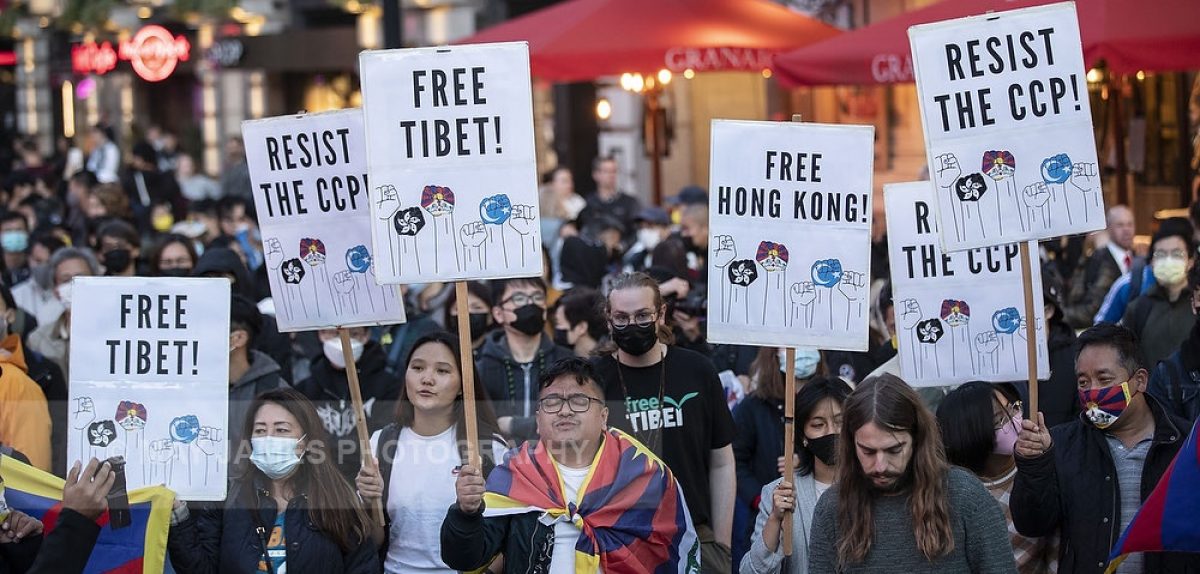
Protest at White Cube Gallery
To coincide with the preview event for Gunpowder and Abstraction 2015–2025, a peaceful protest has been organised by Tibetan activists and their allies outside the White Cube gallery in Bermondsey. The demonstration will take place today, 25 September, from 18:00 to 20:00, and aims to draw attention to what organisers describe as the “dangerous glorification” of art complicit in the erasure of Tibetan culture and environmental degradation.
Cai Guo-Qiang’s exhibition officially opens to the public on 26 September.
 Global Alliance for Tibet & Persecuted Minorities (GATPM)