
By Tsering Passang*
As His Holiness the 14th Dalai Lama marks his 90th birthday on 6th July 2025, Tibetans around the world – joined by friends and supporters globally – reflect on the extraordinary moral and spiritual leadership of a man whose lifelong commitment to compassion, nonviolence, humility, interfaith harmony and truth has shaped our collective struggle for justice and dignity.

I extend my heartfelt thanks to the BBC – in particular Laura Bicker, the BBC’s China Correspondent, and journalists Geeta Pandey and Samira Hussain – for their timely and thoughtful reporting on this historic milestone, including coverage from Chinese-occupied Tibet and from Dharamsala, home of the Tibetan Government-in-Exile.
The Radio 4 ‘Today’ programme, aired on 3rd July (2:44:43–2:50:03), was especially commendable. It captured not only the deep spiritual significance of His Holiness’s life, but also the political importance of his recent reaffirmation that the Dalai Lama institution will continue.
Yet as welcome as this coverage was, there remains more to say – and more for the public to understand.

A Clear Rejection of Beijing’s Interference
“I am affirming that the institution of the Dalai Lama will continue… I hereby reiterate that the Gaden Phodrang Trust has sole authority to recognise the future reincarnation; no one else has any such authority to interfere in this matter.”
His Holiness the 14th Dalai Lama
This declaration is far more than theological. It is a direct and resolute rejection of Beijing’s attempts to politicise Tibetan Buddhism and manipulate reincarnation traditions – part of a broader campaign to erase Tibetan identity and undermine Tibet’s spiritual sovereignty.
Let it be absolutely clear: Tibetans worldwide – both under occupation and in exile – overwhelmingly support His Holiness’s vision and authority. We are the rightful custodians of this sacred tradition. The Chinese Communist Party (CCP) – an avowedly atheist regime – holds neither moral legitimacy nor spiritual credibility to appoint or recognise any Tibetan spiritual leader.
The CCP’s claim that it will determine the next Dalai Lama is not only profoundly offensive, it is universally rejected by Tibetans. China may manufacture goods that dominate global markets, but it cannot manufacture spiritual legitimacy – nor can it impose a religious leader on a people it continues to suppress.
Britain and Tibet: A Forgotten but Vital History
To understand Tibet’s current plight, we must revisit Britain’s long and often overlooked historical relationship with Tibet – one that predates China’s 1950 invasion by decades.
From the Younghusband Mission in 1904 and the Simla Convention of 1914, to multiple treaties, trade missions and direct diplomatic exchanges, Britain engaged with Tibet as a distinct political entity. This history directly challenges Beijing’s revisionist narrative that Tibet has always been part of China.
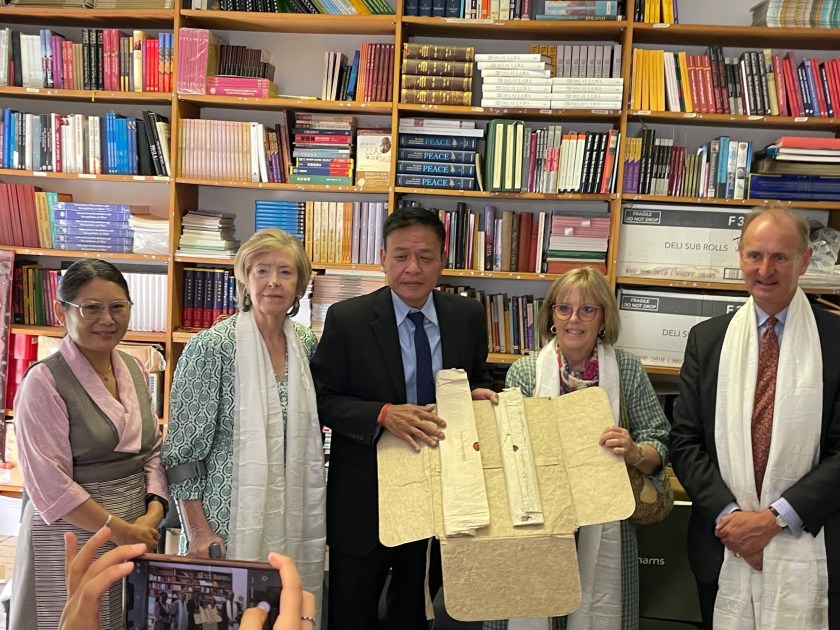
This unique relationship was poignantly reaffirmed in June 2025, when two original letters from 1947 – written by the young 14th Dalai Lama and the Tibetan Regent to the British Government – were formally returned to the Central Tibetan Administration (CTA) in Dharamsala. Addressed to Sir Basil Gould, Britain’s Political Officer for Sikkim, Bhutan and Tibet, these letters reflect Tibet’s independent diplomatic engagement.
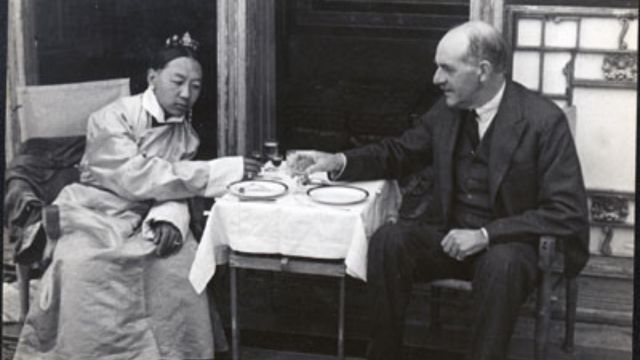
Recovered from auction through advocacy by the Global Alliance for Tibet & Persecuted Minorities (GATPM), the letters were donated by Sir Basil Gould’s granddaughters and will now be preserved at the Tibet Museum in Dharamsala. Their symbolic return, just days before His Holiness’s birthday, stands as a deeply meaningful gift of remembrance and truth – and a reaffirmation of Tibet’s rightful place in the world.
Importantly, Sir Basil Gould also personally attended the 1940 enthronement ceremony of the 14th Dalai Lama in Lhasa, when he was serving as the British Political Officer. His detailed “Report on the Discovery, Recognition and Installation of the Fourteenth Dalai Lama,” published by the Government of India Press in New Delhi in 1941, is a vital historical document that affirms the spiritual authenticity and time-honoured Tibetan tradition of reincarnation – observed and recognised by a British diplomat, at a time when the Communist Government of China had not yet been established.
This report remains a key archival record and offers firsthand insight into Tibet’s religious and political freedom before Chinese occupation. As such, the BBC and other media outlets must draw upon such invaluable documents when reporting on the highly sensitive issue of the Dalai Lama’s succession – an issue rooted in centuries of Tibetan religious tradition, not modern statecraft or communist ideology.
Modernisation – Initiated by Tibetans, Not Imported
The Chinese regime in Beijing often claims that it first brought “modernisation” to a “feudal and backward” Tibet after the establishment of the People’s Republic of China in 1949. History tells a different story.
In the 1920s, Tibetans – with British technical assistance – built the first hydroelectric power station in Lhasa. One of four Tibetan students sent to the UK in 1913 by the previous 13th Dalai Lama studied engineering and later built this pioneering infrastructure development.
Tibet was already embracing reform and progress – on Tibetan terms. These facts directly undermine Beijing’s narrative that Tibet’s advancement began only after Chinese occupation. Tibetan-led modernisation was already underway, long before the People’s Liberation Army crossed our borders.
A Spiritual Leader Embraced by Britain
His Holiness the Dalai Lama has long been respected in the UK not only as a revered spiritual figure, but as a global moral statesman.
From petitions to Sir Winston Churchill in the 1950s, to official meetings with Sir John Major, Gordon Brown, and David Cameron, British leaders have consistently acknowledged His Holiness’s role as a voice of peace, resilience and hope. His Majesty King Charles III, as Prince of Wales, hosted His Holiness at Clarence House and Highgrove, reinforcing this special relationship.
Resistance: Then and Now
Tibetan resistance is not a relic of the past – it remains a living, ongoing struggle, both inside occupied Tibet and across the global exile community.
From the 1959 Lhasa Uprising to the CIA-backed guerrilla resistance in Mustang, near Nepal-Tibet border, Tibetans have long fought for our rights. My own father was part of the Mustang resistance. I was born and raised in Tibetan refugee camps in Nepal. Today, our resistance takes peaceful forms – through education, cultural preservation, environmental advocacy and global solidarity. But our spirit remains unbroken.
Honouring His Holiness the Dalai Lama in London – 5th July 2025
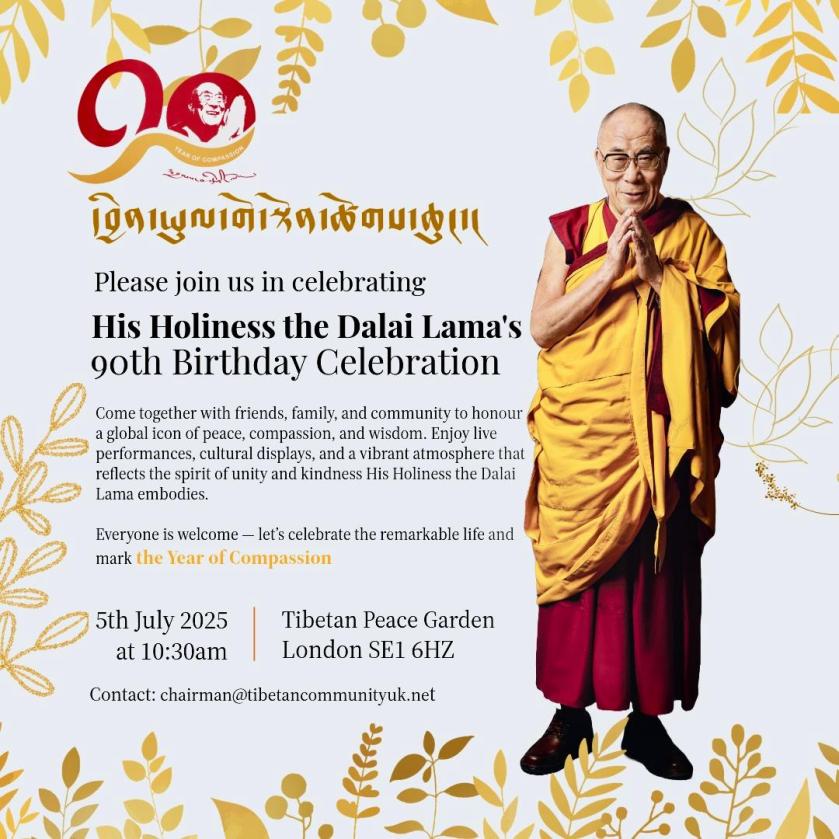
To mark this historic occasion, the Tibetan Community in Britain is hosting a public celebration on Saturday, 5th July, at the Tibetan Peace Garden beside the Imperial War Museum in London. Commissioned by Tibet Foundation and inaugurated by His Holiness the Dalai Lama in 1999, the Tibetan Peace Garden remains the UK’s only dedicated Tibetan monument.
Distinguished guests and speakers include:
- Cllr. Linda Bird, The Worshipful Mayor of the Royal Borough of Greenwich, who recently raised the Tibetan flag at Woolwich Town Hall in a bold show of solidarity
- Sir Iain Duncan Smith MP, a leading voice on human rights and China accountability
- Tsering Yangkey, Dalai Lama’s UK Representative based at The Office of Tibet, London
- Phuntsog Wangyal, Dalai Lama’s First UK Representative; Founding-Trustee of Tibet Foundation; and the Core Person behind the Tibetan Peace Garden project
- Phuntsok Norbu, Chair of the Tibetan Community in Britain
Woolwich holds a unique connection to Tibet. In 1913, four Tibetan students – sent at the request of the 13th Dalai Lama and supported by the British Government – arrived in Britain. Two of them, Gongkar and Ringang, received military training at the Royal Arsenal and Royal Military Academy Woolwich, with the support of Sir Basil Gould. This historic exchange reflects Tibet’s early openness to reform and international collaboration – long before the Communist China’s occupation.
A Personal Reflection
As someone born stateless in a refugee camp and now a British citizen, I see in His Holiness the Dalai Lama a symbol of wisdom, moral courage and principled leadership. He reminds us that the most powerful leadership comes not from coercion, but from compassion and truth.
I also see in the BBC’s journalism a valuable platform – one that can do more than inform. It can help educate and reconnect the British public with a shared, often-suppressed history.
I thank the BBC once again for its important coverage. And I respectfully urge it – and all British institutions – to go further. The full story of Tibet’s past, present and future deserves to be told.
To learn more about the Dalai Lama’s 90th birthday celebration in London, or to support Tibetan advocacy efforts, please visit: www.Tsamtruk.com
Follow: @Tsamtruk | @AllianceTibet
Hashtags: #DalaiLama90 | #TibetUKHistory | #FreeTibet | #TruthForTibet
About the Author
Tsering Passang is a Tibetan writer and blogger, and the Founder-Chair of the Global Alliance for Tibet & Persecuted Minorities. A long-standing advocate for Tibetan rights and democratic values, he previously served as Director of Tibet Foundation and as Chairman of the Tibetan Community in Britain. He also held roles on the Council of the Tibet Society, including as Special Adviser from 2014 to 2018.
Follow BBC Reporting…
BBC: Dalai Lama confirms he will have a successor after his death (2nd July 2025
BBC visits heart of Tibetan resistance as showdown looms between Dalai Lama and China (2nd July 2025)
BBC: Dalai Lama confirms he will have a successor after his death (1st July)
BBC News: As Dalai Lama turns 90, BBC visits heart of Tibetan resistance to China
 Global Alliance for Tibet & Persecuted Minorities (GATPM)

Iran: Human Rights Focus: Action Needed
−
René Wadlow, Association of World Citizens
On Fri, Jul 4, 2025 at 10:57 AM Global Alliance for Tibet & Persecuted
LikeLike