London, 24 June 2025 | Tsering Passang
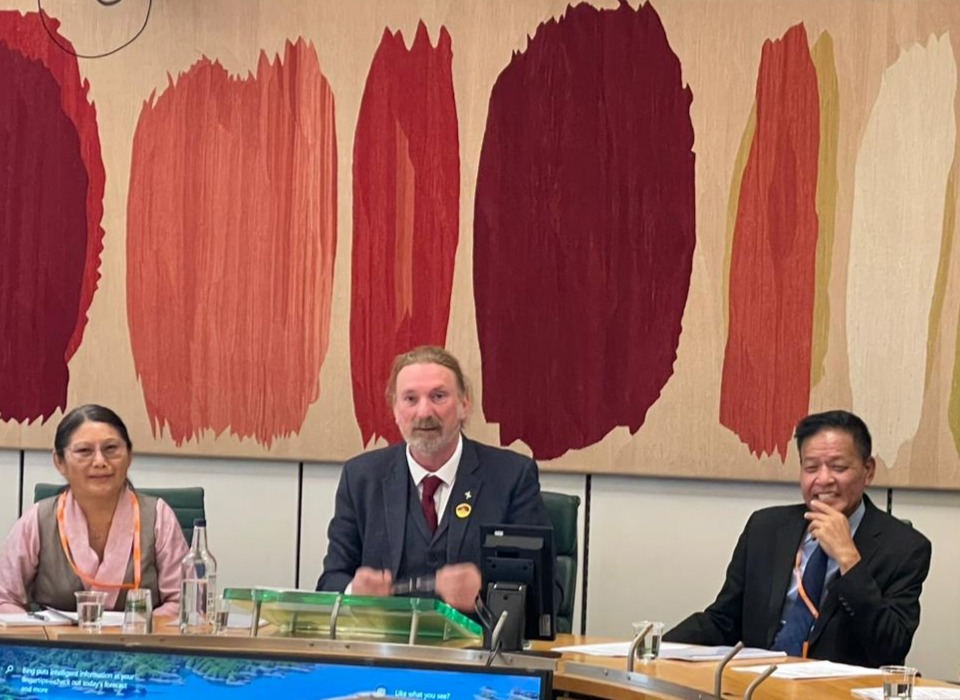
The All-Party Parliamentary Group for Tibet Meeting at Portcullis House, Westminster | 23 June 2025
The President of the Central Tibetan Administration (CTA), Sikyong Penpa Tsering, concluded a meaningful visit to London with a final engagement at the UK Parliament on Monday, alongside a series of meetings with government officials. The parliamentary event, held at Portcullis House, was hosted by Chris Law MP, Chair of the All-Party Parliamentary Group for Tibet (APPGT), and brought together British parliamentarians, aides, Tibet supporters, and civil society figures for an in-depth dialogue on the Tibetan cause and the future of UK-Tibet relations.
In his keynote address, Sikyong Penpa Tsering outlined the CTA’s preparations to mark the 90th birthday of His Holiness the 14th Dalai Lama, which will be commemorated globally as the Year of Compassion (July 2025 – July 2026). He reflected on the Dalai Lama’s unwavering commitment to non-violence, interfaith harmony, and peaceful resolution of conflict – universal principles that resonate across political and cultural divides in an increasingly turbulent world.
Renewed Policy Appeals to the UK Government
The Sikyong used the occasion to urge the UK government to take a more assertive role in support of Tibet, presenting a series of principled and timely policy recommendations:
- Reassess the UK’s stance on Tibet by returning to its pre-2008 policy, when Tibet was treated as an unresolved international issue, rather than being dismissed as an internal matter of the People’s Republic of China (PRC).
- Defend Tibetan religious freedom by supporting the right of the Tibetan people to determine the reincarnation of the Dalai Lama in accordance with their centuries-old Buddhist traditions – free from Chinese government interference, particularly the PRC’s 2007 State Religious Affairs Order No. 5, which seeks to control reincarnation processes.
- Issue an unequivocal public statement affirming that decisions regarding reincarnation rest solely with the Tibetan Buddhist community, not with any secular authority, and certainly not the Chinese Communist Party.
- Reject the usage of the term “Xizang”, which the Chinese government increasingly promotes in global discourse to replace “Tibet.” The Sikyong warned that this strategic shift is part of a wider effort to erase Tibetan history, diminish its cultural identity, and reduce the geopolitical scope of the Tibetan issue.
He clarified that while “Xizang” refers only to the Tibet Autonomous Region (TAR) – established by the PRC in 1965 and comprising just one-third of historic Tibet – Tibetans consider their homeland to include the three traditional provinces of U-Tsang, Kham, and Amdo, which together form the full cultural, historical, and spiritual territory of Tibet.
Diplomatic Engagements and Parliamentary Solidarity
In addition to the parliamentary meeting, Sikyong Penpa Tsering held constructive discussions with senior officials at the Foreign, Commonwealth and Development Office (FCDO), where he reaffirmed the CTA’s commitment to non-violence, dialogue, and the pursuit of a peaceful solution for Tibet. He also encouraged the UK to demonstrate greater leadership in safeguarding the rights and identity of Tibetans under Chinese rule.
Chris Law MP, in his welcoming remarks, reaffirmed the APPGT’s enduring commitment to the Tibetan people. He underscored the UK’s responsibility to uphold religious freedom, cultural survival, and genuine autonomy, in alignment with the Middle Way Approach and international human rights norms.
Community Engagements and Youth Outreach
Over the weekend, the Sikyong engaged directly with members of the Tibetan community in the UK, including a dynamic session with Tibetan youth, during which he encouraged the younger generation to stay connected to their roots and play a meaningful role in advancing the Tibetan cause. He also attended a vibrant cultural performance by the London School of Tibetan Language and Culture, and delivered a public talk and Q&A session with the Tibetan Community in Britain, fostering open dialogue and renewed energy within the diaspora.
Looking Ahead: A Seasoned Leader in a Defining Moment
Following his UK engagements, Sikyong Penpa Tsering departed for Germany to continue his European tour, where he will deepen diplomatic outreach and engage with Tibetan communities across the continent.
With the next round of Central Tibetan Administration elections expected in late 2025 or early 2026, Sikyong Penpa Tsering is widely regarded as a strong contender for re-election. A seasoned Tibetan politician with over three decades of public service, including seven years as Speaker of the Tibetan Parliament-in-Exile, his current tenure as Sikyong has been marked by principled international engagement, attempts of renewing global visibility for the Tibetan cause, and a commitment to defending Tibetan identity against rising authoritarian pressures.
Emerging Dynamics and Potential Rivals
Speculation is growing about potential challengers in the upcoming elections. Among the most frequently mentioned is former Sikyong Dr Lobsang Sangay, who led the CTA from 2011 to 2021. A Harvard-trained legal scholar, Dr Sangay currently serves as a Senior Fellow at East Asian Legal Studies Program, Harvard Law School. His recent public commentaries, academic appearances, and visible re-engagement with Tibetan diaspora communities have fuelled rumours of a possible political comeback. During his tenure, he helped elevate the global profile of the CTA, engaging directly with Western governments and institutions.
Meanwhile, attention has also turned to Shepenn Kymsar, a Tibetan-American filmmaker and activist currently on an international tour screening his acclaimed resistance-themed film, Four Rivers Six Ranges. Notably, Sikyong Penpa Tsering has appeared at several of these screenings, including in London, Toronto, and other places, where he shared the stage with Kymsar during post-screening remarks. These appearances have prompted speculation about a coordinated narrative effort, potentially aimed at mobilising younger Tibetans and reinforcing the political legitimacy of the CTA through cultural engagement.
Some observers interpret this as the Sikyong’s attempt to align himself with youth voices and creative platforms, presenting a modernised, culturally fluent leadership style that resonates with the diaspora’s younger demographic. Others suggest it may signal a strategic endorsement of Kymsar’s activism, or possibly a prelude to political collaboration or alliance-building ahead of the elections.
Though no official candidacies have yet been declared, these developments indicate a subtle but significant shift in the Tibetan political landscape. With the incumbent consolidating his record while engaging new constituencies, and potential rivals re-entering public discourse, the 2025/26 elections are shaping up to be a pivotal moment for the future of Tibetan leadership in exile.
 Global Alliance for Tibet & Persecuted Minorities (GATPM)