
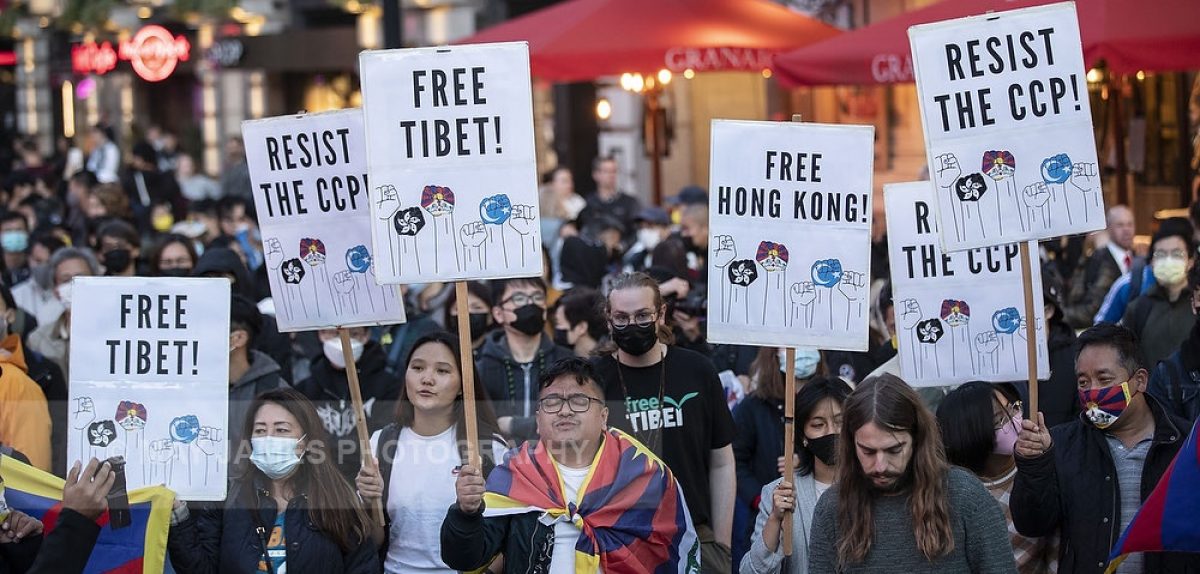
London, 23 May 2025 | Tsering Passang
Today marks the 74th anniversary of the so-called Agreement of the Central People’s Government and the Local Government of Tibet on Measures for the Peaceful Liberation of Tibet – commonly known as the “17-Point Agreement”. Signed under duress on 23 May 1951 in Beijing, this document was never recognised by the Tibetan people and is now widely regarded as invalid under international law.
Despite Chinese assertions that it represented a peaceful accord between “motherland” and “minority,” the agreement remains a symbol of coercion, broken promises, and military occupation – not of voluntary unification.
A Signature at Gunpoint
The 17-Point Agreement was signed not through free negotiation, but under extreme military pressure. Tibet’s delegation in Beijing lacked authorisation from Lhasa and was denied any communication with the Tibetan government. The agreement bears seals, but not the informed consent of the sovereign Tibetan state.
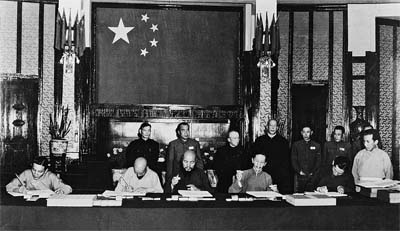
Front row right to left: Ngapoi Ngawang Jigme, Sonam Wangdu, Thuptan Tenthar, Thuptan Lekmuun, Tenzin Thondup. Back row left to right: Chen Yun, Zhu De, Li Jishen. Photo: Wikipedia.org
In 1952, Tibetan Prime Minister Lukhangwa confronted Chinese representative Zhang Jingwu, stating unequivocally that “the Tibetan people did not accept the agreement.” His Holiness the 14th Dalai Lama, then a teenager, later wrote in My Land and My People that he chose to cooperate temporarily only “to save my people and country from total destruction.”
Assurances Made – and Violated
In 1954, the Dalai Lama travelled to Peking for six months, meeting top Chinese leaders including Chairman Mao Zedong and Premier Zhou Enlai. He attempted for nearly eight years to work within the agreement’s framework. But as the People’s Liberation Army (PLA) tightened its grip and resistance was violently crushed, the CCP’s true intentions became clear.

The promised autonomy, religious freedom, and protection of Tibet’s traditional system were swiftly undermined. What followed was the destruction of monasteries, the erosion of language rights, and the dismantling of Tibet’s independent governance.
Repudiation in Exile
In March 1959, following the brutal suppression of the Tibetan National Uprising in Lhasa, the Dalai Lama fled to India. At his first press conference in Mussoorie, he publicly repudiated the 17-Point Agreement, declaring it null and void due to its coercive origins and systematic violations by China.
The exile government, now the Central Tibetan Administration (CTA), continues to reject the agreement’s legitimacy to this day.
International Law: Coercion Invalidates Consent
The Vienna Convention on the Law of Treaties (1969), though adopted years later, codifies longstanding principles of customary international law: any agreement signed under threat or use of force is invalid. China’s invasion of eastern Tibet in 1950 and its military intimidation during the 1951 negotiations clearly contravene this norm.
Sikyong Penpa Tsering, President of the Central Tibetan Administration, (CTA), has categorically called the agreement “illegal under international law.” On the 63rd anniversary of the Tibetan National Uprising in 2022, he denounced the so-called “peaceful liberation” as a violent annexation dressed in diplomatic clothing.

The 17 Points: A Catalogue of Broken Promises
The agreement’s language painted a picture of partnership and protection. In practice, every major clause was betrayed. Below are the 17 key provisions of the agreement, followed by their historical context:
The 17-Point Agreement: Core Clauses
- Tibet to be unified with the “motherland”; imperialist forces to be expelled.
- Tibetan Government to assist PLA entry and help consolidate national defence.
- Tibetan regional autonomy guaranteed under Central Government leadership.
- Tibet’s political system and the Dalai Lama’s status to remain unchanged.
- The Panchen Lama’s status and authority to be similarly protected.
- Statuses of the 13th Dalai Lama and 9th Panchen Lama upheld.
- Freedom of religion guaranteed; monastery income protected.
- Tibetan troops to be integrated into the PLA.
- Tibetan language and education to be developed as per local conditions.
- Economic development in agriculture, livestock, industry, and commerce.
- No reforms imposed; changes to occur via local initiative and consultation.
- Former pro-KMT or pro-imperialist officials allowed to remain if loyal.
- PLA to conduct fair trade and avoid taking anything from locals without consent.
- External affairs to be handled by the Central People’s Government.
- Military and administrative committees to include local Tibetan personnel.
- Costs of PLA and administration to be covered by the Central Government.
- Agreement to take effect upon signing.
A Record of Systematic Violations
Despite these promises, Tibet’s political autonomy was swiftly dismantled. The Dalai Lama was rendered a figurehead, religious institutions were destroyed during the Cultural Revolution, and Tibetan language and culture were marginalised.
Rather than being respected as partners, Tibetans were treated as subjects of an imposed colonial administration. China’s claim that Tibet “willingly returned” to China under this agreement is a falsehood, not supported by historical facts or legal principles.
Conclusion: Reclaiming the Truth
The 17-Point Agreement is not a foundation for Chinese sovereignty over Tibet – it is a case study in coercion, occupation, and betrayal. It was signed under military threat, repudiated by the Tibetan leadership, and violated by China at every step.
As Tibetans mark 74 years since this unjust agreement, their call for justice, freedom, and self-determination grows stronger. Upholding these principles is not just a matter of historical redress – it is a vital test of the international community’s commitment to truth and the rule of law.
To access the full document “Facts About the 17-Point Agreement Between Tibet and China”, please visit: https://tibet.net/wp-content/uploads/2014/10/FACTS-ABOUT-17-POINT-AGREEMENT..pdf
 Global Alliance for Tibet & Persecuted Minorities (GATPM)