
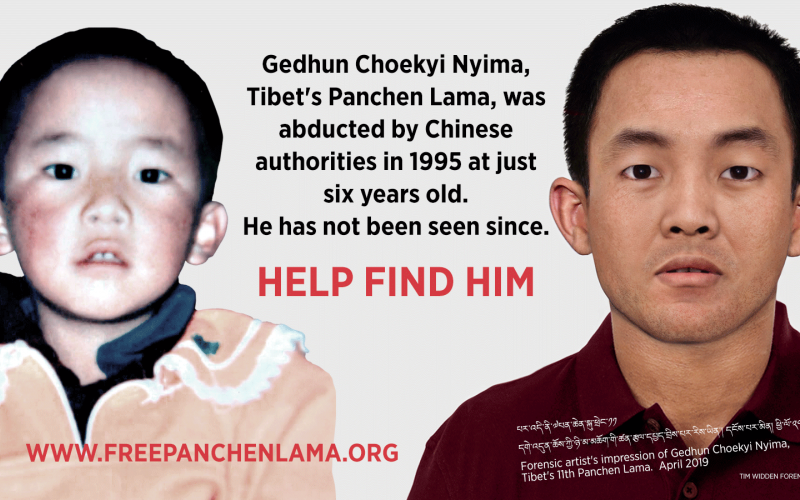
Thirty years ago, on 17 May 1995, before he could speak his first words as a spiritual leader or sit among his people, Gedhun Choekyi Nyima was abducted by Chinese authorities. He was just six years old. Since that day, neither he nor his family has been seen.
Born on 25 April 1989 in Lhari County, Tibet, Gedhun Choekyi Nyima was a child whose destiny was to rise far beyond the remoteness of his birthplace. At the age of six, he was formally recognised by His Holiness the 14th Dalai Lama as the 11th Panchen Lama – the second-highest spiritual figure in Tibetan Buddhism.
What should have been a sacred milestone in Tibetan religious tradition instead marked the beginning of one of the longest and most egregious cases of enforced disappearance in modern history. The Panchen Lama, then only a child, became the world’s youngest political prisoner. Nearly three decades later, he remains forcibly disappeared – a haunting symbol of China’s relentless effort to dismantle the spiritual and cultural bedrock of Tibetan life.
A Deliberate Attack on Tibetan Faith
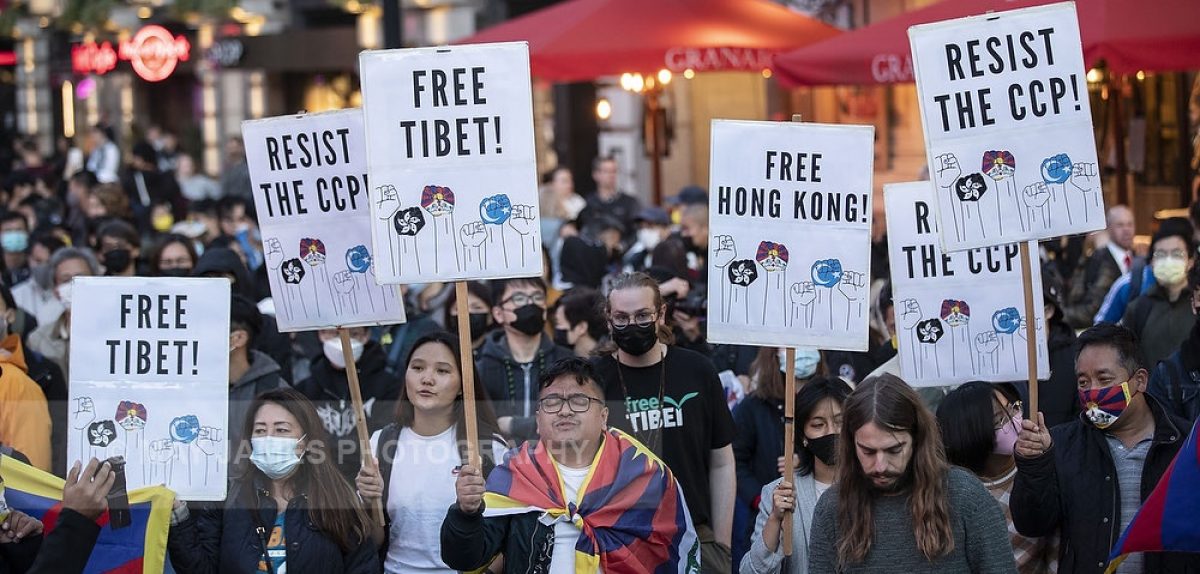
The abduction of the 11th Panchen Lama was not an isolated act. It is part of a systematic strategy by the Chinese Communist Party (CCP) to control, co-opt, and ultimately erase Tibetan Buddhism and identity. Recognising the crucial spiritual and political role the Panchen Lama plays – particularly in identifying the reincarnation of the Dalai Lama – Beijing has sought to impose its own narrative. Just months after kidnapping Gedhun Choekyi Nyima, the CCP installed its own hand-picked candidate, Gyaincain Norbu, as a puppet Panchen Lama.

This brazen move violated centuries-old Tibetan religious tradition and exposed the CCP’s deep-seated fear of the power of genuine faith. Tibetan Buddhism, with its foundation in reincarnation, ethics, and truth, is fundamentally at odds with an authoritarian regime that thrives on propaganda, censorship, and coercion.
More hypocritically, the Chinese Communist Party – which is constitutionally atheist and ideologically materialist – has no belief in spiritual systems. Yet it takes the liberty of selecting and installing religious leaders for political control. This cynical manipulation lays bare the Party’s true intent: not to protect faith, but to weaponise it.
Contravening China’s Own Constitution
The CCP’s actions in the Panchen Lama case not only violate international human rights standards, but also contradict the People’s Republic of China’s own constitution. Article 36 of the PRC Constitution clearly states:
“Citizens of the People’s Republic of China enjoy freedom of religious belief… The state shall protect normal religious activities.”
There is nothing “normal” about abducting a six-year-old child recognised through legitimate Tibetan religious processes and replacing him with a state-appointed proxy. Moreover, by imposing State Religious Affairs Bureau Order No. 5 (2007), which mandates that all Tibetan reincarnations must receive government approval, the CCP blatantly violates the constitutional guarantee of religious freedom.
Such actions transform the PRC’s constitutional promises into hollow words and expose the Chinese regime’s duplicity. When an atheist state presumes authority to approve or deny reincarnated lamas, it tramples not only on religious freedom but also on the principle of non-interference in spiritual affairs.
The Historical Legacy of the Panchen Lama

The institution of the Panchen Lama dates back to the 17th century and is inextricably linked with the lineage of the Dalai Lamas. These two great spiritual figures have traditionally recognised each other’s reincarnations – a sacred mutuality that preserves the continuity of Tibetan Buddhism.
This continuity was violently disrupted when the People’s Republic of China invaded and occupied Tibet in 1950, bringing an abrupt end to centuries of Tibetan self-rule. Since then, the Chinese Communist Party has systematically sought to dismantle Tibet’s religious institutions and exert absolute political control over its spiritual life.
The 10th Panchen Lama, Lobsang Trinley Lhündrub Chökyi Gyaltsen, was a courageous figure who stood up to the CCP’s brutal policies. In 1962, he risked his life by presenting a 70,000-character petition to the Chinese leadership, detailing the horrors inflicted upon Tibet – including mass starvation, destruction of monasteries, and persecution of monks. For his truth-telling, he was imprisoned and later placed under house arrest until his suspicious death in 1989.
State-Manufactured Religion and Cultural Erasure
In its attempt to control Tibetan Buddhism, the CCP has launched a systematic assault not only on religious leaders but on the entire Tibetan cultural and spiritual ecosystem. From banning the Dalai Lama’s image and teachings to enforcing Mandarin language instruction in schools and restricting monastery enrolments, the Party is working to erase a civilisation.
Beijing’s tactics amount to nothing short of cultural genocide. The forced imposition of state policy over sacred religious practices, including the reincarnation process, is an existential threat to Tibetan identity. The state’s manipulation of faith is not only unethical – it is genocidal in scope, aimed at replacing a vibrant living tradition with hollow propaganda.
The Global Pattern of Repression
The Panchen Lama’s disappearance is emblematic of a broader pattern of religious persecution in the People’s Republic of China and its occupied territories. In East Turkestan (Xinjiang), over a million Uyghur Muslims have been detained in internment camps. Christian churches are demolished, pastors jailed, and crosses torn down. Falun Gong practitioners endure arbitrary imprisonment and torture. In Inner Mongolia, the Mongolian language is being phased out of schools. Across the board, the CCP seeks to dissolve identities that do not conform to its monocultural, authoritarian vision.
Why the World Must Act
As the Dalai Lama ages, time is of the essence. The international community must not allow Beijing to hijack the sacred traditions of Tibet and install a counterfeit Dalai Lama. Such a deception would not only betray the Tibetan people but also undermine global religious freedom.
The United States, through the Tibet Policy and Support Act (TPSA), has already declared that only Tibetan Buddhists have the right to determine their spiritual leaders. India, home to the Dalai Lama and the Tibetan Government-in-Exile (Central Tibetan Administration), bears a unique historical and moral responsibility. The European Union and other democratic nations must follow suit by linking human rights to diplomatic and economic ties with China.
Above all, the United Nations Human Rights Council must break its prolonged silence. It is unacceptable that a six-year-old boy could disappear for 30 years without a single independent investigation. The Panchen Lama is not a forgotten relic – he is a living, breathing soul, whose voice has been silenced by tyranny.
Recommendations for Immediate International Action:
- Demand Independent Access: China must reveal the whereabouts of Gedhun Choekyi Nyima and allow the UN and the International Committee of the Red Cross (ICRC) to verify his wellbeing.
- End State Interference in Reincarnation: Repeal Order No. 5 and respect the religious autonomy of Tibetan Buddhists.
- Support Genuine Tibetan Religious Leadership: Nations must publicly declare that only reincarnations confirmed by the Tibetan Buddhist community will be recognised.
- Apply Targeted Sanctions: Impose Magnitsky-style sanctions on Chinese officials responsible for the disappearance of the Panchen Lama and for broader religious persecution.
- Raise the Issue at the UN: The Human Rights Council must prioritise the Panchen Lama’s case and hold China accountable for enforced disappearances and violations of religious freedom.
Faith Cannot Be Manufactured
China may excel at replicating consumer goods, technology, and industrial prowess, but it cannot fabricate spiritual legitimacy. Faith is not a state commodity – it is a sacred contract between a people and their tradition. By abducting the Panchen Lama and imposing a false successor, the CCP has not only violated the rights of a child, but assaulted the spiritual heart of an entire civilisation.
Gedhun Choekyi Nyima’s silence echoes louder with each passing year. His story is not just a cry for justice – it is a global call to conscience.
Return the Panchen Lama to the Tibetan people. Restore Tibetan religious freedom. Respect Tibetan spiritual sovereignty.
Tsering Passang is the founder and chair of the Global Alliance for Tibet & Persecuted Minorities. A dedicated human rights advocate and blogger, he champions Tibetan freedom, justice, democracy, and the rights of persecuted communities around the world.
 Global Alliance for Tibet & Persecuted Minorities (GATPM)