
13th March 2025 | GATPM
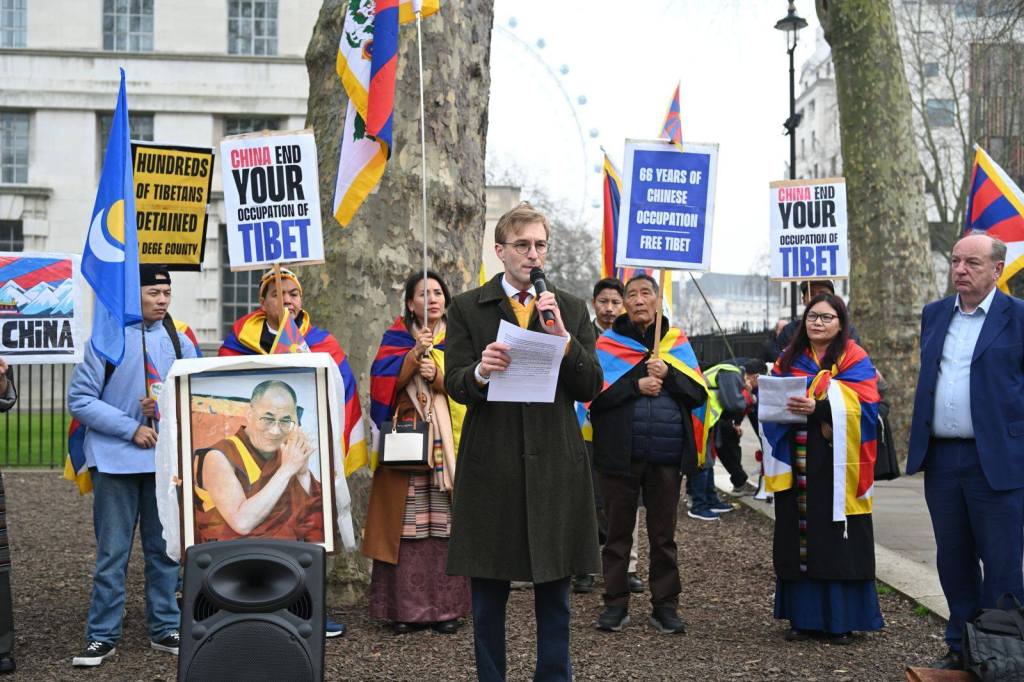
“Confront the stark realities that challenge the very essence of Tibetan identity,” said Luke de Pulford, Co-founder and Executive Director of the Inter-Parliamentary Alliance on China (IPAC), addressing a powerful gathering in Whitehall on 10th March 2025.
The rally, held directly opposite Downing Street, drew several hundred British Tibetans, supporters, and human rights defenders to mark the 66th anniversary of the Tibetan National Uprising Day. This commemoration remembers the tragic events of March 10th 1959, when Tibetans rose against the invading People’s Liberation Army (PLA) of Communist China. The rally was jointly organised by the Tibetan Community in Britain, Free Tibet, and the Global Alliance for Tibet & Persecuted Minorities (GATPM).
In his speech, Luke de Pulford urged attendees to confront the harsh realities threatening Tibetan identity. He condemned Beijing’s systematic efforts to erase Tibetan language, culture, and religious practices — including the coercive assimilation of Tibetan children in colonial-style boarding schools.
“Despite its rich cultural legacy, Tibet has endured severe human rights violations,” de Pulford said. “The United Nations General Assembly has passed resolutions expressing grave concerns about the violation of the Tibetan people’s fundamental human rights and freedoms. As early as 1959, the UN highlighted the suppression of Tibet’s distinctive cultural and religious life.
“More recently, reports indicate that around one million Tibetan children are compelled to attend state-run boarding schools, separated from their families and taught primarily in Mandarin Chinese. This, as we all know, is a large-scale programme aimed at assimilating Tibetans into the majority Han culture, contravening international human rights standards.”
De Pulford emphasised that the campaign for Tibet is not only about self-determination but also about defending universal human rights. He asserted that the UK has a moral duty to ensure Tibet’s plight is neither forgotten nor ignored.
As the Executive Director of IPAC, Luke de Pulford has consistently championed democracy and human rights in the face of China’s expanding influence. IPAC unites lawmakers worldwide to defend freedom and counter Beijing’s threats to the rules-based international order.
Full Transcript of Luke de Pulford’s Address on 10th March 2025:
“Dear friends and esteemed guests,
As we gather to commemorate Tibet National Day, we rightly honour a land of profound spirituality and cultural richness. Yet, we must also confront the stark realities that challenge the very essence of Tibetan identity.
Tibet has been a beacon of unique cultural and spiritual traditions for centuries. Dr. Lobsang Sangay, former Sikyong (President) of the Central Tibetan Administration, once said “The issue of Tibet is not just about six million Tibetans; it’s about justice, human rights, and freedom that we all cherish.”
That we ALL cherish. We have heard words like these spoken often. So often that their significance may pass us by. Living in the UK, few of us have to confront the loss of those cherished rights. As a result, many have forgotten their value.
But the former Sikyong’s sentiment touches upon something crucial to those of us who believe in human solidarity. The quest to preserve Tibetan heritage is not just a matter for the people of Tibet, indeed, it is not a matter for the people of China or any other single body of peoples. It is an imperative for us all.
And that imperative is urgent.
Despite its rich cultural legacy, Tibet has endured severe human rights violations. The United Nations General Assembly has passed resolutions expressing grave concerns about the violation of the Tibetan people’s fundamental human rights and freedoms. As early as 1959, the UN has highlighted the suppression of the distinctive cultural and religious life of the Tibetan people.
More recently, reports indicate that around one million Tibetan children are compelled to attend state-run boarding schools, separated from their families and taught primarily in Mandarin Chinese. This, as we all know, is a large-scale programme aimed at assimilating Tibetans into the majority Han culture, contravening international human rights standards.
The issues don’t stop with egregious human rights abuses. Even the land bears the scars of oppression.
China’s plans to construct a massive hydroelectric dam on the Yarlung Tsangpo River threatens to disrupt the river’s natural flow, impacting agriculture and access to drinking water downstream.
It’s so serious that it could impact India and Bangladesh, which have both raised concerns. A recent earthquake in Tibet highlighted the seismic risks associated with such large-scale infrastructure projects. The 6.8 magnitude quake resulted in significant casualties and damage to reservoirs, underscoring the potential dangers of constructing dams in this seismically active region.
So, why don’t we hear more about this? Why isn’t it front-page news?
It is true that the international community has increasingly voiced concerns over the situation in Tibet. In October 2024, Australia, the United States, and 13 other countries criticised China at the United Nations for alleged human rights abuses in regions including Tibet, urging China to uphold its international human rights obligations. This is one of many recent statements, including those made by members of IPAC globally. It’s also encouraging to see pro-Tibet protests in Taiwan today, for the first time ever.
But it’s not enough. For too long, Tibet has languished in the “too difficult” pile, hampered by its perception internationally as a conflict over territory. Beijing is very successful with this strategy. Have you ever noticed a pattern? Every time Beijing persecutes a minority, they justify it with reference to sovereignty and territory? Beijing’s leaders have worked hard on the Tibet issue, to muddy the waters, making it a “complicated territorial dispute” in the minds of foreign onlookers.
Friends, my experience is this: when an issue becomes a dispute about Chinese territory, we lose. Think of Hong Kong. Think of East Turkestan. Think of Inner Mongolia.
This is not because people don’t care about sovereignty questions. It’s because the barriers to entry are too high. In order to debate an issue where sovereignty is disputed, some knowledge of the history of the region is required. Think of the Falkland Islands. In order to take a reasoned position, it’s essential to know about their history of ownership and development, even when disputed by both sides. Friends, not everyone in Parliament knows about the history of the Falkland Islands, and this is a UK overseas territory. If they don’t know about a UK territory, how many do you think know the history of Tibet? Beijing understands this, which is why they seek to cloak their persecution in sovereignty related issues.
Let’s be clear: separating children from their families has nothing to do with sovereignty. Destroying natural habitats and places of cultural importance has nothing to do with sovereignty. Mass forced labour has nothing to do with sovereignty.
Now, while some of the issues are unavoidably about sovereignty, it’s important to emphasise that the campaign for Tibet isn’t solely a campaign for self-determination. It’s a campaign against violations of UNIVERSAL rights.
Our politicians, at all levels, have no excuse for failing to decry these heinous abuses, and friends, it is up to us to hold their feet to the fire to ensure that they do.
So, as we observe Tibet National Day, it is imperative to reaffirm our commitment to supporting the Tibetan people’s struggle for human rights, environmental preservation, and cultural integrity. This involves:
Awareness: Educating the global community about the environmental and cultural threats facing Tibet. I can’t emphasise this enough. In a political environment where MPs aren’t picking this up for fear of making a mistake, we need to be teaching them all about Tibet, patiently, methodically, with objectivity and persistence.
Advocacy: Urging governments and international bodies to hold China accountable for human rights violations in Tibet. This means deploying sharp-edged parliamentary tools to force a government response. It also means speaking to your MPs. You all have that right. If you haven’t done it, why not? Now is the time, and it really makes a difference.
Solidarity: Standing with Tibetan communities in their peaceful efforts to preserve their heritage and identity.
As the Dalai Lama once said: “If you think you are too small to make a difference, try sleeping next to a mosquito.” So, in the spirit of resilience and determination, let us honour our collective responsibility by advocating for a Tibet where human rights are respected, cultures are preserved, and the environment is protected.
Thank you.”
 Global Alliance for Tibet & Persecuted Minorities (GATPM)