

London, 12 February 2025 | GATPM

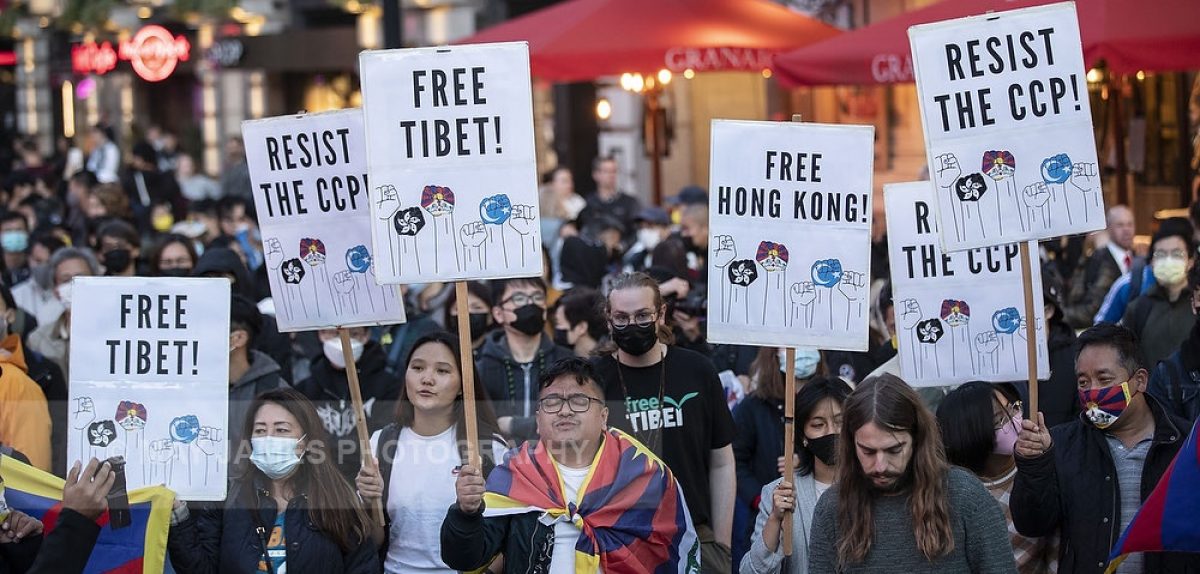
On the 112th anniversary of the Proclamation of Tibet’s Independence, the Global Alliance for Tibet & Persecuted Minorities (GATPM) calls on Britain and China to address Tibet’s unresolved status and ongoing human rights violations.
Tsering Passang, Founder & Chair of GATPM, stated:
“13th February 2025 marks the 112th anniversary of the Proclamation of Tibet’s Independence by the Great 13th Dalai Lama, following the expulsion of Qing imperial forces. This reaffirmed Tibet’s sovereign status – one that remained intact until Communist China’s illegal invasion in 1950. For Tibetans worldwide, this historic proclamation remains a cornerstone of their enduring struggle for freedom and international recognition.
We urge British Foreign Secretary David Lammy to raise Tibet and the Chinese government’s ongoing human rights violations during his meeting with Chinese Foreign Minister Wang Yi in London. We also hope that Secretary Lammy recalls GATPM’s policy submission – Strategic and Security Implications for the UK in the Indo-Pacific Region: A Policy Proposal on Tibet. A key recommendation in this proposal is the strategic necessity of restoring Tibet as a buffer state between India and China to ensure long-term peace and stability in the region, a point strongly reinforced in the recent joint Op-Ed by Lord Alton and Chris Law MP, ‘The UK has a strategic and moral imperative to support Tibet,’ published in PoliticsHome.com last month.
The timing of Minister Wang Yi’s visit to London on this significant anniversary underscores Tibet’s unresolved status. His meeting with Foreign Secretary Lammy also takes place against the backdrop of Britain’s historical engagements with Tibet during the British India era, including the 1904 Younghusband Expedition and subsequent treaties that shaped Tibet’s diplomatic standing. As senior British and Chinese diplomats convene, it is imperative that Tibet’s rightful place in history, its strategic significance, and the ongoing plight of the Tibetan people remain firmly on the agenda.”
With growing global concerns over China’s increasing assertiveness, the UK has a responsibility to uphold democratic values and advocate for Tibet’s rightful status. The Global Alliance for Tibet & Persecuted Minorities urges the British government to reaffirm its commitment to human rights and international law by addressing Tibet’s past, present, and future.
13th February 1913 – 13th February 2025: Why Tibetans Commemorate the 112th Anniversary of the Proclamation of Tibet’s Independence?
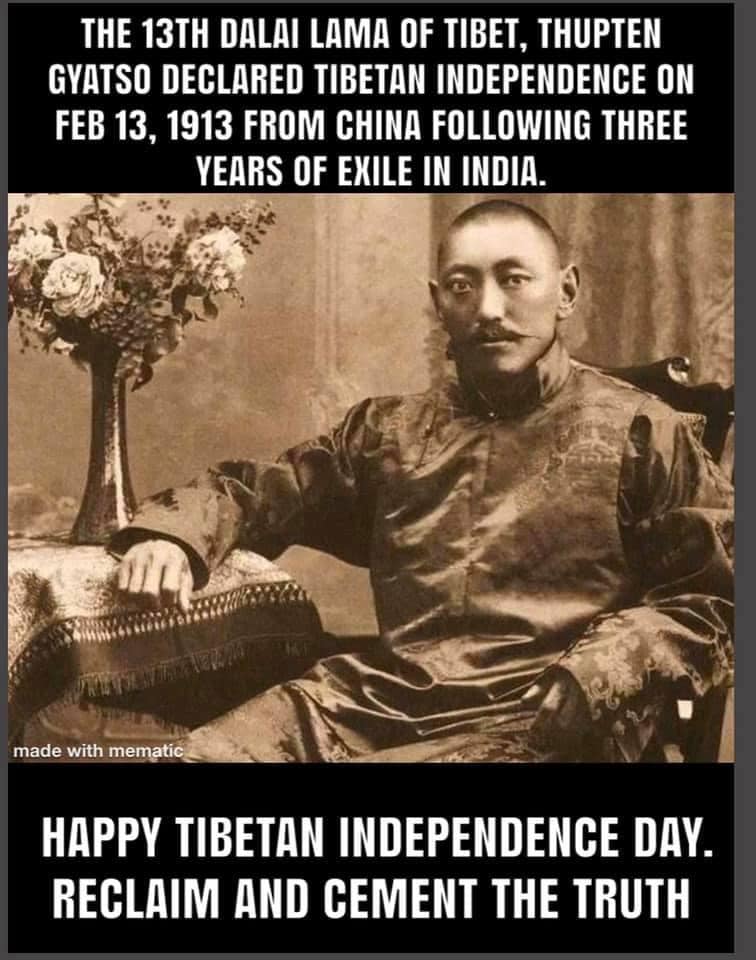
In his Proclamation of the Tibetan Independence, on 13th February 1913, His Holiness the Great XIII Dalai Lama, declared: “Tibet is a country with rich natural resources; but it is not scientifically advanced like other lands. We are a small, religious, and independent nation. To keep up with the rest of the world, we must defend our country. In view of past invasions by foreigners, our people may have to face certain difficulties, which they must disregard. To safeguard and maintain the independence of our country, one and all should voluntarily work hard. Our subject citizens residing near the borders should be alert and keep the government informed by special messenger of any suspicious developments. Our subjects must not create major clashes between two nations because of minor incidents.”
The proclamation was made after the Great Thirteenth Dalai Lama returned to Tibet from exile in India, in January 1913. At the time of the Dalai Lama’s return to his landlocked Tibetan Kingdom, the Manchu dynasty had been dissolved in the course of the Chinese revolution. For nearly forty years afterwards, Tibetans enjoyed self-rule – only for it to come to an end in 1949, after Communist China’s Mao Tsetung declared “peaceful liberation” of Tibetans from the foreign imperialists.
For Tibetans, Mao’s declaration was not only a brutal attack on Buddhist religion and the Tibetan culture but an illegal occupation of their peaceful nation by the giant neighbour, People’s Republic of China. The Tibetan people have a proud history of independence with the successive Dalai Lamas enjoying spiritual patronage over Mongols and Chinese emperors.

Just as it did more than a thousand years ago, today, a doring (pillar) stands outside the Jokhang Temple in Lhasa, Tibet’s capital city. On its stone sides the Tibet-China Treaty of 821-822 AD is carved, signifying the legacy of a free and independent Tibet.
“Tibetans shall be happy in the land of Tibet, and Chinese shall be happy in the land of China,” reads a key text in the treaty, clearly describing the borders between Tibet and China.
For those who haven’t read the Proclamation of Independence Issued by the Great XIII Dalai Lama, please see below:
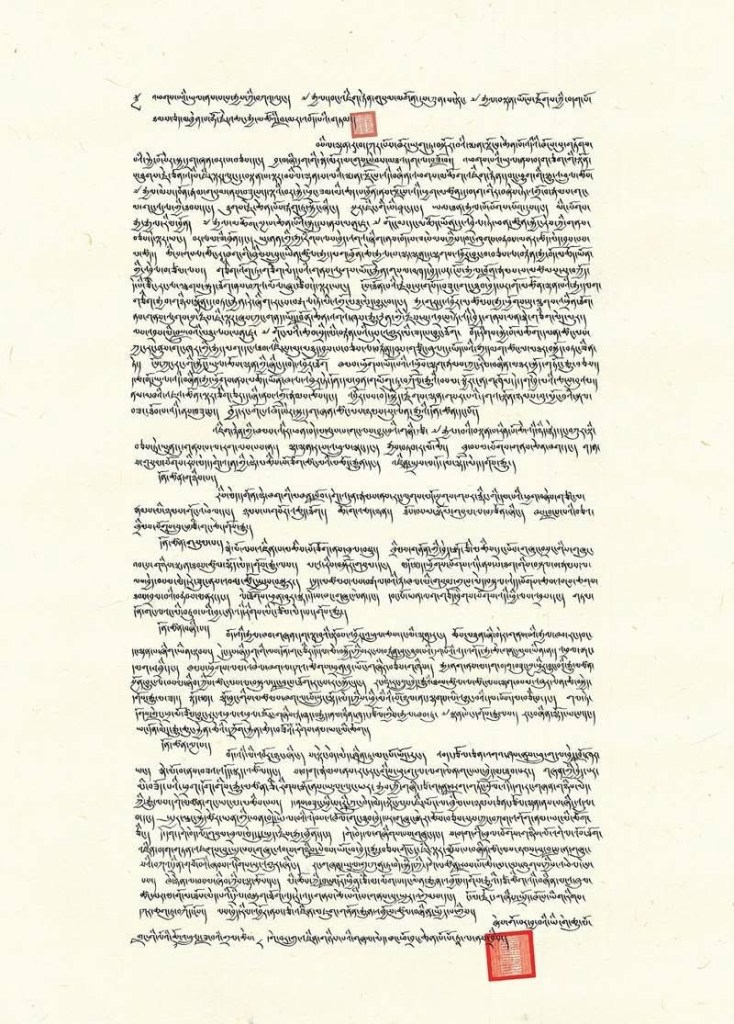
PROCLAMATION ISSUED BY H.H. THE DALAI LAMA XIII, ON THE EIGHTH DAY OF THE FIRST MONTH OF THE WATER-OX YEAR (1913)
Translation of the Tibetan Text
“I, the Dalai Lama, most omniscient possessor of the Buddhist faith, whose title was conferred by the Lord Buddha’s command from the glorious land of India, speak to you as follows:
I am speaking to all classes of Tibetan people. Lord Buddha, from the glorious country of India, prophesied that the reincarnations of Avalokitesvara, through successive rulers from the early religious kings to the present day, would look after the welfare of Tibet.
During the time of Genghis Khan and Altan Khan of the Mongols, the Ming dynasty of the Chinese, and the Ch’ing Dynasty of the Manchus, Tibet and China cooperated on the basis of benefactor and priest relationship. A few years ago, the Chinese authorities in Szechuan and Yunnan endeavored to colonize our territory. They brought large numbers of troops into central Tibet on the pretext of policing the trade marts. I, therefore, left Lhasa with my ministers for the Indo-Tibetan border, hoping to clarify to the Manchu emperor by wire that the existing relationship between Tibet and China had been that of patron and priest and had not been based on the subordination of one to the other. There was no other choice for me but to cross the border, because Chinese troops were following with the intention of taking me alive or dead.
On my arrival in India, I dispatched several telegrams to the Emperor; but his reply to my demands was delayed by corrupt officials at Peking. Meanwhile, the Manchu empire collapsed. The Tibetans were encouraged to expel the Chinese from central Tibet. I, too, returned safely to my rightful and sacred country, and I am now in the course of driving out the remnants of Chinese troops from DoKham in Eastern Tibet. Now, the Chinese intention of colonizing Tibet under the patron-priest relationship has faded like a rainbow in the sky. Having once again achieved for ourselves a period of happiness and peace, I have now allotted to all of you the following duties to be carried out without negligence:
- Peace and happiness in this world can only be maintained by preserving the faith of Buddhism. It is, therefore, essential to preserve all Buddhist institutions in Tibet, such as the Jokhang temple and Ramoche in Lhasa, Samye, and Traduk in southern Tibet, and the three great monasteries, etc.
- The various Buddhist sects in Tibet should be kept in a distinct and pure form. Buddhism should be taught, learned, and meditated upon properly. Except for special persons, the administrators of monasteries are forbidden to trade, loan money, deal in any kind of livestock, and/or subjugate another’s subjects.
- The Tibetan government’s civil and military officials, when collecting taxes or dealing with their subject citizens, should carry out their duties with fair and honest judgment so as to benefit the government without hurting the interests of the subject citizens. Some of the central government officials posted at Ngari Korsum in western Tibet, and Do Kham in eastern Tibet, are coercing their subject citizens to purchase commercial goods at high prices and have imposed transportation rights exceeding the limit permitted by the government. Houses, properties and lands belonging to subject citizens have been confiscated on the pretext of minor breaches of the law. Furthermore, the amputation of citizens’ limbs has been carried out as a form of punishment. Henceforth, such severe punishments are forbidden.
- Tibet is a country with rich natural resources; but it is not scientifically advanced like other lands. We are a small, religious, and independent nation. To keep up with the rest of the world, we must defend our country. In view of past invasions by foreigners, our people may have to face certain difficulties, which they must disregard. To safeguard and maintain the independence of our country, one and all should voluntarily work hard. Our subject citizens residing near the borders should be alert and keep the government informed by special messenger of any suspicious developments. Our subjects must not create major clashes between two nations because of minor incidents.
- Tibet, although thinly populated, is an extensive country. Some local officials and landholders are jealously obstructing other people from developing vacant lands, even though they are not doing so themselves. People with such intentions are enemies of the State and our progress. From now on, no one is allowed to obstruct anyone else from cultivating whatever vacant lands are available. Land taxes will not be collected until three years have passed; after that the land cultivator will have to pay taxes to the government and to the landlord every year, proportionate to the rent. The land will belong to the cultivator.
Your duties to the government and to the people will have been achieved when you have executed all that I have said here. This letter must be posted and proclaimed in every district of Tibet, and a copy kept in the records of the offices in every district.
From the Potala Palace.
(Seal of the Dalai Lama)”
Source (and further reading): Tibet: A Political History, Tsepon W.D. Shagapda, New Haven, 1967, pp. 246-248.
 Global Alliance for Tibet & Persecuted Minorities (GATPM)