London, 20 December 2024 | GATPM

The final debate of 2024 in the House of Lords, led by Lord Alton of Liverpool (Crossbench), Chair of the Joint Committee on Human Rights and Vice-Chair of the All-Party Parliamentary Group (APPG) on Hong Kong, cast a critical spotlight on the UK Government’s policy on China. The discussion focused on urgent human rights abuses and escalating security threats posed by Beijing.
This pivotal debate coincided with the 40th anniversary of the Sino-British Joint Declaration, a landmark treaty guaranteeing Hong Kong’s freedoms, and came ahead of a high-level UK delegation to China in January 2025, led by Chancellor Rachel Reeves, as well as the Labour Government’s forthcoming UK-China Relations Audit.
Key Concerns Raised
The debate underscored a range of pressing issues:
Human Rights Abuses
- The systematic dismantling of Hong Kong’s democratic freedoms.
- Cultural erasure and repression in Tibet.
- The ongoing genocide against Uyghurs in Xinjiang.
Security Threats
- Military aggression towards Taiwan.
- Expansive activities in the South China Sea.
- Cyber and economic subversion targeting the UK.
Peers from across the political spectrum urged the Government to adopt decisive measures to protect British interests and values. Recommendations included safeguarding critical infrastructure, addressing forced labour in global supply chains, and reducing economic dependency on China.
Government Response
Responding on behalf of the Government, Baroness Chapman of Darlington, Parliamentary Under-Secretary of State at the Foreign, Commonwealth and Development Office, reaffirmed the UK’s commitment to balancing pragmatic cooperation with China on global issues, such as climate change, with a firm stance on security and human rights. She emphasised that recalibrating UK-China relations requires a strategic, principled, and clear-eyed approach.
The Moral Imperative
Among the powerful contributions, Lord Callanan (Conservative) delivered a sobering reminder of the moral stakes involved:
“The Chinese Communist Party’s decades-long campaign to erase Tibetan culture, religion, and identity is a stain on the conscience of the international community. Let us not forget that Tibet was once an independent nation, yet it has been absorbed into China, and its people face slow but deliberate eradication.

I had the honour of meeting His Holiness the Dalai Lama in Dharamsala. While I do not share his religion, his unwavering advocacy for non-violence in the face of immense suffering is deeply inspiring. The world must not remain silent as Tibetans endure cultural genocide.”
Other notable contributors included:
- Baroness D’Souza (Crossbench), Director of human rights organisation Article 19.
- Baroness Smith of Newnham (Liberal Democrat), former lecturer in international relations at the University of Cambridge.
A Call to Action
Tsering Passang, Chair of the Global Alliance for Tibet & Persecuted Minorities (GATPM), praised the debate as a critical step in addressing the UK-China relationship:
“This timely debate in the House of Lords signals the UK’s unwavering commitment to upholding democratic values and human rights in the face of China’s oppressive policies. As the Government prepares for its high-level engagement with China, it is essential that principles of freedom and justice remain central to UK-China relations.
The voices raised by members in the House of Lords reflect the growing global demand for accountability and solidarity with oppressed communities, including Tibetans, Uyghurs, and Hongkongers.”
A Defining Moment
As the UK prepares for its engagement with China, this House of Lords debate serves as a clarion call for action rooted in democratic principles and international solidarity. It is an opportunity for the UK to reaffirm its commitment to justice, human rights, and security in an increasingly interconnected and fraught global landscape.
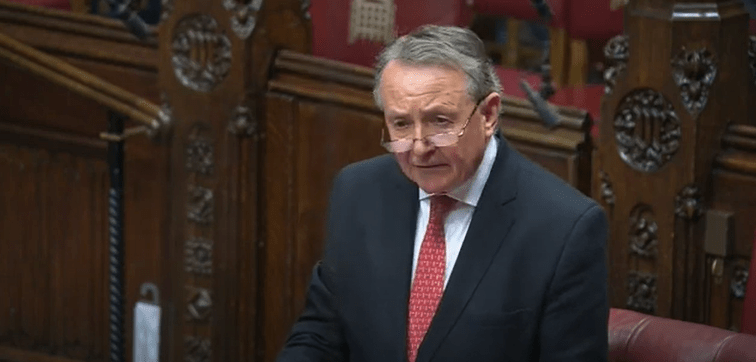
China: Human Rights and Security
(Debated in the House of Lords on 19th December 2024)
Full Opening Speech by Lord Alton of Liverpool:
“My Lords, in opening this last debate of the year, which will focus on human rights and security issues arising from China’s actions in Hong Kong, Taiwan, Xinjiang, Tibet and the South China Sea, I begin by thanking everyone who will speak in the debate, along with the House of Lords Library for its excellent briefing note and the Inter-Parliamentary Alliance on China for its critical role and for its support and assistance. I declare interests as an officer of the all-party groups on Hong Kong, the Uighurs, and Freedom of Religion or Belief, and as a patron of Hong Kong Watch. I also note that today has symbolic significance, because on this day 40 years ago, the Sino-British treaty was signed by Margaret Thatcher and Zhao Ziyang.
China’s human rights violations and the growing security challenges posed by Beijing’s international posture are well documented and will raise profound questions during this debate about our principles, security and strategic resilience. In this week of all weeks, we have seen more evidence of the threats to our domestic security and institutions. Commenting on the activities of the 40,000 agents of the United Front Work Department, our Intelligence and Security Committee says that the UFWD has penetrated “every sector of the United Kingdom economy”.
MI5’s head, Ken McCallum, says infiltration is on an “epic scale”. It is extraordinary, then, in those circumstances for the Prime Minister to be pressing for closer ties with the Chinese Communist Party regime and to say that we should no longer describe it as a threat.
This may not be Maclean and Burgess, Philby and Blunt, but subversion of our state and its institutions involves manipulation and entrapment, influencing and cyberattacks, and intimidation, threats and transnational repression. Not long ago, the Foreign Secretary wanted this regime prosecuted for genocide.
In setting the scene for the debate today, let me begin in Hong Kong. In 2019, it was a privilege to be one of the international team which monitored the last fair and free election in a city that was once a bastion of freedom in Asia. Since 2020 and the enactment of the draconian national security law, it has seen every vestige of democracy dismantled.
The consequences are stark: over 1,200 political prisoners languish in jails, including prominent figures such as the British citizen, Jimmy Lai, with exiled legislators such as Nathan Law facing bounties placed on their heads simply for advocating democracy. Recent Human Rights Watch analysis has highlighted increasing transnational repression aimed at British national (overseas)—BNO—passport holders and their families and even at non-Hong Kong residents, threatening critics abroad with extradition. Recalling the attacks on protesters outside the Manchester consulate, which the Foreign Affairs Select Committee described as a “brazen violation of diplomatic norms”, we can see where this has taken us.
In a letter to the Security Minister, I recently requested a dedicated email address to be set up so that victims of CCP overseas intimidation could guarantee getting through to someone adequately trained in this very specialised crime. When the Minister comes to reply, can she say when a response might be forthcoming? Can she also say a word to those UK Hong Kongers still denied access to mandatory provident funds—an estimated £3 billion? What progress have the Government made in securing the release of this money, and what does she have to say about the role of HSBC and Standard Chartered? Did Minister West raise this matter when she recently visited Hong Kong, and, if so, what response did she receive?
Perhaps I may take the opportunity to say a word or two more about Jimmy Lai, although I know that the noble and learned Lord, Lord Garnier, and others will do so too. Mr Lai is currently on the stand, being asked spurious questions about his involvement with British nationals, including people he never met or even heard of. The United Nations Working Group on Arbitrary Detention found multiple violations of his freedom. For a British national who has never held a Chinese passport to be held in solitary confinement, with no consular access, to be denied access to the sacraments and to be dragged out to court to respond to an entirely fabricated narrative is simply outrageous. It certainly makes a mockery of the Sino-British joint declaration.
Does the Minister support the request by the British nationals cited during the proceedings on the case to be heard in the Hong Kong court? Will she place on record her view of the absurdity of this show trial, as well as the spurious charade of dragging foreign legislators into it? Will she also roundly condemn the recent jailing of 45 Hong Kong pro-democracy leaders, including Joshua Wong and Benny Tai, who were sentenced to years in jail for so-called subversion? It is shocking.
I turn to the atrocities in Xinjiang and Tibet. In Tibet, the CCP continues its campaign of cultural erasure. There are systematic efforts to suppress the Tibetan language, dismantle monasteries and impose sinicisation policies. The Dalai Lama remains exiled and religious freedoms are virtually non-existent. Freedom House has ranked Tibet among the least free regions in the world, highlighting the CCP’s use of surveillance, mass arrests and propaganda to suppress Tibetan identity. Tibet’s plight and world silence are mirrored by the persecution of China’s religious believers, such as the young woman Zhang Zhan, a journalist jailed in Wuhan for seeking the truth about the origins of Covid.
Let us note the atrocities against Falun Gong practitioners and the industrial-scale repression of Uighur Muslims in Xinjiang. Over 1 million of the latter have been detained in camps, subjected to forced labour, indoctrination and even sterilisation. The United Nations Human Rights Office has described potential crimes against humanity, while the House of Commons, with 11 other global Parliaments and the United States Government, called it by its proper name—genocide. By virtue of the CCP’s intentional aim to prevent the births of Uighurs through forced sterilisation, it certainly meets the criteria set out in the 1948 genocide convention.
Canada has just sanctioned Chen Quanguo and Tuniyaz Erkin, two key officials responsible for Xinjiang atrocities. The UK failed to do so in 2021. Will we do so now?
What about Uighur forced labour embedded in global supply chains? The House will have seen reports on this in the Financial Times and on BBC’s “Panorama”. I have been raising this during the proceedings on the energy Bill and will have more say about it in due course. I name again Canadian Solar, a huge beneficiary, and ask: how precisely do the Government intend to root out slavery in the renewables industry? Will the Minister take this opportunity to reiterate the Business Secretary’s clear statement that he absolutely expects there to be “no slavery in any part of the supply chain”?
How will that commitment be honoured? What will we do to prioritise supply chain resilience by diversifying imports and supporting domestic industries?
In the light of breaches of the Modern Slavery Act 2015 and the Proceeds of Crime Act, I am glad that the Joint Committee on Human Rights will make this the subject of an in-depth inquiry in the new year. To help that inquiry, will the Minister ask for an audit of dependency on authoritarian regimes across UK critical infrastructure? Can she update the House on whether Project Defend, which was supposed to build UK resilience, has been entirely dropped? With a trade deficit of over £23.7 billion with China, and British workers losing their jobs in the car industry—undercut by slave labour—this immoral trade is also a threat to our economy and security, undercutting resilience and deepening dependency, points often made by the noble Lords, Lord Blencathra and Lord Purvis, from whom we will hear later.
That leads me to Taiwan and the South China Sea. In May, with my noble friend Lady D’Souza and the noble Lord, Lord Rogan, I attended the inauguration of President Lai in the vibrant democracy of Taiwan, home to 23 million free people. Taiwan’s Ministry of Defense reported over 1,700 military incursions into its airspace in 2023 alone, a 40% increase from the previous year. Meanwhile, as noted in Jane’s Defence Weekly, Beijing continues to hold large-scale military drills around the island.
A conflict over Taiwan would be catastrophic, with consequences extending far beyond the region. A recent Bloomberg report estimated that a war over Taiwan could shave $10 trillion from the global economy. That is five times worse even than the impact that the horrific war in Ukraine has had. As Taiwan produces over 60% of the world’s semiconductors and 90% of advanced chips, the disruption to supply chains would be unparalleled. Of course, without these chips, nothing works. Our critical infrastructure depends on them and the devices in our pockets cannot run without them. Have the Government assessed the UK’s economic exposure to various scenarios in the Taiwan Strait, and will that be part of the China audit?
Our headaches in the South China Sea do not end there. With China’s militarisation of artificial islands in defiance of the 2016 ruling by the Permanent Court of Arbitration, undermining international maritime law, we must recognise these changed circumstances, deepen military and economic ties with Taiwan, expand freedom of navigation operations and further bolster alliances with like-minded partners in the Indo-Pacific, including Japan, Australia and ASEAN nations. AUKUS is of course a promising step in this direction, but we must commit further resources and political will. We should support Taiwan’s accession to the CPTPP.
We must also be far more aware of China’s military heft. Note the support that China has given to Russia’s invasion of Ukraine. It has provided Moscow with dual-use technology, expanded trade in sanctioned goods and offered diplomatic cover in multilateral forums. President Zelensky’s own adviser says that China provides over 60% of the components used to prosecute Putin’s illegal war—and that is without the supply of weaponised drones, in violation of sanctions.
A deadly quartet now led by China poses a direct challenge to the rules-based international order. As the European Council on Foreign Relations notes, the Sino-Russian alignment extends beyond Ukraine; it is aiming to reshape global norms in its favour. Russia’s war is China’s war. The CCP knows that depleted war chests make it harder to deter escalation over Taiwan. Meanwhile, China is engaged in what the former Foreign Secretary called the “biggest military build-up in … history”.
I have sent the noble Baroness the Minister, the noble Lord, Lord Coaker, and Sir Julian Lewis MP a disturbing report given to me alleging an illicit bio-weapons programme, along with a separate report on imagination technologies and China reform, which has deep connections to China’s military-industrial complex and national security establishment. I hope the noble Baroness will promise a full written reply in due course. What is clear enough is that this is a hostile state. It is ludicrous and worse to try to justify deepening business links, pouring public and private money into China’s coffers, while it is making possible an illegal war in Europe.
There is also of course an enemy within. Chinese companies dominate critical infrastructure sectors, from energy to technology—I know we will hear from the noble Lord, Lord Fox, on this—including the millions of China-made surveillance cameras right across Britain. RUSI speculates that over 80% of foreign direct investment into the UK from China comes from Chinese state-owned enterprises: heavily subsidised companies operating under the direction of a one-party state.
Universities, too, are entangled in partnerships with Chinese institutions linked to the People’s Liberation Army. Note the examples in the 2023 Civitas report, including work on artificial intelligence and quantum computing. Perhaps the Minister can tell us what we are doing to assist universities to become less reliant on CCP money—and what we did to challenge UCL, an illustrious university, when Professor Michelle Shipworth was removed from teaching a course on China, with the university saying that it conflicted with its “commercial interests”. Professor Shipworth had highlighted data from the Global Slavery Index which suggested that China had the second-highest prevalence of modern slavery in the world.
Such examples, and this debate, underline what the International Relations and Defence Committee of this House said was the need for a coherent strategy, filling what was referred to as “a strategic void”. How will the China audit attempt to fill that void, and how will it connect to the strategic defence review by the noble Lord, Lord Robertson?
To conclude, a coherent strategy would face the multifaceted challenges posed by China, strengthening our alliances, protecting national security, reducing economic dependencies and exposing authoritarian collaboration. We ought not to be persuaded by those who seek to talk down Britain by making out that we have no international clout. Capitulating now will cause greater pain later. By aligning our policies with our principles, we can safeguard our security, support those who suffer under oppression and lead by example in defending democracy on the global stage. I beg to move.”
Source: Hansard
Useful Links
 Global Alliance for Tibet & Persecuted Minorities (GATPM)
One thought on “UK House of Lords Debate on China: A Critical Moment for Human Rights and Security”