

By Tsering Passang, Founder and Chair, Global Alliance for Tibet & Persecuted Minorities
London, 22 December 2023

Two leading human rights organisations – Asian Dignity Initiative (ADI) and Tibetan Centre for Human Rights and Democracy (TCHRD) released a joint report exposing the dire situation of the 10,000 Tibetan refugees in Nepal, on Human Rights Day, 10th December.
The report titled ‘Languishing in Limbo: Tibetan Refugees in Nepal’ makes a compelling reading in the light of China’s increased influence on Nepal’s authorities. The report echoes what many Tibetan refugees describe Nepal as “Second Tibet” or even “a Chinese province”, alluding to the fact that the level of restrictions they experience is second only to Tibet, which is known as one of the least-free places in the world.
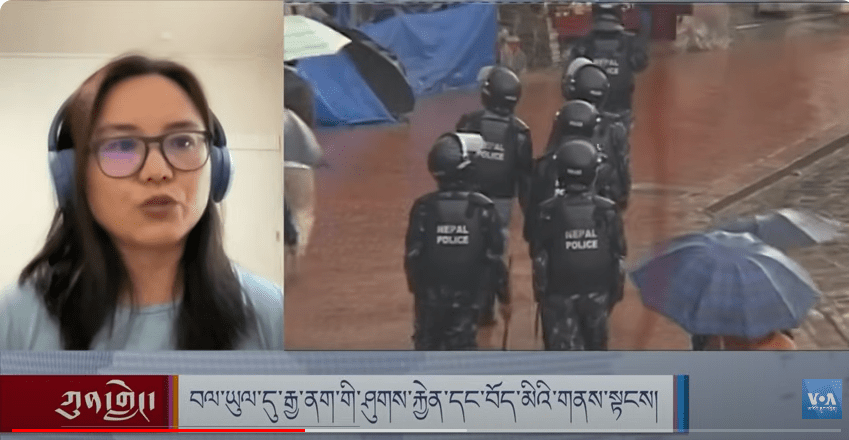
Speaking to the Voice of America (VOA) Tibetan programme, Ms Tsering Tsomo, Research Director and former Executive Director of TCHRD, said that the report confirms previous findings that Nepal, once known for providing a safe haven for Tibetan refugees fleeing Chinese government repression, has become a highly unsafe and insecure place for Tibetan refugees to exercise basic human rights, including freedom of religion, culture and expression.
Those Tibetan refugees who were interviewed for the report shared how they are living a precarious existence, lacking many basic human rights. Many continue to remain undocumented, exposing themselves to further human rights violations. Even those who do hold refugee identification cards enjoy only limited freedoms, as the document does not go beyond simply recognising their existence. Attempts made by foreign governments to facilitate third country resettlement were thwarted by Chinese pressure on Nepal, resulting in Nepal’s refusal to issue exit permits to Tibetan refugees. “They won’t let us live or leave. What sort of arrangement is that? This is among the worst situations for a person to live in!” a Tibetan NGO worker in Kathmandu is quoted as saying in the report.
Chinese authorities have often told foreign leaders not to interfere in China’s “internal” affairs. They also claim that they don’t interfere in other countries’ internal affairs. However, what they are capable of doing in Nepal, which implicates the lives of ordinary Tibetan refugees, is clear evidence of interference as well as human rights infringement outside of China.
Kinam Kim, Executive Director of the Asian Dignity Initiative, said: “We urge the Nepali authorities to protect the human rights of Tibetan refugees living within its border and grant them refugee identification cards with substantial rights and freedoms to live with dignity and freedom. Although Nepal is not a signatory to the Refugee Conventions, it is party to seven of the nine international human rights conventions. As per the 1990 Nepal Treaty Act, international human rights law has the same validity as the domestic law.”
Ms Tenzin Dawa, Executive Director of Tibetan Centre for Human Rights and Democracy, said: “In keeping with its international treaty obligations and for the sake of its national sovereignty, we urge Nepal to review and repeal all policies and agreements that violate the human rights of Tibetan refugees. We are particularly concerned about the increased Chinese-led surveillance and espionage activities targeting Tibetan refugees in Nepal.”
The report presents practical “Recommendations” to Nepal and Chinese Governments as well as to the International Community to give assistance to the Tibetan refugees in Nepal to protect their basic human rights amongst other things.
The Tibetan Centre for Human Rights & Democracy has also launched a Signature Petition: Safeguard Tibetan refugee rights in Nepal.

Up until about a decade ago, Nepal was home to 20,000 Tibetan refugees. The Himalayan Kingdom also served as safe passage for several thousand Tibetans fleeing from Tibet via Nepal to India every year. Thanks to China’s tightening of border security especially since 2008, including the funding and training of Nepal’s border security personnel, Tibetan refugees fleeing across the Himalayas have dwindled to less than 100 over these past few years.
The full report is available here.
II. RECOMMENDATIONS
To the Nepal Government
- Sign and ratify the international conventions on refugees and stateless persons namely the 1951 Convention Relating to the Status of Refugees and its 1967 additional Protocol as well as the Convention Relating to Status of Stateless Persons and the Convention on the Reduction of Statelessness
- Adhere to the principle of non-refoulement, which is enshrined in the Convention against Torture and Other Cruel, Inhuman or Degrading Treatment or Punishment (Article 3), that Nepal has ratified
- Honour the terms of the ‘Gentleman’s Agreement’ that Nepal signed with UNHCR to allow Tibetan refugees to safely transit through Nepali territory in their onward journey to India
- Introduce specific legislation and policy on protecting the basic human rights of refugees and asylum seekers
- Issue Tibetans and their children with refugee documentation that go beyond merely recognising their existence but also provide them with specific rights to live, work, study, and travel outside of Nepal
- Introduce amendments in the Constitution to ensure that the fundamental rights and freedoms are also granted to all persons residing in Nepal, in keeping with Nepal’s ratification of key international human rights treaties
- Allow Tibetan refugees in Nepal to leave the country under the third-country resettlement programs by issuing them required documents such as travel documents or exit permits
To the Chinese Government
- Cease violating the sovereignty and territorial integrity of Nepal as per the provisions of the UN Charter
- Stop pressuring Nepali authorities to violate the human rights of Tibetan refugees
- End all surveillance and espionage activities against Tibetan community leaders and activists living in Nepal
- Allow the UNHCR and Nepali authorities to provide safe transit to all Tibetan refugees travelling or transiting through Nepal
- Dismantle military infrastructure along the Tibet-Nepal border that endanger the safety and security of Tibetan refugees
- Honour the rights and protection of all refugees as enshrined in the 1951 Refugee Convention and 1967 Protocol both of which China has ratified
To the International Community
- Exert concrete pressure on Chinese authorities to stop violating the human rights of Tibetan refugees in Nepal
- Engage proactively with Nepali authorities to protect and guarantee the human rights of Tibetan refugees including providing them with refugee documentation
- Urge Nepal to sign and ratify the 1951 Convention Relating to the Status of Refugees and its 1967 additional Protocol as well as the Convention Relating to Status of Stateless Persons and the Convention on the Reduction of Statelessness
- Provide appropriate financial and other assistance towards building the capacity and lifting the morale of Tibetan refugees particularly the youth living in remote refugee camps
- Hold periodic meetings and other engagements with Tibetan community leaders and activists to understand existing and emerging issues and to make representations to the relevant Nepali authorities about addressing these issues promptly
- Urge the UNHCR, international human rights organisations as well as domestic NGOs to prioritise the issues faced by Tibetan refugees in their advocacy efforts
- Consider ways to provide third-country resettlement opportunities for Tibetan refugees by taking Nepali authorities into confidence
Useful Links
Tibetan Centre for Human Rights and Democracy
Thin Ice on the Horizon for Tibetans in Nepal

 Global Alliance for Tibet & Persecuted Minorities (GATPM)