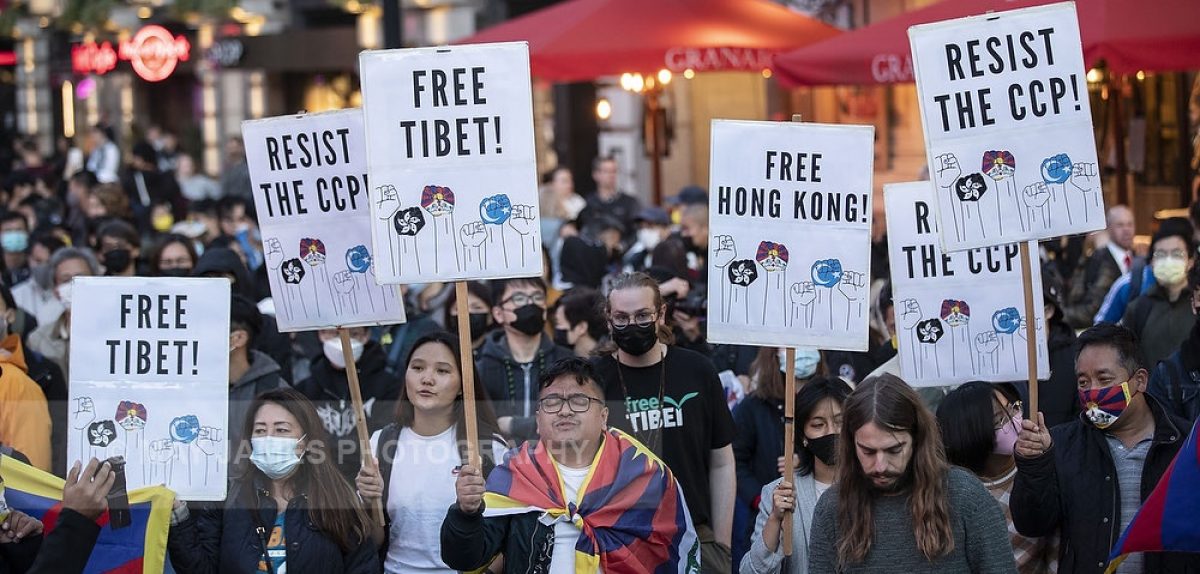
China should look closer home and end its illegal occupation of Tibet if it wants to be taken seriously on the world stage.
By Tsering Passang, Founder & Chair, Global Alliance for Tibet & Persecuted Minorities

Beijing’s ever closer ties with terrorist groups such as the Taliban and the Hamas shows the Chinese Communist Party (CCP) has the same trademark of terrorizing people, no matter who they are. From Mao Tsetung’s era to the current brutal dictator Xi Jinping, the CCP regime continues to cause atrocities against its own people as well as all those in People’s Republic of China (PRC) occupied countries such as Tibet and East Turkestan.
China now has a choice. Beijing’s continued occupation of Tibet and the denial of basic freedoms, including universal human rights and religious freedom, as well as the curtailment of free speech must stop. Today, nearly a million Tibetan children, aged between 4 and 18, are forcefully being admitted in residential schools across the Tibetan plateau (China’s colonial-style boarding schools) with core intent to annihilate Tibetan identity, language, their history and culture. This is a continuation of the regime’s sinicization policy against the oppressed people of Tibet.
Sixty-four years ago, His Holiness the 14th Dalai Lama was forced into exile after China’s illegal occupation of Tibet. When the news reached the residents of Lhasa that the Chinese troops were plotting to kidnap or hurt the young Dalai Lama, tens of thousands of Tibetans surrounded the Norbulingka Palace, summer residence of the Dalai Lamas, in no time, and shielded their temporal and spiritual leader from China’s advanced military forces. The People’s Liberation Army (PLA) troops were shelling mortars and detonations mercilessly to cause chaos, destruction and killing people in the landlocked Buddhist nation. The Tibetan Buddhist Leader, who was 24 at the time, left Norbulingka Palace in Lhasa, on the night of 17th March 1959, to save lives and to avoid further bloodshed against his people from brutal attacks by the Chinese military forces.
Resistance against China’s military aggression started on eastern frontiers from where Mao Tsetung’s PLA troops entered Tibet in 1950. It was an unprovoked military aggression on a small and peaceful Buddhist nation by a giant neighbour, Communist China. Due to this foreign invasion, displacements of Tibetan citizens ensued in the 1950s, who became refugees in their own homelands. Tibetans moved from the eastern region to more central in Lhasa, Tibet’s capital, as China’s armed forces marched further into the hinterland.
For a brief period in Lhasa, Tibet’s spiritual heartland became a war zone, spilling blood and dead bodies into the Kyichu River, a tributary of the Yarlung Tsangpo, which is the upper section of the Brahmaputra River in India. Communist China’s illegal invasion of Tibet has directly resulted in the death of over 1.2 million Tibetans, an equivalent to 20% of Tibet’s population at the time. In addition, China destroyed over 6,000 Buddhist monasteries and great learning centres, a huge loss to Tibet’s rich heritage. Tibetans believe that they have some tangible contributions to make to the world through their spiritual technology and ancient wisdom which they have been developing for centuries in this hidden Buddhist nation.
After nearly two weeks of treks and horse-riding, the Dalai Lama reached Indian soil on 31st March 1959. After granting political asylum by the Government of India, under Prime Minister Pandit Jawaharlal Nehru, the Dalai Lama has remained in exile in India ever since. The Tibetan leader then established Tibet’s “Government-in-exile” officially known as the Central Tibetan Administration, to take care of some 80,000 Tibetan refugees, who followed him into exile, as well as to secure justice and freedom for his people. Today, there are about 140,000 Tibetans in exile with the majority residing in the Indian subcontinent.
On 10th December 1989, the Dalai Lama was awarded the Nobel Peace Prize in Oslo, by the Norwegian Nobel Committee in recognition of his nonviolent campaign to end Chinese rule in Tibet. For many decades, the Dalai Lama travelled across the world to secure support for the Tibetan cause. The Dalai Lama has also reached out to the Chinese leaders in Beijing. Despite his sincere efforts, no meaningful political resolution has so far materialised to the China-Tibet conflict. This is solely due to lack of political will on the part of the Chinese side.
In July this year, the Tibetan spiritual leader turned 88. The Dalai Lama is in good health considering his advanced age. However, on 20th October, his office issued a statement: “In view of His Holiness the Dalai Lama’s recent bout of the flu, his personal physicians have strongly advised that any travel will be taxing on His Holiness and more importantly hamper his full recovery. We have, therefore, after careful consideration, decided not to visit Sikkim in the month of November 2023 and to also cancel His Holiness’ planned visit to South India (Bylakuppe and Hunsur) scheduled in the second half of November to mid-December 2023.”
To the delight of thousands of Buddhist pilgrims from all around the world, the recent statement also added: “There is no change to His Holiness’ planned visit to Bodhgaya, Bihar, starting in the second half of December 2023.” If this schedule remains unchanged, then the Dalai Lama will give three days of teachings at the Kalachakra Teaching Ground in the sacred Buddhist site in India. On 29th and 30th December, His Holiness will give teachings on Nagarjuna’s In Praise of Dhammadhatu (choying toepa). On 31st December, His Holiness will confer the Manjushri Empowerment (jamphel yang jenang). On 1st January 2024, His Holiness the Dalai Lama will attend a Long Life Prayer offered to him at the same venue.
Since his full retirement from the Tibetan political leadership in 2011, the Dalai Lama has been dedicating more time on his Four Principal Commitments: (i) promotion of human values like compassion, forgiveness, tolerance and self-discipline; (ii) promotion of religious harmony; (iii) preservation of Tibetan culture, which currently faces mortal danger from China’s occupation of Tibet; and (iv) revival of India’s ancient civilisational heritage – Buddhism came to Tibet from India.
In Dharamsala, the Tibetan Nobel Peace laureate continues to entertain a busy daily schedule and engages with visitors from around the world. Followers from mainland China and Taiwan also come to receive Buddhist teachings. Recently, His Holiness the Dalai Lama has acknowledged that some kind of backdoor channel of communication exists between Dharamsala and Beijing. In the past, the Tibetan Buddhist leader has openly stated his desire to visit his homelands and pilgrimage in China. He has also expressed his hope of conferring Buddhist teachings to his followers in front of the Potala Palace in Lhasa very soon. Perhaps, materialisation of these hopes could be one step closer to bringing back freedom to his people from exile in India.
 Global Alliance for Tibet & Persecuted Minorities (GATPM)
One thought on “Bringing Freedom Home – Tibet’s Dalai Lama in Exile”