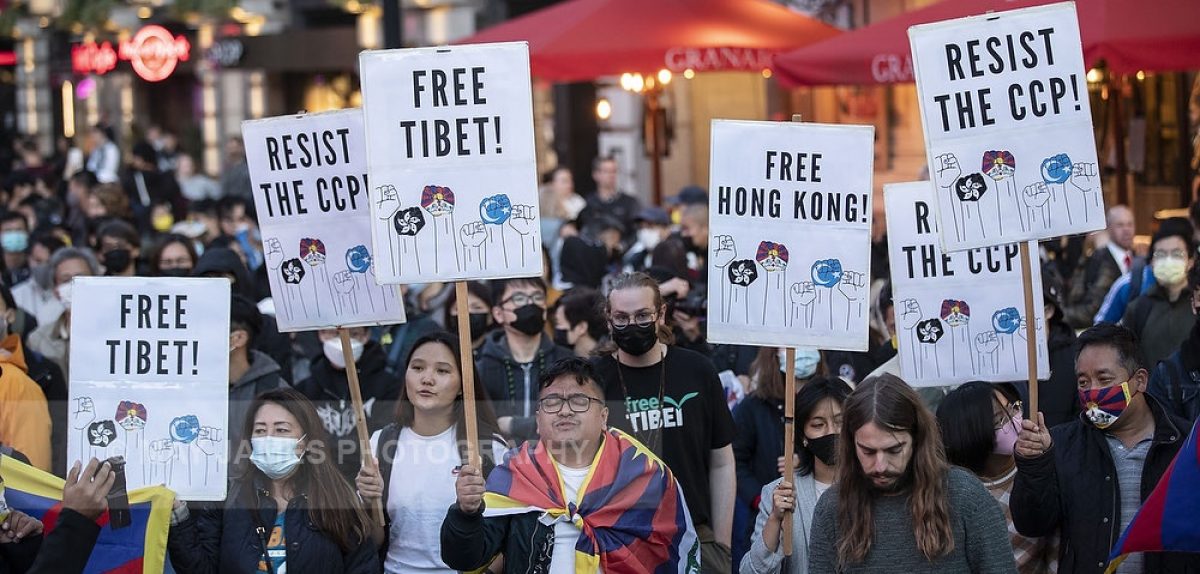
China’s brutal dictator Mao Tsetung ordered his PLA troops to invade Tibet in 1950. Over a million Tibetans died as a direct result of China’s occupation. Beijing took full control of the peaceful Buddhist nation after the 24-year-old Dalai Lama fled to India in March 1959, where he was given political asylum.

After establishing Tibet’s Government-in-Exile (aka the Central Tibetan Administration), the young Dalai Lama continued to promote the democratic reforms for his people which he had sought to implement in Tibet before forced to flee in 1959. Today, based in Dharamsala, northern India, the Central Tibetan Administration continues to carry out its mission of securing political freedom for Tibetans in Tibet whilst taking care of its refugee community.
During an early public gathering in February 1960, in Bodh Gaya, where the Lord Buddha achieved his enlightenment, the Dalai Lama advised the exiled Tibetans to set up an elected body. The Commission of Tibetan People’s Deputies (CTPD) took its first oath on 2nd September 1960. Since then, this historic date is observed by the Tibetan diaspora as Mang-tso Dus-chen – Tibetan Democracy Day. The final stage of this democratisation process was achieved when the Dalai Lama voluntarily relinquished his remaining political authority to the elected Tibetan leadership in 2011 after a young Tibetan legal scholar from Harvard University, Dr Lobsang Sangay, had secured a landslide victory in the general election. Dr Sangay held the highest Office of Sikyong (formerly Kalon Tripa) for two consecutive terms, until 2021. Sikyong Penpa Tsering is the incumbent President of the Central Tibetan Administration.
On 2nd September, the Tibetan diaspora marked their 63rd anniversary of democracy (Mang-tso Dus-chen).
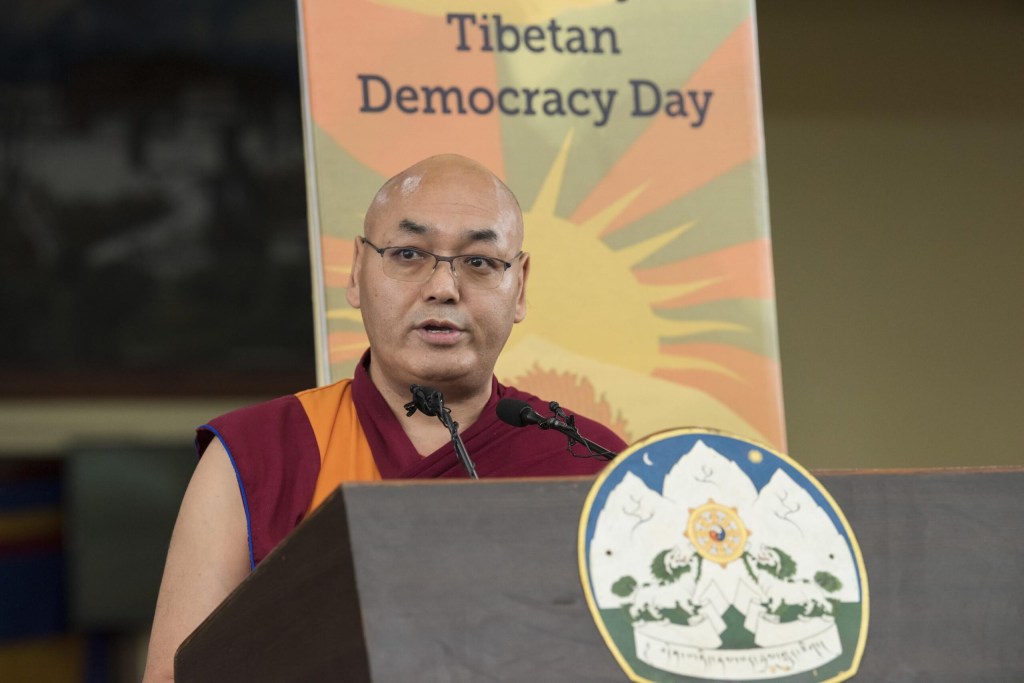
Statement of Tibetan Parliament-in-Exile on 63rd Tibetan Democracy Day
It was on this 2nd day of September in 1960 that the fruit of His Holiness the Dalai Lama’s gift of the excellence of the democratic system of government to the Tibetan people was realized with the establishment of the Tibetan parliament which was made up of elected representatives from all the three provinces as well as the religious orders of Tibet. And so, on this universal calendar day in the Tibetan Royal Year 2150, when we mark the 63rd anniversary of that momentous occasion, the Tibetan Parliament-in-Exile, with the humility of a profound gratitude to His Holiness, wishes to extend its greetings and good wishes to all the Tibetan people, governments and parliaments that have extended support for Tibet and the Tibetan people, to the Tibet support groups, as well as to the entirety of the public in the international community that aspire peace, fairness and truth.
The democratic system of government is based on a political ideology that does not differentiate people on the basis of the question whether a person is strong or weak, rich or poor, male or female, or on the basis of their race or lineage, and so forth with regard to their status in society. Rather, it postulates the founding of a society in which everyone is seen as equal, viewed through the prism of the generality or commonality of everyone. Such a system is seen as being based on an ideology that reflects the primacy of the will of the people. It does not bear saying that in the records of the histories of many nations, people have had to make many great sacrifices for the purpose of finally realizing the establishment of a system of government that is based on this great ideology. However, in the case of the Tibetan democracy, we never felt the need to strive for realizing or achieving the present system of democracy, it was bestowed upon us by our pre-eminent leader, His Holiness the Great Fourteenth Dalai Lama, on the basis of the importance He attached to His great foresight and concern for the wellbeing of His people.
Immediately on assuming political and spiritual leadership of Tibet in 1950, His Holiness embarked on a quest to modernize the system of working of the Tibetan society, for which purpose He newly established in 1952 a reform office. But before this office could work out its full order of plans of action, Communist Chinese invaders launched an armed aggression on Tibet and soon overran the entire territory, thus creating a huge obstacle to the implementation of His reform agenda. However, as soon as He reached the holy land of India in exile, His Holiness, in tandem with the establishment of a Tibetan government in exile, oversaw the establishment in 1960 of the Tibetan parliament with its members elected by the Tibetan people. In 1961, He publicized a document outlining the salient features of a democratic constitution for a future free Tibet. He followed it up, in 1963, with the proclamation of a democratic constitution for a future free Tibet. This was followed, in 1991, by His Holiness taking further action to transform the Tibetan parliament into a true legislative body. Pursuant to this development, His Holiness, on the 28th of June in 1991, granted His assent to the Charter of Tibetans in exile following its adoption by the 11th Tibetan Parliament-in-Exile. His Holiness thereby transformed the Tibetan government in exile into a charter-based body which functions in accordance with a modern democratic system. Further, in the year 2001, a major step was taken in continuing the development of Tibetan democracy with a decision for the Kalon Tripa being elected directly by the Tibetan people. Later, in the year 2011, His Holiness transferred to the leadership elected directly by the Tibetan people the entirety of His political and government powers to make them effective representatives who have a mandate to serve the interests of both those living in Tibet and in exile. And so, we owe a debt of gratitude to His Holiness the Dalai Lama that the Central Tibetan Administration has today become a fully functioning government system within a democratic framework in every aspect.
Although we have been refugees over the last more than six decades, the leaders of Tibetan government in exile or the Central Tibetan Administration are being directly elected by the Tibetan people in diaspora, like the major independent and progressive democratic countries. Similarly, the local bodies under the CTA, scattered all over the world also exercise democratic electoral system in appointing their representatives – such as the members of the Local Tibetan Assemblies, a section of the Tibetan Settlement Offices, and members of the Regional Tibetan Freedom Movement. Besides, the manner of taking decisions in these bodies is subject to the democratic procedure of majority vote. These bear ample testimony to the gradual progress and development of Tibetan democracy achieved through the meticulous process of refinement in the way a goldsmith tests the purity of gold with regard to the system of Tibetan democracy, its basic framework, and in the manner of the people’s participation in it since His Holiness the Dalai Lama granted to the general Tibetan populace the noble gift of democracy. And so, when in future, the just cause of Tibet prevails and the fortunate era of sunshine dawns on Tibetan people being able to return to their homeland, the best contribution we can make in the exchange of experiences with those who had remained in Tibet would obviously be the democracy that we practice in exile.
Among the numerous features of the democratic system, one of the more important is the guaranteeing of respect for basic human rights and adhering to the rule of law. There is no person who does not consider his personal freedoms and rights to be important. In the same way, it is equally important that the freedoms and rights of other people, and likewise, their desire to be governed by rule of law, should also be respected. This, while, no doubt, being true, is also fundamental for maintaining harmony in society. In particular, what Tibetans living in exile need to bear in mind is that during their period of living as refugees in foreign countries, they should value the opportunity they enjoy of their freedom and equality by directing their efforts towards the realization of a system of Tibetan democracy which is characterized by attributes of a modern democratic system as well as ethical values rooted in Tibetan culture more than ever before. This has become vital.
When it comes to talking about the situation in Tibet today, it does not bear mentioning that not only are the Tibetan people living there deprived of their democratic freedoms, they also lack even the most fundamental of human rights recognized and proclaimed by the United Nations Organization. Pursuing a series of hard line policies during the past many decades, the Communist Chinese government has subjected the Tibetan people to all manners of hardship on successive occasions that affected every aspect of their day-to-day living conditions. And this was not all. It has even been engaged in implementing a policy to obliterate without a trace the linguistic heritage, religion, culture, traditions and customs, natural environment and so forth which are the defining characteristics of the Tibetan people and their nation. This entailed the indiscriminate arrest or forcible taking away of Tibetan people on false incriminations, their detention and imprisonment, beating and torture, and all others sorts of ill-treatment which continue to be rampant to this day. The government of China is presently engaged in a policy to forcibly assimilate more than a million Tibetan children in boarding schools which has been especially set up for this purpose. This was the reason why recently, on the 22ndof August this year, the Department of State of the United States government announced the imposition of visa sanctions on a section of Chinese leaders involved in this policy. The Tibetan Parliament-in-Exile welcomes this action from the United States government. Still, it bears emphasizing that the situation wherein the government of China continues to carry out a policy to Sinicize the Tibetan people, religion, culture, and nation and to trample on the human rights of the Tibetan people in Tibet remain an abiding cause for great anxiety.
On the 10th of August in 2023, three United Nations human rights experts – the Special Rapporteur on the situation of human rights defenders Ms. Mary Lawlor; the Special Rapporteur on freedom of assembly and association Mr. Clément Nyaletsossi Voule; and the Special Rapporteur on human rights obligations relating to the enjoyment of a safe, clean, healthy and sustainable environment Mr. David Boyd – issued a joint statement. This statement questioned the government of China for its long term imprisonment of nine Tibetan environment activists whose names it mentioned. “If China is committed to tackle the impacts of climate change, it should refrain from persecuting environmental human rights defenders and release all nine immediately,” the experts said. The Tibetan Parliament-in-Exile wishes to express its appreciation to these United Nations human rights experts. Along with it, we wish to appeal to the United Nations as well as governments across the world to pressure and appeal to the government of China to grant freedom to the people in Tibet to engage in initiative and activities on issues of respect for their religious, cultural, linguistic, and fundamental human rights.
As the current, 17th Tibetan Parliament-in-Exile nears the end of the second year of its term, its members have undertaken visit and inspection tours to the settlements and other areas where Tibetan people have settled, for which purpose settlement destinations were allocated to them at the start of the parliamentary term. Along with undertaking their visits and inspections, the members have, as and when occasions arose, spoken to the Tibetan public about the noble activities and services being undertaken by His Holiness the Dalai Lama and developments in political activities; they also inspected the state of wellbeing of the Tibetan public. By these means, the members of the Tibetan Parliament-in-Exile have acted, and continue to act, as a sort of bridge between the Tibetan public and their administration. Also by these means, a significant number of grievances and problems of the Tibetan public have been solved.
A large number of political activities of various types have been undertaken, and continues to be undertaken, by the Tibetan Parliament-in-Exile for furthering the fundamental cause of Tibet. These include, and have included, lobbying for support for the Tibetan struggle in a number of countries, with focus on members of parliament of India and other countries, leaders of governments in their respective countries, Tibet support groups and their members through meetings and making of requests for support through various programmes, and also by means of organizing a meeting of the World Parliamentarians’ Convention on Tibet. In order to ensure further improvement in the parliamentary conduct of the members of the Tibetan Parliament-in-Exile, a number of training and strategy meetings were held on successive occasions. Local Assemblies in the Tibetan settlement areas are also important institutions within the democratic framework of the Tibetan people living in exile. Hence, in order to further and improve success in their functioning, the Tibetan Parliament-in-Exile has undertaken, and continues to undertake, programmes to impart training to the members of the Local Tibetan Assemblies at their various locations from time to time. This year, a new initiative was launched, and continues to be carried out, to spread awareness of the issue of Tibet among the Indian youths in different states of the country, with the main focus being on college and university students, for which purpose visit allocations of states were made for the members of the Tibetan Parliament-in-Exile. To sum up, the Tibetan Parliament-in-Exile wishes to apprise the Tibetan public about the activities it has undertaken, and continues to undertake, to the best of its means, directed at efforts to realize the just cause of Tibet and towards overcoming the grievances and solving the problems of the general Tibetan public.
The Tibetan democracy being practiced by us in exile is the result of a vision long held by His Holiness the Dalai Lama and is based on the foundation of truth and fairness, and of ethical conduct. It is therefore established on the recognition of the values of democracy, on the foundation of which we have continued to pool whatever capabilities we possessed to cumulatively enrich it with our experiences in our pursuit of the democratic way. Nevertheless, it bears pointing out that from the start of the year 2020 following the outbreak of the Covid-19 global pandemic in the central Chinese city of Wuhan, the entire world got plunged into hardship and suffering, engulfed by its spread. This had a great deleterious effect on our Tibetan community in exile too, including the fact that the Tibetan Parliament-in-Exile was unable to hold its regular session in accordance with the laws and rules governing it. But now, following an agreement reached during the 5thsession of the 17th Tibetan Parliament-in-Exile, resolution No. 2023/17/5/5 was adopted under which a Rules and Regulation Review Committee made up of five members of the Parliament was constituted. The mandate of this committee is to review the laws, and the rules and regulations of the Central Tibetan Administration, and submit its report and recommendations to the Parliamentary Secretariat by the end of Feb 2024. As such, the committee is already fully immersed in carrying out this task. The Tibetan Parliament-in-Exile remains hopeful that by means of this approach, greater clarity will be achieved in carrying out its works in accordance with the laws and the rules and regulations governing the conduct of its business and affairs.
It is solely on account of the kindness of and the debt of gratitude we owe to His Holiness the Dalai Lama, the unsurpassable leader of the Tibetan people, that there has been a groundswell of assistance and support for Tibet and the Tibetan people from governments, parliaments, organizations and associations, as well as private individuals from countries across the world, including especially India, the United States of America, and across Europe. To all of them, the Tibetan Parliament-in-Exile takes the opportunity provided by this occasion to express its immense gratitude.
Finally, we pray that His Holiness the Great 14th Dalai Lama, the refuge of the Tibetan people for this life as well as hereafter, and our unsurpassable leader, may continue to live for ten thousand eons; that, on this basis, all His great and noble desires may be seen fulfilled with spontaneity and without obstacles; and that the noble path of Tibetan democracy may continue to develop and progress and, on that basis, the just cause of the Tibetan people may definitely prevail in all speediness.
The Tibetan Parliament-in-Exile
2 September 2023
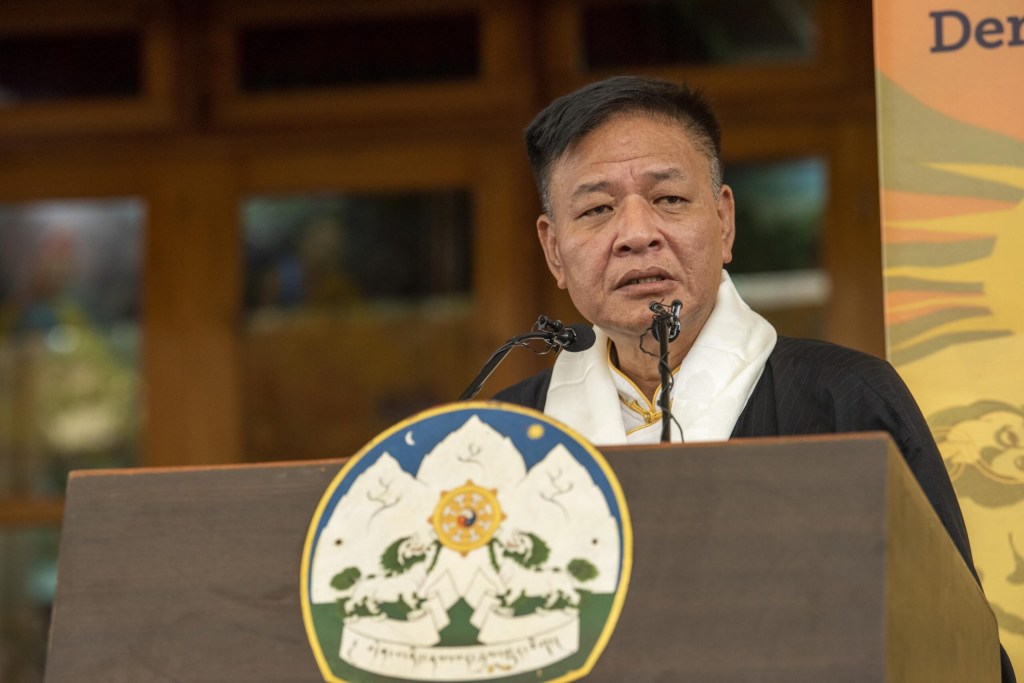
Statement of Kashag on Sixty-third Anniversary of Tibetan Democracy Day
Today, as we celebrate the historic occasion of the sixty-third anniversary of the Tibetan Democracy Day, on behalf of Tibetans both in and outside Tibet, the Kashag submits our deepest obeisance to His Holiness the Great Fourteenth Dalai Lama for democratizing the system of Tibetan polity. The Kashag would also like to extend our sincere greetings to the distinguished guests-the Swedish parliamentary delegates-Honourable MPs Margareta Elisabeth Cederfelt, Johanna Hornberger, Marie Charlotte Nicholson, Maria Viktoriam Stockhaus, Alexandra Anstrell, Ann-Sofie Lifvenhage, John E Weinerhall from the Moderate Party; Hon. MPs Richard Johannes Jomshof and Björn Söder from the Sweden Democrats Party; Hon. MP Gudrun Margareta Brunegard from the Christian Democrats Party; Hon. MP Janine Sofia Alm Ericson from the Green Party and Mr. Carl Mattias and Ms. Kristina Eva Maria Bjornerstedt of Swedish Tibet Committee. We would also like to extend a warm welcome to the delegates of the CTA’s Donor Conference from different parts of the world. On this occasion, we would also like to send our hearty greetings to all Tibetans, both in and outside Tibet, as well as to the supporters of Tibet and Tibetan people spread across the globe.
The Kashag’s last two statements issued on Tibetan Democracy Day briefly touched upon how His Holiness the Dalai Lama has instilled and conferred a culture of democracy among the Tibetan people over the years. These statements also provided a general overview of the development of the three pillars of democracy within the Tibetan administration. Today, we shall delve briefly into the phases of evolution of the constitutional history of Tibet.
When we look back into the history of our legal system, we had the Laws of Two Penalties and Five Approaches during the reign of Nyatri Tsenpo, the first king of Tibet; Ten Divine Virtues and 16 Codes of Conduct during Emperor Songtsen Gampo; and the Five Codes and Five Laws during the Tibetan imperial period. The period of disintegration of Tibet witnessed some deterioration in our legal system. The reign of Sakya adopted the best practices of then prevailing Mongolian laws, followed by The 15 Legal Codes during the reign of Phagmodrupa, The 16 Legal Codes during Depa Tsangpa and The 13 Legal Codes during the Gaden Phodrang. Thus, Tibet throughout its history had evolved its own national laws, religious laws and laws governing human conduct.
After coming into exile, His Holiness the Dalai Lama promulgated the Constitution in 1963 which initiated major reforms in the traditional administrative structure and introduced a system of check and balance amongst the three pillars of democratic governance. While upholding the core values of our traditional temporal and religious legal codes, such as compassion, justice, equality, non-violence, and environmental consciousness, the Constitution also safeguarded the fundamental rights and freedoms of the people. Moreover, this Constitution laid the essential groundwork for the adoption of the Charter of the Tibetans-in-Exile in 1991 by the democratically elected members of the 11th Assembly of Tibetan People’s Deputies.
From 1960 to 1990, before the adoption of the Charter of the Tibetans-in-Exile, the deputies served as members of both the Assembly of the Tibetan People’s Deputies (ATPD) as well as the Standing Commission of the National Assembly. Half-yearly and yearly work assembly meetings of both central and local civil servants as well as representatives from all settlements were convened by the ATPD to discuss and deliberate upon all issues concerning administration and public welfare. These meetings provided a platform for the representatives of people at the grassroots level to participate extensively in the decision-making process of the administration. Between 1972 to 1974, the rules and regulations governing the functioning of the Election Commission, the Public Service Commission and the Tibetan Freedom Movement were also formulated. A high-level National Committee comprising of Kalons, MPs and senior civil servants was formed to discuss and decide on important national matters. All these developments laid a robust foundation for ultimately realizing a democratic system of governance within the exile community.
A Special Tibetan People’s Meeting was convened in Dharmshala from 11 to 17 May 1990, which was attended by 369 people. Members of the Kashag, members of the ATPD, senior civil servants, representatives of various Tibetan Buddhist traditions, Tibetan NGOs, people’s representatives from various Tibetan settlements and representatives of the newly-arrived Tibetans from Tibet participated in this meeting. At this historic meeting, His Holiness the Dalai Lama dissolved the Kashag (Kalons appointed by His Holiness the Dalai Lama) and the 10th Assembly of Tibetan People’s Deputies. As authorized by His Holiness, this special meeting elected three Kalons to the interim Kashag. His Holiness urged the meeting to discuss and propose any necessary democratic reforms. Subsequently, 14 important resolutions were passed at the meeting, which paved the way for the establishment of the Tibetan Justice Commission and the expansion of the strength of the Tibetan Parliament to 10 MPs from each of the three traditional regions of Tibet, two each from the four sects of Tibetan Buddhism and native Tibetan Bon religion as well as three MPs nominated by His Holiness the Dalai Lama. Furthermore, a five-member Constitution Drafting Committee was constituted.
Assuming its role as the Constituent Assembly, members of the 11th Tibetan parliament and the constitution drafting committee discussed and deliberated upon the draft Charter on 30 May 1991. On 31st May, following the election of the officiating Speaker and Deputy Speaker, the Rules and Regulation of Parliamentary Procedure and Conduct of Business was adopted. After intensive discussions on the content of draft Charter from 3 to 13 June 1991, all the sitting MPs signed the Charter of the Tibetans-in-Exile on 14 June 1991. His Holiness the Dalai Lama assented the Charter on 28 June 1991.
Over the last 35 years, the Charter has undergone 35 amendments. Over 85% of them are related with the qualifications, election processes and responsibilities of the dignitaries of the three pillars of Tibetan polity: Kashag, Parliament and Supreme Justice Commission. About fifteen of these amendments were specifically related to the Kashag, including six which were made after 2011.
If we look at the legislative accomplishments, eleven legislations were passed within just two years of the adoption of the Charter. These include: Rules and Regulation of Parliamentary Procedure and Conduct of Business; Rules and Regulations of the Standing Committee of the Tibetan Parliament; Administrative Rules and Regulations of Central Tibetan Administration Rules; Rules and Regulations of the Public Service Commission; Exile Tibetan Rules and Regulations on Raising funds, Annual Budget and Financial Management; Rules and Regulations of Regional Tibetan Freedom Movement Committee; Rules and Regulations of Tibetan Voluntary Contribution and Other Contributions Act; Rules and Regulations of the Office of Auditor General; Rules and Regulations of the Tibetan Parliamentary Secretariat; Rules and Regulations for the Allotment of Staff Quarters and Retired Staff Quarters; and Rules and Regulations for the Presentation of Excellency Award to the Outstanding Staff of CTA.
Between 1995 to 2015, within a span of twenty years, fifteen rules and regulations were adopted, including six related with the privileges and benefits of the dignitaries. For instance, Tibetan Parliamentarian Housing Rules (1995); Tibetan Parliament Speaker’s Relief Trust Fund Rules (1997); exile Tibetan Electoral Rules (2000); the Central Council of Tibetan Medicine Act (2003); six different rules and regulations related to the salaries, allowances and privileges of Justice Commissioners, MPs, Sikyong, Kalons and the heads of the three autonomous bodies (2004); Settlement Housing and Land Use Regulations (2005); the act regulating the Council of Tibetan Religious Affairs (2009); Daily Allowance and Other Entitlements of the Members of Local Tibetan Assembly Rules (2010); rules on collecting general donation (2011); rules on officialization of the works of non-standing committee members of Tibetan parliament (2015). However, since 2015, no new legislation has been passed.
Among the rules and regulations mentioned above, the act regulating the council of Tibetan Religious Affairs, remains unimplemented, whereas certain others have gradually lost their effectiveness.
The rules and regulations of the Tibetan Public Service Commission saw the highest number of amendments (26 times), followed by the exile Tibetan Election Rules (20 times), and the Allocation of Staff Quarters and Retired Staff Quarter Rules (19 times). The parliament has already endorsed the bill put forth by the 16th Kashag, aiming to standardize workforce demarcation within the Tibetan administration and establish structured criteria and prerequisites for special appointments. Once again, the Kashag is preparing to introduce a new bill during the upcoming session of the Tibetan parliament. This proposed bill aims to introduce additional amendments to the rules and regulations of the Public Service Commission, with the goal of enhancing the overall structure of the Tibetan workforce and fostering uniformity in their privileges and benefits. Similarly, in alignment with the amended articles of the Charter, we are currently engaged in a thorough review of the regulations that oversee our electoral processes. The parliament has already granted approval to our proposed bill, which aims to enlarge the residential quarters for our entry-level civil servants. This bill also includes provisions to address any conflicting perspectives that might arise during the allocation of staff accommodations. To secure long-term sustainability of Tibetan settlements, the Kashag has initiated measures to enable the internal transfer of land and housing among Tibetans. Additionally, provisions have been established for individuals residing abroad; if they occupy their settlement residences for a minimum of one month within every two-year period, they will retain their house and land rights and will not be required to relinquish them to the administration.
In yet another advancement in our legal system, as per Article 67 of the Charter, which empowers the Tibetan Supreme Justice Commission (TSJC) to establish its own rules of procedure and codes of law, the Judiciary Code, Civil Procedure Code, and Evidence Code of the TSJC were formulated in 1996.
In accordance with the provisions outlined in the Charter, additional regulations governing the operations of our Election Commission, Public Service Commission, and the Office of the Auditor General were developed. Similarly, the Kashag has also established a series of administrative rules and regulations. These rules and regulations are continuously undergoing revision to adapt to the evolving needs of the times. Furthermore, as per Article 82 of the Charter, which empowers the Local Tibetan Assembly to create its own rules and regulations governing local activities, a total of 39 local assemblies have enacted their respective rules and regulations.
These rules and regulations have established a strong legal groundwork for the administration and its financial management, the entitlements of dignitaries and civil servants, as well as the rights and liberties of the populace. These regulations have not only bolstered the effectiveness of all aspects of our democratic governance but have also safeguarded the rights and freedoms of our people.
In the Guidelines for Future Tibet’s Polity and Basic Features of its Constitution promulgated in 1992, His Holiness the Dalai Lama has stated that “Personally, I have made up my mind that I will not play any role in the future government of Tibet, let alone seek the Dalai Lama’s traditional political position in the government.” Consequently, in 2011, His Holiness devolved all his political and administrative authority to the elected leadership.
Last year, on the Democracy Day, the Kashag appealed to constitute a charter review committee, and finally, the Parliament’s newly constituted Charter Review Committee has commenced its work. We, the Kashag, have also submitted our proposals. We earnestly hope that both the committee and the Parliament will give due consideration to the insights and opinions received extensively from the general population, including the civil servants of the CTA.
The Kashag upholds that the rule of law stands as a cornerstone in guaranteeing equality and justice, which are the embodiment of democratic values. For those of us who believe in the democratic principle of ultimate power residing in the hands of the people, a nation’s trajectory of progress depends upon the active participation of its citizens in shaping and implementing the CTA’s fundamental objectives and public policies. Even though we have made remarkable achievements over the years, our aspiration for freedom in Tibet remains unrealized. Hence, the Kashag would like to reiterate our appeal to stand united in the face of challenges.
On this occasion, we would like to take this opportunity to convey our deepest gratitude and appreciation to all the supporters for your unwavering support for the just cause of Tibet and its people. We look forward to your continued solidarity and friendship.
In conclusion, we pray for the long life of His Holiness the Great Fourteenth Dalai Lama and the perpetual flourishing of His Holiness’ endeavours and fulfilment of all His noble aspirations.
The Kashag
2 September 2023
(N.B. This is the English translation of the Tibetan original. If there are any discrepancies, please consider the Tibetan version as final and authoritative.)
 Global Alliance for Tibet & Persecuted Minorities (GATPM)