The United States Commission on International Religious Freedom (USCIRF) released its annual Country Report on the religious freedom issues in Nepal.
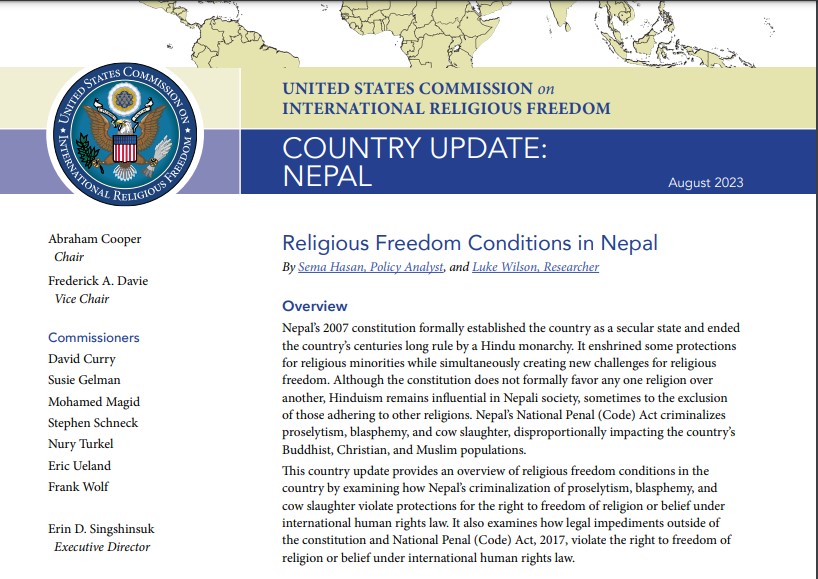
This annual Country Report, released on 17th August, also highlighted the challenges and violation of religious freedom for Tibetan refugees in Nepal, where about 20,000 have been residing since China took full control of Tibet in 1959.
The report reads: “Finally, the Tibetan Buddhist refugee population has faced continued legal impediments to their right to freedom of religion or belief. Approximately 20,000 Tibetan refugees currently reside in Nepal, which is viewed as the closest destination to escape persecution from Chinese authorities who engage in systematic arrests, suppression, and punishment of those protesting against its influence in Tibet. After Tibetans make the treacherous journey across the Himalayas into Nepal, however, the government denies the refugee population identity cards, which prevents them from securing work and educational opportunities in the country and abroad. Further, while the government in 2022 did provide the refugees with a two-hour window to celebrate the birthday of their religious leader, the Dalai Lama, the population is generally prohibited from displaying public devotion to him. The Nepali government enforces this prohibition through ongoing surveillance of refugees, including home visits and searches. Fears of surveillance are further compounded by an extradition treaty with China, which would require both countries to hand over individuals found crossing the border within seven days of detainment. While Nepal has signed but not yet ratified the agreement, human rights groups note that the government has sent back some Tibetans found near the Nepal-China border. Tibetan refugees returned to China are at a heightened risk of persecution at the hands of the Chinese government, including violations of their right to life and their right to freedom from torture or cruel, inhuman, or degrading treatment. As such, Nepal returning Tibetan refugees to China violates the principle of non-refoulement under international humanitarian and human rights law, which provides that no individual shall be returned to a country where they are likely to face persecution.”
The U.S. Commission on International Religious Freedom (USCIRF) is an independent, bipartisan federal government entity established by the U.S. Congress to monitor, analyze, and report on religious freedom abroad. USCIRF makes foreign policy recommendations to the President, the Secretary of State, and Congress intended to deter religious persecution and promote freedom of religion and belief.
 Global Alliance for Tibet & Persecuted Minorities (GATPM)