As the Tibetans, Buddhists and their friends worldwide celebrate Tibet’s spiritual leader His Holiness the 14th Dalai Lama’s 88th birthday this week, it is a good time to reflect on the Four Principal Commitments of this great moral leader and Champion of Peace, writes Tsering Passang, founder & chair of the Global Alliance for Tibet & Persecuted Minorities.
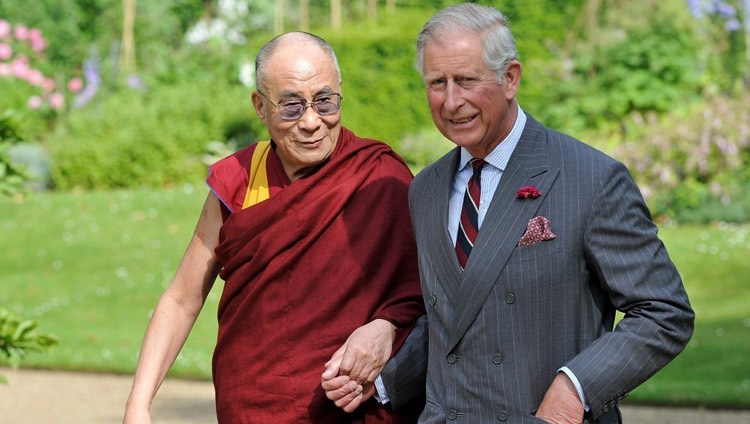
His Holiness the 14th Dalai Lama with His Majesty The King Charles III
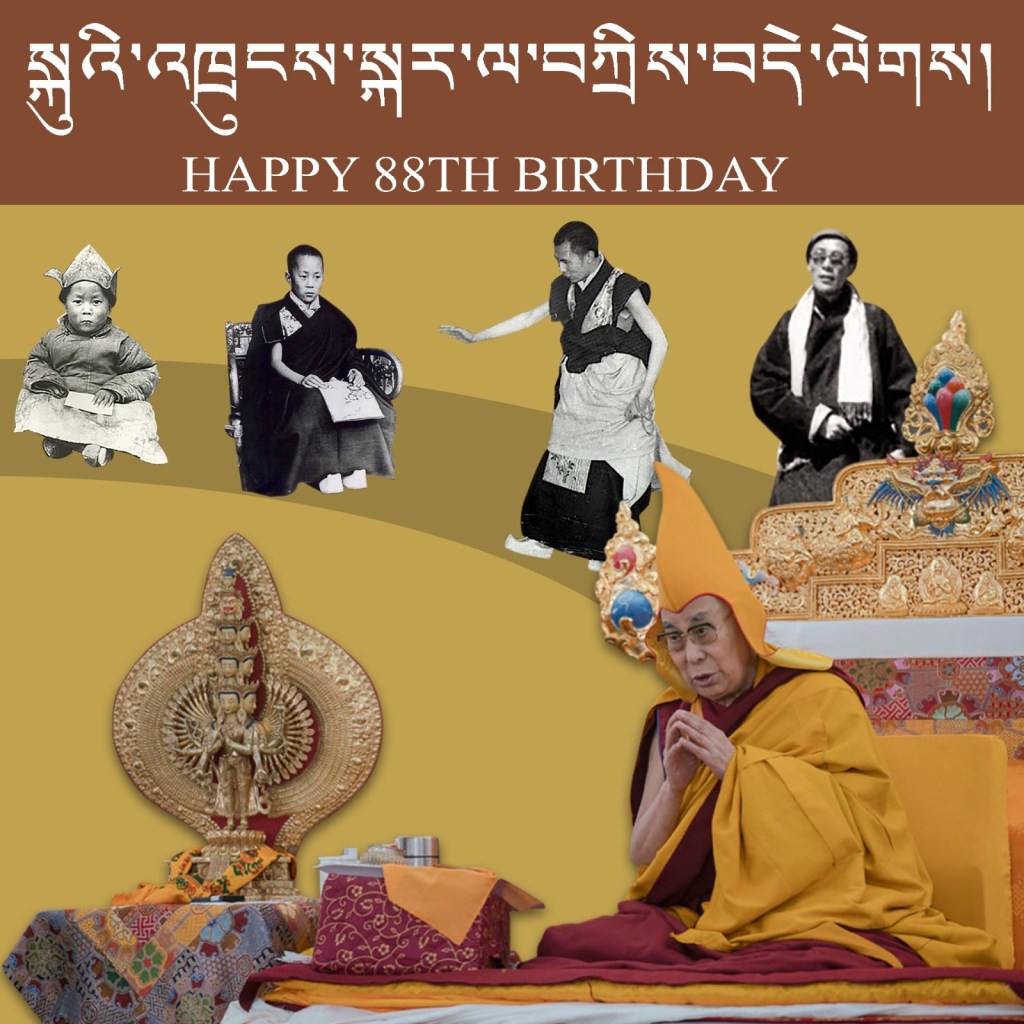
Tenzin Gyatso, His Holiness the 14th Dalai Lama of Tibet, turns 88 on 6th July 2023. He was born in Taktser, Amdo, north-eastern Tibet in 1935. Recognised as the reincarnation of the previous 13th Dalai Lama at the tender age of two-and-half, the life of a Tibetan farmer’s boy changed forever.
Following the Grand Welcome Reception in Lhasa, Tibet’s capital, the young Dalai Lama’s Official Enthronement Ceremony was held in 1940. Many foreign dignitaries, including from Great Britain, attended the Grand Ceremony. This historical event affirms Tibet having enjoyed its independence status prior to China’s invasion. Some decades earlier, Tibet had signed treaties with other countries. The UK Foreign, Commonwealth and Development Office (FCDO) has well documented the ‘Simla Treaty’ of 1914, signed between the representatives of Great Britain and Tibet, in their archives.
After Mao Tsetung came to power, the communist leader declared the establishment of the People’s Republic of China (PRC) on 1st October 1949. China’s illegal invasion of Tibet soon followed through military force.
The young Dalai Lama assumed Tibet’s political leadership when he was merely 16 years old. It was around this turbulent period in Tibet’s history that the Chinese government forced representatives of the Tibetan Government to sign the so-called ‘17-Point Agreement’ in May 1951 in Peking. The Tibetan delegation had no choice but to comply with the Chinese threat to avoid further military intervention to destroy Tibet.
Despite the unfortunate and disadvantageous situation, the young Dalai Lama and his government ministers did their best to cooperate with the Chinese regime in the subsequent years until the Tibetan Leader was forced into exile in March 1959.
Soon after his arrival in India, the Dalai Lama established Tibet’s “Government-in-exile” (formally known as the Central Tibetan Administration), which is currently based in Dharamsala, Himachal Pradesh, northern India. With generous support of the Indian Government and other foreign assistance, the Dalai Lama and his administration started rehabilitation and educational programmes for tens of thousands of Tibetan refugees who followed him into exile. The major mission of the Central Tibetan Administration is to regain the political freedom of the Tibetan people, which is still yet to be achieved.
His Holiness the Dalai Lama’s long-term vision of reforming the old theocratic Tibetan society into a modern-day democratic system gained great successes after bringing major structural changes. In 2011, the Dalai Lama voluntarily and proudly relinquished all his remaining Political Authority, which he inherited, to the directly elected Tibetan leadership.
His Holiness the Dalai Lama has been enjoying his full retirement after the transfer of political authority. Tibetan people’s devotion and trust in the Dalai Lama is unquestionable, whether they are in China’s occupied Tibet or in exile. The bond between the Tibetan people and the Dalai Lama is very much intact. Everyday Tibetans, Buddhists, school and university students, scientists, politicians and others travel to Dharamsala to meet and interact with the 1989 Nobel Peace laureate.
At 88, His Holiness is very healthy, joyful, and very committed to serving the Tibetans and humanity at large. His Holiness has a tight schedule every day and his public engagements are broadcast live on TV and social media platforms, and can be watched by anyone around the world.
On this special occasion of his 88th birthday celebration, we at the Global Alliance for Tibet & Persecuted Minorities extend a very warm and happy birthday wish to His Holiness the Dalai Lama. We pray for his long and healthy life.
His Holiness Dalai Lama’s Four Principal Commitments
As we celebrate the great moral leader and the most principled human being in the world, it is a good time to reflect on the Dalai Lama’s Four Principal Commitments.
The Four Principal Commitments of The Dalai Lama:
- Firstly, as a human being, His Holiness is concerned with encouraging people to be happy – helping them understand that if their minds are upset mere physical comfort will not bring them peace, but if their minds are at peace even physical pain will not disturb their calm. He advocates the cultivation of warm-heartedness and human values such as compassion, forgiveness, tolerance, contentment and self-discipline. He says that as human beings we are all the same. We all want happiness and do not want suffering. Even people who have no religious belief can benefit if they incorporate these human values into their lives. His Holiness refers to such human values as secular ethics or universal values. He is committed to talking about the importance of such values and sharing them with everyone he meets.
- Secondly, as a Buddhist monk, His Holiness is committed to encouraging harmony among the world’s religious traditions. Despite philosophical differences between them, all major world religions have the same potential to create good human beings. It is therefore important for all religious traditions to respect one another and recognise the value of their respective traditions. The idea that there is one truth and one religion is relevant to the individual practitioner. However, with regard to the wider community, he says, there is a need to recognise that human beings observe several religions and several aspects of the truth.
- Thirdly, His Holiness is a Tibetan and as the ‘Dalai Lama’ is the focus of the Tibetan people’s hope and trust. Therefore, he is committed to preserving Tibetan language and culture, the heritage Tibetans received from the masters of India’s Nalanda University, while also speaking up for the protection of Tibet’s natural environment.
- In addition, His Holiness has lately spoken of his commitment to reviving awareness of the value of ancient Indian knowledge among young Indians today. His Holiness is convinced that the rich ancient Indian understanding of the workings of the mind and emotions, as well as the techniques of mental training, such as meditation, developed by Indian traditions, are of great relevance today. Since India has a long history of logic and reasoning, he is confident that its ancient knowledge, viewed from a secular, academic perspective, can be combined with modern education. He considers that India is, in fact, specially placed to achieve this combination of ancient and modern modes of knowing in a fruitful way so that a more integrated and ethically grounded way of being in the world can be promoted within contemporary society.
Useful links:
 Global Alliance for Tibet & Persecuted Minorities (GATPM)
One thought on “Tibet’s spiritual leader turns 88, Nobel Peace laureate Dalai Lama’s Four Principal Commitments”